Low Humidity on Red Prayer Plant: Crisp Edges & Fixes
Quick answer
Low humidity on Maranta red prayer plant shows up as crispy brown edges along the thin red-veined margins, inward leaf curl that does not relax overnight, and stalled rolled new leaves. First step: move the plant away from vents, radiators, and cold glass, then run a humidifier nearby rather than misting.
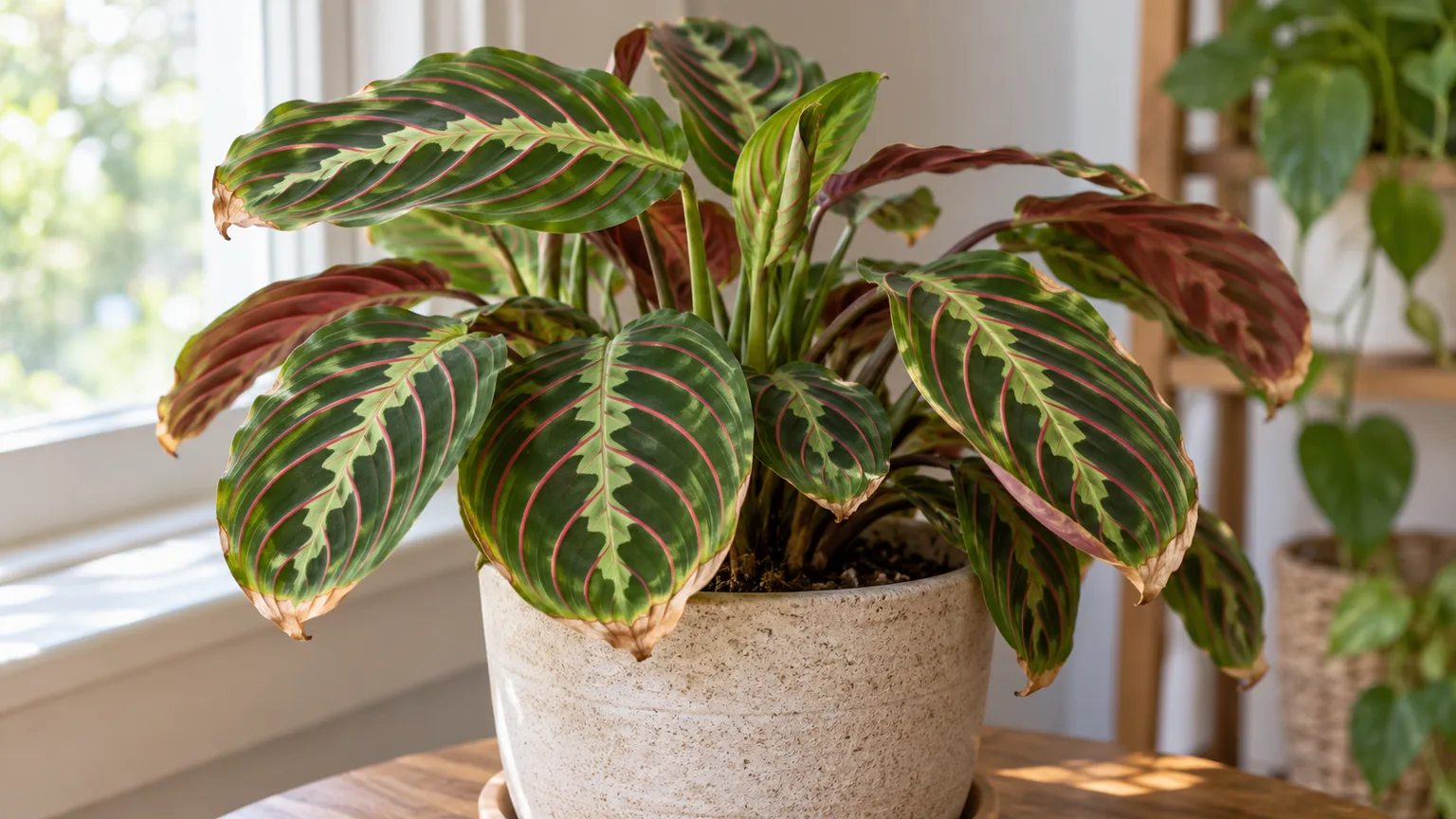
Low Humidity on Maranta Red Prayer Plant: Causes, Checks & Fixes
This guide covers low humidity on Maranta Red Prayer Plant. See also the general Low Humidity guide, watering, and light pages for this plant.
Low Humidity on Maranta Red Prayer Plant: Causes, Checks & Fixes
Quick answer
Low humidity on Maranta red prayer plant (Maranta leuconeura var. erythroneura) almost always shows up at the thinnest tissue first: the red-veined margins crisp to tan-brown while the darker center still looks fine. Leaves may cup inward during the day and, unlike normal nighttime prayer-folding, never fully relax. New leaves can stall as tight rolled tubes with browned tips.
For how dry indoor air stresses houseplant foliage in general, see our low-humidity guide. On Maranta red prayer plant, the pattern is unmistakable because the high humidity this rainforest-floor species needs collides with heated, air-conditioned rooms it was never built for.
First step: move the plant out of the dry-air zone — away from heat vents, radiators, fireplaces, AC outlets, and cold window glass — and run a small humidifier nearby. Do that one move before changing water, fertilizer, or potting mix, then watch the next new leaf for a clean unrolling.
When to use this page vs other Maranta Red Prayer Plant guides
This page is the dry-air entry point for crisping red-veined foliage. Use the table to route yourself when the pattern points elsewhere.
| Pattern | Read next |
|---|---|
| Crisp edges but soil dry 2 cm down, pot light | Underwatering |
| Crisp edges plus yellow soft leaves in soggy mix | Overwatering or root rot |
| Brown tips only, pale crust on soil surface | Brown tips |
| Fine stippling or webbing under leaves | Spider mites |
| Whole-plant yellowing, no crisping | Yellow leaves |
| Full species baseline: light, water, soil | Maranta Red Prayer Plant overview |
What low humidity looks like on Maranta Red Prayer Plant
Dry air writes its signature on the red herringbone veins before anywhere else. The pale central stripe usually holds color the longest, while the thin red-veined margins turn papery tan, then brown, starting at the leaf tip and outer edge.
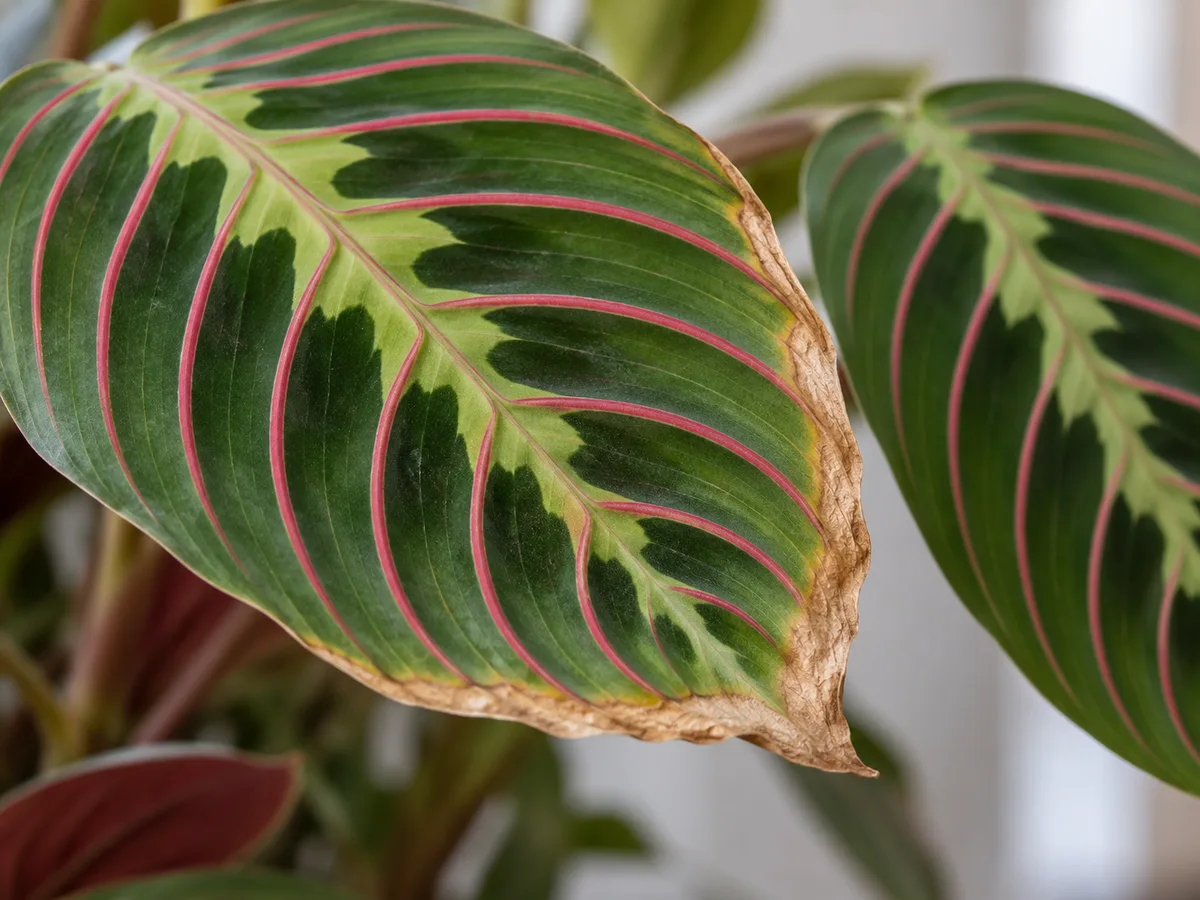
Crispy brown margins along the thin red veins with the leaf center still green — compare with healthy tissue on the same plant.
- Browning starts on the red vein margins — the thinnest tissue crisps first, often as a tan halo that darkens to brown at the very edge.
- Daytime cupping that will not relax — leaves curl inward along the midrib and stay cupped instead of resuming the flat-by-day posture.
- Stalled rolled tubes — new leaves emerge as tight rolls and sit for a week or more without unfurling, sometimes with browned roll tips.
- Worst leaves face the dry source — damage concentrates on the side nearest a vent, radiator, sunny glass, or drafty pane.
- Soil reads moist anyway — the mix at 2 cm can be correctly damp while edges still crisp, which separates dry air from drought.
Old leaves near the base naturally age out with some edge wear. One tired lower leaf on a plant whose newest roll is opening clean is maintenance, not an emergency.
Why Maranta Red Prayer Plant dries out indoors
Maranta evolved as a low, spreading rainforest-floor plant with broad, thin leaves built to trade moisture freely with humid air. Indoors it is intolerant of low humidity, and normal heated winter air — often 20 to 30 percent relative humidity — pulls water from leaf margins faster than the shallow rhizomatous roots can replace it.
Three household realities stack against it. Heating season drops indoor humidity just as shorter days slow the plant, so thin leaves lose moisture they cannot quickly regrow. Forced-air vents and radiators bathe nearby foliage in a constant dry stream even when the room thermostat reads comfortable. Cold window glass chills leaf tissue at night and accelerates morning moisture loss, a particular problem for a plant that is also intolerant of cold drafts.
The shallow rhizome system compounds the problem. Maranta stores modest reserves in horizontal rhizomes, not a deep water-hoarding caudex, so a plant with slightly dry roots plus dry air crisps margins far faster than either stress alone would cause. Keep the mix consistently moist per the watering guide while you fix the air — the two halves of the problem must be solved together.
Night folding vs dry-air curl: reading nyctinasty correctly
This is the diagnostic skill no generic humidity article can give you. Healthy Maranta lifts its leaves to a near-vertical prayer position after dark and lowers them flat by morning — active nyctinastic movement driven by pulvini at the leaf-stalk joints. Dry air disrupts the rhythm in recognizable ways.
Normal folding is symmetrical and reversible: every leaf rises in the evening, lowers by mid-morning, and feels supple at both positions. Dry-air curl is asymmetrical and stiff: leaf halves cup inward along the midrib, edges feel papery, and the morning lowering is partial or absent. If leaves that used to pray now sit half-raised and leathery around the clock, the pulvini are short of turgor from chronic moisture loss, not from a broken clock.
Test it over two evenings after moving the plant away from the dry source and running humidity support. A return to full evening lift within a few days is your earliest sign the fix is working — well before new leaves unfurl. Leaves that stay rigid and cupped despite moist soil and steadier air have desiccated joint tissue and should be judged by the next flush, not coaxed flat by hand.
New rolled leaves: the humidity readout
Maranta pushes each leaf as a tight rolled tube that should unfurl over several days. These rolls are the most honest humidity gauge on the plant because expanding tissue has the thinnest cuticle and the highest water demand per gram.
In steady humidity, rolls lengthen, loosen, and open to full flat blades with clean red margins. In dry air, rolls stall halfway, sit unchanged for a week or longer, and develop brown papery tips while still furled. A stalled roll beside older leaves with crisped edges is near-confirmation of a humidity problem rather than a feeding or light issue.
Do not peel a stalled roll open by hand — you will tear the blade along the fold. Instead, confirm the soil is moist at 2 cm, keep the humidifier running, and give the roll three to five days. Rolls that resume lengthening mean the environment is fixed; rolls that brown through while the rest of the plant stabilizes can be snipped once the next roll opens clean.
Fluoride, salts, and light: lookalikes that crisp the same margins
Not every browned red margin is dry air. Maranta is unusually sensitive to water chemistry: leaves burn with high fluorides and with over-fertilization, and hard tap water leaves mineral deposits on the foliage or in the soil. Rule these out before blaming the room:
- Fluoride or salt burn — even browning on leaf tips across the whole plant regardless of vent position, sometimes with a white crust on the soil surface. Switch to filtered or overnight-stood water and pause feeding; full detail lives in brown tips.
- Underwatering — limp, dull leaves plus a light pot and mix dry well below 2 cm. Dry air crisps with moist soil; drought crisps with dry soil. See underwatering.
- Too much direct sun — bleached or scorched patches on the sun-facing side within days of a move, distinct from slow edge crisping. Reposition per the light guide.
- Spider mites — dry air invites them, and fine stippling plus webbing under leaves means the crisping has a pest driver. Confirm with spider mites before spraying anything.
- Cold damage — sudden blackening after a cold night near glass, not slow tan-to-brown crisping. Move to stable warmth above 60°F (16°C) first.
When two causes overlap — common in winter, when dry air, short days, and hard tap water arrive together — fix placement and humidity first, then reassess water chemistry on the next new leaf.
First fix for Maranta Red Prayer Plant
Move the plant out of moving dry air today and put steady humidity around it — a small humidifier set nearby is the fix that actually holds. NC State Extension recommends a humidified room or a pot standing in a tray of wet pebbles for this species, and practical care guides agree: run a small humidifier nearby or place the plant on top of a pebble tray filled with water.
Place the humidifier a meter or so away so mist does not settle constantly on the leaves, keep the pebble tray filled without letting the pot sit in water, and change nothing else for a week. Grouping with other humidity-loving plants helps at the margins — gardeners have long used several plants together to create more humid conditions — but grouping alone rarely rescues a Maranta already crisping in a heated room.
Step-by-step recovery
Week 1: stabilize the air. Relocate away from vents, radiators, and cold glass. Start the humidifier or pebble tray, confirm soil moisture at 2 cm stays consistently damp, and water with filtered or overnight-stood water. Watch the evening prayer lift — its return is the first win.
Weeks 2 to 3: read the new growth. The next rolled tube should lengthen and unfurl faster than the stalled one did, with clean margins. Trim only fully brown, papery edge tissue for appearance if you wish, cutting just outside the green line. Leave half-damaged leaves in place while they still photosynthesize.
Weeks 3 to 6: rebuild the canopy. Plants suffering from a lack of humidity often begin developing brown edges as an early warning — so judge recovery by the absence of that warning on each successive leaf. Two consecutive clean unfurlings with strong nightly folding mean the routine is working. Resume balanced liquid feeding at half strength only once new growth looks normal.
Existing crisped margins stay crisped. Success is measured in new tissue, not repaired old leaves.
What not to do
Do not mist the leaves as your humidity plan. Droplets evaporate within minutes in dry rooms and do nothing for the steady transpiration balance Maranta needs — and foliage that stays wet in still indoor air invites leaf-spot problems. A humidifier or pebble tray changes the room; misting only wets the leaf.
Do not drown the pot to compensate for dry air. Soggy mix on shallow rhizomes trades crisp edges for root rot within weeks. Keep the moist but well-drained standard from the soil guide: damp at 2 cm, never waterlogged, saucer emptied.
Do not fertilize a crisping plant to push new leaves. Extra salts on stressed roots worsen margin burn, and feeding cannot substitute for humidity. Hold feed until new rolls open clean.
Do not repot, prune hard, and relocate in the same week. One environmental correction at a time lets you read what actually helped.
How to prevent it next time
Build the routine around what this species is: a humidity-dependent forest-floor plant in a dry box we call a living room.
- Light: bright indirect light with no harsh direct sun, per the light guide — strong enough for steady unfurling, gentle enough to avoid scorch on thin blades.
- Water and mix: consistently moist mix at 2 cm in a moist but well-drained medium; review the watering and soil guides before each season change.
- Water quality: filtered or overnight-stood water to avoid fluoride tip burn that mimics humidity damage.
- Humidity hardware: humidifier in the room from the day heating season starts, not after edges crisp; pebble tray as backup, never letting the pot sit directly in water.
- Seasonal placement audit: recheck vent, radiator, and window-glass distances every autumn and spring — rooms change with the heating cycle. Browse the full problems hub when a new pattern appears.
Related Maranta Red Prayer Plant guides
- Maranta Red Prayer Plant overview — baseline light, water, soil, and humidity for the species.
- Problems hub — all 16 documented issues on this plant in one place.
- Brown tips — water-chemistry edge burn that mimics dry air.
- Underwatering — drought crisping with dry deep soil.
- Overwatering — the soggy-soil failure mode to avoid while raising humidity.
- Yellow leaves — when discoloration spreads past the margins.
- Wilting and drooping leaves — turgor loss vs low-humidity cupping.
- Watering guide — the 2 cm moisture check behind every diagnosis above.
When to worry
Escalate quickly if new rolled tubes brown before opening across several leaves at once, if crisping spreads daily despite steady humidity and moist soil, or if stems soften at the base — that last pattern points past dry air toward rhizome or root failure. Prayer plants are finicky about humidity and water, and crispy brown leaves or dropping leaves are often signs of these conditions being incorrect — but rapid collapse is not typical dry-air behavior.
Slow edge browning on older leaves while new rolls open clean can wait for routine care. The plant is adjusting, not dying.
Related tool
Use the Humidity Calculator to narrow causes for low humidity on this plant before changing multiple variables at once.