Spider Mites on Maranta Red Prayer Plant: Causes, Checks &
Quick answer
Pale stippling across the red-veined herringbone pattern plus fine silk at leaf joints means spider mites on red prayer plant. First step: isolate the plant and rinse every leaf underside with lukewarm water before applying any spray.
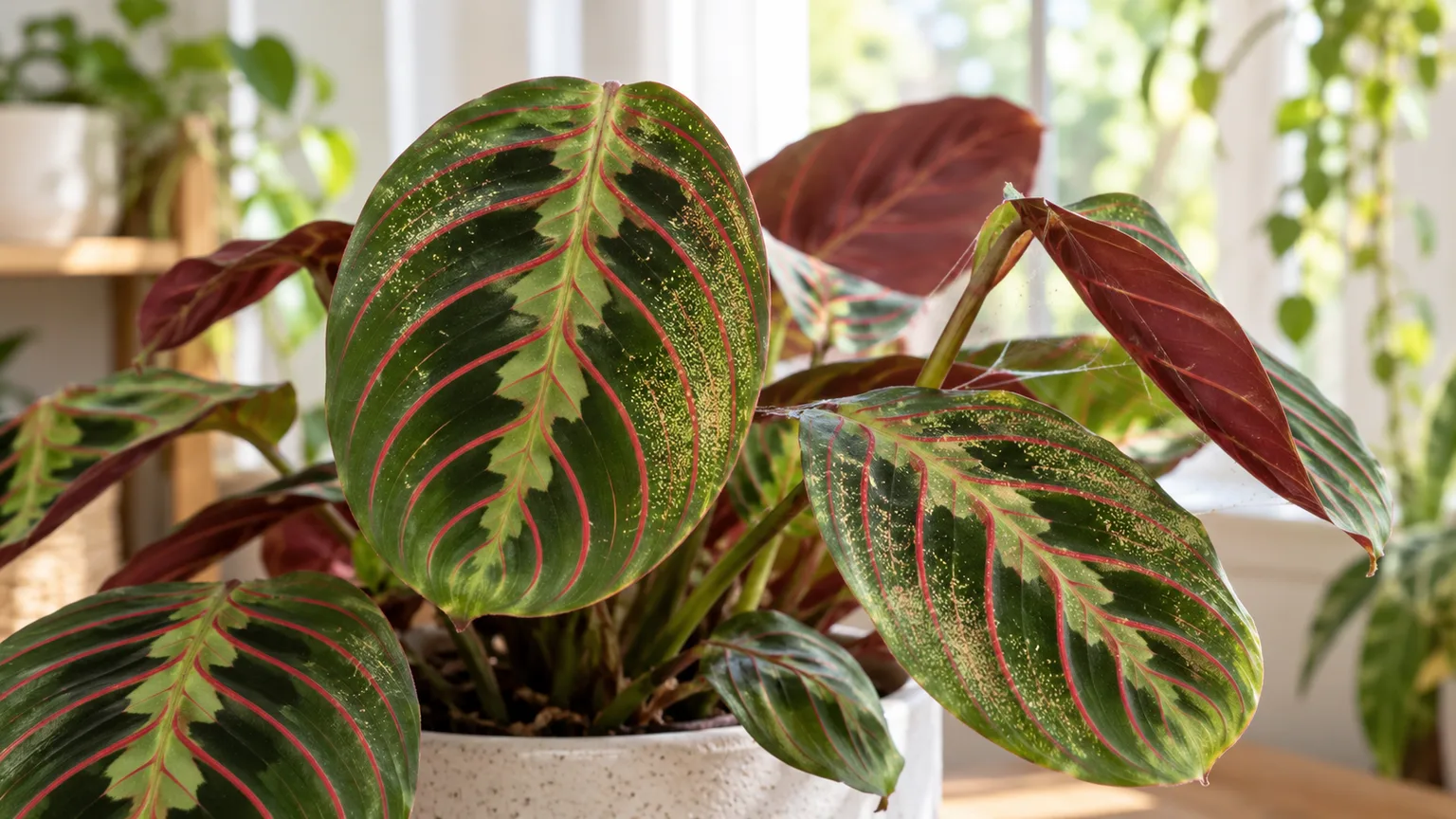
Spider Mites on Maranta Red Prayer Plant: Causes, Checks & Fixes
This guide covers spider mites on Maranta Red Prayer Plant. See also the general Spider Mites guide, watering, and light pages for this plant.
Spider Mites on Maranta Red Prayer Plant: Causes, Checks & Fixes
Quick answer
Pale stippling breaking up the red herringbone pattern, plus fine silk threads at the leaf joints, means spider mites on your red prayer plant. This pest almost always traces to dry, warm indoor air hitting a humidity-loving Marantaceae, not random bad luck. For how mites feed and cycle in general, see our spider mites guide; on this plant the pattern usually shows up as dull, dusty-looking leaves whose red veins fade first while the undersides hide the colony.
First step: isolate the plant and rinse every leaf underside with lukewarm water. Knock live mites and webbing off before reaching for soap or oil. One rinse is not a cure because eggs hatch in waves, but isolation plus a thorough wash is the correct opening move.
What spider mites look like on Maranta Red Prayer Plant
Thin, patterned Maranta leaves show mite damage earlier than thick-leaved houseplants. Feeding punctures drain chlorophyll cell by cell, so the first sign is tiny yellow-white dots scattered across the dark green blade that visibly interrupt the red fishbone veins. Leaves turn dull and dusty-looking even right after you wipe the top surface, and heavy feeding bronzing the whole leaf.
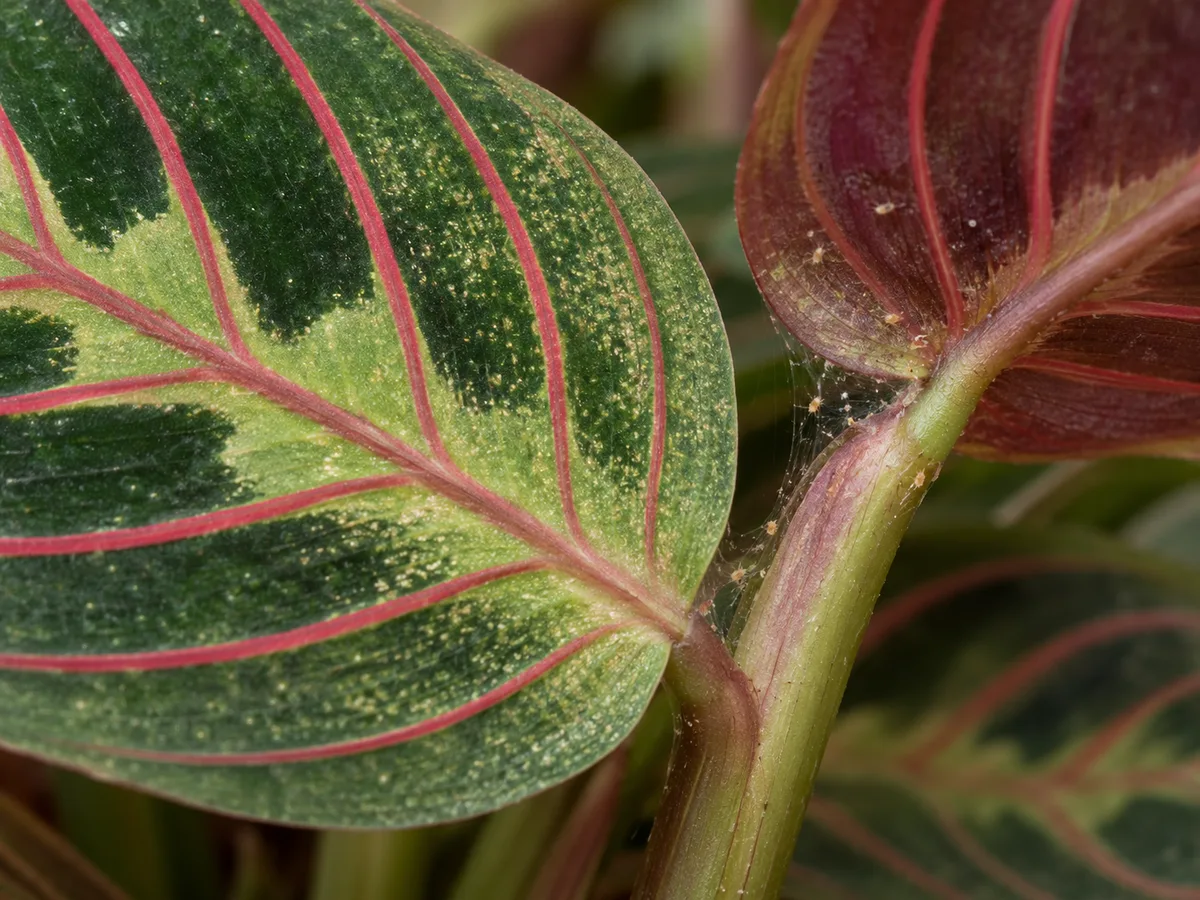
Close-up of stippling breaking up the red-vein herringbone pattern with fine silk at the petiole joint; compare against clean new growth on the same plant.
Established infestations add fine silk webbing between petioles, at leaf bases, and along the low creeping stems. On undersides you may find amber eggs, whitish cast skins, or black fecal specks with a magnifying glass. Newest rolled leaves sometimes unfurl already stippled, which means mites colonized the crown while the leaf was still furled. Mites themselves are barely visible without magnification until populations build, so confirm with the paper-tap test below rather than by eyesight alone.
Damaged patterned tissue does not green up again. Judge recovery by clean new leaves and stopped spread, not by old stippled patches reverting.
Why red prayer plant gets spider mites
Dry heated air meets humidity-dependent foliage
Red prayer plant evolved for humid understory conditions and requires high humidity indoors, remaining intolerant of low humidity and cold drafts. When winter heating drops room humidity, two problems stack: the foliage is already stressed, with red veins showing brown tips before green tissue, and the warm dry air shortens the mite reproductive cycle so a new generation builds every few days. NC State notes this species has no serious pest problems but occasional spider mites and mealybugs; outbreaks on this plant almost always follow a dry-air spell near a vent or radiator.
Nightly folding hides the undersides where mites feed
Healthy red prayer plant leaves fold upright at night in nyctinastic prayer movement, and the low overlapping rosette keeps lower-leaf undersides pressed together all day. Mites colonize exactly those hidden undersides, so a plant can look acceptable from above while the colony builds below. Mite-stressed leaves behave differently from normal prayer movement: they stay dull and stippled during the day instead of holding flat green blades, and may cup from feeding damage rather than folding cleanly at night.
Red-vein pattern makes early stippling unmissable, once you look
On Maranta leuconeura var. erythroneura, pale feeding dots contrast sharply against the dark green blade and disrupt the red fishbone veins, which is why this cultivar often shows damage earlier than plain-green houseplants. That visibility is an advantage only if you flip leaves weekly during heating season; from above, early stippling reads as ordinary dust on patterned foliage.
Dusty leaves and still air near the pot
Red prayer plant sits low with broad horizontal leaves that collect dust, and still air in a dim corner lets webbing anchor undisturbed. Plants grouped tightly with other humidity lovers share mites across touching leaves, which is why isolation is part of the first fix rather than an optional extra.
How to confirm the cause
Work in this order so you treat mites and not a lookalike:
- Paper-tap test - Hold white paper under a dull leaf and tap the blade firmly. Moving specks that smear red-brown when crushed are spider mites feeding on sap. The Missouri Botanical Garden recommends tapping leaves over white paper precisely because mites are nearly invisible otherwise.
- Underside scan with magnification - Flip the lowest, most overlapped leaves first. Look for fine silk at petiole joints, amber eggs, cast skins, and black specks on the pale underside.
- Pattern check - True mite stippling breaks up the herringbone veins across the blade. Even brown crisp edges with no dots and no silk point to low humidity instead.
- New-growth check - Newest rolled leaves opening already stippled means an active crown colony, not old damage. Clean new leaves with damage only on older foliage suggests a past outbreak you already interrupted.
- Room check - Note heating vents, humidity readings below 45 percent, and dusty foliage. Trusted prayer-plant growers flag dry air as the core invitation for mites on Maranta, so a dry room reading corroborates the diagnosis.
Confirmed diagnosis: moving specks on the paper tap plus stippling and silk on undersides. Suspected: dull stippled leaves without silk need a second tap test in two to three days before you start spraying.
First fix: isolate, then rinse every underside
Isolate the plant away from other houseplants, especially other Marantaceae, until you see no new stippling for at least two weeks after treatment. Mites travel across touching leaves, and prayer plants are usually grouped with calatheas and stromanthe that catch mites just as easily.
Then take the plant to a sink or shower and rinse with lukewarm water, aiming the stream at the undersides of every leaf where mites cluster. The Missouri Botanical Garden advises forceful water sprays on the undersides, repeated at least three times starting as soon as stippling is detected. Support each thin Maranta leaf from above with your hand so the stream does not tear the blade, and let the plant drain fully so the crown never sits wet.
Repeat the rinse every two to three days for two weeks to knock down nymphs hatching between washes. Wipe remaining webbing with a damp soft cloth, working along stems and leaf joints where silk anchors.
Step-by-step treatment after the rinse
If stippling spreads after two or three rinses, add a contact spray on top of the rinse routine, not instead of it:
- Apply insecticidal soap labeled for ornamentals, coating tops and undersides until lightly wet. Contact sprays only kill mites they touch, so underside coverage is the whole treatment.
- The Missouri Botanical Garden recommends soap sprays every 3 to 5 days for two weeks when water alone does not hold heavy infestations.
- Alternatively use neem oil mixed per label, applied in the evening so thin Maranta leaves dry before bright light; prayer-plant growers report neem or soap reapplied every five to seven days clears Maranta infestations when rinsing alone stalls.
- Patch-test first. Maranta blades are thin and fluoride-sensitive, so test one lower leaf and wait 24 hours before treating the whole rosette. Never spray at midday or above 90°F, and skip fertilizer the same week you start spraying so you can read whether mites or care stress caused any setback.
Do not repot on day one. Mites live on foliage, not in mix, and disturbing the shallow Maranta root zone while the plant is stressed adds root rot risk without touching the pest. If the mix is soggy or sour, fix drainage per the red prayer plant watering guide first, then continue mite treatment.
Recovery timeline
Week one should show no fresh webbing and no new stippling on leaves that were clean. Live-mite counts on the paper tap should fall to near zero after the second rinse-plus-spray cycle. Expect the first clean new leaves to unfurl within two to three weeks during active growth; stippled older leaves stay marked permanently.
Recovery is confirmed when two consecutive weekly checks show clean undersides and unstippled new growth. Worsening signs are bronzing spreading to the crown, webbing matting whole leaf undersides, and newest rolled leaves opening damaged. Red prayer plant is pet safe per the ASPCA, so rinsing and soap treatment need no pet-isolation beyond keeping cats from chewing wet foliage.
Lookalike symptoms and how to tell them apart
| What you see | Likely cause | Key check |
|---|---|---|
| Pale dots across herringbone pattern plus silk at joints | Spider mites (this page) | Paper tap shows moving specks; undersides hold eggs and silk |
| Even brown crisp edges, no dots, no silk | Low humidity | Hygrometer below 45 percent; red veins brown first |
| Silver scuff streaks, distorted new leaves, no silk | Thrips | Streaks look scraped rather than dotted; isolate and treat as thrips |
| White cottony clusters in leaf axils | Mealybugs | Stationary wax masses, not silk threads |
| Yellow lower leaves, wet mix, no pest signs | Overwatering | Heavy pot, possible sour soil; check roots before spraying |
| Brown tips only on red veins after tap-water change | Fluoride sensitivity | Leaves burn with high fluorides; switch to filtered or overnight-stood water |
| Sticky residue plus tiny crawling insects | Aphids | Visible clusters on new growth, not stippling |
Fluoride browning deserves special attention on this cultivar because it strikes the same red veins mites dull first. If tips crisp without any stippling, silk, or tap-test movement, compare the brown tips guide and change water before reaching for pest sprays.
Mistakes to avoid
Do not blast the crown with cold water or leave water pooling where petioles meet the stem; a soaked crown on this moisture-sensitive plant invites rot faster than mites kill. Do not apply neem or soap in bright midday light on thin Maranta leaves, which scorch more readily than glossy aroid foliage. Do not fertilize a mite-stressed plant to push replacement leaves; feeding cannot outgrow an active colony and excess nitrogen softens tissue mites favor. Do not prune every stippled leaf at once on a small rosette; badly marked leaves still photosynthesize while clean replacements unfurl, so remove only the worst webbed blades. And do not treat once and stop: eggs hatch in waves, so a single spray without the two-week repeat cycle is the most common reason Maranta infestations rebound.
Maranta Red Prayer Plant care cross-check
Keep the routine aligned with the red prayer plant overview while you treat. Water on the plant’s actual moisture need, keeping mix consistently moist at 2 cm depth without waterlogging, as the red prayer plant watering guide describes. Hold medium to bright indirect light per the red prayer plant light guide; weak light slows the clean regrowth you are judging recovery by. Keep the moisture-retentive but well-drained mix described in the red prayer plant soil guide so roots stay oxygenated during the treatment weeks. Pause feeding until new leaves emerge clean, then resume lightly per the red prayer plant fertilizer guide.
How to prevent it next time
Raise humidity with a humidifier or pebble tray rather than misting alone; prayer-plant growers find humidity above 50 percent makes conditions far less inviting for mites while suiting the plant. Quarantine every new plant for two weeks and flip a few leaf undersides before it joins the group. Flip red prayer plant undersides weekly during heating season, rinse foliage when you water, and keep spacing so leaves of neighboring plants do not touch. Dust blades gently with a damp cloth monthly so early stippling stays visible instead of hiding under grime. Browse the full red prayer plant problems hub whenever a new pattern appears so you catch the next issue while it is still small.
When to worry
Escalate if bronzing reaches the crown and newest rolled leaves open stippled after three full rinse-plus-spray cycles, if webbing mats most leaf undersides, or if wilting and drooping leaves spread alongside stippling, which suggests root stress compounding the pest. Fungus gnats hovering over the same pot signal chronically wet mix that needs drainage attention first. Slow, stalled regrowth belongs on the slow growth guide once mites are confirmed gone, and pale whole-leaf yellowing without dots fits yellow leaves better than this page.
When to use this page vs other Maranta Red Prayer Plant guides
- Red prayer plant watering guide - Use for routine moisture checks before assuming mites are the main issue.
- Red prayer plant problems hub - Browse all common issues on this species.
- Low Humidity on Maranta Red Prayer Plant - Different entry point when crisp edges appear without stippling or webbing.
- Brown Tips on Maranta Red Prayer Plant - Different entry point when only red-vein tips crisp, especially after tap-water changes.
- Yellow Leaves on Maranta Red Prayer Plant - Different entry point when whole leaves yellow without dots or silk.
Related Maranta Red Prayer Plant guides
- Maranta Red Prayer Plant overview
- Maranta Red Prayer Plant watering
- Maranta Red Prayer Plant light
- Maranta Red Prayer Plant soil
- Low Humidity on Maranta Red Prayer Plant
- Brown Tips on Maranta Red Prayer Plant
- Yellow Leaves on Maranta Red Prayer Plant
- Mealybugs on Maranta Red Prayer Plant
- Aphids on Maranta Red Prayer Plant
- Overwatering on Maranta Red Prayer Plant
- Underwatering on Maranta Red Prayer Plant
- Maranta Red Prayer Plant problems