Overwatering on Maranta Red Prayer Plant: Causes, Checks &
Quick answer
Overwatering on Maranta Red Prayer Plant shows as limp leaves on a heavy wet pot, yellowing lower leaves, weak prayer movement at night, and sometimes a sour smell or fungus gnats. First step: stop watering, empty all standing water from saucers and cachepots, and let the top 2 cm of mix dry before the next drink.
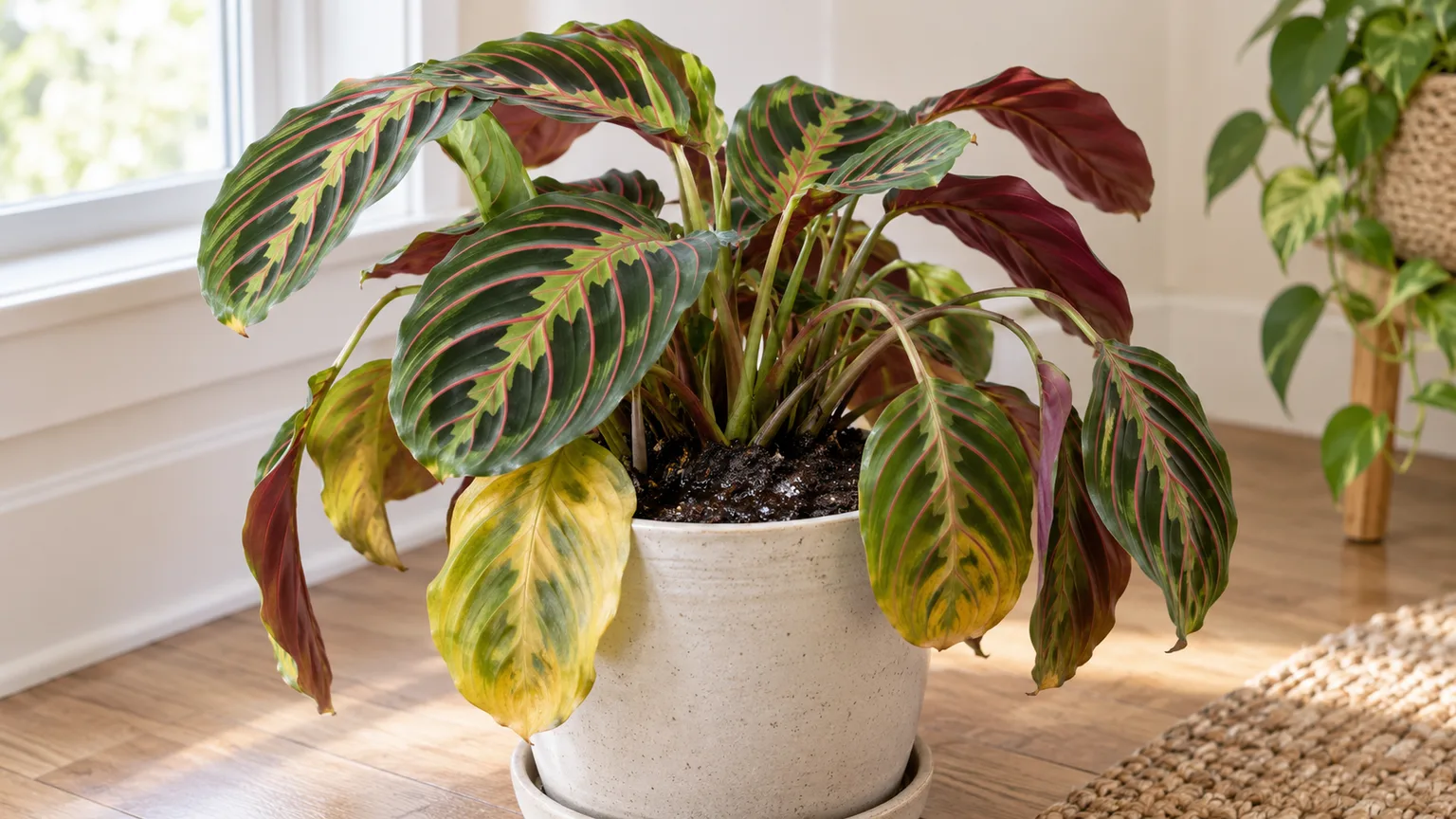
Overwatering on Maranta Red Prayer Plant: Causes, Checks & Fixes
This guide covers overwatering on Maranta Red Prayer Plant. See also the general Overwatering guide, watering, and light pages for this plant.
Overwatering on Maranta Red Prayer Plant: Causes, Checks & Fixes
Quick answer
Overwatering on Maranta Red Prayer Plant (Maranta leuconeura var. erythroneura) means the shallow rhizome zone stays wet too long — roots in saturated mix lose oxygen, fine feeder roots fail, and leaves go limp even though the pot feels heavy. The classic trap is watering a moisture-lover on a calendar: this plant wants evenly moist mix, not constantly soggy mix. For how chronic wet mix damages roots in general, see our overwatering guide. On Maranta, the pattern usually shows up as limp herringbone leaves plus fading night folding on wet soil.
First step: stop watering, slide the nursery pot out of any cachepot, empty all standing water, and let the top 2 cm of mix dry before the next thorough drink. Do not fertilize. If yellowing keeps spreading or stems soften after the mix dries appropriately, inspect the rhizomes before watering again.
What overwatering looks like on Maranta Red Prayer Plant
Red prayer plant leaves are broad-elliptic with red herringbone veins on dark green and gray-green to purple undersides. That thin, patterned blade shows wet-soil stress differently from thick succulent leaves: damage looks soft and limp rather than crispy alone.
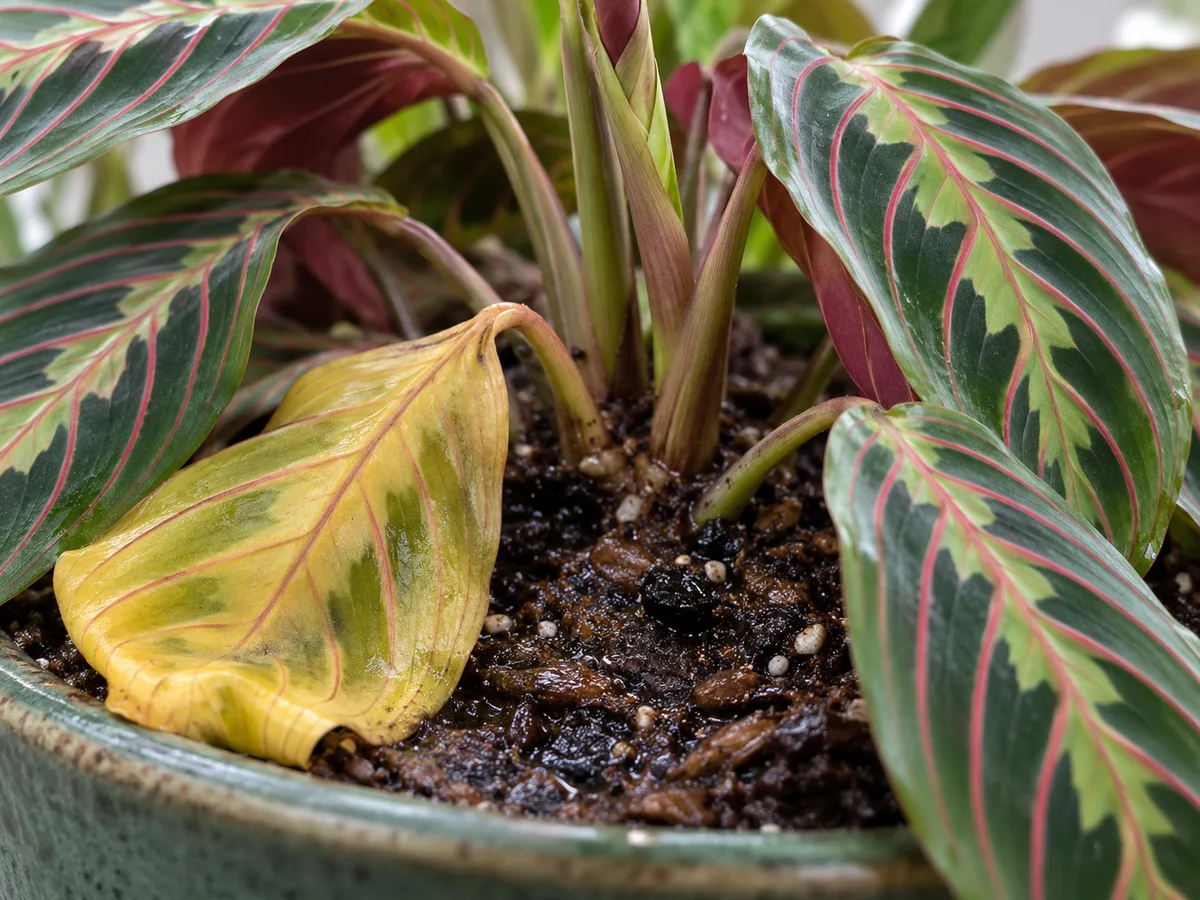
Overwatering close-up on Maranta Red Prayer Plant: soft yellowing lower leaves and limp petioles on saturated mix — compare with firm new rolls on the same plant.
Watch for these patterns together:
- Limp or drooping leaves while soil is wet — petioles lose stiffness even though the pot feels heavy and cool
- Weak or missing prayer movement — leaves stay flat or half-raised at night instead of folding crisply, then look tired again by midday
- Yellow leaves on Maranta Red Prayer Plant starting low — lower leaves yellow first and feel soft, while the center may still look green for a while
- New rolls emerging small, floppy, or stuck — unfurling tubes tear or stall when roots cannot support growth
- Soil wet for 7+ days — surface stays dark and cool without reaching the top-2-cm dry check
- Musty or sour smell from drainage holes or when you lift the nursery pot
- Fungus gnats on Maranta Red Prayer Plant hovering over a surface that never dries
- Soft stems at the soil line — the crown begins to collapse where leaves meet the rhizome
Unlike underwatering on Maranta Red Prayer Plant, which pairs curl with a light, dry, pulling-away pot, overwatering pairs limpness with weight, dampness at depth, and sometimes odor. If the pot is light and leaf edges are crisp and papery, look toward drought and low humidity on Maranta Red Prayer Plant instead.
Why Red Prayer Plant stays wet too long
Maranta is a Brazilian forest-floor plant grown for foliage, and indoors it lives in a narrow band: keep potting soil evenly moist through the growing season but let it dry out more in winter. Several ordinary habits push it from evenly moist into chronically soggy:
Calendar watering through slower seasons. Mix that dried in five to seven days in summer may stay wet for two weeks in a cool, dim winter room. Reduce soil moisture from autumn to late winter as growth slows, but keep checking rather than stopping checks entirely.
Heavy peat mix in a pot with no air. Nursery Maranta often arrives in moisture-retentive peat blends. In a plastic pot with one small hole, a single thorough watering can keep the core saturated long after the surface looks dry. Root rot may occur with poorly drained soils, and oversized pots make it worse by holding unused wet mix below the shallow rhizome zone.
Cachepots and standing saucers. Decorative outer pots without drainage trap runoff invisibly below the root ball. Water appears to drain, then sits at the base for days while the surface check says the plant looks fine.
Low light slowing water use. Maranta tolerates low to medium light but color fades and growth stalls there, so water applied on a bright-window schedule accumulates. A plant moved to a dim corner without adjusting watering is the most common winter setup for this problem.
Answering limpness with more water. A prayer plant that stops folding or goes limp is often assumed thirsty. On wet soil that limpness means suffocating roots, not thirst — adding water deepens oxygen loss.
Prayer movement as a moisture gauge
Nyctinasty — leaves lying flat by day and rising to a vertical prayer position at night — is driven by turgor shifts in the pulvini at each leaf-stalk base, and it runs on a daily rhythm. That makes it a better live gauge on Maranta than on almost any other houseplant.
Healthy movement looks like this: flat, patterned display through the day, full crisp fold after dark, reopening by mid-morning. Early overwatering flattens the rhythm: folds come late, feel soft rather than crisp, or stop entirely while soil stays wet. Check at two times before deciding — once midday for soil plus posture, once in the evening for folding. Night folding alone never diagnoses overwatering; missing folding on a heavy wet pot does.
Do not confuse this with a plant kept under a lamp late into the night. Constant bright evenings also suppress folding without any watering fault. If evenings are genuinely dim for several hours and folding still fails on wet mix, treat the root zone first. Track folding nightly for two to three weeks after your dry-down fix — a return to full crisp folding is one of the clearest confirmations the correction is working.
Rhizome check: shallow runners, not deep roots
Maranta spreads horizontally on fleshy rhizomatous stems just under the surface, with fine feeder roots rather than a deep taproot. That anatomy changes both diagnosis and rescue.
You do not need to unpot to read the rhizome zone early. Brush back the top centimeter of mix at the pot edge and press gently near the crown: firm, pale underground stems with healthy pale roots support a simple pause-and-dry fix. Dark, mushy, stringy, or sour-smelling tissue at the crown means the problem has moved past sogginess toward root rot on Maranta Red Prayer Plant.
When repotting is genuinely needed, bury rhizomes only 1–2 cm deep in fresh airy mix — deep burial in a tall pot of wet compost is a repeat setup for the same failure. Wide, shallow containers with open drainage suit the creeping habit better than deep narrow ones that hold wet soil below the roots. Full container logic lives in the Maranta Red Prayer Plant soil and Maranta Red Prayer Plant repotting guides.
Red veins, fluoride, and yellow: telling wet soil from water quality
Red-veined Maranta cultivars telegraph water-quality stress earliest on thin red vein margins — leaves burn with high fluorides and with over-fertilization. That can look confusingly similar to overwatering yellowing, but the patterns separate:
| What you see | Likely cause | First check |
|---|---|---|
| Limp leaves, heavy wet soil, yellow lower leaves, weak night folding | Overwatering / root rot | Stop water; dry to top 2 cm; inspect rhizome |
| Light dry pot, tight daytime curl, crisp edges | Underwatering | Soak and drain; check watering rhythm |
| Brown crispy margins on otherwise firm plant, moist soil, clean new center | Fluoride or salt burn / brown tips | Switch to filtered or rainwater; flush salts |
| Crisp brown edges on moist soil with dry air | Low humidity | Humidifier before more water |
| Acute whole-plant flop within hours on wet soil | Wilting / advancing rot | Crown firmness plus root inspection |
| Fine dark flies over a never-dry surface | Fungus gnats | Dry the surface; fix watering habit |
| Normal evening fold, firm by mid-morning | Nyctinasty | No action |
Fluoride and salt burn browns thin margins while the plant otherwise feels firm and the pot weight cycles normally. Overwatering yellows whole lower leaves soft, stalls folding, and keeps the pot heavy. If only margins brown after a water-source change while new growth opens clean, you found a quality problem, not a quantity problem.
How to confirm overwatering
Work through these checks in order before changing multiple variables:
- Pot weight — Lift the container. Heavy and cool days after watering suggests saturation. Very light points toward drought.
- Top 2 cm moisture — Push a finger or wooden skewer about 2 cm in near the pot edge. Damp with limp leaves means root stress, not thirst. Water only when this layer is just beginning to dry, per the Maranta Red Prayer Plant watering guide.
- Cachepot inspection — Slide the nursery pot out and pour off any pooled runoff. Check drainage holes for blockage.
- Skewer at depth — Insert near the pot wall for a minute. Damp residue deep down while the surface looks dry confirms retention in peat-heavy mix.
- Smell — Musty or sour odor from the mix or drainage holes signals decaying organic matter and stressed roots.
- Crown feel — Gently press stems at the soil line. Firm with limp outer leaves is more recoverable; soft, dark, or collapsing tissue on wet mix means escalate to rot steps.
- Light and season context — Dim winter corner, recent move away from the window, or unchanged summer schedule in cool months all implicate slow evaporation. Cross-check the Maranta Red Prayer Plant light guide.
- Time of day — Assess posture at midday after normal opening and folding in the evening. Night folding alone is not a watering diagnosis.
Confirmed overwatering needs wet mix at depth plus declining foliage — limpness, lower-leaf yellowing, or stalled folding that does not match a dry pot.
First fix for Maranta Red Prayer Plant
Stop watering immediately and remove all standing water from saucers, cachepots, and trays.
Set the plant in bright indirect light with stable warmth and gentle airflow — bright indoor light but no strong direct sun, and temperatures that do not dip below 60°F. Do not move it into hot direct sun to dry it faster; thin Maranta blades bleach quickly.
Let the mix dry until the top 2 cm feels just beginning to dry before the next thorough drink. On a heavily saturated pot that may take one to two weeks depending on pot size and room conditions. Water thoroughly once, until a little runs from drainage holes, then empty the saucer within 30 minutes. Do not fertilize a waterlogged plant, do not repot into a larger container to help drying, and do not prune healthy green leaves hoping to force recovery.
When to inspect roots and escalate
If decline continues after the mix has dried appropriately — more yellow leaves, worsening limpness, sour smell, or a soft crown — unpot and inspect:
- Gently remove the plant and brush away loose mix from the shallow rhizomes.
- Look for brown, black, or mushy roots and rhizome sections versus firm, pale, healthy tissue.
- Trim dead roots and any collapsed rhizome with clean scissors, keeping as much healthy root mass as possible.
- Repot into fresh, airy, well-draining mix with perlite, in a pot only slightly larger than the trimmed root ball, with an open drainage hole.
- Water once lightly to settle the mix, then resume the top-2-cm rhythm.
Maranta is in the same species as lemon lime prayer plant and shares its recovery habit: caught while rhizomes stay firm, it can push fresh roots and new center rolls. If most of the crown is soft or the root system is largely mushy, a healthy division with intact roots is sometimes a better salvage than saving a collapsed parent. Full trim-and-repot steps are in the root rot guide.
Recovery timeline
Mild overwatering caught early often stabilizes within one to two weeks once soil oxygen returns. Outer limp leaves may stay yellow — yellow lower leaves are often the first symptom and that tissue will not re-green.
Moderate root damage takes three to six weeks before new center rolls look firm and folding returns to full crispness. Old yellow leaves may keep declining while roots repair underground.
Judge recovery by firm new rolls unfurling from the center, stable pot weight that drops predictably between waterings, no upward spread of yellowing, and a firm crown at the soil line. If the plant perks briefly after drying, then wilts again on the next normal watering, fine roots are still compromised — re-inspect before returning to a generous schedule.
What not to do
Do not add water because leaves curl without checking soil first — that is how mild sogginess becomes rot on this plant.
Do not fertilize a stressed, waterlogged plant. Over-fertilization burns leaves on its own, and salts add burden to oxygen-starved roots.
Do not repot into a bigger pot during recovery. Extra soil volume holds more water and slows dry-down around shallow rhizomes.
Do not mist heavily instead of fixing drainage. Surface moisture does not restore root-zone oxygen and can worsen fungus gnats.
Do not swing to extreme underwatering out of fear. Maranta still needs evenly moist soil between drinks — just not constant saturation.
Do not water because leaves fold at night. Evening folding is normal prayer-plant behavior; check soil at midday instead.
How to prevent overwatering next time
Build a check habit tied to the pot and season, not a calendar:
- Feel the top 2 cm every few days until you learn the rhythm in the current spot
- Lift the pot before watering — heavy means wait, appropriately light means drink
- Empty saucers and cachepots within 30 minutes of every watering
- Reduce frequency in winter when growth slows and evaporation drops, while never letting the whole root ball go brick-hard
- Use a pot with drainage and avoid sizing up until roots fill the current container
- Match light to watering — dim rooms need less frequent drinks than bright indirect spots
For filtered water, seasonal schedules, and the full moisture-check routine, use the Maranta Red Prayer Plant watering guide — this page focuses on diagnosis and recovery.
When to worry
Treat as urgent when the crown feels soft at the soil line while mix stays wet, soil smells sour and remains saturated, the plant collapsed within days on a heavy wet pot, or inspection shows mostly mushy roots. Persistent fungus gnats despite drying the surface can also signal deep decay. Rattling through one extra watering rarely kills Maranta if you catch saturation early; repeated watering into wet soil strips fine roots and invites pathogens.
Conclusion
Overwatered Maranta Red Prayer Plant reads clearly once you check the pot: heavy weight, wet mix at depth, limp herringbone leaves, and night folding that fades instead of snapping shut. Stop watering, drain every vessel, and let the top 2 cm dry before the next drink. If decline continues, inspect the shallow rhizomes before reaching for the watering can again, and match future watering to how fast your specific pot dries in its spot.
When to use this page vs other Maranta Red Prayer Plant guides
- Maranta Red Prayer Plant watering — Use for routine moisture checks and seasonal rhythm before assuming overwatering is the main issue.
- Maranta Red Prayer Plant problems — Browse all 16 common issues on this species when symptoms overlap.
- Root Rot on Maranta Red Prayer Plant — Escalate here when roots are mushy or the crown is soft on wet mix.
- Yellow Leaves on Maranta Red Prayer Plant — Use when yellowing dominates and you need to separate wet-soil progression from other causes.
- Wilting on Maranta Red Prayer Plant — Use for acute whole-plant collapse that needs same-day triage.
Related Maranta Red Prayer Plant guides
- Maranta Red Prayer Plant overview
- Maranta Red Prayer Plant watering
- Maranta Red Prayer Plant light
- Maranta Red Prayer Plant soil
- Root Rot on Maranta Red Prayer Plant
- Underwatering on Maranta Red Prayer Plant
- Wilting on Maranta Red Prayer Plant
- Drooping Leaves on Maranta Red Prayer Plant
- Yellow Leaves on Maranta Red Prayer Plant
- Fungus Gnats on Maranta Red Prayer Plant
- Maranta Red Prayer Plant problems