Fungus Gnats on Red Prayer Plant: Dry the Surface, Keep
Quick answer
Fungus gnats on red prayer plant mean the top layer of mix stays wet too long. First step: let the top 2 cm dry fully and set a yellow sticky trap at the pot rim, while keeping the deeper root zone moist.
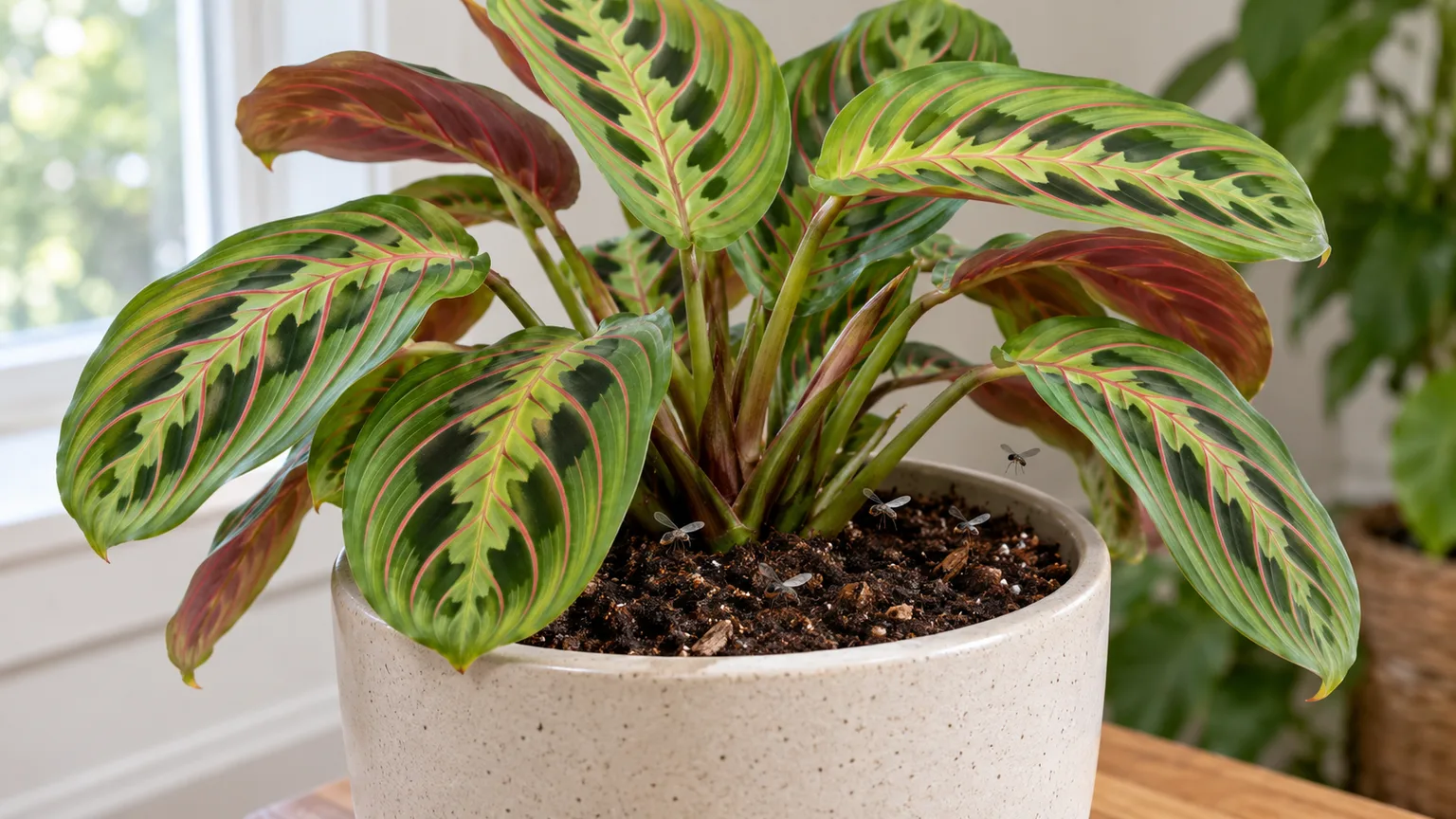
Fungus Gnats on Maranta Red Prayer Plant: Causes, Checks & Fixes
This guide covers fungus gnats on Maranta Red Prayer Plant. See also the general Fungus Gnats guide, watering, and light pages for this plant.
Fungus Gnats on Maranta Red Prayer Plant: Causes, Checks & Fixes
Quick answer
Fungus gnats on red prayer plant mean the top layer of mix stays wet too long, not that the patterned leaves are diseased. Adults are tiny dark flies hovering at soil level, and their larvae live in the damp upper mix feeding on fungi and decaying matter. For how these flies breed in general, see our fungus gnats guide. On Maranta, the trigger is almost always the plant’s thirsty reputation: owners keep the surface moist to protect humidity-loving foliage, and that surface becomes a nursery.
First step: let the top 2 cm of mix dry fully, and set a yellow sticky trap at the pot rim. Keep the deeper root zone lightly moist the way this species likes, but break the wet-surface cycle that larvae need. Spraying the leaves will not reach anything living in the soil.
When to use this page vs other Maranta guides
| What you see | Read next |
|---|---|
| Flies rising from soil when tapped | This page (fungus gnats) |
| Yellow leaves on wet, heavy mix | Overwatering |
| Fuzzy white or grey film on the surface | Mold on Soil |
| Mushy stems or sour-smelling roots | Root Rot |
| Brown crispy edges, no flies | Brown Tips |
| Routine moisture rhythm questions | Watering guide |
Why red prayer plant pots breed gnats
Maranta leuconeura is a moisture-loving spreader with shallow roots and rhizomes sitting close to the surface. NC State Extension describes it as a plant that wants evenly moist soil plus high humidity, held in bright indirect light rather than direct sun. Every part of that prescription can keep the pot surface damp:
The moisture paradox. This species genuinely dislikes drying out, so growers water little and often. Frequent shallow top-watering wets only the upper layer where gnat eggs hatch, while the deeper mix may be no wetter than usual. The plant looks correctly cared for while the surface never dries.
Humidity habits that wet the soil. Daily misting, pebble trays kept brim-full, and grouping plants into a still damp corner all hold surface moisture for days. Misting aimed at the foliage runs down stems into the crown and onto the mix. A pebble tray with standing water wicks humidity but also breeds flies and algae at the pot base.
Low-light corners. Red prayer plant tolerates low to medium light, so it often sits in dim spots where evaporation crawls. A rhythm that dried the surface in two days near a bright window can leave it soggy for a week in a hallway, and gnats notice before you do.
Peat-heavy nursery mix. Maranta ships in moisture-retentive blends rich in peat or coir. Once that organic surface stays wet, females lay eggs in its cracks and larvae feed in the top few inches of mix. Decorative cachepots without drainage make it worse by holding saucer water against the shallow root zone.
New-plant hitchhikers. Adults commonly arrive on freshly bought houseplants and spread across a shelf. A new Maranta placed beside the collection without quarantine can seed every moist pot in the room.
What fungus gnats look like on red prayer plant
Adults are dark grey-brown flies about 3–4 mm long, often seen running across the soil or drifting just above the pot (RHS). Tap the rim and a small cloud lifts, then resettles on the mix, the pot edge, or the lowest leaf bases near the soil. Nothing will be feeding on the patterned leaf blades themselves.
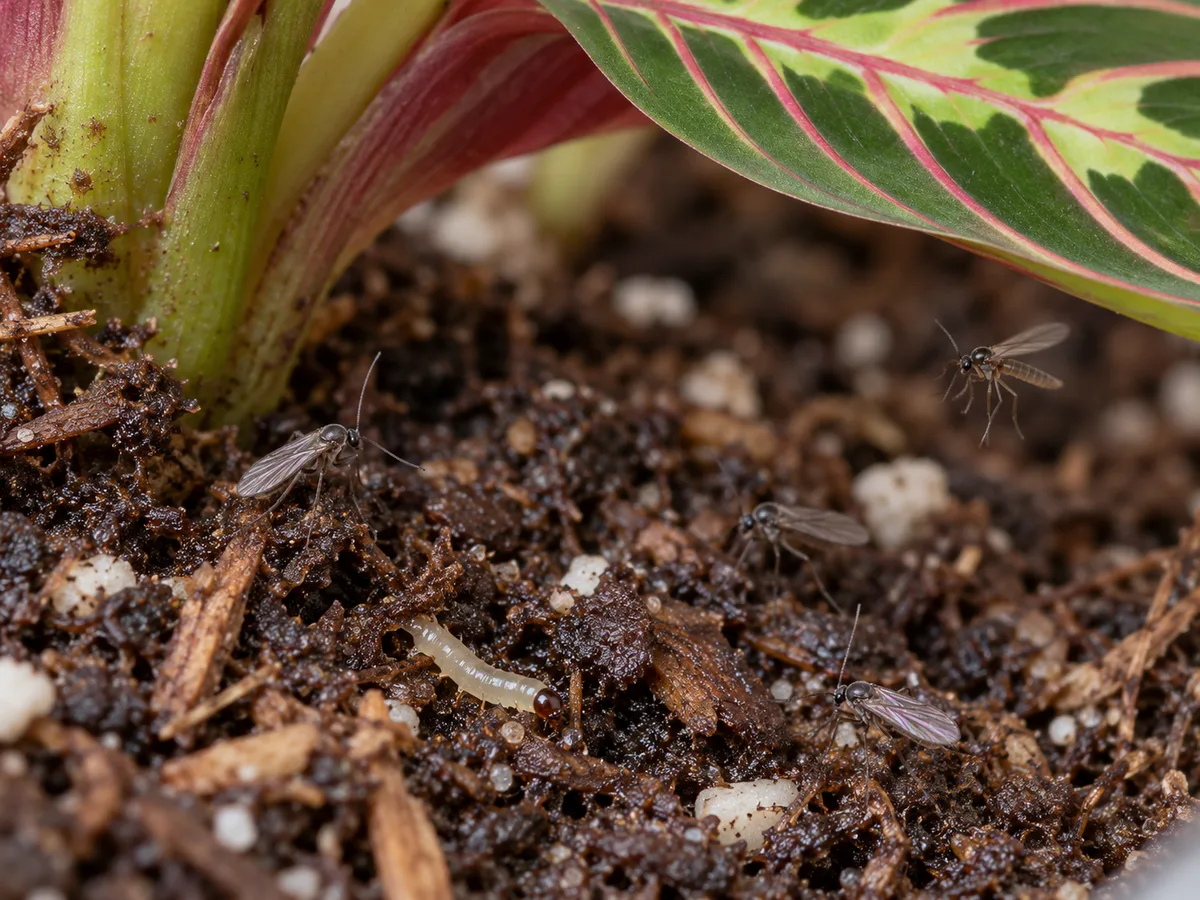
Tiny dark adults at the soil surface with translucent larvae in the damp top layer — the signature fungus gnat pattern on Maranta.
Larvae are slender whitish maggots up to about 6 mm with visible black heads, living in damp compost rather than on foliage (RHS). Scrape back the top centimeter of a wet pot and you may see them threading through the mix, sometimes with a green algae film on the surface.
Foliage clues are indirect. New rolled leaves may emerge slowly and older leaves can dull when larvae prune fine feeder roots, but webbing points to spider mites and white cottony clusters to mealybugs instead. On this species, genuine gnat damage shows below the soil line first.
How to confirm fungus gnats
- Tap test — Ruffle the soil surface or tap the rim. Flies that rise straight out of the pot are fungus gnats; flies hovering around fruit bowls or drains belong to a different problem with a different fix (Snap Plant).
- Surface-moisture check — Push a finger 2 cm into the mix. Cool, clinging dampness several days after watering confirms the breeding condition. Note whether pebble trays or cachepots are holding hidden water too.
- Potato-slice test — Press raw potato flesh-down into the damp surface overnight. Translucent wormlike larvae on the underside confirm larvae in the mix (Potting Corner).
- Sticky-trap count — Cut yellow traps into small squares on skewers at soil level. A catch of small dark flies within days supports the diagnosis and gives you a baseline number to track.
- Shelf sweep — Check every pot on the same shelf or humidity tray. Treating one Maranta while a neighboring pot stays soggy guarantees reinfestation.
Confirmed case: soil-level flies plus larvae in the wet top layer, with foliage pests ruled out.
First fix for Maranta Red Prayer Plant
Let the top 2 cm dry fully, and stake a yellow sticky trap at the pot rim.
Water from the bottom or soak thoroughly at the soil line only when that top band feels dry, following our watering guide. Empty the saucer, cachepot, and pebble tray within 30 minutes so the roots never sit in standing water. Keep humidity up with a humidifier or a tray of pebbles with water kept below the pot base rather than touching it.
If larvae persist after two weeks of a genuinely drying surface, drench the top layer with Bacillus thuringiensis israelensis (BTI) at label rate and repeat every five to seven days for three to four weeks so hatching eggs keep meeting the treatment (Potting Corner). Refresh traps weekly and count the catch. Do not spray the herringbone foliage for a soil pest — it misses the larvae and risks spotting the thin leaves.
Step-by-step recovery
- Week 1 — Dry the top 2 cm between drinks, set traps, drain saucers and trays every time.
- Week 2 — Trap numbers should fall. Repeat the potato test to see whether larvae are thinning.
- Weeks 3–4 — Apply BTI on schedule if larvae remain. The full life cycle runs roughly three to four weeks, so persistence now is normal, not failure.
- Week 5+ — Resume the Maranta rhythm: moist deeper mix, dry surface, per the soil guide for a perlite-lightened blend that drains faster.
- Ongoing — Quarantine newcomers for two weeks and probe the top layer before every watering.
Recovery reads clearly: fewer adults on fresh traps, clean potato slices, and new leaves unfurling with sharp red veining.
Mistakes to avoid
- Misting the foliage several times a day to “raise humidity” while the surface never dries — use a humidifier instead and keep crowns dry overnight.
- Keeping pebble trays flooded so pots sit in water, which breeds flies at the drainage holes.
- Light daily sprinkles that wet only the top centimeter, the exact band larvae inhabit.
- Repotting into denser peat without perlite on day one — it recreates the soggy surface. Reserve repotting guidance from our repotting guide for when roots truly need it.
- One trap for a heavy hatch. Match trap count to pot count and fix the moisture underneath.
- Right-side mistyping: because this is a pet-safe species many owners choose deliberately, reach for traps, dry-down, and BTI before any broad spray in a pet household.
Care cross-check during recovery
| Factor | Maranta need while treating gnats |
|---|---|
| Top 2 cm | Dry fully between waterings |
| Deeper root zone | Lightly moist, never sour — probe before each drink |
| Humidity | High air humidity via humidifier, not a wet surface |
| Light | Bright indirect per the light guide so pots dry predictably |
| Water quality | Filtered or rested tap water — fluoride-burned margins stress plants already fighting root pests |
| Pot setup | Drainage holes open, no standing water in cachepots or trays |
How to prevent fungus gnats next time
- Water when the top 2 cm are dry, deeply rather than in daily sips.
- Bottom-water routinely so the breeding surface stays inhospitable.
- Grow in the airy moisture-retentive blend from our soil guide and top-dress with coarse perlite or fine bark so the very surface dries fast.
- Empty saucers, cachepots, and pebble trays within 30 minutes of every session.
- Give enough bright indirect light that the surface dries within a few days.
- Replace degraded mix that stays wet and sour-smelling; stale organic matter feeds the fungi larvae eat (RHS).
When to worry
Move quickly when clouds of flies survive a month of corrected watering, when soil smells sour and stems soften, or when fresh divisions and cuttings collapse. Established Maranta are unlikely to be seriously damaged by larvae, so decline at that scale usually means overwatering or root rot has joined the gnats. Unpot, check rhizomes and roots for brown mush, and trim only what is clearly dead before resetting the mix.
Related Maranta Red Prayer Plant guides
- Maranta Red Prayer Plant overview — placement, humidity, and water-quality basics for this species.
- Watering guide — use for the moist-but-draining rhythm that starves larvae without droughting roots.
- Soil guide — use when the mix itself holds surface water too long.
- Light guide — use when dim corners slow dry-down.
- Overwatering — use when yellow leaves and heavy pots accompany the flies.
- Mold on Soil — use when a fuzzy or algae-coated surface accompanies the flies.
- Root Rot — use when stems soften and roots smell sour.
- Brown Tips — use when crispy red-vein margins appear without any flies.
- Problems hub — browse all 16 recorded issues on this plant.