Underwatering on Maranta Red Prayer Plant: Causes, Checks &
Quick answer
Underwatering on Maranta Red Prayer Plant shows as tight daytime leaf curl, crispy brown edges on thin herringbone leaves, and a light pot with mix pulling from the edges. First step: give a slow deep soak until water runs from drainage holes, drain fully, and return to watering when the top 2 cm begins to dry.
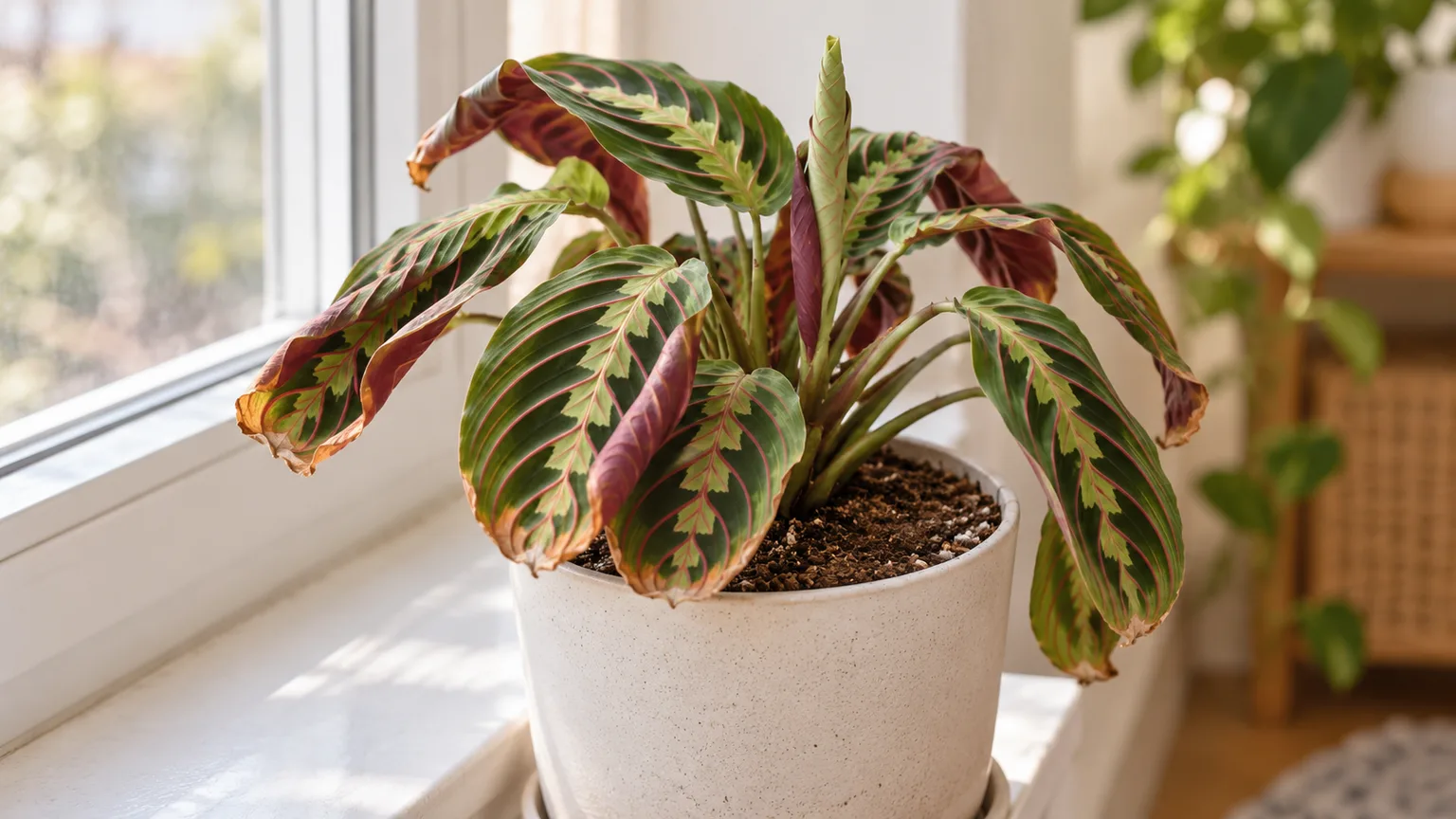
Underwatering on Maranta Red Prayer Plant: Causes, Checks & Fixes
This guide covers underwatering on Maranta Red Prayer Plant. See also the general Underwatering guide, watering, and light pages for this plant.
Underwatering on Maranta Red Prayer Plant: Causes, Checks & Fixes
Quick answer
Underwatering on Maranta Red Prayer Plant (Maranta leuconeura var. erythroneura) means the shallow root zone has gone too dry between drinks — leaves curl inward by day, thin herringbone blades turn papery at the edges, and the pot feels conspicuously light. This species wants you to keep potting soil evenly moist through the growing season, so a plant left to go bone-dry shows stress faster than a pothos or snake plant would. For how dry mix and water-repellent soil behave in general, see our underwatering guide. On Maranta, the pattern usually shows up as daytime curl plus crispy red-vein margins on a light, pulling-away pot.
First step: water slowly and deeply until a little runs from the drainage holes, let the pot drain fully, and empty the saucer. Do not fertilize. If water races straight through without wetting the mix, switch to a bottom soak rather than pouring more from the top.
What underwatering looks like on Maranta Red Prayer Plant
Red prayer plant leaves are broad, thin, and patterned with red herringbone veins on dark green — that thin blade loses moisture fast and shows drought as crisp texture rather than soft limpness.
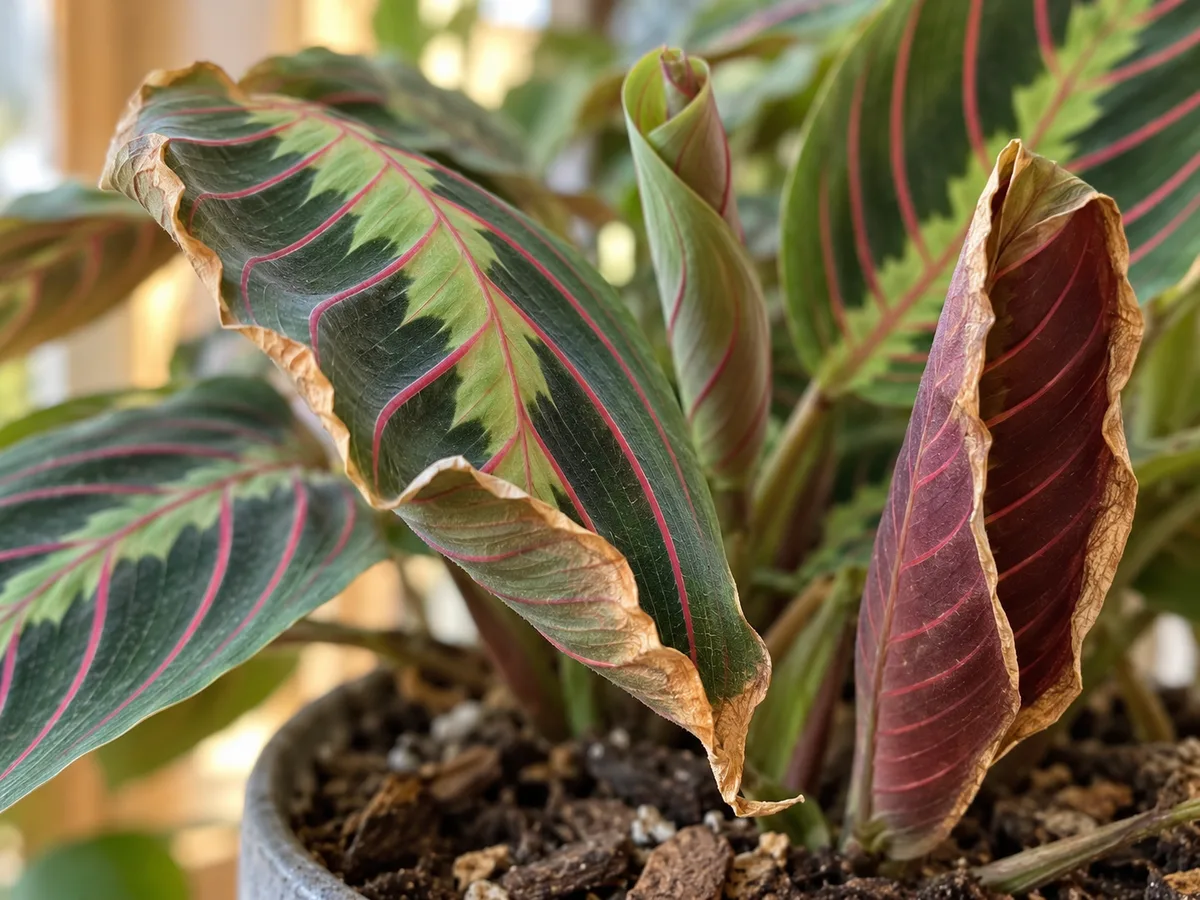
Underwatering close-up on Maranta Red Prayer Plant: inward-curling herringbone leaves with papery brown margins on dry, shrunken mix — compare with firm new rolls at the center.
Watch for these patterns together:
- Tight inward curl during the day — leaves roll toward the midrib instead of lying flat, and stay curled into the evening
- Crispy brown edges and tips — margins feel papery and dry, often browning first along the thin red veins
- Light pot with mix pulling from the edges — the container feels very light and you can see a gap between soil and pot wall
- Drooping plus slow browning while curling on completely dry soil, the classic dried-out prayer plant sequence
- Weak or missing night folding — severely dry plants cannot generate the turgor needed for crisp prayer movement
- New rolls stalling — unfurling tubes pause mid-open and their tips crisp before expanding
- Faded pattern — red veins and pale central stripe look washed out on long-dry plants
Unlike overwatering on Maranta Red Prayer Plant, which pairs limpness with a heavy wet pot, underwatering pairs curl and crispness with lightness. If the pot is heavy and leaves are soft-yellow, you are looking at the opposite problem.
Why Red Prayer Plant dries out so fast
Maranta is a Brazilian forest-floor plant with shallow, spreading roots and thin leaves built for humid shade — indoors it lives or dies by steady root-zone moisture. Several ordinary habits push it from evenly moist into too dry:
Calendar gaps through bright or warm spells. Mix that held moisture for a week in a cool room can dry in three to four days near a bright window, above a radiator, or under air conditioning. The plant still needs you to keep potting soil evenly moist while it is actively growing, and fixed schedules miss those swings.
Small pots and porous containers. Nursery Maranta often sits in a small plastic pot where the shallow rhizome zone exhausts water quickly. Moved into terracotta without adjusting frequency, the same plant dries dramatically faster.
Peat mix gone water-repellent. Dry potting soils, especially peat or bark blends, can become hydrophobic — water sheets off and drains out while the core stays dry. Pouring more from the top then looks like watering while the roots stay thirsty.
Low humidity accelerating leaf loss. This plant requires high humidity, and dry indoor air pulls moisture from thin blades faster than roots can replace it. Curling leaves with brown tips is the textbook low-moisture complaint on this species, and dry air plus dry soil stack the damage.
Heat and direct sun. Maranta performs with bright indoor light but no strong direct sun, and a pot baking in a hot window dries the shallow mix while bleaching the pattern.
Daytime curl vs normal prayer movement
Nyctinasty — leaves flat by day, rising to prayer position at night — runs on turgor shifts in the pulvini at each leaf-stalk base, and drought scrambles the signal. Learning the difference prevents the most common misdiagnosis on this plant.
Healthy movement looks like this: flat patterned display through the day, full crisp fold after dark, reopening by mid-morning. Underwatering curl looks different: leaves roll inward along the midrib during daylight hours, feel stiff and papery rather than soft, and stay curled or only half-open into the evening. Night folding alone never diagnoses watering — persistent daytime roll on a light dry pot does.
Afternoon curl that relaxes into a normal evening fold is usually a heat, bright-light, or dry-air response rather than a dry root zone. Check the pot before deciding: if the top 2 cm still feels lightly moist and the pot has weight, raise humidity and soften the light before adding water. Full curl-versus-wilt logic lives in the wilting and drooping leaves guides.
Shallow rhizomes: why the top 2 cm rule matters
Maranta spreads on fleshy rhizomatous stems just under the surface, with fine feeder roots rather than a deep taproot. Almost the entire working root zone sits in the top few centimeters of mix — which is exactly the layer that dries first.
That anatomy makes the standard check unusually reliable here: push a finger or wooden skewer about 2 cm in near the pot edge. Dry and crumbly at that depth with a light pot means the rhizome zone is dry. Do not dig at the crown or unpot to diagnose simple drought — surface check plus pot weight is enough, and disturbing shallow runners adds stress. Reserve unpotting for cases where a good soak fails to perk the plant, which points toward dead roots rather than simple dryness. Container and mix logic lives in the Maranta Red Prayer Plant soil guide.
Dryness, fluoride burn, and low humidity: telling them apart
Red-veined Maranta cultivars telegraph several stresses on the same thin margins, and the patterns separate once you check pot weight:
| What you see | Likely cause | First check |
|---|---|---|
| Tight daytime curl, crispy edges, light dry pot, mix pulling away | Underwatering | Slow deep soak; check watering rhythm |
| Limp leaves, heavy wet soil, yellow lower leaves | Overwatering / root rot | Stop water; dry to top 2 cm |
| Brown crispy margins on a firm plant, moist soil, clean new center | Fluoride or salt burn — leaves burn with high fluorides | Switch to filtered water; see brown tips |
| Crisp edges on moist soil with dry air | Low humidity | Humidifier before more water |
| Whole-plant flop within hours | Wilting — confirm dry vs wet first | Pot weight decides soak vs dry-down |
| Yellowing that starts low with dry curl | Yellow leaves from drought progression | Soak, then track new growth |
Fluoride and salt burn browns thin margins while the pot cycles normally and new growth opens clean. Drought curls whole leaves, crisps edges, and always pairs with a light pot.
How to confirm underwatering
Work through these checks in order before changing multiple variables:
- Pot weight — Lift the container. Very light means dry; heavy and cool days after watering points away from drought.
- Top 2 cm moisture — Push a finger or skewer 2 cm in near the pot edge. Dry and crumbly with curled leaves confirms it against your normal watering rhythm.
- Soil shrinkage — Look for mix pulling away from the pot wall, a reliable sign the root ball has dried hard.
- Run-through test — Water a little from the top. If it races out the drainage holes in seconds while the surface still looks dry, the mix has gone water-repellent.
- Leaf feel — Curled leaves that feel stiff and papery indicate drought; limp-soft leaves on wet mix indicate the opposite.
- Time of day — Assess curl at midday and folding in the evening. Curl that persists into the night on a dry pot is drought; curl that relaxes into a normal fold is usually heat or dry air.
- Light and season context — Recent move to a brighter spot, heating season start, or terracotta repot all accelerate drying. Cross-check the Maranta Red Prayer Plant light guide.
Confirmed underwatering needs dry mix at depth plus matching foliage — light pot, dry top 2 cm, and curl or crisping that does not match a wet pot.
First fix for Maranta Red Prayer Plant
Give one slow, thorough soak until water runs from the drainage holes, then let the pot drain completely.
Water from the top in two or three slow passes a few minutes apart so dry mix absorbs instead of channeling. Once water flows freely below, empty the saucer within 30 minutes and return the plant to bright indoor light but no strong direct sun with stable warmth — temperatures that do not dip below 60°F. Do not fertilize a freshly drought-stressed plant, and do not prune curled-but-green leaves yet; many reopen within hours.
When water runs straight through: the bottom soak
If the top pour races through, the peat core is water-repellent and top watering cannot fix it. Set the nursery pot in 2 to 3 inches of room-temperature water for 15 to 30 minutes so moisture wicks upward like a sponge absorbing from below. Check the surface: if it feels moist and the pot has gained obvious weight, the root ball is rehydrated. Repeat once if the center still feels dry. Never leave the pot standing in water for more than 60 minutes, or the rescue swings into root-rot conditions.
If the plant has fully dried out to the point of severe curl and browning, it will still usually respond to this deep soak approach — dried prayer plant pots most often need one patient rehydration rather than repeated shallow pours.
Recovery timeline
Mild underwatering caught at the curl stage often visibly improves within hours: leaves unroll through the evening and lie flatter by the next morning.
Moderate drought with crispy margins takes two to three weeks before judgment is possible. Brown crispy tissue will not re-green — that damage is permanent. Judge recovery by firm new leaf rolls unfurling clean from the center, stable pot weight that drops predictably between waterings, no spread of browning, and a return to full crisp night folding.
If the plant stays curled and limp days after the mix is properly moist, fine roots likely died during the dry period and can no longer take up water. Unpot, trim dead roots, and repot into fresh airy mix as described in the root rot guide — then resume the top-2-cm rhythm.
What not to do
Do not drown a dry plant in a panic pour followed by a permanently full saucer. One thorough soak plus full drainage is the fix; standing water invites rot on freshly stressed roots.
Do not fertilize a drought-stressed plant. Salts add burden to struggling roots — and this cultivar already burns with over-fertilization.
Do not repot on the same day as the rescue soak unless the mix is completely failed or pests are obvious. Rehydration first, repotting later if needed.
Do not prune every curled leaf immediately. Curled-but-green blades often reopen; only trim fully brown, papery tissue after the plant stabilizes.
Do not swing to constant saturation out of guilt. Maranta still needs oxygen between drinks — just not brick-hard dryness.
Do not mist as the fix for a dry root ball. Surface moisture does not rehydrate a shrunken core and can invite leaf spotting; fix the soil moisture instead.
How to prevent underwatering next time
Build a check habit tied to the pot and season, not a calendar:
- Feel the top 2 cm every few days until you learn the rhythm in the current spot
- Lift the pot before watering — appropriately light means drink, very light with curl means overdue
- In bright, warm, or heating-season rooms, check twice as often; shallow rhizome pots dry fast
- Use filtered or overnight-stood water to avoid stacking fluoride stress on drought stress
- Keep humidity up — dry air plus dry soil crisps thin blades twice as fast
- Avoid oversized terracotta for this moisture-lover unless you can water to match
For filtered water, seasonal schedules, and the full moisture-check routine, use the Maranta Red Prayer Plant watering guide — this page focuses on diagnosis and recovery.
When to worry
Treat as urgent when most leaves stay tightly curled and papery days after a proper soak, stems feel brittle at the soil line, or new rolls emerge already brown. A plant that perks briefly after watering then collapses again on moist soil likely has dead roots from the dry period — inspect promptly rather than soaking repeatedly. One missed watering rarely kills Maranta if you rehydrate properly; repeated bake-dry cycles exhaust the shallow rhizomes.
Conclusion
Underwatered Maranta Red Prayer Plant reads clearly once you check the pot: light weight, dry mix at 2 cm, tight daytime curl, and crispy herringbone margins. Soak slowly until water runs through, drain fully, and let the top 2 cm guide the next drink. If a good soak fails to reopen the leaves, inspect the shallow roots before watering again, and match future frequency to how fast your specific pot dries in its spot.
When to use this page vs other Maranta Red Prayer Plant guides
- Maranta Red Prayer Plant watering — Use for routine moisture checks and seasonal rhythm before assuming underwatering is the main issue.
- Maranta Red Prayer Plant problems — Browse all 16 common issues on this species when symptoms overlap.
- Overwatering on Maranta Red Prayer Plant — Use when the pot is heavy and leaves are limp-soft rather than curled-crisp.
- Low Humidity on Maranta Red Prayer Plant — Use when crisp edges persist on correctly moist soil in dry air.
- Brown Tips on Maranta Red Prayer Plant — Use when margin browning dominates and water quality or salts may be involved.
Related Maranta Red Prayer Plant guides
- Maranta Red Prayer Plant overview
- Maranta Red Prayer Plant watering
- Maranta Red Prayer Plant light
- Maranta Red Prayer Plant soil
- Overwatering on Maranta Red Prayer Plant
- Root Rot on Maranta Red Prayer Plant
- Wilting on Maranta Red Prayer Plant
- Drooping Leaves on Maranta Red Prayer Plant
- Yellow Leaves on Maranta Red Prayer Plant
- Brown Tips on Maranta Red Prayer Plant
- Low Humidity on Maranta Red Prayer Plant
- Maranta Red Prayer Plant problems