Root Rot on Maranta Red Prayer Plant: Signs, Rescue &
Quick answer
If your Maranta Red Prayer Plant wilts in damp soil and its leaves stop rising at night, suspect root rot: slide the plant out of the pot and inspect the roots before adding any more water.
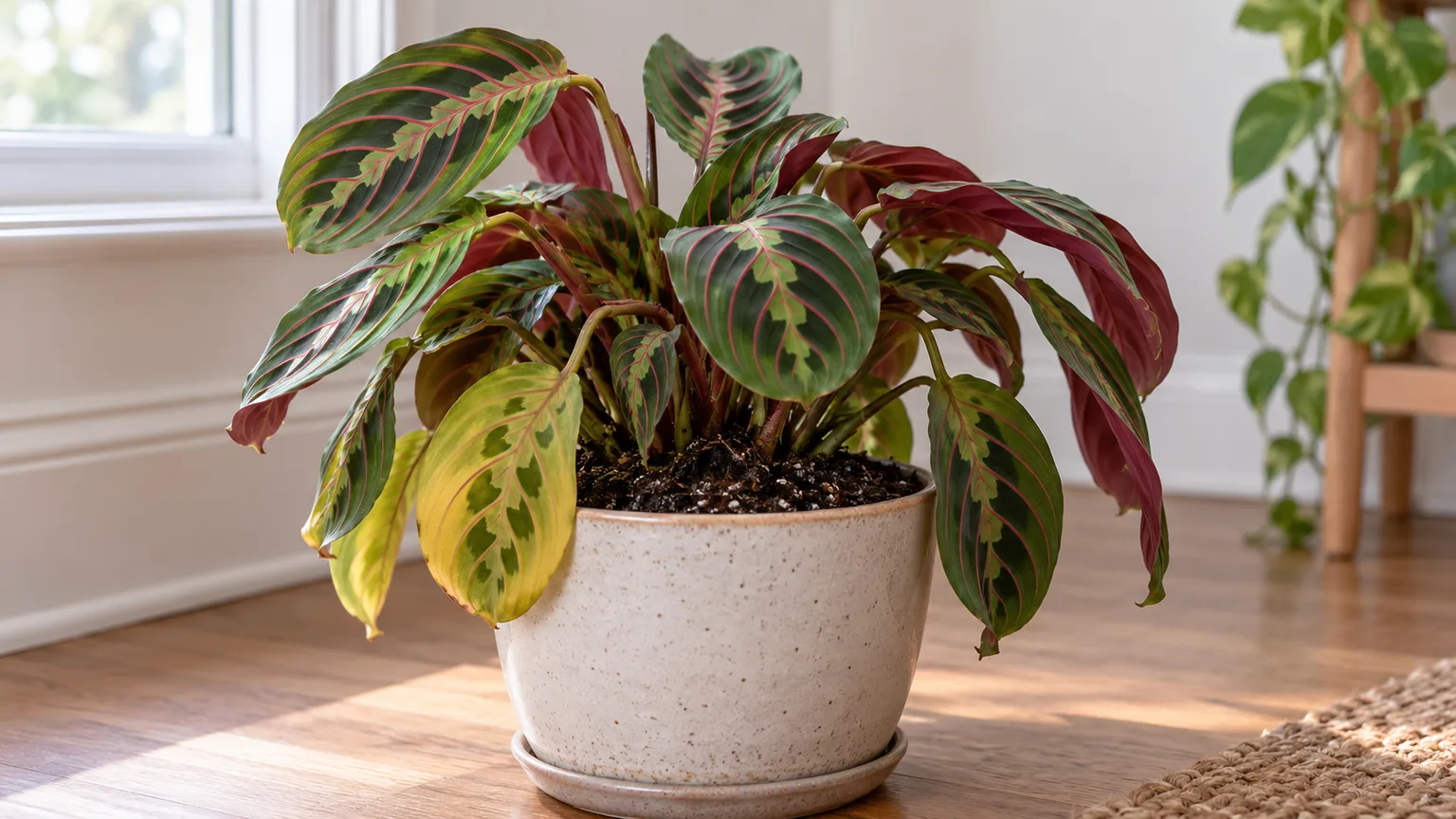
Root Rot on Maranta Red Prayer Plant: Causes, Checks & Fixes
This guide covers root rot on Maranta Red Prayer Plant. See also the general Root Rot guide, watering, and light pages for this plant.
Root Rot on Maranta Red Prayer Plant: Causes, Checks & Fixes
Quick answer
If your Maranta Red Prayer Plant wilts even though the soil feels damp — and its leaves stop folding upward at night — suspect root rot, not thirst. First step: slide the plant out of its pot and look at the roots before adding a single drop of water. For how chronic wet mix damages roots in general, see our root rot guide. On Maranta Red Prayer Plant, the pattern usually shows up as limp leaves in heavy mix, yellowing lower foliage, and a nightly leaf lift that quietly stops.
This plant is unusually honest about root trouble because of its nyctinastic leaf movement: healthy leaves rise each evening and lower each morning, and that rhythm stalls when the root system can no longer move water. A thirsty plant in dry mix perks up within hours of watering; a rotted one stays limp in wet mix no matter what you pour in.
What root rot looks like on Maranta Red Prayer Plant
On this species, root rot announces itself through movement first and color second. The earliest sign is often behavioral: leaves that used to stand upright at night stay flat or droop, and new rolled leaves emerge slowly, emerge small, or unfurl already yellowed. Lower leaves yellow from the edges inward while the mix is still moist — a combination that should immediately rule out simple underwatering.
Yellowing lower leaves, stalled new rolls, and a soft crown on Maranta Red Prayer Plant — compare limp tissue against any leaves still rising at night.
Stems near the soil line may soften or darken as the decay spreads upward from the roots into the shallow rhizomes. In advanced cases the whole clump feels loose in the pot because the fine feeder roots that anchored it have dissolved, and the mix gives off a sour, swampy smell. Decaying roots in saturated mix invite water molds such as Pythium and Phytophthora, which is why the odor test matters: earthy-smelling mix with firm roots is a watering problem, while sour mix with mushy roots is a disease problem.
Why this plant sits in the danger zone
Maranta Red Prayer Plant wants consistently moist soil through the growing season, and that single preference causes most rot cases — owners hear “never let it dry out” and keep the mix permanently wet. But NC State’s guidance pairs that moisture with restraint in winter and high humidity in the air rather than water pooled at the roots. Wet mix plus dry air is the classic indoor trap: the owner waters often to compensate for crisping leaf edges, while the roots sit in airless soil.
Three Maranta-specific factors stack the risk. First, the recommended moisture-retentive but well-drained mix only works if it actually drains — dense peat-heavy soil or a pot without holes turns “moisture-retentive” into “suffocating.” Second, this plant tolerates low to medium light, so specimens parked in dim corners drink very slowly while owners keep watering on a summer schedule; check the Maranta Red Prayer Plant light guide before assuming the watering routine still fits the spot. Third, temperatures below 60°F stall growth, and a cold, wet root zone near a drafty window rots far faster than a warm one — review placement against the Maranta Red Prayer Plant overview before winter.
Cachepots, pebble trays kept too full, and terrarium culture finish the job by holding water where this plant’s shallow roots live. Unlike a succulent that signals drought loudly, a prayer plant declines quietly in soggy mix until the nightly leaf lift stops — by which point fine roots are often already gone.
How to confirm the cause
Work in this order so each check earns the next one:
- Night-movement test. Watch the plant in the evening. Healthy Maranta leaves rise toward vertical; leaves that stay flat or droop at night while the mix is damp point below the soil line, not at the leaves.
- The 2 cm and weight check. Push a finger 2 cm into the mix — the depth this plant’s routine is calibrated to — and lift the pot. Wet mix plus a heavy pot plus limp leaves means the plant cannot drink, which implicates the roots rather than the watering can. Log what you find against the Maranta Red Prayer Plant watering guide instead of guessing.
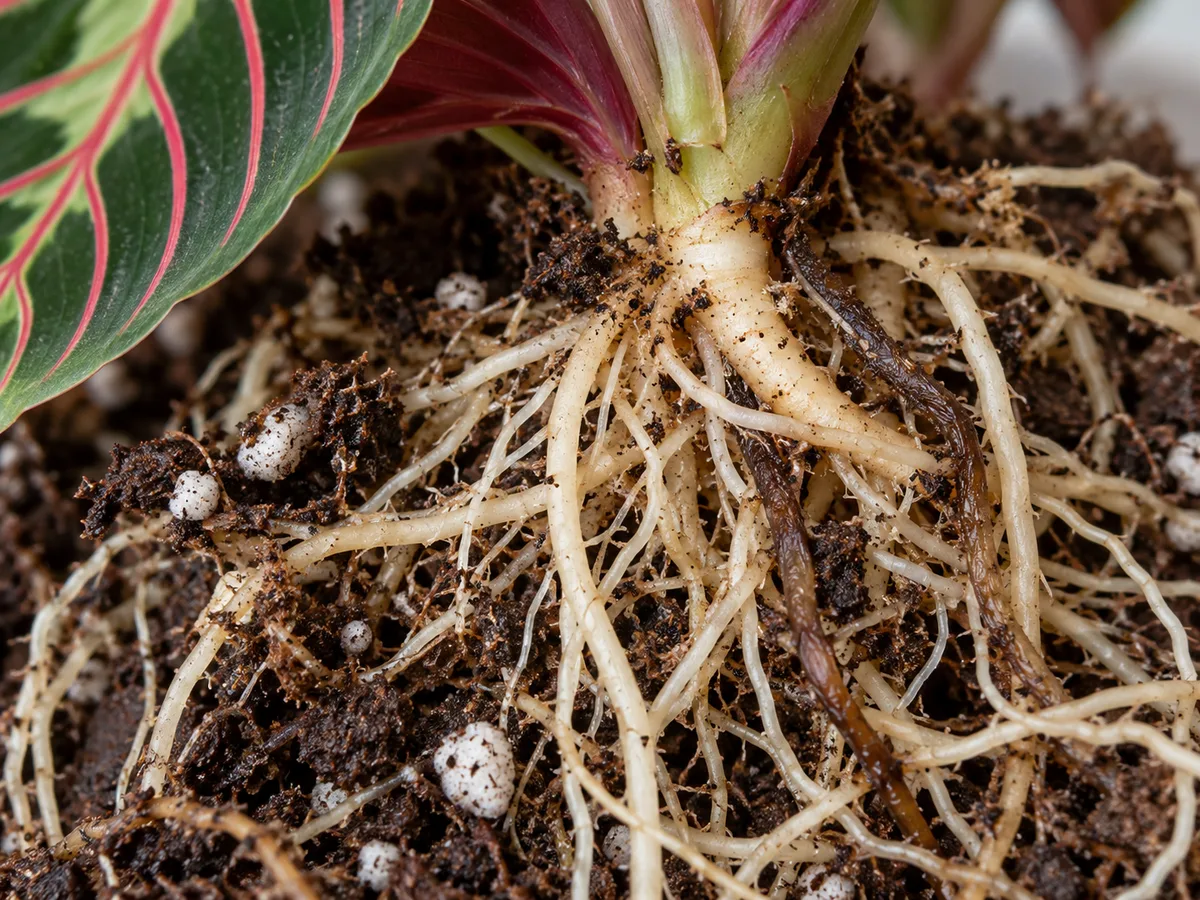
- Unpot and look. Slide the root ball out intact. Healthy roots are firm and pale; rotted roots turn dark brown or black, feel mushy or slimy, and may shed their outer sheath. A sour or swampy smell confirms anaerobic decay.
- Rhizome press. Maranta spreads by fleshy underground rhizomes. Press them gently — firm rhizomes are your rescue material even when fine roots are lost, while soft, discolored rhizomes mean the rot has reached the plant’s reserves.
- Rule out the crown. If roots are firm and pale but lower stems are soft, compare with wilting on Maranta Red Prayer Plant and drooping leaves on Maranta Red Prayer Plant before committing to the full rot protocol.
Do not fertilize, mist heavily, or repot on suspicion alone — confirm with the unpot inspection first, since every one of those actions stresses a plant that may only need a watering correction. See overwatering on Maranta Red Prayer Plant if roots prove healthy but the mix is waterlogged.
First fix: unpot and inspect the roots
Slide the plant out of its pot and expose the root ball. This single action separates a watering mistake (firm pale roots — just let it dry and adjust) from true rot (mushy dark roots needing surgery), and it prevents the worst possible error: watering a rotted plant. Everything after this step depends on what you see, so do nothing else until the roots have told you which problem you own.
Step-by-step rescue for rotted Maranta roots
Once inspection confirms mushy, dark, foul-smelling roots, proceed in order:
Trim with sterile tools. Cut away all mushy, dark roots with sterilized shears, being aggressive since leftover rot recolonizes healthy tissue. Wipe blades with rubbing alcohol between cuts. Remove any soft, discolored rhizome sections back to firm pale tissue, and prune yellowing lower leaves that the reduced root system cannot support.
Rinse and dry. Rinse remaining roots under lukewarm running water to wash off contaminated mix, then let the root system air-dry for several hours. This pause matters for Maranta because its thin roots bruise easily — potting sopping-wet trimmed roots straight into mix invites reinfection.
Divide if the clump allows. Maranta propagates naturally by rhizomatous division, which turns a rescue into an opportunity: if one section of rhizome is firm with healthy roots while another is rotted, separate them with a sterile knife and pot only the sound division. Discard every rotted portion rather than composting it near houseplants.
Repot into fresh airy mix. Throw away all old mix, scrub the pot with diluted bleach or use a clean pot with drainage holes, and replant in the coarse, free-draining blend from the Maranta Red Prayer Plant soil guide — the 60/20/20 compost, perlite, and coco coir structure keeps oxygen around recovering roots. Set the rhizomes at their original depth, water lightly once to settle the mix, and empty any cachepot completely.
Recover in bright indirect light. Place the plant where the Maranta Red Prayer Plant light guide recommends — medium indirect light — so it photosynthesizes without baking stressed foliage. Hold fertilizer until new rolled leaves appear; feeding a rootless plant burns what little uptake capacity remains, as the Maranta Red Prayer Plant fertilizer guide explains.
Recovery timeline
Week one is about stabilization, not growth: leaves may stay limp for several days after surgery even when the rescue worked. By weeks two to three, the key signal is behavioral — surviving leaves resume their evening rise, which is the earliest proof that water is moving again. Expect the first clean rolled leaf within four to eight weeks in warm, bright conditions; old yellowed leaves will not green up, so judge only new growth.
Escalate if no leaf resumes night movement after three weeks, if stems keep softening upward, or if the sour smell returns — that means rot survived the trim. A second unpot, a harder trim back to fully firm rhizome, and isolation from other humidity-tray plants are warranted. If no firm rhizome remains at all, the plant is spent; healthy divisions or stem cuttings taken earlier, per the Maranta Red Prayer Plant propagation guide, become the replacement plan.
Lookalike symptoms: rot vs thirst vs air vs fluoride
| What you see | Likely cause | Key check |
|---|---|---|
| Limp leaves in damp, heavy, sour-smelling mix; no night lift | Root rot | Unpot: mushy dark roots — follow this guide |
| Limp leaves in dry, light pot; leaves still attempt evening rise | Underwatering | Mix pulls from pot edges; perks within hours of watering |
| Crispy brown leaf tips, otherwise firm plant, prayer rhythm intact | Dry air or fluoride, not rot | Low humidity damage and brown tips; leaves burn with high fluorides |
| Overall yellowing in wet mix but roots firm and pale | Overwatering without rot yet | No mush, no sour smell — dry down, do not operate |
| Yellow lower leaves plus tiny webs or sticky residue | Pests, not rot | Inspect undersides; compare spider mites and mealybugs |
| White or green fuzz on the soil surface | Mold on soil with possible fungus gnats | Surface issue from chronic wetness; check roots while treating |
Underwatering deserves special care because it mimics rot above the soil — both wilt. The pot-weight test never lies: light pot means thirsty, heavy wet pot with wilt means roots. When in doubt, the Maranta Red Prayer Plant problems hub routes each symptom to its own diagnostic path.
Mistakes to avoid
Do not water a limp plant “just in case” before checking the roots — on wet mix this accelerates decay within days. Do not drench recovering roots with hydrogen peroxide soaks, fungicide drenches, or fertilizer cocktails in the same week as surgery; one stressor at a time lets you read whether the trim worked. Do not reuse the old mix or an unwashed pot, since pathogens persist in contaminated soil and reinfect fresh roots. Do not bury rhizomes deeper “for stability” — depth suffocates the exact tissue you are trying to save. And do not place the patient in a sealed terrarium or on a constantly full pebble tray; recovering Maranta needs humid air, not a wet basement.
How to prevent it next time
Prevention is a watering rhythm matched to this plant’s actual drinking speed. Water when the top 2 cm dries rather than on a calendar day, and confirm with pot weight — the routine in the Maranta Red Prayer Plant watering guide exists precisely because this species punishes both extremes. Keep the airy soil structure from the soil guide intact by repotting every one to two years as peat compacts; compacted mix is the slowest, commonest route back to rot. Give enough medium indirect light that the plant transpires steadily, empty cachepots within minutes of watering, and keep winter temperatures above 60°F so cold does not stall uptake while the mix stays wet.
Watch the nightly leaf lift as your dashboard: leaves rising crisply each evening means roots are breathing. If movement weakens two waterings in a row, check the root zone before the leaves yellow — that early catch is the difference between a dry-down week and root surgery. A monthly glance under the pot for circling roots, plus yellow sticky traps that reveal fungus gnats breeding in chronic wetness, closes the loop. New leaves arriving with brown edges instead of rot signs point to not enough light or humidity rather than the root zone.
When to use this page vs other Maranta Red Prayer Plant guides
- Maranta Red Prayer Plant watering guide — Use for routine moisture checks before assuming rot is the main issue.
- Maranta Red Prayer Plant problems hub — Browse all 16 common issues on this species.
- Overwatering on Maranta Red Prayer Plant — Use when the mix is waterlogged but roots are still firm and pale.
- Yellow Leaves on Maranta Red Prayer Plant — Use when yellowing dominates and you need to separate nutrient, light, and root causes.
- Wilting on Maranta Red Prayer Plant — Use when limp leaves are the entry symptom and the cause is still unconfirmed.
Related Maranta Red Prayer Plant guides
- Maranta Red Prayer Plant overview
- Maranta Red Prayer Plant watering
- Maranta Red Prayer Plant light
- Maranta Red Prayer Plant soil
- Overwatering on Maranta Red Prayer Plant
- Underwatering on Maranta Red Prayer Plant
- Yellow Leaves on Maranta Red Prayer Plant
- Wilting on Maranta Red Prayer Plant
- Drooping Leaves on Maranta Red Prayer Plant
- Mold on Soil on Maranta Red Prayer Plant
- Maranta Red Prayer Plant problems