Mealybugs on Maranta Red Prayer Plant: Causes, Checks &
Quick answer
Mealybugs on Maranta Red Prayer Plant hide as white cottony wax in leaf axils, along the midrib under patterned leaves, and inside rolled new leaves. First step: isolate the plant and dab every visible cluster with a cotton swab dipped in 70% rubbing alcohol before any spray.
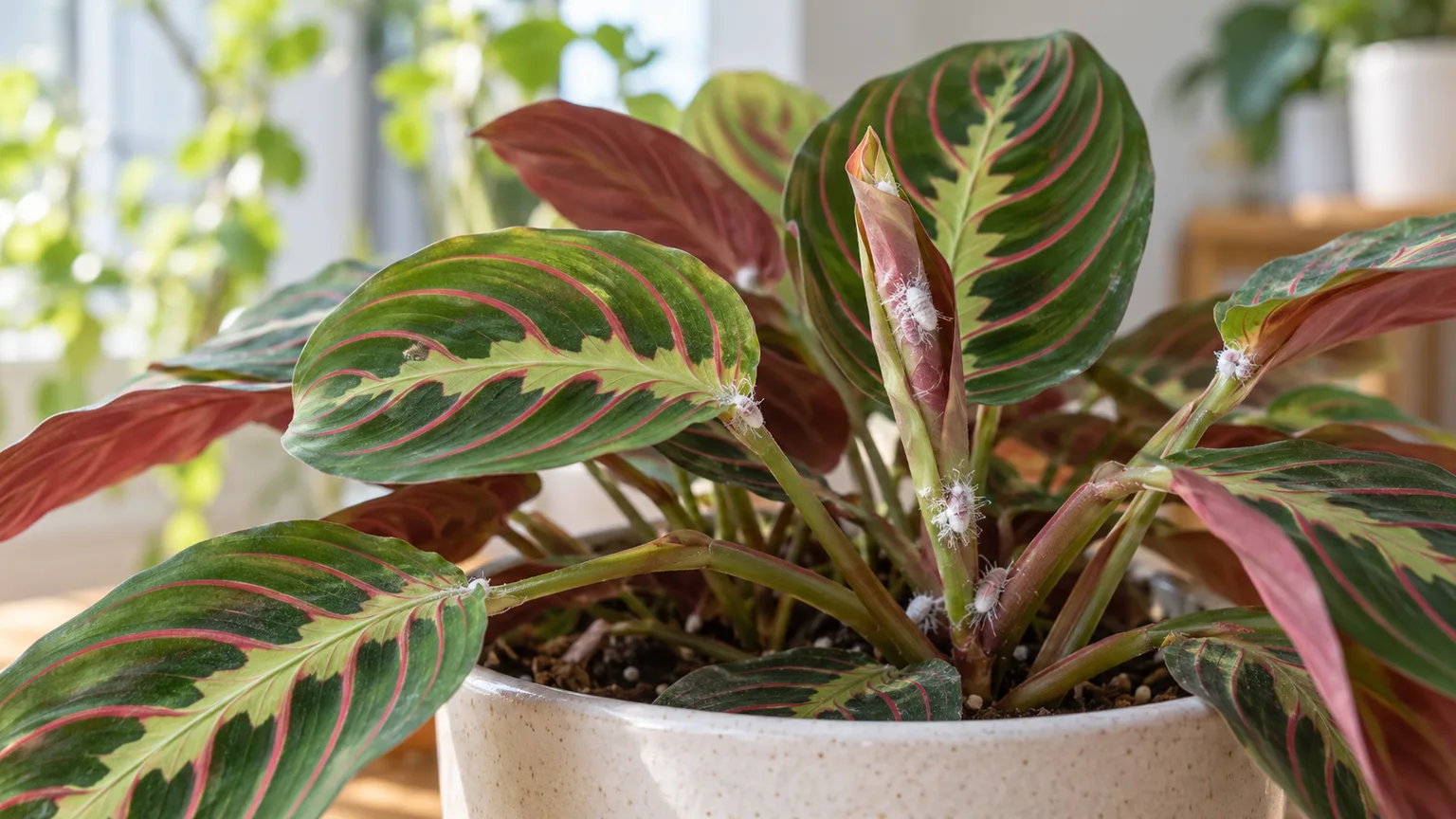
Mealybugs on Maranta Red Prayer Plant: Causes, Checks & Fixes
This guide covers mealybugs on Maranta Red Prayer Plant. See also the general Mealybugs guide, watering, and light pages for this plant.
Mealybugs on Maranta Red Prayer Plant: Causes, Checks & Fixes
Quick answer
Mealybugs on Maranta Red Prayer Plant (Maranta leuconeura var. erythroneura) appear as white, cottony wax clusters tucked into leaf axils where petioles meet stems, along the midrib on leaf undersides, and inside newly unfurling rolled leaves. They suck sap, stunt the next flush of patterned growth, and leave sticky honeydew that dulls the herringbone red veins and can grow black sooty mould on leaves below.
First step: isolate the plant and dab every visible mealybug with a cotton swab dipped in 70% rubbing alcohol. Isolation stops crawlers reaching neighboring pots, and direct contact kills the adults you can reach. Only after manual removal should you plan repeat sprays for hidden eggs and crawlers.
What mealybugs look like on Maranta Red Prayer Plant
A healthy red prayer plant holds thin, oval leaves with a pale central stripe and red herringbone veins on a low, spreading canopy. Mealybugs break that picture with soft white tufts exactly where the plant folds and overlaps itself. Mealybugs cluster in inaccessible parts of plants such as leaf axils and leaf sheaths, and maranta offers those shelters at every node.
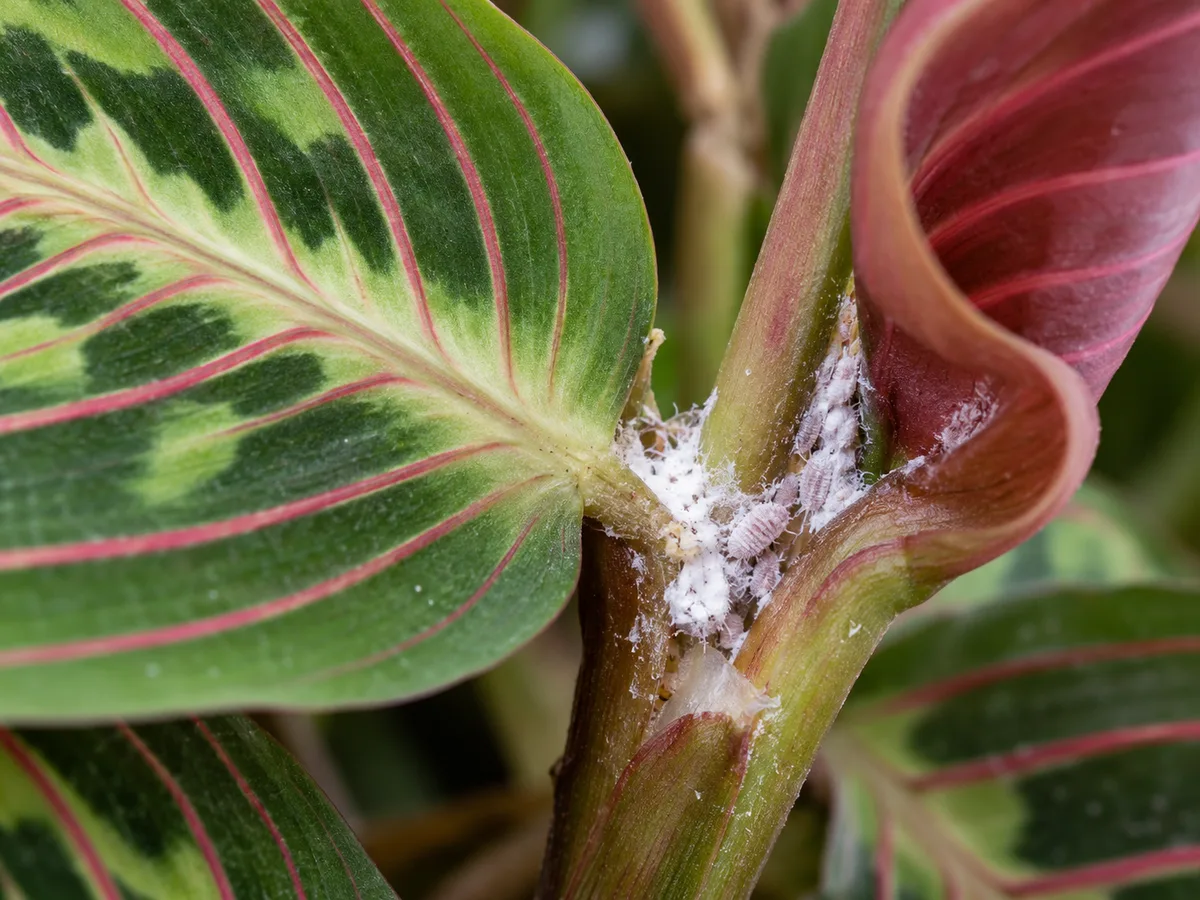
White cottony mealybug wax packed into a maranta leaf axil — compare with clean joints on the same plant.
Typical signs on this plant:
- White cottony masses where petioles join stems, especially deep in the canopy
- Wax lines along the midrib and veins on leaf undersides
- Sticky, tacky film on upper leaf surfaces from honeydew drips
- Blackish sooty coating on honeydew-covered leaves
- New rolled leaves that unroll stunted, sticky, or misshapen
- Premature leaf drop and a general loss of vigor under heavy feeding
- Ant trails on the pot rim or shelf farming the honeydew
Mealybugs are small, white, oval-shaped sap-sucking insects that cluster on leaf veins, leaf undersides, and stem joints. Part a tuft gently: live mealybugs show soft pinkish-gray segmented bodies under the wax. For the general mechanics of how these sap feeders damage houseplants, see our mealybugs guide — on maranta, the pattern usually shows up first in the lowest, most crowded axils rather than out on open leaf faces.
Why Maranta Red Prayer Plant gets mealybugs
Maranta is not uniquely attractive to mealybugs, but its structure and care needs create ideal cover. The dense low canopy stays humid, leaves overlap, and new growth emerges as tight rolled tubes — each one a protected nursery where a female can lay hundreds of eggs in a cottony mass undisturbed.
Introduction beats spontaneity. Adult females barely travel, so outbreaks almost always arrive on a new plant that skipped quarantine, on pots touching an infested neighbor, or on crawlers bridging across overlapping leaves. Inspect new plants carefully and keep them isolated for at least a month before joining the collection.
Soft growth invites feeding. Maranta kept in weak light with heavy water and excess nitrogen pushes pale, tender tissue that sap feeders prefer. Plants under the low light end of their range grow slowly and recover slowly, giving a small colony time to build.
Constant moisture hides early signs. This species wants soil consistently moist at 2 cm depth in a moisture-retentive but draining mix, so owners mist, hover, and fuss over the canopy daily — yet rarely lift leaves to check axils. Honeydew washes off thin leaves with misting while the colony underneath keeps feeding.
Warm rooms year-round. Heated homes let breeding continue through winter at a slower rate instead of stopping, so a missed autumn colony becomes a spring explosion.
How to confirm the cause
Work through these checks before buying any spray:
- Axil inspection — Lift the spreading stems and look into every joint where a petiole meets the main stem, starting low. Mealybugs pack the most sheltered axils first.
- Underside midrib check — Turn leaves over and run a finger along the midrib. White wax following the vein plus sticky residue confirms sap feeders, not dust.
- Rolled-leaf check — Examine each new rolled leaf without forcing it open. Sticky tips, wax at the roll opening, or a roll that stalls half-open points to crawlers feeding inside.
- Texture test — Part the white mass. Mealybugs feel soft with bodies underneath; scale forms hard domes fused to stems; dust wipes away dry.
- Honeydew test — Rub an upper leaf surface. Tacky film with optional black sooty coating means something above is excreting honeydew that supports sooty moulds.
- Crown and soil line — Pull stems aside at the pot surface and check the crown with a phone light. White fluffy patches on the rootball itself suggest root mealybugs, which appear as white fluffy patches worth checking when a plant wilts despite regular watering.
- Neighbor sweep — Inspect every plant within leaf-touch distance. Mealybugs rarely stay on one pot once crawlers are mobile.
If you find cottony colonies with sticky honeydew and soft bodies under the wax, mealybugs are confirmed. Skip to the first fix rather than re-checking yellow leaves or low humidity pages — those explain leaf edges, not wax plus stickiness.
First fix for Maranta Red Prayer Plant
Isolate the plant, then dab every visible mealybug with a cotton swab dipped in 70% isopropyl alcohol.
Move the pot to a separate spot with similar medium indirect light so treatment does not add light stress. Soak a cotton ball in rubbing alcohol of no more than 70% and wipe the mealybugs off, testing one leaf first — maranta leaves are thin and chemically sensitive, so check the test leaf the next day for burn before treating the whole canopy.
Work from the crown upward, opening each leaf axil and dabbing wax, insects, and egg masses directly. Expect twenty minutes for the first pass on a full plant. Do not force open rolled new leaves; dab what is reachable at the opening and catch the rest on the repeat pass after the leaf unfurls.
Do not repot on day one unless you confirmed root mealybugs. Do not fertilize a pest-hit maranta hoping to outgrow the damage — soft forced growth feeds the next generation.
Step-by-step recovery
After the alcohol dab pass:
- Repeat manual removal every three to five days until two consecutive inspections find no live clusters. Eggs hatch on a staggered schedule, so one pass never finishes the job.
- Spray with insecticidal soap covering leaf axils, undersides, and stem joints thoroughly. Spray all plant parts including leaf undersides and repeat biweekly or weekly until the infestation is gone. Soap works on contact only, so drench crevices rather than misting leaf tops.
- Add neem oil on the alternate week if colonies persist. Mix per label and spray in the evening; neem affects feeding and growth and acts as a repellent. Test on one patterned leaf first — oil films can mark thin maranta foliage.
- Rinse honeydew gently once live insects are gone. A lukewarm shower dislodges residue, but shake excess water from axils afterward and let the canopy air-dry in airflow; maranta crowns sitting wet invite root rot.
- Control ants on the pot rim and shelf. Honeydew attracts ants, which can protect colonies, so sticky barriers or bait stations near the pot help treatment stick.
- Hold the plant in quarantine for six weeks. Most failures come from stopping treatment when the plant looks clean while hidden eggs still wait in rolls and axils.
- Repot only for root mealybugs — white wax through the rootball or foliar bugs gone but colonies returning within days. Shake off old mix, rinse roots, and repot into fresh moisture-retentive but draining mix per the repotting guide.
Prune only leaves that are more than half coated in sooty mold or fully yellowed; follow the pruning guide for clean cuts. Keep watering steady at the 2 cm check — do not swing between drought and flood while the plant is stressed.
Recovery timeline
Visible colonies shrink within days of thorough dabbing, but full clearance takes three to four weeks of repeated soap or neem applications through at least two hatch cycles. New rolled leaves emerging clean and opening flat is your recovery signal.
Old leaves with heavy sooty coating rarely regain their herringbone brightness — judge progress by fresh growth, not by damaged leaves turning perfect again. If colonies rebound after three full treatment rounds, or the crown stays matted with stalled growth, the infestation has outrun manual control and replacing the plant protects the rest of the collection.
Lookalike symptoms to rule out
Scale insects form hard brown or tan domes glued to petioles and stems. They do not look cottony and do not wipe off with a swab.
Spider mites cause fine stippling and pale speckling with delicate webbing, not cottony wax. Mites explode in hot dry air; mealybugs tolerate the humid conditions maranta prefers.
Aphids cluster soft-bodied on new growth and also drip honeydew, but they lack the white waxy cotton coating and move visibly when disturbed.
Brown tips from fluoride-heavy tap water or dry air crisp the red vein margins without any wax, stickiness, or insects. If edges brown but axils are clean and leaves are not tacky, check water quality before treating pests.
Normal night folding (nyctinasty) raises leaves each evening and lowers them by day. Folded leaves that still open flat daily with clean axils are healthy behavior, not pest wilt — confirm with the stickiness test before acting.
Mistakes to avoid
- Returning the plant to the shelf after one treatment. Hidden eggs in rolled leaves hatch days later and restart the colony.
- Blasting the canopy with a hard hose jet. Maranta leaves bruise and tear; thin foliage plus a soaked crown trades pests for rot. Dab and spray instead.
- Pooling alcohol or oil in axils. Test one leaf first and let the crown air-dry; pooled liquids burn thin tissue.
- Fertilizing during treatment. Extra nitrogen pushes the tender growth mealybugs prefer. Hold feed until new leaves open clean for two weeks, then resume the light fertilizer rhythm.
- Unpotting and dividing a stressed plant. Maranta spreads by shallow rhizomes and division, but splitting a pest-hit crown on day one multiplies wounds. Stabilize first; propagate later per the propagation guide.
- Ignoring nearby plants. Check every pot within crawler distance, or the cleaned plant gets reinfested within weeks.
Maranta Red Prayer Plant care cross-check
While treating pests, keep baseline care stable so the plant has energy to recover:
- Light — Medium indirect light supports steady new growth; deep shade stalls recovery and extends the treatment window.
- Water — Keep soil consistently moist at 2 cm with filtered or overnight-stood water. Leaves burn with high fluorides in tap water, which complicates reading pest damage.
- Soil — A moisture-retentive yet well-draining mix keeps shallow roots oxygenated. Soggy mix plus sap loss collapses the plant fast — review overwatering if the pot stays heavy.
- Humidity and temperature — High humidity suits maranta, but misting does not kill mealybugs; use a humidifier or pebble tray instead of wetting the canopy. Keep temperatures above 60°F (16°C) — cold stress slows recovery.
- Fertilizer — Hold feed until clean new growth holds for two weeks.
Fixing only the bugs while the plant sits in a dark corner with fluoride water and soggy mix usually brings the infestation back.
How to prevent mealybugs next time
Quarantine every newcomer for at least a month and inspect leaf axils at purchase — dealers routinely miss colonies tucked deep in prayer plant canopies.
Build axil checks into the watering routine: each time you test moisture at 2 cm, lift two or three stems and glance into the joints with a phone light. Space pots so trailing stems never touch; crawlers bridge gaps between overlapping leaves.
Avoid excess nitrogen and overpotting, both of which push soft growth pests colonize first. Wipe shelves and saucers after an outbreak, and run the periodic check in the overview guide so small colonies get caught before honeydew appears.
When to worry
Treat as urgent when cottony colonies fill multiple axils, honeydew drips daily, ants swarm the pot, or new rolled leaves emerge stunted and sticky while older leaves yellow and drop. Heavy sap loss on thin-leaved maranta spirals faster than on thick succulent species.
A few isolated tufts in one axil, caught early, are very manageable with dabbing plus two soap rounds. But a fully matted crown with stalled growth over several weeks, especially combined with sour soil or mushy stems, means rescue odds are poor — discarding protects neighboring plants, and mealybugs spread to fungus gnat-stressed or wilting companions quickly.
FAQs
How can I confirm mealybugs on Maranta Red Prayer Plant?
Part the white wax with a fingernail: live mealybugs show soft pinkish-gray segmented bodies, while dust wipes away dry and scale stays hard. Colonies with sticky honeydew in leaf axils and along under-leaf veins confirm the diagnosis — dry spots without stickiness point elsewhere.
Where do mealybugs hide on a red prayer plant?
Check every leaf axil where petioles meet stems, the undersides of leaves along the midrib, the crown at the soil line, and inside newly unfurling rolled leaves. Lift the low spreading canopy and inspect from below with a phone light — top-down glances miss the lowest, most crowded joints.
Will damaged Maranta Red Prayer Plant leaves recover after mealybugs?
Heavily drained or sooty-coated leaves rarely regain full herringbone color, so judge recovery by new rolled leaves that open clean and flat. Steady warmth, medium indirect light, and even moisture usually show improvement within three to six weeks after feeding stops.
When are mealybugs urgent on Maranta Red Prayer Plant?
Act the same day when colonies coat multiple axils, honeydew drips, ants farm the pot, or new leaves emerge stunted and sticky. A fully matted crown with weeks of stalled growth means rescue odds are poor — replacing the plant is safer for the collection than endless retreatments.
How do I prevent mealybugs on Maranta Red Prayer Plant?
Quarantine newcomers for at least a month, check axils and rolled leaves at every watering, and space pots so stems never touch. Stable medium indirect light, filtered water, and even soil moisture keep growth firm — soft stressed tissue is what mealybugs colonize first.
Related Maranta Red Prayer Plant guides
- Maranta Red Prayer Plant overview — care basics, humidity, and water quality
- Watering — consistent moisture at 2 cm without soggy crowns
- Light — medium indirect light for steady recovery growth
- Soil — moisture-retentive yet draining mix for shallow roots
- Spider Mites on Maranta Red Prayer Plant — stippling and webbing vs cottony wax
- Aphids on Maranta Red Prayer Plant — soft colonies on new growth without wax
- Yellow Leaves on Maranta Red Prayer Plant — sap-loss yellowing vs care yellowing
- Brown Tips on Maranta Red Prayer Plant — fluoride and dry-air edges vs pest damage
- Root Rot on Maranta Red Prayer Plant — when wet crowns turn to decay
- All Maranta Red Prayer Plant problems
Related tool
Use the Pest Identifier Tool to narrow causes for mealybugs on this plant before changing multiple variables at once.