Slow Growth on Maranta Red Prayer Plant: Causes, Checks &
Quick answer
Slow growth on Maranta Red Prayer Plant usually means low light, cool or dry air, an old or crowded mix, or a winter rest — not a need for more fertilizer. First, move it to bright indirect light with warmth above 60°F and confirm new rolled tubes are still emerging before feeding or repotting.
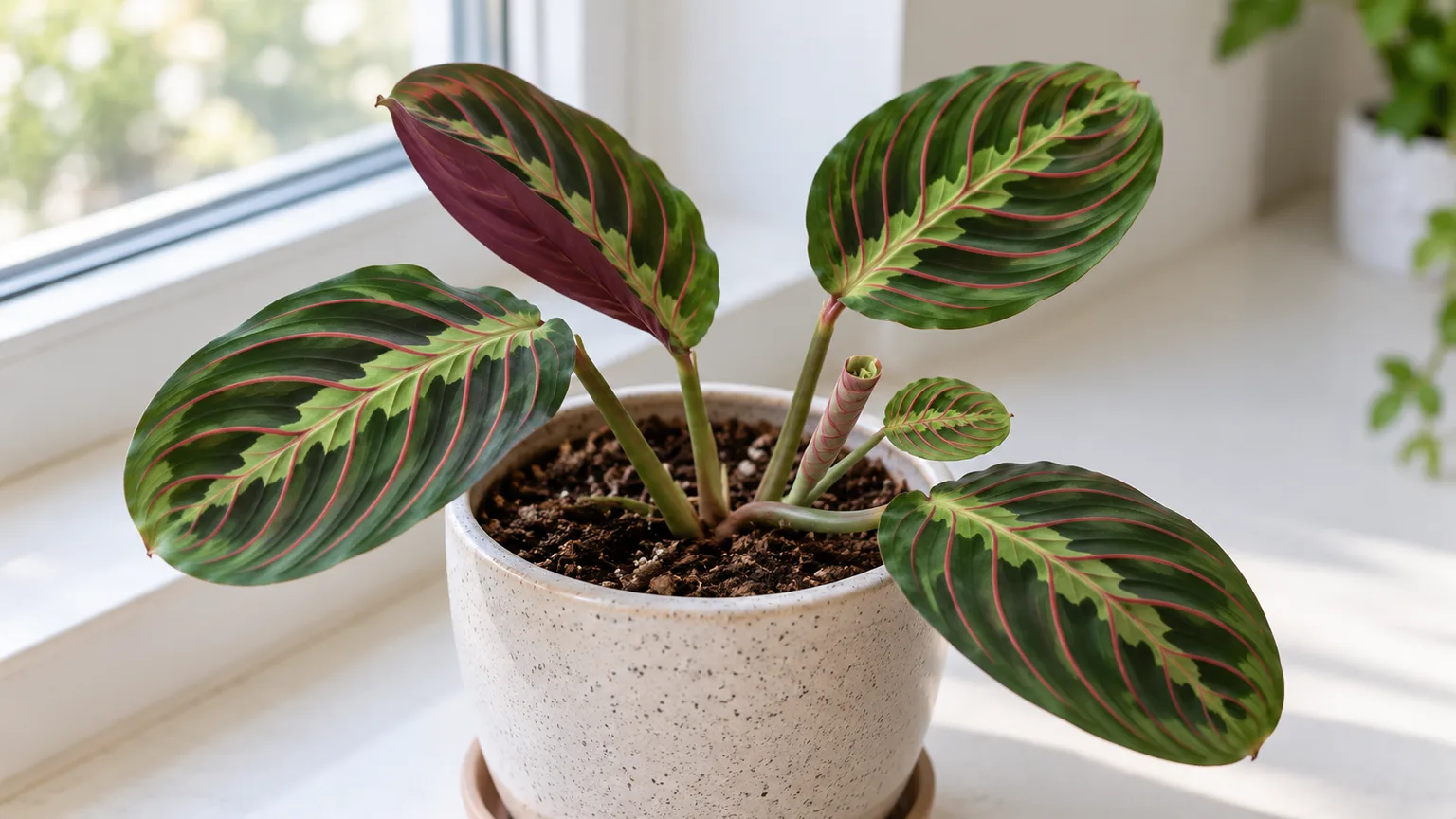
Slow Growth on Maranta Red Prayer Plant: Causes, Checks & Fixes
This guide covers slow growth on Maranta Red Prayer Plant. See also the general Slow Growth guide, watering, and light pages for this plant.
Slow Growth on Maranta Red Prayer Plant: Causes, Checks & Fixes
Quick answer
Your Maranta Red Prayer Plant (Maranta leuconeura var. erythroneura) is a naturally slow-growing evergreen perennial from Brazil, so a quiet month is not always a problem. Worry when spring and summer pass with almost no new rolled tubes, shrinking new leaves, or fading red veins despite steady care.
First step: move the pot to bright indirect light for 6 to 8 hours a day, keep the room above 60°F, and watch for one new rolled tube before feeding or repotting. Maranta stalls fastest when light is dim, air is cool and dry, or the clump has filled its pot. For how pot limits and low light stall houseplants in general, see our slow growth guide. On Maranta Red Prayer Plant, the pattern usually shows up as fewer night-lifting young leaves, not as a tall stretched stem.
When to use this page vs other Maranta Red Prayer Plant guides
Use this page when the plant looks alive but static: firm leaves, no spreading rot, just very few or very small new leaves over weeks. Go deeper elsewhere when a sharper symptom dominates:
- Pale, stretched stems with wide gaps between leaves point to not enough light or leggy growth.
- Yellowing lower leaves with a heavy, sour pot point to overwatering or root rot.
- Crisp red-vein margins in dry air point to low humidity or brown tips.
- Sticky residue, webbing, or deformed tubes point to spider mites, mealybugs, or aphids.
- Soil flies or fuzz with a wet surface point to fungus gnats or mold on soil.
What slow growth looks like on Maranta Red Prayer Plant
A healthy Maranta pushes slim rolled tubes from the center of the clump. Each tube unrolls into a broad oval leaf with a red herringbone midrib, then begins the nightly routine of lifting upright and lowering flat again. When growth stalls, that pipeline dries up.
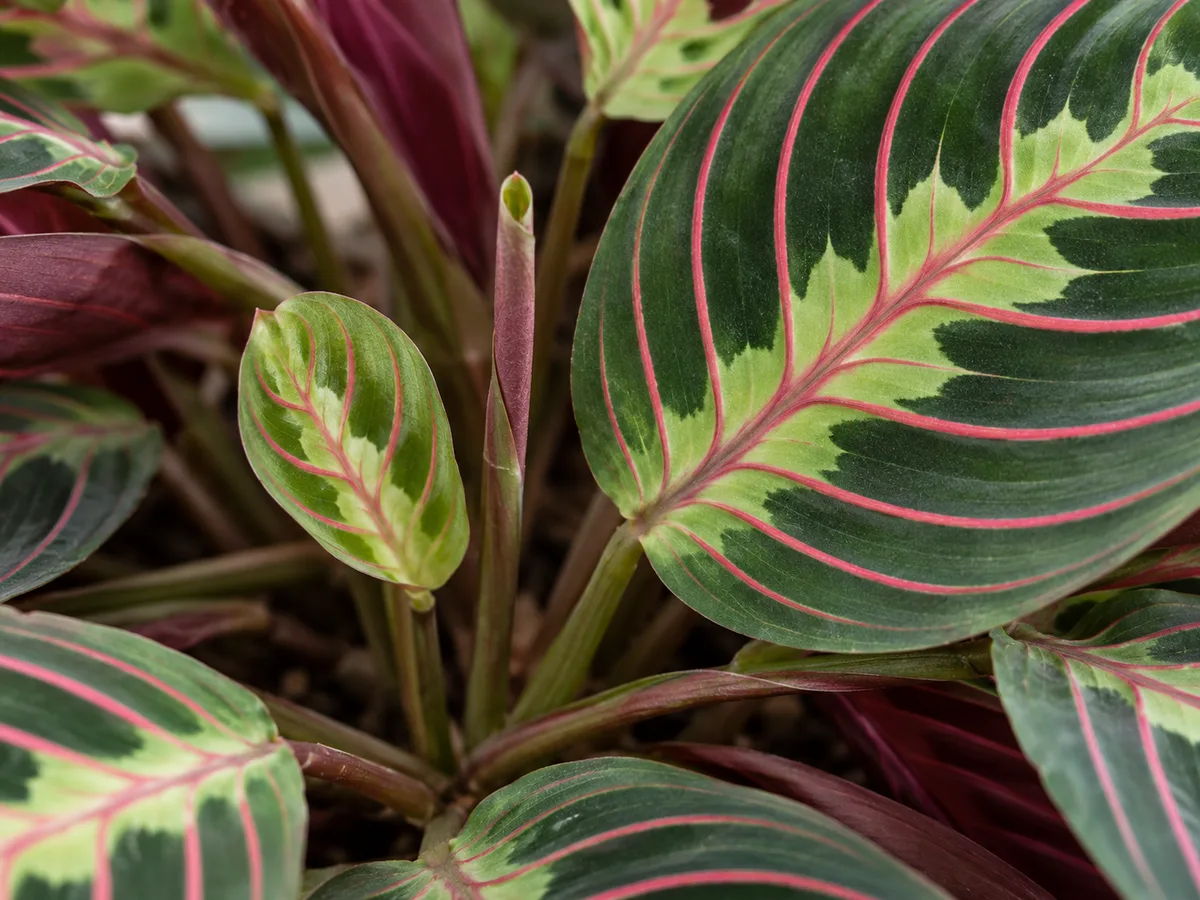
Close-up: few or undersized rolled tubes and faded red veining signal stalled Maranta growth rather than normal leaf aging.
Expect one or more of these:
- No new rolled tubes for 6 to 8 weeks in spring or summer.
- New tubes emerge but stay small, pale, or slow to unroll.
- Red midrib and veins look washed out; leaf undersides lose purple tone.
- Older leaves stay firm while the center of the clump looks empty.
- No soft rhizomes or sour smell, which separates simple stalling from rot.
Winter-only stalling with firm leaves is often a normal rest. The Missouri Botanical Garden notes Maranta should get substantially less water and fertilizer from autumn to late winter, which naturally slows new leaves during short days.
Nyctinasty and rolled tubes: your Maranta growth gauge
Maranta-only signal number one is nightly leaf movement. Vigorous plants lift their leaves steeply after dark and lower them by morning. When energy runs short from dim light or chronic dryness, the lift weakens, new tubes stay furled for two weeks or more, and freshly opened leaves sit small and cupped instead of lying broad and flat.
Do not judge progress by old leaves. A stalled leaf that opened small will not stretch to full size later. Track the next two tubes: date when each spear appears, how many days it takes to unroll, and whether the blade is larger and better veined than the last one. That is the honest growth meter on a prayer plant, and it works on no succulent or climbing aroid.
Why Maranta Red Prayer Plant stalls
Maranta comes from humid Brazilian forest floors, where it spreads horizontally in dappled shade with steady moisture and warmth. NC State Extension describes it as an evergreen tropical that wants bright indirect light plus high humidity, and notes it is intolerant of direct sun, low humidity, and cold drafts. Every common stall traces back to one of those forest conditions going missing indoors.
Low light is the most common brake. Maranta tolerates low to medium light without dying, but it banks little energy there. Epic Gardening notes these slow growers do better with 6 to 8 hours of bright indirect light and enough light to support significant growth. A north-facing corner three meters from the window, or a bright room where blinds stay half closed all winter, is enough to keep leaves alive while new tubes stop.
Cool rooms pause the engine. Growth is tuned for normal household warmth. The Missouri Botanical Garden advises temperatures that do not dip below 60°F, and Epic Gardening places the tolerance range at roughly 60 to 85°F. A Maranta parked by a drafty door or a single-glazed window can sit at 55 to 60°F overnight and simply idle, even when daytime care looks right. See wilting if cold exposure also brings limp leaves.
Dry air and uneven moisture tax each new leaf. New tubes unroll by cell turgor, so repeated dry-downs plus humidity under 40 percent produce small, slow, or crisp-edged leaves. This is different from drought-tolerant plants that merely pause; Maranta spends energy defending thin leaves instead of making new ones. Compare with low humidity and underwatering when edges crisp alongside the stall.
Old, compacted, or crowded mix chokes uptake. Maranta feeds through fine roots and shallow rhizomes that branch just under the surface. After 1 to 2 years the peat breaks down, holds water unevenly, and leaves little room for new roots. Gardening Know How notes prayer plants like to be somewhat root bound and need repotting only every 1 to 2 years, with early spring the moment to divide a crowded clump. A pot that dries in one day or stays soggy for ten days despite the same watering points to mix failure rather than laziness in the plant.
Salt buildup and overfeeding stall more than they stimulate. NC State Extension warns that leaves burn with high fluorides and with over-fertilization. Heavy or frequent feeding in dim light deposits salts the shallow roots cannot use, and Gardening Know How notes tip burn from fluoride shows as brown leaf tips and margins that eventually die. The result looks like stalling plus tip burn, not a hungry plant begging for more food.
Rhizome crowding and division timing on a clump-former
Maranta-only section number two is the underground picture. Unlike a vine with nodes you can cut anywhere, Maranta grows as a clump of stems joined by branching rhizomes. New tubes can only emerge where a rhizome eye has room, moisture, and oxygen.
Slide the nursery pot off once, in spring, if you suspect crowding. Healthy rhizomes are firm, pale, and knobby with white fine roots. If they circle the pot wall, mat into a solid disk, or push through drainage holes, the clump is pot-bound and each new eye competes for the same exhausted mix. Repot one size up, or divide a large clump so each piece keeps several stems plus its own rhizome and roots, then replant at the same depth. The Royal Horticultural Society recommends propagation by division in spring using standard perennial division technique, which matches Maranta’s spring recovery window.
Do not divide in late autumn or midwinter unless the mix is failing. A freshly divided Maranta in short days sits with wounded rhizomes and no light budget to regrow, which converts a mild stall into months of sulking. If the plant is only slightly snug in October, wait until lengthening days return, then divide and refresh the mix together. Full steps live in the repotting guide and the propagation guide.
Fluoride, fertilizer salts, and humidity: why Maranta stalls instead of stretching
Maranta-only section number three is water chemistry plus air moisture. Many houseplants respond to dim light by stretching; Maranta more often just stops and burns at the margins.
Fluoride and dissolved salts accumulate fastest in a small pot that is watered lightly but never flushed. NC State Extension flags fluoride burn on this species, and the practical trigger is months of hard tap water plus monthly feeding with no thorough leaching. Switch to filtered, distilled, or overnight-stood water if your tap is fluoridated, and leach the pot every month or two by watering deeply until a fifth of the volume drains, then emptying the saucer. The watering guide covers the consistently moist but never soggy rhythm, and the soil guide covers the airy peat-perlite-coir balance that lets salts wash out instead of pooling.
Humidity is the other half. Aim for roughly 50 to 60 percent, the band Epic Gardening cites for prayer plants, using a humidifier or a pebble tray rather than constant leaf misting in still air. Grouping plants helps, but leave airflow around the clump so damp tubes do not sit wet overnight. When new tubes unroll cleanly after humidity rises, you have confirmed dry air was part of the brake.
How to confirm the cause
Work through this order on a bright morning, when leaf position and soil moisture read most honestly.
- Season and light. Is it October to February with short days? Is the pot more than 2 meters from an east or north window, or behind heavy sheers? If yes, low seasonal energy is at least part of the story. Compare with not enough light.
- Temperature and drafts. Has the room dropped near or below 60°F at night, or does cold air hit the leaves when a door opens? Slow tubes plus limp daytime leaves after a cold snap point to temperature, not hunger.
- Moisture rhythm. Push a finger 2 cm into the mix and lift the pot. Bone dry and feather-light every few days means chronic underwatering; heavy and cool a week after watering means the mix is spent or drainage has failed. Cross-check the watering guide before changing the schedule.
- Pot and mix age. When did you last refresh the mix? Roots circling the wall or matting under the drainage holes confirm crowding. White crust on the surface or brown margins after feeding suggest salt buildup.
- Pests on new growth. Unroll your phone flashlight on tube bases and leaf undersides. Fine webbing, cottony clusters in axils, or sticky film point to mites, mealybugs, or aphids draining the exact tissue that would become new leaves. Rule out spider mites and drooping leaves before blaming nutrition.
- Feeding history. Did you feed through winter, double-dose to force growth, or use hard tap water every time? Tip burn plus stalling after heavy feeding implicates salts and fluoride rather than deficiency.
If several checks point the same way, treat that bottleneck first. Maranta recovers faster from one clean correction than from light, water, repot, and feed changes stacked on the same weekend.
The first fix to try
Move the plant to bright indirect light with stable warmth and humidity, and change nothing else for two weeks. An east-facing window with sheer, or a spot 1 meter from a bright north window, delivering roughly 6 to 8 hours of gentle light, matches the bright indirect light but no strong direct sun standard Missouri Botanical Garden sets for this variety.
Keep the mix evenly moist at 2 cm depth, empty the saucer, and hold humidity near 50 percent. Do not fertilize, divide, or repot during this window unless the pot has no drainage or rhizomes are visibly rotting. You are testing whether energy, not nutrients or pot size, was the limit. One new tube starting within 2 to 4 weeks in growing season confirms the diagnosis.
Step-by-step recovery
Follow this sequence only after the light trial, and stop as soon as new tubes resume.
- Stabilize light and climate. Keep the brighter position, room above 60°F, and humidity steady. Moving the plant between rooms every few days resets acclimation and costs more energy than it saves.
- Reset watering. Water thoroughly when the top 2 cm feels lightly dry, using room-temperature filtered or stood water. Let excess drain fully. If the mix stays wet past 7 to 10 days, skip feeding and address drainage and poor mix structure instead.
- Leach salts once. If you fed heavily or see crust, flush once with filtered water at about twice the pot volume, drain completely, and resume normal moisture. Do not follow the flush with fertilizer the same day.
- Feed lightly, only in season. From spring through summer, apply a balanced liquid fertilizer at half strength monthly, the cadence the Royal Horticultural Society prescribes as balanced liquid fertiliser monthly when in growth. Missouri Botanical Garden likewise advises fertilizing monthly during the growing season and cutting back from autumn to late winter. Skip feeding for stressed, freshly repotted, or winter-resting plants; see the fertilizer guide for dilution details.
- Repot or divide only if root-bound. Move up one pot size or divide in spring when roots circle densely or water runs straight through a shrunken root ball. Keep divisions humid and shaded for the first two weeks, then return to bright indirect light.
- Prune for shape, not for speed. Snip only spent flower spikes and fully brown leaves at the base. Removing green leaves to force growth removes the energy factories the plant needs. Shape work belongs in the pruning guide after growth resumes.
Recovery timeline
Maranta rebuilds tube by tube, not overnight. Judge by new growth quality, not by old leaves greening up.
- Weeks 1 to 2: Leaf lift strengthens; soil rhythm stabilizes. No new size yet.
- Weeks 3 to 6: First new rolled tube emerges in growing season; it should unroll broader and better veined than stalled predecessors.
- Weeks 6 to 12: Two to three successive tubes, each as large or larger than the last, with crisp herringbone veining. That is the all-clear.
- Warning signs: Continued tiny pale tubes, tubes that brown before unrolling, spreading yellow leaves, soft stems, or a sour pot mean the bottleneck is roots or pests rather than light. Inspect rhizomes and revisit root rot.
Winter starters should expect slower proof: a January light correction may show only firmer leaves until March, then tubes once days lengthen.
Lookalike symptoms
| What you see | More likely | Go here next |
|---|---|---|
| Long pale stems, small widely spaced leaves | Low light stretching rather than simple stalling | Not enough light, leggy growth |
| Yellow lower leaves, heavy sour pot, soft base | Overwatering or early root rot | Overwatering, root rot |
| Brown crisp margins on red veins, dry air | Humidity or fluoride burn | Low humidity, brown tips |
| Sticky film, webbing, cottony axils, deformed tubes | Sap-sucking pests draining new growth | Spider mites, mealybugs, aphids |
| Tiny flies when watering, wet surface fuzz | Fungus gnats or surface mold from wet mix | Fungus gnats, mold on soil |
| Limp leaves after a cold night or missed watering | Temperature or water stress | Wilting, underwatering, drooping leaves |
The full cluster map starts at the problems hub and the plant overview.
Mistakes to avoid
- Feeding a stalled plant to force it. Fertilizer cannot replace light, warmth, or root room, and excess salts burn Maranta margins. Feed only in bright growing conditions at half strength.
- Repot-then-prune-then-spray on the same day. Each is a separate stress. Correct light and water first, then repot weeks later only if crowding is confirmed.
- Baking it in direct sun. A sudden south-window move bleaches the herringbone pattern and crisps thin leaves. Bright indirect light means bright shade, not midday beams. The light guide shows how to step exposure up safely.
- Keeping the saucer full for humidity. Standing water suffocates shallow rhizomes. Raise humidity with a pebble tray where the pot sits above the water line, not in it.
- Chasing growth with constant misting in still air. Wet tubes in stagnant corners invite spot diseases. Favor a humidifier plus gentle airflow.
How to prevent it next time
- Hold 6 to 8 hours of bright indirect light year-round; supplement with a grow light in dark winters rather than accepting a dim corner.
- Keep nights above 60°F and humidity near 50 to 60 percent through heating season.
- Refresh the mix every 1 to 2 years with a moist but well-drained peat-perlite-coir blend before it compacts.
- Feed monthly at half strength only in spring and summer; leach occasionally when using hard tap water.
- Repot or divide in spring when roots fill the pot, not in autumn when the plant is winding down.
- Log each new tube monthly through the growing season so next year’s slowdown gets caught while it is still a light problem, not a root problem.
Related Maranta Red Prayer Plant guides
- Plant overview — growth habit, placement, and seasonal rhythm for the whole plant.
- Problems hub — full symptom index when more than one issue overlaps.
- Watering guide — the consistently moist 2 cm check that keeps shallow rhizomes breathing.
- Light guide — how to hit bright indirect without bleaching red veins.
- Soil guide — airy moisture-retaining mix that drains salts and protects rhizomes.
- Fertilizer guide — half-strength monthly feeding in season only.
- Repotting guide — when a crowded clump needs one size up or spring division.
- Not enough light — use when stretching and spacing dominate over simple stalling.
- Leggy growth — use when stems elongate instead of holding a compact clump.
Related tool
Use the Plant Problem Diagnosis Tool to narrow causes for slow growth on this plant before changing multiple variables at once.