Leggy Growth on Maranta Red Prayer Plant: Causes, Checks &
Quick answer
Leggy growth on Maranta Red Prayer Plant is etiolation: low light stretches stems into long bare sections with smaller, faded leaves on a plant that should stay low and spreading. First step: move the pot to bright indirect light, wait for one compact new leaf, then pinch stretched stems just above a node.
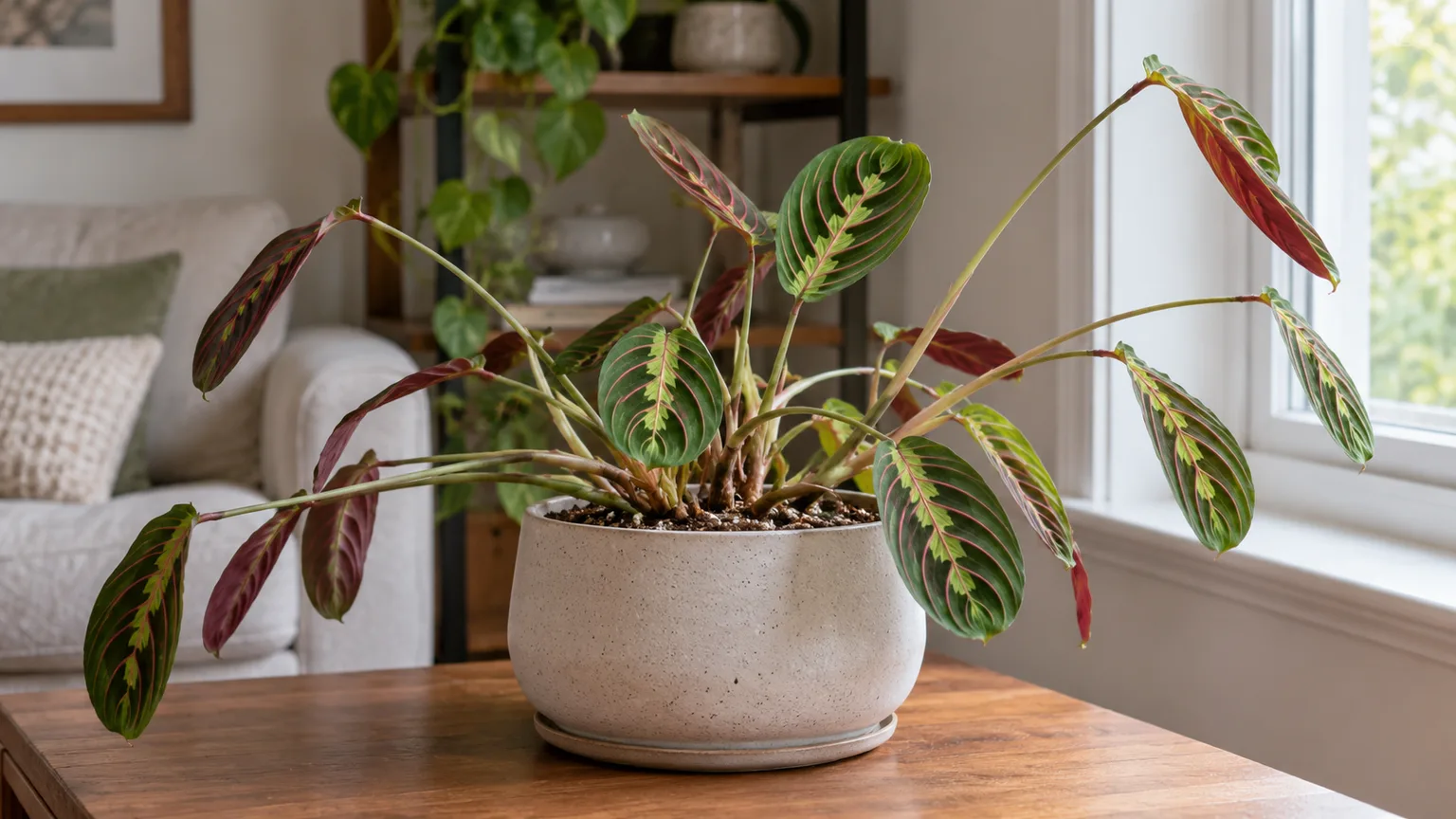
Leggy Growth on Maranta Red Prayer Plant: Causes, Checks & Fixes
This guide covers leggy growth on Maranta Red Prayer Plant. See also the general Leggy Growth guide, watering, and light pages for this plant.
Leggy Growth on Maranta Red Prayer Plant: Causes, Checks & Fixes
Quick answer
Leggy growth on Maranta Red Prayer Plant (Maranta leuconeura var. erythroneura) is etiolation: the plant lengthens stems and petioles to reach usable light, leaving bare gaps between smaller, washed-out leaves on a clump that should stay low and spreading. You are not watching normal trailing habit — this plant spreads horizontally in good light instead of climbing or vining upward on thin stems.
First step: brighten placement before you prune. Confirm the pot sits in bright, indirect light at the canopy, not just in a bright room, then wait for one compact new leaf with tight spacing. Only then pinch stretched stems above a node or root the cuttings. For how chronic dim conditions weaken houseplants in general, see our leggy growth guide. On red prayer plant, the pattern usually shows up first as fading red veins and widening gaps between new leaves, not as yellowing.
Leggy growth vs. not enough light — which guide to use
Both pages share the same root cause, but they answer different questions.
| Your question | Start here |
|---|---|
| ”Is my plant getting enough light?” — dull veins, wet soil in a dim corner, stalled crown | Not Enough Light on Maranta Red Prayer Plant |
| ”Why are the stems so long with gaps?” — obvious stretch, bare sections, lanky clump | This page |
| ”Where should it live year-round?” - window direction, watering rhythm, humidity | Watering and light placement for this plant |
If stretch is your main complaint, keep reading. If you have not confirmed placement yet, run the checks on the not-enough-light page first — pinching before light improves usually produces more weak stretch, not a fuller plant.
What leggy growth looks like on Maranta Red Prayer Plant
Stretch on the red prayer plant is easy to misread because older leaves may still look acceptable from across the room while the crown quietly elongates.
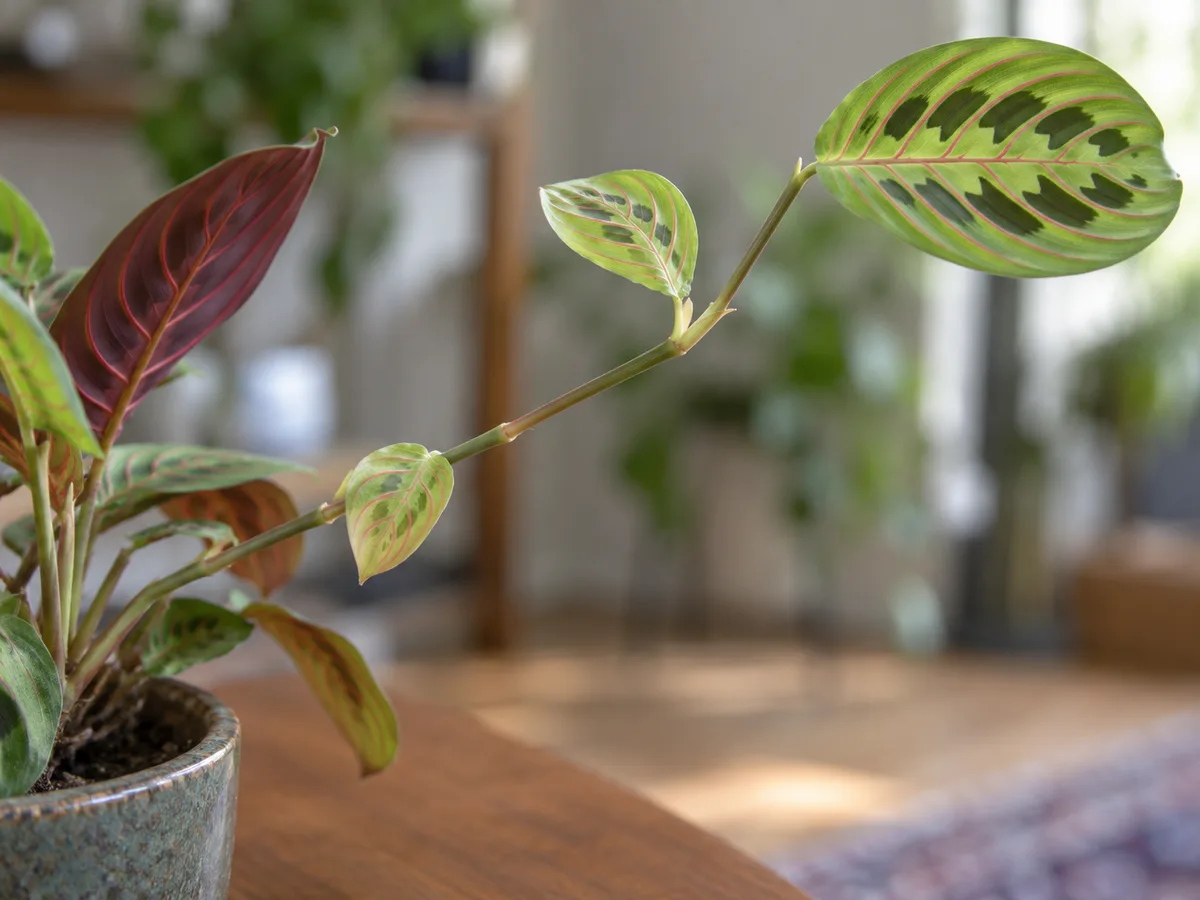
Stretched stem sections with wide internode gaps and faded herringbone veins — compare with compact growth on the same plant.
Stretch-specific signs:
- Long bare sections between leaves — elongated stems with wide gaps, not the low mound this rhizomatous clump-former builds in adequate light
- Smaller new leaves — each fresh leaf unfurls smaller and thinner than leaves made when light was adequate
- Faded red herringbone veins — the upper and undersides of the leaves lose color in low light before any generic yellowing appears, so vein wash on new growth is your earliest red-flag
- Strong lean toward one window as the clump reaches for brightness
- Weak nightly folding — healthy leaves rise at night, but thin etiolated leaves may lift weakly or unevenly
- Upward reach without healthy spread — the plant exceeds its typical low footprint with sparse vertical stems rather than dense creeping growth
This plant is not a trailing vine. Long bare stem sections with small leaves at the tips are etiolation on a clump-forming species, not a natural cascade — do not treat it like a pothos that wants a pole or a hanging basket.
Why Maranta Red Prayer Plant gets leggy
Insufficient light at the leaf surface is the primary cause. When brightness falls short, the plant stretches petioles toward any available source, and stems elongate faster than leaf tissue can expand. The species tolerates low to medium light for survival, but tolerance is not the same as compact growth — a plant that merely survives in a dim corner will still etiolate.
Distance from glass matters more than room brightness. A pot six feet from a window receives a fraction of the light at the sill. The red-vein cultivar shows this early: new leaves emerge with washed-out herringbone patterning while older leaves still hold color, which owners often mistake for a feeding issue.
Short winter days stall the crown. Even a good summer window delivers fewer usable hours in December. Growth slows, then resumes as weak stretch when spring light returns — so legginess that worsens through winter points to seasonal light drop rather than disease.
One-sided exposure builds a lopsided clump. Stems on the shaded side grow longer reaching for the window while the lit side stays relatively tight. Without rotation, the plant leans permanently instead of mounding evenly.
** Heavy feeding in dim light pushes soft growth.** Leaves burn with over-fertilization, and excess nitrogen without matching light produces elongated weak shoots with scorched red margins — stretch plus brown edges together usually mean dim placement combined with too much fertilizer, not a deficiency asking for more feed.
Crowded shelves shade half the crown. A neighboring plant or furniture blocking one side produces uneven legginess on the shaded half only, which confirms a light problem rather than a whole-pot root issue.
How to confirm the cause
Work through these checks before pinching or repotting:
- Light at the leaf surface — Hold your hand just above the leaves at midday. A faint, fuzzy shadow means too little light for compact growth; a soft defined shadow suits this plant. Remember it is intolerant of direct sunlight, so the goal is bright filtered exposure, not a sunbeam.
- Internode comparison — Compare the newest stems to older ones from when the plant looked full. Widening gaps on new growth confirm ongoing stretch.
- Vein contrast on new leaves — Faded herringbone on fresh leaves while older leaves hold pattern points to light fade, not aging.
- Lean direction — Stems angling strongly toward one window confirm the plant is reaching, not randomly weak.
- Rhizome and soil check — Firm shallow rhizomes and normally drying mix support an etiolation diagnosis. Soft bases with persistently wet soil point toward overwatering on Maranta Red Prayer Plant instead — fix that first.
- Season timing — Stretch that accelerated through winter and steadied in summer implicates daylight hours, not pests.
If stems are firm, the plant leans toward light, and new veins look washed out, you have confirmed etiolation. Upgrade light — do not fertilize or repot yet.
First fix for Maranta Red Prayer Plant
Move the pot to the brightest indirect location available, acclimating over seven to ten days.
Shift it one step closer to an east-facing window or a filtered south or west sill every couple of days. Sudden jumps from deep shade to strong exposure scorch the thin leaves this cultivar is known for, so graduate the move. Keep humidity high during the transition — dry air plus a brighter spot crisps leaf edges fast on this species.
This single step addresses the root cause. After relocating, rotate the pot a quarter turn weekly so all sides receive similar exposure, and water only when the top layer of mix dries, since brighter light changes the dry-down rhythm. Wait for one compact new leaf before any pruning.
Step-by-step recovery
Weeks 1–2: Relocate gradually and stop fertilizing. Note which stems lean most and where new rolled leaves emerge.
Weeks 3–6: Watch the crown. A new leaf with tighter spacing and sharper red veins proves light is sufficient. Maintain high humidity with a pebble tray or humidifier and keep the mix consistently moist but never soggy.
After one compact leaf appears: Pinch or trim stretched stems just above a healthy leaf node using clean, sharp shears. Cutting above the node wakes dormant buds and branches the stem instead of leaving a bare stub. Spring and early summer pruning recovers fastest because the plant is actively growing — heavy reshaping in winter usually just stalls.
Root what you remove: Healthy cuttings taken just below a node root in water or moist mix, and an overgrown clump can also be divided at the rhizomes during repotting season. Old elongated internodes never compress on their own — only new tissue grows dense, so staggered trimming plus fresh cuttings is how the silhouette fills back in.
Months 2–6: Continue steady bright-indirect placement and patient watering. This is a slow, low-growing plant, so expect gradual refilling rather than instant bushiness.
Recovery timeline
Expect three to six weeks before a clearly more compact leaf unfurls after a light upgrade, and several months before pinched areas look filled in. Cool rooms and winter short days extend both timelines, since the species is intolerant of low temperatures and cold drafts.
Signs recovery is working:
- New leaves emerge with tighter spacing and stronger red veining
- Lean stops worsening once rotation is consistent
- Fresh rolled leaves open at near-normal size
- Rhizomes stay firm with steady, even moisture use
Signs the problem is worsening or misdiagnosed:
- New growth stays sparse after six weeks in clearly brighter light — verify the spot or add a grow light
- Leaf edges bleach or crisp after the move — pull back from direct sun and acclimate slower
- Stems soften at the base with wet, sour soil — switch to a rot protocol rather than more light
- Widespread yellowing with stalled crown — compare with the yellow-leaves and slow-growth guides for this plant
Lookalike symptoms
| What you see | More likely | How to tell apart |
|---|---|---|
| Long bare stems, firm base, faded veins, leaning toward window | Leggy growth (this page) | Internode gaps widen on newest growth; rhizomes firm |
| Pale small leaves, wet soil, no obvious stretch yet | Not enough light (the full placement diagnostic) | Whole-crown dullness and stalled growth without long gaps |
| Few new leaves but no stretch or lean | Slow growth | Compact but static; check roots, pot size, and season |
| Soft collapsing stems, sour wet mix | Overwatering or root rot | Mushy bases and smell; light upgrade alone will not fix it |
| Drooping leaves that perk after watering | Wilting from underwatering | Temporary wilt cycle, not permanent internode stretch |
Mistakes to avoid
- Treating it like a vine — giving it a trellis or hanging basket normalizes the stretch instead of correcting the light deficit behind it.
- Pinching before brightening — cutting in still-dim conditions regrows just as leggy while spending the rhizome reserves.
- Jumping straight to direct sun — thin red-veined leaves scorch quickly on hot glass; acclimate to filtered brightness.
- Fertilizing to “push” bushiness — extra feed without light makes soft elongated shoots and fluoride and fertilizer burn on the margins.
- Repotting on day one — a root disturbance plus a light change at once stalls the crown; only repot if the mix is failing or the pot is root-bound.
- Misting as a humidity strategy — brief misting wets leaves without raising ambient moisture and invites spotting; use a pebble tray or humidifier instead.
Maranta Red Prayer Plant care cross-check
Leggy growth usually flags a placement mismatch with how this cultivar actually grows:
- Light: Bright indirect at the leaf surface; tolerates lower light without staying compact. See the light guide.
- Water: Keep mix consistently moist, drying slightly at the surface between drinks. Match frequency to the new brighter spot — check the watering guide.
- Soil: Moisture-retentive yet open and draining; dense soggy mix slows the crown and mimics light problems. Review the soil guide.
- Humidity: High humidity keeps new leaves unfurling cleanly; dry air browns the thin red margins first.
- Feeding: Apply a balanced liquid fertiliser monthly only when in active growth, and never to push a dim, stressed plant.
- Temperature: Keep above 60°F (16°C) and away from cold drafts, which stall the crown and compound winter stretch.
How to prevent it next time
Place new plants in bright indirect light from day one rather than the darkest acceptable corner. Rotate weekly, supplement short winter days with a grow light, and prune lightly in spring or early summer to keep the clump branching instead of reaching. When buying, choose specimens with evenly spaced leaves along short stems rather than tall sparse ones — a compact young plant in adequate light stays manageable far longer than a rescued etiolated clump.
Insufficient light remains the main driver of legginess, so an annual placement review each autumn — before daylight shrinks — prevents most recurrences. Keep humidity steady through heating season, since dry air plus low light produces the thin, faded, brown-edged leaves owners often misread as a single problem.
When to worry
Legginess alone is cosmetic and reversible. Escalate when:
- Stems flop from soft, translucent bases in soil that never dries — inspect rhizomes for rot
- Yellowing spreads across the crown while soil stays damp — stop watering and unpot
- No compact new leaf appears after two months in clearly brighter light — reassess roots, pot size, or pest pressure
- Multiple stems collapse despite corrected placement — the primary issue is likely below the soil line, not light
When to use this page vs other Maranta Red Prayer Plant guides
- Maranta Red Prayer Plant overview — Start here for the full species profile and normal growth habit.
- Maranta Red Prayer Plant problems hub — Browse all common issues on this plant when the diagnosis is still open.
- Not Enough Light on Maranta Red Prayer Plant — Use when dullness and stalled growth dominate and stretch is not yet obvious.
- Slow Growth on Maranta Red Prayer Plant — Use when the crown is static but compact, without long internodes.
- Yellow Leaves on Maranta Red Prayer Plant — Use when yellowing, not spacing, is the main complaint.