Mold on Monstera Dubia Soil: Causes and First Fixes
Quick answer
A small, soft white patch on Monstera dubia’s potting mix is usually surface growth, not proof that roots are diseased. First, lift off the visible patch with a clean spoon. Then check the base pot’s dry-down before watering again, keeping board moisture separate from pot moisture.
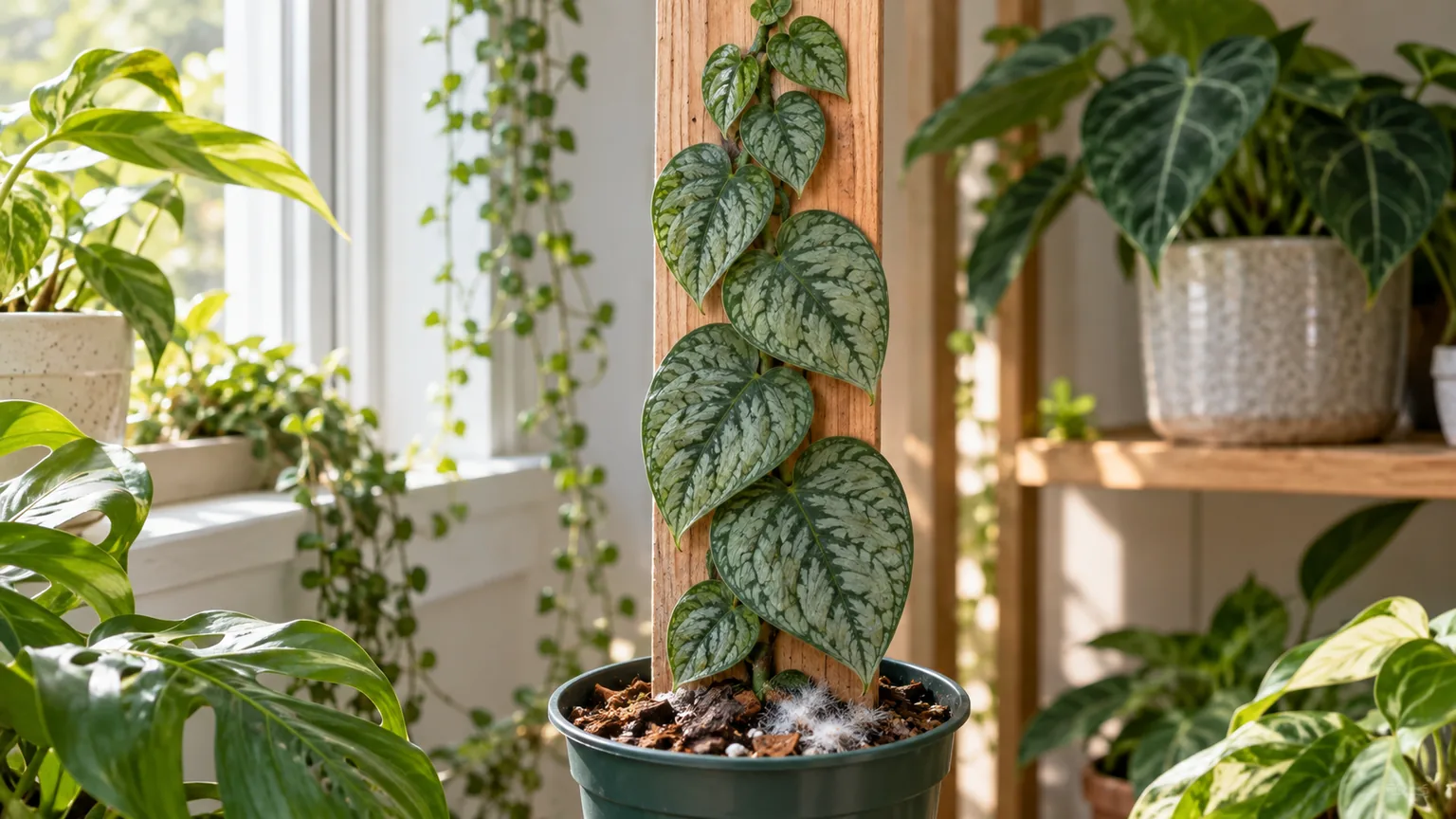
Mold on Monstera Dubia Soil: Causes, Checks & Fixes
This guide covers mold on soil on Monstera Dubia. See also the general Mold on Soil guide, watering, and light pages for this plant.
Mold on Monstera Dubia Soil: Causes, Checks & Fixes
Quick answer
A small, soft white or pale-gray patch on Monstera dubia’s potting mix is usually a surface-growth issue, not proof that its roots are infected (The Spruce’s soil-mold overview). The first move is simple: lift the visible growth and any loose dead leaf fragments off the surface with a clean spoon, bag the debris, and leave a firm, well-draining plant in its pot. Then check whether the base mix is staying wet between waterings. Keep any climbing board or wrap as humid as the plant needs, but do not water the pot again just to moisten that separate support.
For general identification and the whole-houseplant explanation, see our mold on soil guide. This page focuses on a Dubia owner’s common diagnostic trap: the plant’s climbing support may need moisture while the roots in the base pot still need an appropriate dry-down. Start from the Monstera Dubia overview if you are unsure how the plant is mounted or what its normal setup looks like.
What mold on soil looks like on Monstera Dubia
Surface mold tends to look like a soft, fuzzy white-to-light-gray patch, wispy threads, or a thin mat crossing the potting mix. It may gather around bark pieces, old leaf fragments, the stem base, or the pot edge where damp organic material stays in place. The fuzzy texture matters: The Spruce describes soil mold as soft, fuzzy patches and notes that such growth is often saprophytic fungi using dead or decaying plant material as food (The Spruce’s mold identification and explanation).
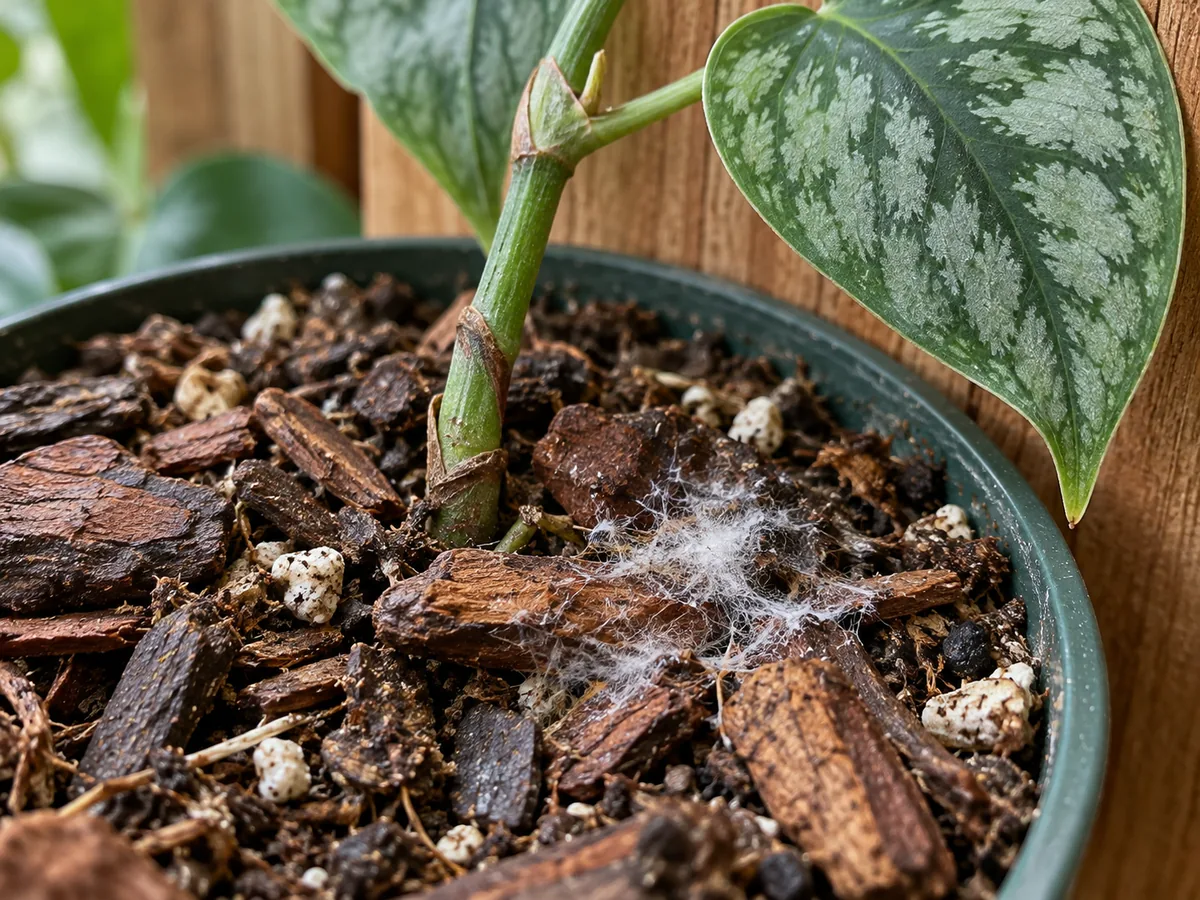
A small surface patch can be removed without unpotting Dubia when the stem remains firm and the mix still drains normally.
The patch stays on the soil surface or on a loose piece of debris. It does not look like the silver pattern that naturally appears across Dubia’s juvenile leaves, and it is not enough by itself to diagnose root rot. If you can brush a small edge with a spoon and lift a soft film or tuft, surface growth is plausible. If the white material is hard, gritty, and forms a waterline crust instead, compare it with mineral residue rather than assuming it is fungus.
A fresh patch can appear quickly after repeated watering, a cool low-light stretch, or a period when damp debris was left in the pot. It can also appear on an otherwise healthy plant, especially when bark or other organic pieces remain damp at the surface. Its presence tells you to investigate the surface conditions; it does not tell you which single care mistake happened or whether the entire root ball is wet.
Why a Dubia pot develops surface growth
The potting mix for a climbing aroid is often built from chunky organic pieces such as bark and coir, with more open materials such as perlite. That mix can support the plant while also leaving small pockets where dead leaf bits and damp bark stay exposed at the surface. Mold uses that organic debris; it is not eating a healthy Dubia leaf from the inside. The diagnostic question is whether a limited patch appeared on surface material or whether the base pot has stayed wet long enough to affect roots.
Moisture is the most useful clue, but it should be read with drainage, room conditions, and the pot size. Family Handyman’s houseplant-soil review identifies excess water, poor drainage, low air circulation, and decomposing leaf matter as conditions that can accompany mold growth (Family Handyman’s cause checklist). Those are practical checks, not a guarantee that every fuzzy patch has the same origin. A damp surface after watering is expected; a pot that remains heavy and wet for an unusually long period deserves a closer look.
Monstera dubia also asks growers to separate the base pot from the vertical support. A board, cork panel, or wrap may be lightly moistened to maintain contact for aerial roots, while the potting mix follows its own watering check. If water runs down the board and back into the pot, or if you repeatedly pour into the pot whenever the support looks dry, the soil surface can stay wet even though the plant’s leaves seem to need more humidity. Treat that pattern as a setup issue: the mount and the root zone are different surfaces to inspect.
This is why the same visual patch can mean different things in two Dubia setups. A small patch on airy bark mix in a pot with clear drainage and firm foliage may need only a surface cleanup and an adjustment to the next watering decision. A patch paired with a pot that stays heavy, yellowing leaves, or soft stems deserves an assessment of drainage and roots. Do not decide between those cases from the mold’s color alone.
Does surface mold mean root rot?
No. A visible patch on the top of the mix is not proof that roots below it are rotting. Clemson Cooperative Extension explains that roots need oxygen as well as water; when roots remain surrounded by excess water, their oxygen supply can be restricted and root decline can follow (Clemson’s indoor-plant watering guidance). That is a reason to check the root zone, not a reason to equate every bit of surface mold with root damage.
Look for a combination of evidence before escalating. Wet mix that does not dry down, blocked drainage, standing runoff, several leaves yellowing in sequence, a persistently soft stem base, or a vine that declines while the soil is wet is more concerning than a small patch alone. Dubia leaves can also lift from a support when the board or room air is too dry; that symptom does not prove the base pot needs another watering. If the plant is still firm and the mix is draining, avoid unpotting it just to confirm a problem you do not yet see.
If wet soil is paired with a weakening stem or progressive yellowing, use the Monstera Dubia root rot guide to decide whether a root inspection is warranted. If the pot dries normally and the plant continues to make healthy shingles, treat the mold as a surface clue and return to the watering guide for the plant’s pot-level routine. The purpose of this distinction is to avoid two opposite mistakes: ignoring genuine root decline, or disturbing healthy roots because of a cosmetic surface patch.
How to confirm the cause without unpotting
Start with the mix, then the container, then the vine. This order gives you useful information while leaving the aerial roots and board attachment undisturbed. Note when the plant was last watered, whether the room has recently cooled or become darker, and whether the support was misted or watered shortly before the patch appeared. A change in the last week is more informative than a memorized watering interval.
Check the base pot’s dry-down
Touch the mix a few centimeters below the visible surface rather than judging by the top bark alone. Dubia’s top layer can look dry while a pocket lower in the pot is still damp, or a patch can sit on the surface while most of the root ball is already approaching its normal next watering. Compare the pot’s weight with how it feels immediately after a thorough watering and full drainage. Clemson recommends assessing actual media moisture and notes that watering frequency changes with plant species, location, pot size, mix, and weather (Clemson’s moisture checks).
The RHS Dubia profile advises keeping the compost moist but not waterlogged, checking the top few centimeters before watering, and not allowing the compost to dry out completely (RHS guidance for Monstera dubia). Use those points together. Do not interpret “let the surface dry” as “leave the entire pot bone-dry for days,” and do not interpret “keep the plant humid” as “keep the soil surface constantly wet.” For a setup-specific review, compare your mix with the Monstera Dubia soil guide.
Check drainage and where runoff lands
Make sure the pot has an open drainage hole and that water can leave it freely. If it sits inside a decorative cachepot, lift the nursery pot after watering and empty any water collected in the outer pot; a layer of water can keep the lower mix wet even when the visible surface seems dry. Check whether the board or moss wrap drips into the same pot, especially after you moisten the climbing surface. If it does, adjust where the runoff lands rather than adding less humidity to the whole room.
A container that is far larger than the root ball can hold moisture for longer than a small plant uses it. Dense, fine mix can also behave differently from a barky, open mix. These are reasons to assess the actual container, not reasons to replace the pot automatically. Penn State’s Monstera guidance recommends a well-draining mix and notes that bark, charcoal, or perlite can be added to a purchased mix; it also frames watering around the soil drying between waterings, not a fixed weekly calendar (Penn State’s Monstera care notes). Dubia-specific care still takes priority over a schedule written for Monstera generally.
Read the vine and board separately
Look at several leaves, the stem close to the soil line, and the most recent shingle. A firm stem and leaves that remain attached do not prove that every root is healthy, but they make a severe emergency less likely when paired with a normally drying mix. A single older yellow leaf can have more than one explanation; a cluster of yellowing leaves while the pot stays wet is a stronger reason to inspect drainage and roots. Watch for repeated change, not one isolated leaf.
Then inspect the support. If new leaves are lifting away from the board but the potting mix is moist, the issue may be the climbing surface, loose node contact, or room humidity rather than a dry root ball. The RHS describes Dubia as preferring bright indirect light and high humidity, while also warning against waterlogging; that combination supports a humid growing area without keeping the base mix saturated. If light is also poor, review the Monstera Dubia light guide and change the position gradually so the soil can dry at a more predictable pace.
First fix: lift off the visible patch
For a small surface patch on a plant with a firm stem and freely draining pot, the first fix is to remove the growth you can see. Use a clean spoon to skim the affected surface and any loose, dead leaf pieces without digging down into the root ball or pulling on the vine. Put the debris in the trash, then leave the plant in place so you can observe its normal dry-down. The Spruce lists gentle surface removal as a practical option for limited mold growth; this is enough for a cosmetic patch while you check the underlying moisture pattern.
Do not combine that first action with a full repot, leaf pruning, extra watering, fertilizer, and a soil treatment. Changing several conditions at once makes it hard to tell whether the patch was superficial or whether the pot truly had a drainage problem. After removing the growth, make one measured change only if your checks support it: empty trapped runoff, wait until the correct top layer dries before watering, or adjust the board so its water does not run back into the pot. If signs point to root damage, move to the escalation steps below instead of repeatedly scraping the same surface.
Dubia’s two moisture zones need two separate checks
A board-grown Dubia is easier to diagnose when you write down two observations instead of one: the condition of the base mix and the condition of the climbing surface. A board that feels dry is not a direct measurement of the pot. A damp soil surface is not a direct measurement of whether the aerial roots have useful contact with the board. Keeping those checks separate prevents a dry mount from triggering repeated root-zone watering.
If the soil surface is damp and the pot remains heavy, do not water the base pot again. Let the surface move toward the normal dry-check point described in the RHS guidance, while ensuring that the container still drains and the root ball is not left to dry completely. If the board also needs moisture, dampen the support with a controlled amount and catch or redirect runoff so it does not soak the soil. If the mix is wet for many days, the next question is whether the pot is oversized, the mix is too fine or broken down, or water is collecting below it.
If the pot has dried normally but the board is crisp and the shingling leaves are lifting, address the board or ambient humidity separately. Penn State’s houseplant humidity guidance notes that misting only raises humidity until the droplets evaporate; a humidifier is a more stable way to raise room humidity when needed (Penn State on houseplant humidity). Do not mist the soil as a substitute for a humidifier or support care. The aim is a comfortable climbing zone with a base mix that still has air spaces between watering events.
If your Dubia is not mounted, use the same separation without assuming it needs a board: check the pot first, then the leaf pattern and room conditions. The article’s two-zone model is specific to mounted or wrapped plants, not a requirement to add a support to every specimen. A stable plant in an appropriate pot does not need a new mount just because a small patch appeared. Add or change support only if the vine’s setup already calls for it.
Lookalikes: mold, deposits, pests, and root trouble
| What you see | How it differs from surface mold | What to do next |
|---|---|---|
| Soft white or pale-gray fuzz on bark or debris | Fibers or threads sit on the mix and may lift with a spoon. It often follows damp organic material. | Remove a small patch and check the pot’s moisture and drainage. |
| Hard pale crust at the rim or on bark | It is rigid or granular rather than soft and filamentous. | Check a small edge with a damp swab and review water or feeding history before calling it mold. |
| Tiny moving insects, larvae, or small flies | Insects move independently of the white material; adult fungus gnats may fly up when the pot is disturbed. | Use the Monstera Dubia fungus gnats guide if you find insects, not just white fibers. North Dakota State University Extension describes adult fungus gnats as small, dark, mosquito-like flies and their larvae as top-soil feeders (Extension’s fungus gnat identification notes). |
| Soft stem base, several yellowing leaves, or worsening growth in a wet pot | This pattern points beyond a surface patch and makes a root-zone problem more plausible. | Assess drainage and use the plant-specific root-rot guide before deciding to repot. |
| Flat silver patches on juvenile leaves | Dubia’s leaf pattern is part of the foliage and is not soil mold. It does not lift like a soil-surface film. | Leave intact, healthy leaf pattern alone; inspect the mix only if growth is actually on the potting surface. |
The table is a first sort, not a laboratory identification. Do not scrape or wet a patch on every pot in a collection to compare them; use one clean tool and wash it afterward if you move between plants. If you are unsure whether the patch is mold or another surface deposit, remove only a small edge and inspect the texture while leaving the plant’s stem and roots undisturbed.
When repotting is justified
Repotting is not the default answer to a little white fuzz. It becomes reasonable when the mix has broken down into a dense mass, water cannot leave the container, the pot remains saturated despite a careful watering pause, or root and stem symptoms support a deeper problem. A persistently soft stem base or a vine that continues to decline while the pot stays heavy also warrants closer inspection. A single surface patch on an otherwise stable Dubia does not meet that threshold.
If you do need to inspect roots, support the vine and board so the stem is not used as a handle. Slide the root ball out gently rather than tugging on aerial roots attached to the mount. Keep the inspection limited to the question you are trying to answer: are the roots still firm, or are sections soft and deteriorating in wet mix? If the roots are firm and the potting material is still open, return the plant to its container and correct the watering or runoff issue. If substantial root decline is visible, remove only damaged material with clean tools and repot into a suitably sized container with fresh, airy mix.
A replacement pot should not be dramatically larger than the root mass. The goal is drainage and space for the existing roots, not a reservoir of wet soil around a small Dubia. Use the established barky aroid mix rather than replacing it with heavy garden soil. Penn State’s genus-level Monstera advice supports a well-draining, organic mix; for Dubia’s exact composition and pot fit, use an appropriately sized container with an open, airy mix as described above. After repotting, do not keep adding water to the board and pot together; resume the base-pot check once the mix begins drying at the surface.
Recovery timeline and signs of improvement
The visible patch may be gone immediately after careful removal, but that alone does not prove the cause has changed. Watch the next few dry-downs: the pot should lose weight as it dries, water should drain rather than collect, and the same patch should not repeatedly spread across the surface. If a thin trace returns while the mix is still damp, repeat the moisture and debris check before escalating. Surface growth can recur when the conditions that supported it remain in place.
When roots were not affected, the plant may show no visible recovery because it was never damaged; the goal is simply a clean surface and a stable moisture pattern. If the root zone had been stressed, stop judging the plant by the old damaged leaf. Use stopped decline, firm stems, a normally unfolding next leaf, and a repeatable dry-down as recovery signs instead of relying on the appearance of an already damaged leaf.
Do not treat the absence of a new leaf within a few days as evidence that mold is still harming it. Keep board contact stable and avoid moving the plant repeatedly while you watch the pot. If the plant keeps declining or the mix remains wet after you corrected standing water and drainage, investigate the root zone instead of waiting indefinitely. There is no precise calendar recovery time for an indoor plant because pot size, light, room temperature, and the amount of root damage all change the pace.
What not to do
Do not water the pot on a calendar to maintain the board’s humidity. Dubia’s support and root zone have different jobs, so make the next pot-watering decision from the mix rather than reacting to the patch alone. Do not deliberately leave the whole root ball dry, and do not leave a cachepot full of drainage water after irrigation.
Do not unpot a stable plant, cut healthy leaves, or replace the entire substrate simply because one patch appeared. Do not bury the patch under a thick decorative layer of gravel or moss before you have corrected the moisture pattern; a cover can make the surface harder to inspect and may keep the soil beneath it damp. Avoid using a fungicide or household cleaner as the first response to a superficial patch. If there is a separate disease or pest diagnosis, choose a treatment for that diagnosis and follow its current label rather than treating soil mold as a plant pathogen by default.
Finally, do not confuse a humid board with stagnant air. A small amount of ordinary room movement can help the pot surface dry between waterings, while a strong fan aimed at the vine can dry the support and leaves faster than intended. Keep the plant in bright indirect light, provide enough spacing to inspect the pot, and avoid direct sun as a quick drying trick. The Monstera Dubia overview and care pages help keep those adjustments within the plant’s normal setup.
Prevent mold from returning on a board-grown Dubia
Build prevention around repeatable observations rather than a fixed number of days. After watering, let the pot drain fully, note its weight, then check the upper few centimeters before the next irrigation. The goal is a consistent dry-down, not a calendar interval; a drop in light or temperature may slow it, so reassess conditions instead of carrying a summer schedule into winter.
Remove fallen leaf pieces as they appear and keep the soil line visible. If a board or moss wrap is dampened, apply the water to the support rather than soaking the pot; tilt or reposition the support if runoff consistently lands in the container. Keep a drip tray empty, leave the drainage opening clear, and avoid crowding the pot so you can check the soil surface and stem base. These habits are especially useful for a shingling vine because the board can attract attention while the actual source of excess moisture sits unseen in the base pot.
Use an open, appropriately sized container and a mix that drains freely. If the top layer remains wet for many days, do not automatically add more bark or repot: first check whether the pot is oversized, a drainage hole is obstructed, or runoff has been trapped. If the mix has visibly collapsed and no longer drains well, review the Dubia soil guide and correct the substrate at a suitable time. A surface patch that stays small and disappears after a sensible dry-down does not require a new soil formula.
Maintain the room conditions that support the mounted plant without turning the pot into a water reservoir. Bright indirect light is preferable to a dark corner; if the plant is in a dim location, adjust it gradually and keep observing how quickly the mix dries. If the board repeatedly dries out while the base pot remains moist, increase humidity around the climbing surface or use a stable humidifier rather than increasing pot watering. This is the practical boundary for Dubia care: protect the shingling zone without sacrificing root-zone air space.
Related Monstera Dubia guides
Use this page when the visible issue is fuzzy growth on the potting mix and you need to decide whether it is superficial or a sign that the base pot stays wet. Use the Monstera Dubia problems hub when you are still sorting among several symptoms. The overwatering guide fits a pot that stays wet with broader signs of stress, while the root rot guide is the better next step when the stem or root zone is deteriorating. If you see small flies or larvae, use the fungus gnats guide; if the issue is only dry or lifted shingles, check the watering guide and light guide.
Related tool
Use the Plant Problem Diagnosis Tool to compare the soil-surface patch with the watering, drainage, and root-zone clues before making a second change.