Fungus Gnats on Monstera Dubia: Causes, Checks & Fixes
Quick answer
On Monstera Dubia, fungus gnats usually point to a persistently damp or breaking-down potting mix, not to the shingling leaves. Let the top 2–3 cm of the base-pot mix dry before watering again, keep any climbing support moisture separate, and confirm larvae with a short potato-slice check before escalating treatment.
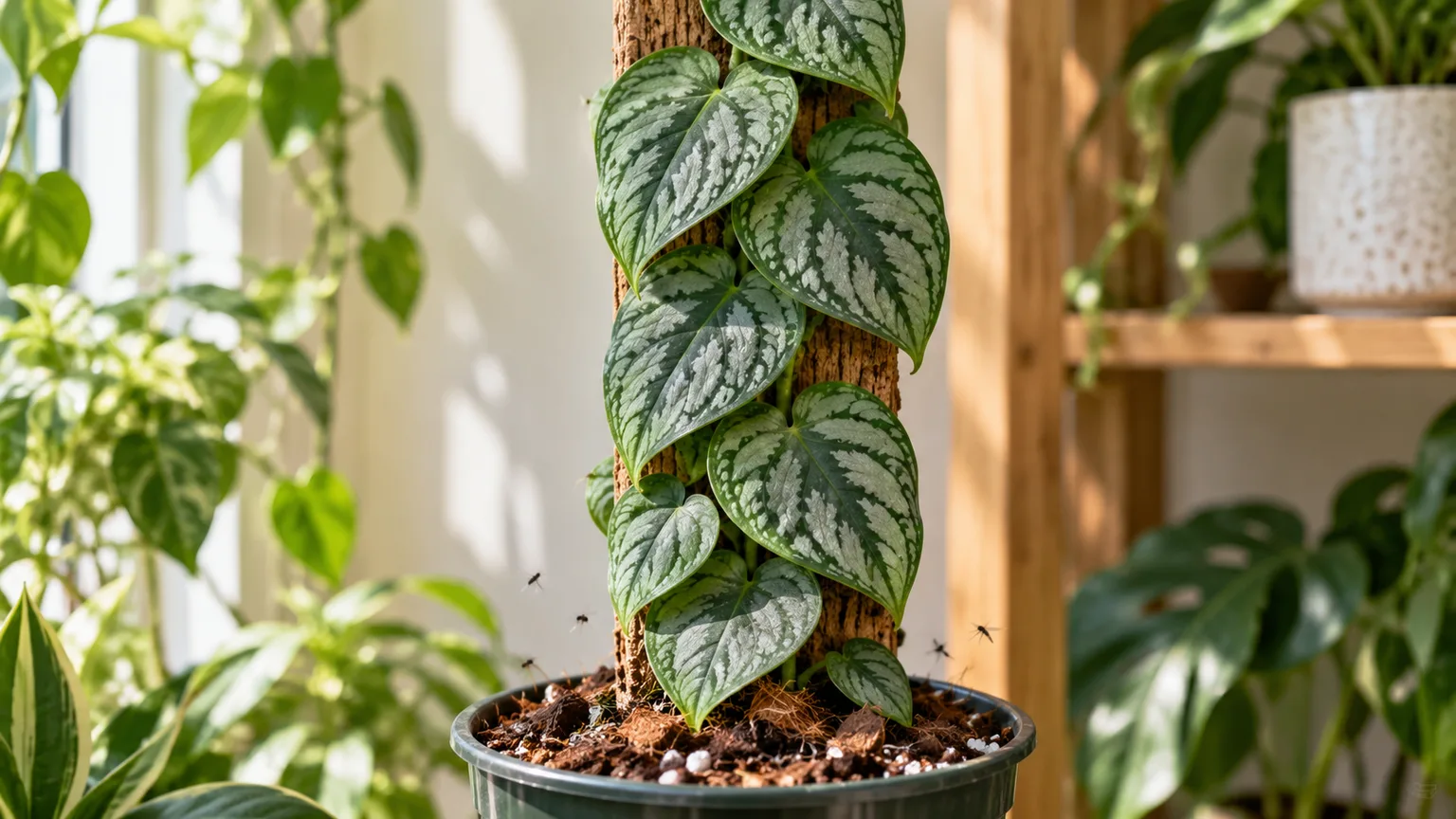
Fungus Gnats on Monstera Dubia: Causes, Checks & Fixes
This guide covers fungus gnats on Monstera Dubia. See also the general Fungus Gnats guide, watering, and light pages for this plant.
Fungus Gnats on Monstera Dubia: Causes, Checks & Fixes
Quick answer
Small dark flies rising from the pot of a Monstera Dubia usually indicate that the growing mix has stayed moist enough for fungus gnats to lay eggs and for larvae to find food. Adult flies are the visible nuisance; larvae live in the mix, where they feed mainly on fungi and decaying material and can nibble fine roots when populations are high. The Colorado State University Extension guide describes the adults as delicate, mosquito-like flies and the larvae as translucent, wormlike forms with a black head capsule.
The first correction is simple: do not water the base pot until the top 2–3 cm of its mix has dried. That is the threshold used in the Monstera Dubia watering guide, and it avoids the over-dry treatment often suggested for other plants. If your plant is on a board or a moss-based support, judge that surface separately; do not pour extra water into the pot just to keep the climbing surface damp.
Confirm that the pot is the source before repotting. A yellow card placed just above the mix helps track adult activity, while a potato slice can reveal larvae in the medium. This page focuses on the plant-specific checks; the general fungus-gnat life cycle and control options are covered in our fungus gnats guide.
What fungus gnats look like around Monstera Dubia
You may see the adults when you move the board, water the plant, or disturb the pot: small, dark flies making short, weak flights close to the mix. The larvae are less obvious. They are slender and translucent, with a dark head, and they stay in the damp growing medium rather than crawling over the silver-green leaves.
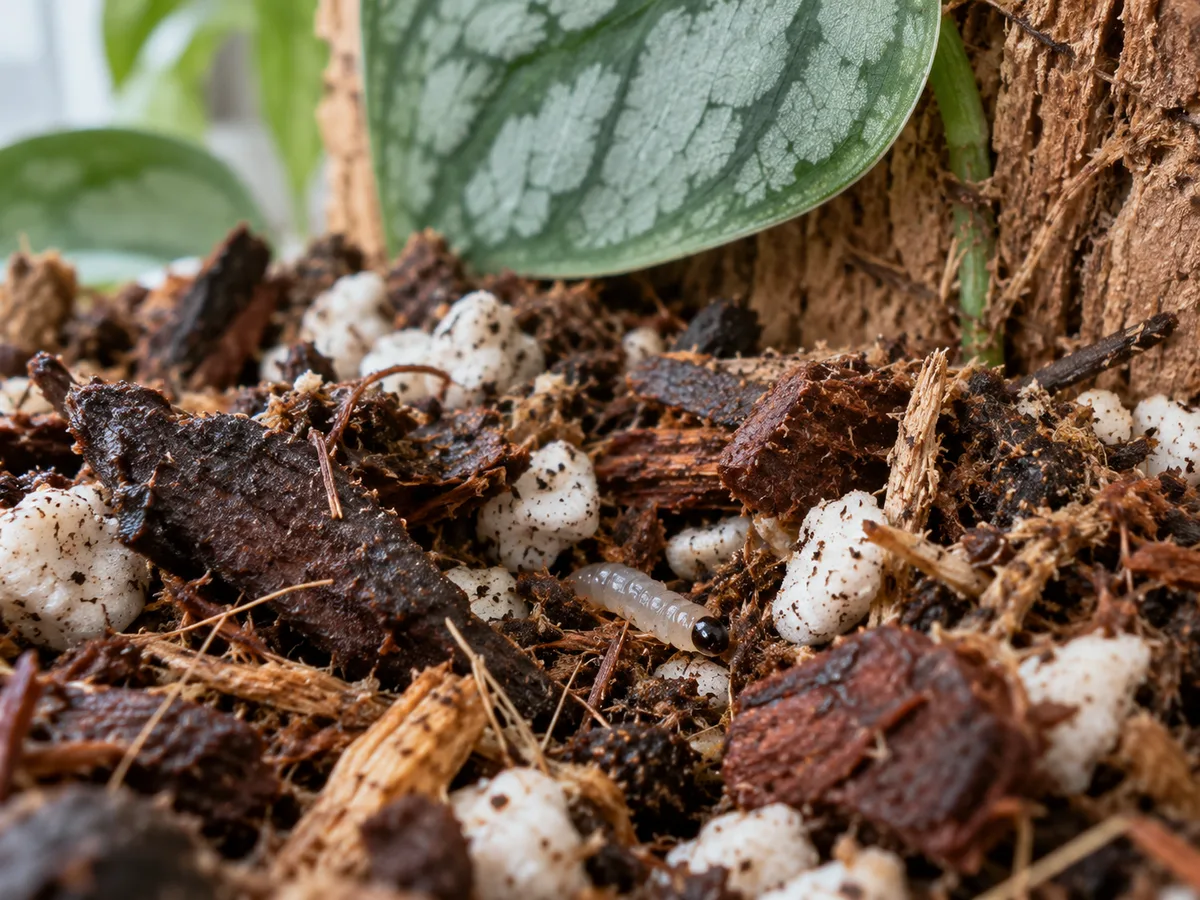
Look for a translucent larva with a dark head in the mix; a few adult flies around the board do not show how many larvae are present.
A shingling Monstera Dubia can make the adult flies seem to be coming from the whole plant because its leaves and support create a tall, close surface. Follow the flight path down to the base pot. If the insects rise when you tap the pot rim or lift the inner nursery pot, the medium is the stronger suspect. If they appear only near a window or fruit bowl, first rule out fruit flies and other small flies rather than treating the plant.
Fungus gnats are not leaf-eating caterpillars. The adult stage is usually a nuisance, while the larvae live where fungi and decaying organic material accumulate. Wisconsin Extension notes that heavy larval populations can feed on root hairs and sometimes roots; this is a risk to investigate when the Dubia is already declining, not a reason to assume every gnat has damaged the plant.
Do not diagnose root injury from the leaf pattern alone. Monstera Dubia naturally grows close against a support in its familiar shingle form, and one lifted or older leaf can also reflect a dry board, a watering change, or ordinary leaf turnover. Gnats become a more convincing cause when adults repeatedly emerge from the mix and a soil check reveals larvae.
Why the base pot can attract gnats even when the board looks dry
A mounted Dubia has two different moisture cues. The pot holds the roots that absorb water; the board, cork, or coco panel gives climbing nodes a surface to grip. A support that feels dry does not tell you whether the lower potting mix is ready for water. Conversely, keeping the root zone constantly wet to compensate for a dry board encourages the damp conditions adult gnats seek.
The Royal Horticultural Society’s Monstera Dubia profile describes the shingle plant and recommends watering after the top few centimetres of compost feel dry. That distinction matters here: the Dubia can have a humid growing environment without a saturated base pot. Check the potting mix directly rather than relying on a weekly schedule or the support’s surface.
A chunky aroid mix is meant to let excess water drain through air spaces. In a Dubia pot, bark, perlite, and coir do not dry at the same rate: large pieces may feel dry at the top while finer material around the root ball holds moisture below. A small nursery pot can also feel light on the outside while a dense center remains damp. Push a clean wooden skewer into the mix near the inner edge, wait briefly, then inspect it; if it comes out dark and coated with wet particles, delay watering and recheck later. This moisture-first approach matches guidance for moist potting soil, where fungus gnats find the conditions their larvae use.
The potting medium’s age matters too. As organic ingredients break down, a mix may settle and hold water longer than it did when it was fresh. Colorado State University Extension explains that a degraded growing medium can retain moisture and improve conditions for fungus-gnat development. If the surface dries but the bottom stays wet for many days, inspect drainage and mix structure using the Dubia soil guide before making a treatment plan.
New plants and stored potting mix can introduce gnats even when your own watering has been careful. New plants can introduce invisible eggs or larvae in their mix. A newly purchased Dubia, a plant moved indoors after spending time outside, or an open bag stored in a damp place can bring them into a collection. That is why seeing adults does not prove that you personally overwatered the plant. It does tell you to check every nearby pot and any damp bag or tray that could be supplying more flies.
Keep the Dubia’s two moisture zones separate
With a climbing Monstera Dubia, think of the support and the pot as separate stations. The root zone should be airy, drain freely, and approach the plant’s normal dry-down cue before the next soak. The mounting surface may be kept lightly moist if the plant has aerial roots that need contact, but it should not be used as a reason to keep the base mix wet. This separation is especially useful when a moss pole or coco panel is watered from the top: run-off can travel down and collect in the nursery pot or cachepot without being obvious from the front.
Check the board from top to bottom, but do not treat every damp spot on it as a gnat nursery. Fungus gnat eggs and larvae are associated with growing medium; adults hovering by the support may simply be following the humid plant corner. Look for larvae in the potting mix first. If your support contains a packed, persistently soggy pocket of organic moss at the base, inspect it as a possible secondary damp area, then let it dry to the material’s normal state rather than stripping the Dubia off its support.
The plant’s leaves help you distinguish a support problem from a root-zone problem. A Dubia leaf that pulls away from the board can signal that the node has lost contact or that the climbing surface is too dry; it does not confirm gnat injury. A soft stem base, a persistently heavy pot, or continuing yellowing alongside larvae makes root stress more plausible. Compare the symptoms with the plant-specific overwatering guide before disturbing healthy roots.
Do not compensate for a dry board with a deep pot drench. If the board needs a small amount of moisture, apply it to the board and keep the cachepot empty; if the potting mix is already damp, wait. If the support is dry but the Dubia’s pot is also dry to the 2–3 cm cue, water the pot thoroughly and let excess water drain. This gives each part of the climbing setup the attention it needs without turning the entire base into a breeding surface.
Read the shingling before you blame gnats
The visual appeal of Monstera Dubia is the neat panel of overlapping juvenile leaves. That close growth makes it easy to misread a healthy shingle pattern as a pest symptom. The leaves are supposed to lie flat against the support; fungus gnats do not make them cling, lift, or fenestrate. Adults often rise around the lower pot, not from the upper leaves.
Instead, look for a pattern that implicates the roots. If multiple leaves yellow in sequence and the pot remains wet, the issue may be wet mix, root decline, or another stressor that happens to coexist with gnats. If only one of the oldest leaves fades while the newest shingle stays firm, there may be no serious infestation damage. Note where the newest leaf emerges, whether the stem is firm, and whether the next watering makes the pot dry at its usual pace.
A Dubia can also show a gap between the root zone and the climbing surface. The shingling vine may continue to look tidy while the base mix stays wet; conversely, the board may dry quickly while the pot is still saturated. That mismatch is why a visual scan of leaves alone is a poor gnat test. Inspect the base pot even if the leaf panel looks healthy, and inspect the support even if the soil surface is dry.
If the leaves are lifting from the board but no larvae appear, prioritize the plant’s moisture and light cues rather than adding pest treatments. A low-humidity room, a dry support, or a recent change in position can affect how leaves sit against the board. Check the Dubia’s light guide and humidity guide if the leaf behavior is the main concern. Keep that separate from gnat control unless adult flies are repeatedly emerging from the pot or a larval check is positive.
How to confirm the pot is the source
Use two observations because adult flies and larvae are different life stages. First, put a small yellow sticky card close to the surface of the Dubia’s mix, without letting it touch leaves or aerial roots. Check it after a few days. A card at soil level is better for this job than one across the room, and the number caught gives you a baseline to compare after the moisture correction.
Second, place a thin slice or wedge of raw potato on the mix surface for three to four days, then turn it over and inspect the underside. Larvae may move up to feed; Gardening Know How describes this potato-slice check as a practical way to reveal them. Remove the potato afterward. Do not leave a wet slice on the pot indefinitely, since the point is to test briefly, not add decaying material to the surface.
A positive check is a small, translucent body with a distinct dark head. Look at the underside of the slice and the nearby upper mix under bright light. If you see only specks of bark, perlite, or coir, that is not a positive result. Repeat the check once in a different spot if the pot remains suspicious, particularly around the side where the mix stays damp longest.
A yellow card alone cannot tell you whether the larvae are still present. Colorado State University Extension explains that sticky cards catch adults and can help monitor or reduce the next wave, while larvae in the mix need a separate response. If the card catches one or two flies but a potato check stays clear and the pot dries normally, monitor before treating. If adults keep appearing and the potato test is positive, treat the medium and correct the moisture pattern together.
Check the cachepot, saucer, and any self-watering reservoir. Water trapped below the nursery pot can keep the bottom of the root ball wet even when the visible surface has dried. Pull the inner pot out, drain the outer container, and feel the drainage holes. If the pot is sitting in water, solving that standing water is more useful than spraying the upper leaves.
First fix: pause the next watering until the mix reaches its cue
For Monstera Dubia, the first action is to wait until the top 2–3 cm of the base-pot mix is dry before watering again. This does not mean letting the whole root ball turn bone-dry. It means ending continuous surface moisture, which reduces the conditions that attract egg-laying adults, while still giving the plant a thorough watering when its own cue is met. Better Homes and Gardens Australia also emphasizes avoiding constantly damp potting mix as a practical gnat-prevention step.
Use the same finger or skewer check each time so you can compare like with like. If the mix is cool, dark, or coated on the skewer, wait another day or two and recheck. If the top layer is dry but a lower reading remains wet, delay the next soak and check the drainage path rather than adding a surface pesticide. The target is a consistent dry-down, not an arbitrary number of days.
When the mix reaches the Dubia’s cue, water evenly over the pot until excess drains through. Let the nursery pot finish draining before returning it to a cachepot. Do not leave the pot in runoff. If the support is separately dry, moisten it gently without pouring water into the base. This keeps the board’s contact conditions from undoing the pot’s dry-down.
Avoid forcing the soil to dry much farther than the plant’s normal threshold. A very deep dry spell can make a mounted vine lose turgor or pull away from its support, which creates a second problem and makes diagnosis less clear. The gnat response is a short-term adjustment toward the plant’s normal dry-down cue, not a permanent drought treatment.
If larvae are confirmed, treat them in sequence
Keep the yellow card in place so you can see whether adult activity is declining. It catches flying adults but does not reach the larvae in the root zone. Replace it when covered or dusty, and keep it clear of the plant’s leaves and sticky aerial roots. If the card count stays high after the mix has been allowed to dry appropriately, look for a second breeding pot instead of repeatedly wetting this one.
For a confirmed larval population, a product containing Bacillus thuringiensis subsp. israelensis (Bti) may be used if its label specifically permits that use on indoor potted plants. Apply it only as the product label directs, and do not improvise a stronger drench. Bti targets larvae in the growing medium; it will not remove adults already flying or instantly clear every life stage. Colorado State University Extension describes Bti as a larval treatment applied to the medium, while availability and product directions can vary.
Do not stack Bti, an insecticide spray, a home remedy, and a repot on the same day. Start with moisture correction and adult monitoring; add a labeled larval treatment only if the checks support it. Avoid spraying the shingling leaves for a soil pest. The larvae are below the leaves, and a foliar treatment does not substitute for fixing a persistently wet base pot.
Repot only when there is a reason the existing medium cannot dry properly: it has collapsed into fine, dense material, drainage is blocked, the pot smells sour, or the roots are visibly soft and decaying. If you do need to repot, keep the root ball intact as much as practical, remove only loose degraded mix, and use a fresh airy aroid mix in a pot with clear drainage. The plant’s repotting guide covers container size and timing; a routine seasonal repot is not necessary just because a few adults appeared.
If roots are firm and the medium drains, leave the plant mounted and change one variable at a time. A complete strip-down can damage fine roots and the node-to-board contact that keeps a Dubia shingling. If a new plant is the source, separate it from nearby plants while you monitor and treat its medium; you do not need to unmount every Monstera in the room. Check surrounding pots because adults can move a short distance and choose another damp container.
Recovery: follow the trap count and the next leaf
Fungus gnats develop through overlapping stages in the medium. Colorado State University Extension reports a three-to-four-week cycle from egg to adult at typical room temperatures, so seeing an occasional adult shortly after treatment does not necessarily mean the treatment failed. A useful sign is a downward trend on the soil-level card across repeated checks, with no larvae found in a later potato test and the pot drying at its normal pace.
Judge the Dubia’s plant recovery separately. Firm stems, roots that remain pale or tan and resilient rather than mushy, and a new shingle that continues to attach to the support are better signs than whether an older leaf turns green again. Yellowed or damaged tissue may remain marked; do not keep cutting leaves to make the panel look perfect. If the newest leaf opens normally and the pot no longer stays wet for days, the plant is moving in the right direction.
If the mix dries correctly but adult numbers stay high, inspect every plant in the same shelf or cabinet. Another pot, damp bag of mix, decaying leaf in a tray, or water-filled cachepot can keep the population going. The Dubia may be a resting place for adults rather than the source. Keep the card by the likely source and move it temporarily between pots to find where catches cluster.
The timeline is not a promise of zero flies by a fixed date. Cool rooms, dense root balls, or another infested container can stretch the response. If counts do not fall over several weeks despite a dry surface cue and a confirmed larval treatment used exactly as labeled, reassess the identification and nearby breeding sources before repeating a product.
Lookalikes: distinguish gnats from root stress and other flies
| What you notice | What it suggests | What to check next |
|---|---|---|
| Slender dark flies lift from the pot when you move the Dubia; a potato slice shows clear larvae with dark heads | Fungus gnats are likely breeding in the medium | Keep a soil-level card and correct the pot’s dry-down |
| A few fruit flies hover near fruit or a kitchen bin, but none emerge from the Dubia pot | A household source is more likely than the pot | Remove fruit and waste, then repeat the pot check before treating |
| Leaves yellow while the inner pot remains heavy and the mix smells sour, with no larvae found | Wet-root stress or root rot may be more important than the adults | Compare with the Monstera Dubia root-rot guide |
| Only a leaf edge lifts away from the board while the roots and pot feel stable | A dry support, lost node contact, or changing humidity may explain the look | Check the board and the Dubia humidity guide |
| Fuzzy growth appears on the mix surface along with adult flies | Surface mold and gnats may share a persistently damp surface; mold itself does not prove root injury | Use the Monstera Dubia mold-on-soil guide and check the pot’s dry-down |
The most useful distinction is where a symptom begins. Gnats originate in damp growing media; root stress shows up in the plant’s tissues and in how the pot behaves after watering. A few adults and one yellow leaf can coexist without a direct cause-and-effect relationship. If the leaf pattern worsens but larvae are absent, use the Monstera Dubia problems hub to compare the plant’s other likely issues rather than repeating a gnat treatment.
Mistakes that make Dubia gnat checks less useful
Do not water on the calendar while a gnat population is active. A fixed interval can keep the top layer wet through a cool spell, even if the same schedule worked in summer. Check the actual mix and the pot’s weight. The Monstera Dubia overview describes this as a climbing shingle plant with an airy base-pot setup; its care works better when water follows the pot’s condition, not the board’s appearance.
Do not let the entire root ball dry simply because a generic gnat article suggests a long dry spell. Dubia care needs its own threshold: wait for the top 2–3 cm, then water thoroughly and drain. Pushing a mounted vine into drought can lift leaves, stress fresh nodes, and make a gnat problem harder to separate from a support or root problem.
Do not rely on sticky cards as the only control. They make adults visible and catch some of them, but they do not remove larvae from the mix. Do not leave a potato slice in place after the brief diagnostic window. Do not use vinegar bowls as a substitute for a soil check; those can attract fruit flies and distract from the actual source. Do not try dish soap, peroxide, cinnamon, or a concentrated oil drench unless a reliable plant-care source and the product label specifically support the method for that plant and use.
Do not repot a healthy-rooted Dubia just to feel that something has been done. Its roots and climbing nodes are part of a connected setup; disturbance can set back the shingle panel without solving the cause if the real breeding source is another container. Reserve repotting for degraded media, blocked drainage, serious root decline, or an infestation that remains after less disruptive steps.
Prevent a repeat without sacrificing the climbing setup
At each watering, check the base pot first. Record how long it takes for the top 2–3 cm to dry in the current room, then use that observation the next time instead of relying on a fixed six- or ten-day interval. In a cooler, darker season, the plant may use water more slowly; Colorado State University Extension notes that shorter days and cooler temperatures can slow houseplant growth and water use, leaving mix moist longer if watering is unchanged.
Keep the inner pot draining freely and empty the outer cachepot after watering. Remove fallen leaves, spent plant material, and any soggy debris from the pot surface. If the medium repeatedly stays damp well beyond the Dubia’s usual dry-down, inspect whether it has broken down and compare it with the plant’s soil guidance. A fresh, airy mix and a pot sized to the root ball are more useful than a thick top layer that hides a wet surface.
Treat a new Monstera Dubia as a separate plant during its first few weeks. Watch the mix, use a temporary sticky card near the pot, and avoid placing it directly beside other sensitive plants until you know whether adults are emerging. Store opened potting mix dry and sealed. When you bring a plant indoors after an outdoor season, inspect the base and drainage holes before it joins the mounted collection.
A board or pole can remain humid enough for aerial-root contact without the pot being kept wet. If you have to refresh a moss-based support, apply small amounts deliberately and check that the water is not running into the cachepot. Good prevention is not “keep everything dry”; it is matching water to the two parts of this shingle setup and removing the persistently damp, decaying pockets that fungus gnats use.
When to worry
Treat the infestation as a plant-health concern if adults are numerous, a potato test finds larvae repeatedly, or the Dubia shows progressive decline while the root ball remains wet. Soft stem tissue, a sour smell, collapsing roots, or several leaves yellowing in sequence deserve a root inspection. If roots are mushy or the stem base is soft, prioritize the root-rot guide and remove only tissue that is clearly dead; do not assume a Bti drench will correct damaged roots.
A small adult count with firm stems and a normally drying pot is not an emergency. Keep monitoring, adjust the next watering to the Dubia’s top-layer cue, and verify larvae before escalating. If a product is needed, use one specifically labeled for the intended indoor plant use, follow its directions, and keep it away from children and pets.
Related tool
Use the Pest Identifier to compare the adult before treating the mix. If fungus gnats are confirmed but the Dubia also has root or leaf symptoms, use Plant Problem Diagnosis to compare the plant-side causes.
Related Monstera Dubia guides
Use this page when small flies repeatedly emerge from the base-pot mix or larvae appear in a potato check. Use the overwatering guide when the mix stays wet but gnats are absent, and the Monstera Dubia root-rot guide when soft roots or stem tissue are the main concern. For a dry surface or potting problem, start with the soil guide and watering guide; the problems hub routes the remaining Dubia symptoms.