Monstera Thai Constellation Not Enough Light: Signs & Fixes
Quick answer
Monstera Thai Constellation suffers disproportionately in low light because its chimeric cream sectors lack chlorophyll, forcing the reduced green surface area to fuel the entire plant. Key signs include missing fenestrations on new leaves, small juvenile foliage, petioles stretching or drooping toward distant light, soggy potting mix staying damp for over 2 to 3 weeks, and necrotic browning of cream patches as the plant self-prunes unsupportable tissue. Fix it by placing the plant 2 to 4 feet from an unobstructed east or filtered south/west window, supplementing with 250 to 400 µmol/m²/s (PPFD) full-spectrum LED lighting for 12 to 14 hours daily, and rotating 90 degrees weekly.
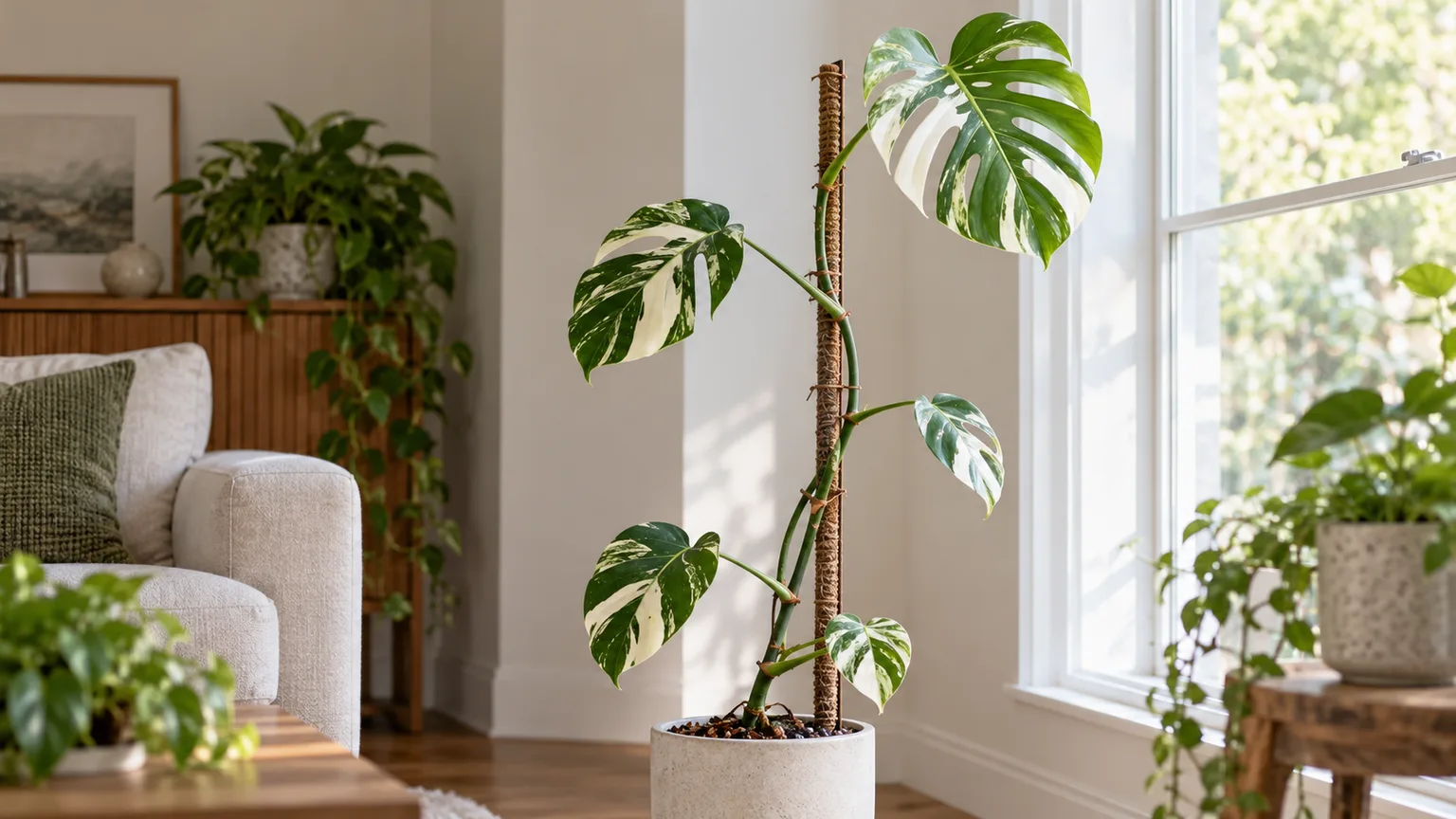
Not Enough Light on Monstera Thai Constellation: Fenestration Loss, Browning Cream & Fixes
This guide covers not enough light on Monstera Thai Constellation. See also the general Not Enough Light guide, watering, and light pages for this plant.
Not Enough Light on Monstera Thai Constellation: Fenestration Loss, Browning Cream & Fixes
Quick answer
Monstera deliciosa ‘Thai Constellation’ cannot maintain its signature fenestrations or sustain its cream variegation in standard low-light indoor environments. Because its cream and ivory patches completely lack chlorophyll, the plant depends solely on its green leaf tissue to drive photosynthesis. When ambient photon delivery falls below the plant’s light compensation threshold, the green tissue cannot generate sufficient carbohydrates to maintain cellular respiration throughout the entire leaf blade. As an energy-conservation mechanism, the plant systematically sacrifices its non-productive cream sectors—leading to localized cellular collapse and dry brown necrosis—while new foliage emerges noticeably smaller, unfenestrated, and carried on elongated, sagging petioles.
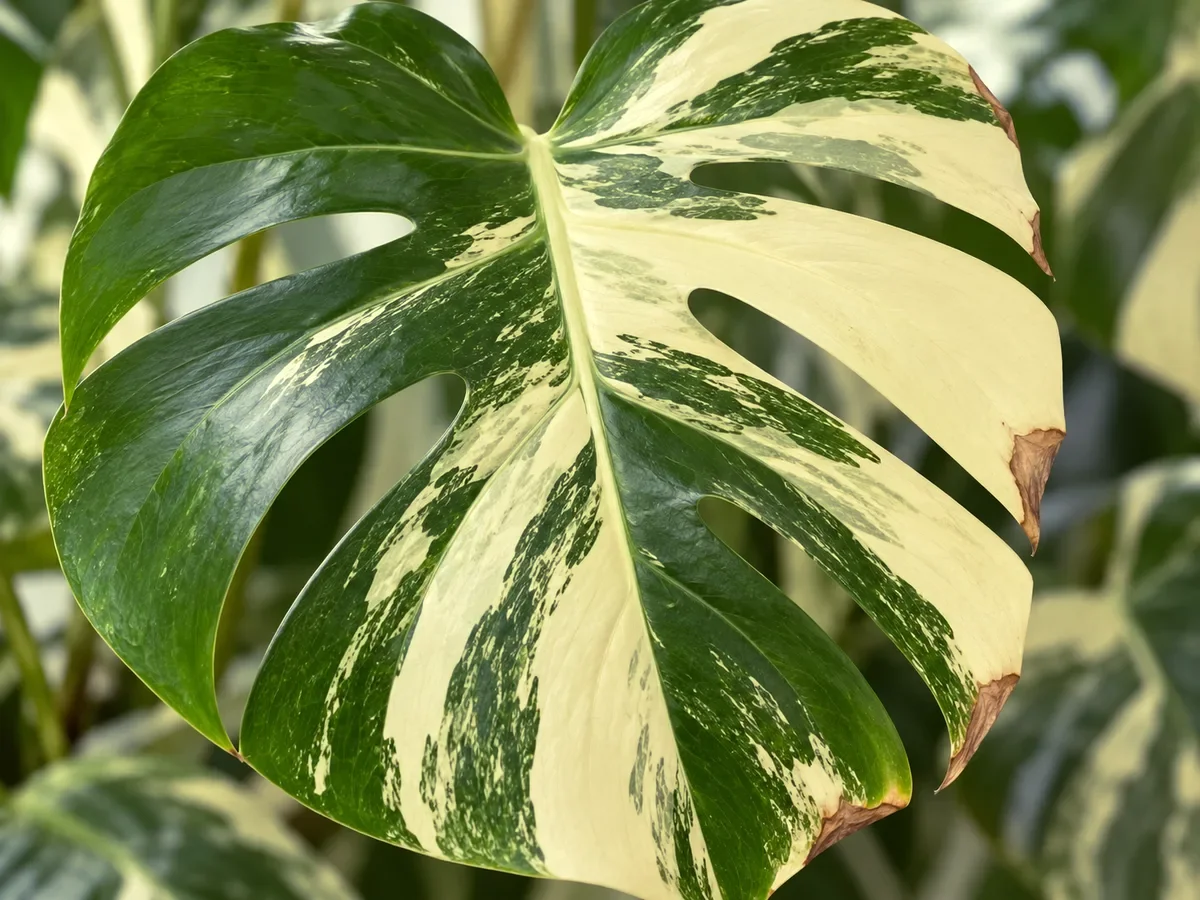
Close-up showing localized cellular necrosis within chlorophyll-free variegated sectors on a Monstera Thai Constellation leaf caused by persistent photon starvation.
Simultaneously, low light severely suppresses transpiration. When photosynthetic activity slows, water uptake at the root zone drops by 60% to 80%, leaving standard potting mix damp and waterlogged for two to three weeks or longer. Resolving insufficient light on Monstera Thai Constellation requires immediate repositioning 2 to 4 feet from an unobstructed east-facing or sheered south/west window, supplemental full-spectrum horticultural LED lighting delivering 250 to 400 µmol/m²/s Photosynthetic Photon Flux Density (PPFD), and a strict weekly 90-degree rotation schedule. For systemic lighting principles across houseplants, reference our global not enough light guide; this document details the unique genetic, anatomical, and salvage realities of ‘Thai Constellation’.
Botanical context: The chimera energy deficit
Understanding why Monstera deliciosa ‘Thai Constellation’ deteriorates so rapidly under low light requires examining its underlying botany. Unlike wild-type green Monstera deliciosa, which naturally climbs forest canopies from southern Mexico to Central America, ‘Thai Constellation’ is a lab-developed cultivar originating from tissue culture in Thailand. Its distinctive marbling, speckling, and large cream patches are the visual result of a stable sectorial and mericlinal chimera mutation.
In wild-type green leaves, almost every mesophyll cell is packed with chloroplasts containing chlorophyll a and b, capturing light energy to synthesize glucose:
$$6\text{CO}_2 + 6\text{H}_2\text{O} + \text{photons} \longrightarrow \text{C}6\text{H}{12}\text{O}_6 + 6\text{O}_2$$
On a Thai Constellation leaf displaying 20% to 50% cream variegation, that photosynthetic machinery is completely missing across those pale sectors:
- Chloroplast Absence in L2 Tissue: The mutated L2 cell histogenic layer lacks functional thylakoid membranes and chlorophyll pigments. These white and cream areas do not synthesize sugars; however, they remain living plant tissue that continues to consume ATP and carbohydrates through baseline aerobic respiration.
- Elevated Light Compensation Point: Because only the green sectors produce sugars while the cream sectors consume them, the plant operates with a significantly higher light compensation point—the light intensity where photosynthetic carbon assimilation equals respiratory carbon loss.
- Variable Variegation Load: The higher the percentage of variegation on a given blade, the harder the remaining green surface must work. Under low-light conditions (such as deep room corners receiving less than 100 foot-candles), the plant enters a severe net-negative carbon balance.
- Targeted Tissue Senescence (Self-Pruning): When carbohydrate production fails to meet the metabolic demand of the whole plant, the vascular system restricts sucrose, magnesium, and water delivery to the non-producing cream tissue. The cellular vacuole walls collapse, turning cream patches into papery, dark brown necrotic zones.
According to research summarized by NC State Extension, variegated cultivars require significantly brighter exposure than their solid green counterparts to produce comparable biomass and maintain cellular vigor. Placing a Thai Constellation in lighting conditions suited for a standard green Monstera guarantees gradual decline.
Diagnostic symptom profile on Monstera Thai Constellation
Insufficient light on Monstera Thai Constellation rarely manifests as an isolated visual symptom; rather, it produces a coordinated whole-plant syndrome affecting new leaf morphology, structural architecture, root-zone hydrology, and variegated sectors.
| Diagnostic Sign | Anatomical Mechanism | Diagnostic Confidence | Primary Risk |
|---|---|---|---|
| Loss of Fenestrations | Suppressed gibberellic acid synthesis and inadequate carbohydrate reserves during leaf primordium differentiation | High | Permanent juvenile growth habit |
| Small, Solid New Leaves | Cellular division restricted by low photosynthetic energy during shoot emergence | High | Structural stunting and loss of specimen value |
| Drooping, Sprawling Petioles | Weakened cellular turgor and extreme phototropic elongation searching for photons | Moderate to High | Mechanical snapping, lanky growth form |
| Soggy Soil (>2–3 Weeks) | Drastically diminished stomatal conductance and transpirational pull at root level | High | Opportunistic root rot (Pythium, Phytophthora) |
| Brown Necrosis on Cream Patches | Starvation-induced cellular self-pruning and localized tissue collapse | High | Secondary saprophytic fungal infection |
                       INSUFFICIENT LIGHT (<150 PPFD)
                                    │
           ┌────────────────────────┴────────────────────────┐
           ▼                                                 ▼
Reduced Photosynthetic Assimilation               Suppressed Transpirational Pull
           │                                                 │
     ┌─────┴──────────────┐                            ┌─────┴──────────────┐
     ▼                    ▼                            ▼                    ▼
Low Auxin/Energy    Carbohydrate Starvation      Stomata Stay Closed   Soil Stays Soaked
     │                    │                            │               (>2-3 Weeks)
     ▼                    ▼                            ▼                    ▼
Small Blades &      Plant Abandons Non-Green     Loss of Stem       Root Hypoxia &
No Fenestrations    Cream Patches (Browning)     Turgor / Droop     Opportunistic Rot
1. Vanishing fenestrations and miniature leaf blades
In mature Monstera deliciosa, fenestrations (both lateral margin cuts and midrib perforations) serve an ecological role: they allow intense wind and flecks of high-intensity canopy sunlight to penetrate lower leaves without damaging large leaf planes. The formation of these perforations is energetically demanding and controlled during early leaf primordium morphogenesis deep inside the petiole sheath.
If your plant was previously producing split leaves with perforated inner fenestrations and suddenly puts out a smaller, solid leaf without a single cut, light deficiency is the primary cause. As highlighted by Wisconsin Horticulture, Monstera requires substantial light intensity and mechanical support to progress from juvenile entire leaves to mature pinnatifid forms. In low light, the plant conserves cellular resources by producing simple juvenile leaves.
2. Drooping and etiolated petioles (Extreme phototropism)
Houseplant growers frequently misinterpret drooping leaves on a Thai Constellation as a cry for water. When light levels are inadequate, the plant produces elevated levels of the plant hormone auxin on the shaded side of the petioles, forcing them to elongate rapidly toward the nearest light source. Because these elongated petioles develop thinner cell walls with reduced lignin reinforcement, they cannot support the weight of heavy, thick variegated blades, causing them to bow horizontally and droop.
Check our in-depth analysis on leggy growth on Monstera Thai Constellation to evaluate node spacing and petiole elongation.
3. Substrate dry-down stagnation: The root-zone link
Under bright light, a robust Thai Constellation functions as an efficient hydraulic pump. The open stomata allow water vapor to escape via transpiration, pulling moisture and dissolved nutrients up through the roots. This transpirational stream normally dries out a well-formulated chunky aroid mix within 7 to 10 days.
When light is chronically dim:
- Guard cells keep stomata largely closed to preserve limited internal moisture.
- Transpiration slows to a crawl.
- The potting mix remains saturated for 14 to 25+ days following a normal watering cycle.
This prolonged saturation expels oxygen from the root zone, creating an anaerobic breeding ground for pathogenic oomycetes. If left unchecked, light starvation seamlessly cascades into devastating root rot on Monstera Thai Constellation.
4. Brown necrosis on cream and marble variegated patches
The most distressing symptom for collectors is seeing pristine cream-colored constellation splatters turn watery yellow and collapse into dry, crunchy brown patches. While high heat or sunburn can scorch cream tissue, low light starves it from within. When total energy production drops below basal maintenance needs, the plant systematically mobilizes mobile nutrients (such as nitrogen, phosphorus, and potassium) out of the cream sectors to preserve its active green growing points. The abandoned cream cells undergo autolysis (cellular self-digestion), yielding localized brown margins and spots.
If your plant is also exhibiting brown tips along green margins, consult our dedicated guide on brown tips on Monstera Thai Constellation.
Differential diagnosis: Separating low light from lookalike problems
Because multiple indoor stressors produce drooping petioles, slow growth, or browning foliage, confirming not-enough-light requires systematically eliminating lookalike conditions.
                               LEAF & SOIL SYMPTOM CHECK
                                           │
                    Is the potting soil staying wet for >2 weeks?
                                ├── YES ──► Check Root Zone & Light Intensity
                                │           ├── Roots firm, light <150 PPFD: LIGHT STARVATION
                                │           └── Roots dark, mushy, foul: ROOT ROT / OVERWATERING
                                │
                                └── NO ──► Check Leaf Texture & Spotting
                                            ├── Crisp brown edges, soil dry in 3 days: UNDERWATERING
                                            ├── Dry, bleached patches facing direct sun: SUNBURN
                                            └── Tiny webbing/stippling on leaf undersides: PESTS
Not enough light vs. Overwatering and root rot
Overwatering and low light are tightly linked twin stressors. True overwatering occurs when an owner drenches a plant on an inflexible calendar schedule regardless of substrate moisture. Low light creates the identical condition indirectly by eliminating the plant’s capacity to process water.
- Differentiating Factor: Inspect the roots. If roots are firm, pale tan or white, and crisp, but the soil has stayed wet for 18 days, the underlying problem is insufficient light suppressing transpirational uptake. If the roots are black, slimy, and shed their outer sheaths when gently pulled, active root rot has already set in. Review our protocol for overwatering on Monstera Thai Constellation.
Not enough light vs. Low humidity stress
Low ambient humidity (below 35% RH) typically causes the extreme tips and paper-thin margins of variegated patches to curl and brown slightly. However, low humidity does not stop fenestration development, does not cause petioles to stretch horizontally toward windows, and does not cause the potting mix to stay wet for weeks. If your plant is growing vigorous, highly fenestrated leaves and dries its soil in 7 days, localized edge crisping is an atmospheric humidity issue rather than a lighting deficit.
Not enough light vs. Direct sunburn (Solarization)
Direct sunburn occurs when a Thai Constellation is suddenly thrust into intense, unfiltered midday summer sun without acclimation.
- Sunburn: Damages the window-facing upper leaf surfaces, presenting as bleached white, yellow-tan, or crispy scorched patches that appear within 24 to 48 hours of exposure.
- Low Light Necrosis: Develops slowly over weeks on cream sectors across any leaf, accompanied by petiole stretching, softening stems, and stagnant root zones.
Actionable restoration protocol: Step-by-step light calibration
Restoring a light-starved Monstera Thai Constellation requires deliberate, incremental environmental adjustments. Sudden drastic changes can shock stressed foliage, while slow half-measures will allow root decay to advance.
Step 1: Calibrate natural window placement
In the Northern Hemisphere, placement relative to window orientation dictates natural usable Photosynthetically Active Radiation (PAR):
- East-Facing Windows (Ideal Natural Exposure): Position your Thai Constellation 2 to 3 feet directly in front of an unobstructed east-facing window. East glass provides gentle, cool morning direct sun (low infrared heat) followed by consistent, bright ambient indirect light throughout the day.
- South-Facing Windows (High Energy with Filtration): South windows offer the highest daily light integral. However, raw summer midday beams through clear glass can scorch delicate cream patches. Place the plant 3 to 5 feet away, or hang a sheer white curtain to diffuse direct rays into a brilliant, soft glare.
- West-Facing Windows: West exposures deliver hot late-afternoon rays. Position the plant 4 to 6 feet back, or ensure sheer filtration between 2:00 PM and 6:00 PM during summer months.
- North-Facing Windows (Inadequate for Thai Constellation): An unobstructed north window rarely delivers more than 75 to 125 foot-candles—far below the compensation point for a heavily variegated Monstera. If a north window is your only natural option, supplemental artificial lighting is non-negotiable.
[!IMPORTANT] Remember the Inverse-Square Law of Light: Light intensity drops exponentially with distance from the source:
$$I = \frac{1}{d^2}$$
A plant moved from 2 feet away from a window to 6 feet away does not lose one-third of its light—it receives only one-ninth ($\approx 11%$) of the original photon volume. Never push a variegated Thai Constellation deep into the interior of a room.
Step 2: Implement supplemental horticultural LED lighting
For consistent leaf fenestration and flawless cream variegation indoors, relying exclusively on ambient window light is often insufficient, especially during autumn and winter months.
        HORTICULTURAL FULL-SPECTRUM LED
                    [===]
                      │
                      │ 12 to 18 Inches
                      ▼
             250–400 µmol/m²/s (PPFD)
            12 to 14 Hours Daily Photoperiod
                      │
           ┌──────────┴──────────┐
           ▼                     ▼
Upper Canopy Emerging Leaf Spire- Light Fixture Specifications: Choose a dedicated horticultural full-spectrum LED (emitting balanced 4,000K to 5,000K daylight with peaks in the 450 nm blue and 660 nm red wavelengths). Avoid basic household incandescent or weak decorative LED bulbs.
- Target PPFD and Lux Targets:
- Minimum Survival Target: 150 µmol/m²/s PPFD (~750 foot-candles / 8,000 lux).
- Optimal Growth & Fenestration Target: 250 to 400 µmol/m²/s PPFD (~1,200 to 2,000 foot-candles / 13,000 to 22,000 lux).
- Upper Threshold (Risk of Bleaching): >500 µmol/m²/s PPFD without carbon dioxide supplementation.
- Distance from Canopy: Suspend the fixture 12 to 18 inches directly above the highest leaves and the central emerging leaf spire. If using a spot-style LED bulb (such as a 36W PAR38 horticultural bulb), ensure the beam angle illuminates the entire leaf plane rather than creating a narrow, scorching hotspot.
- Photoperiod Duration: Plug the lighting system into a digital timer calibrated for 12 to 14 hours of continuous daily illumination. This ensures the plant achieves an adequate Daily Light Integral (DLI) of 12 to 16 mol/m²/day.
For custom calculations based on your room dimensions, glass type, and fixture wattage, use our specialized interactive tool:
[!TIP] Calculate Your Lighting Needs: Use the Plant Light Calculator to input your window distance, orientation, and LED specifications to determine exact PPFD and daily run times for your Thai Constellation.
Step 3: Recalibrate the watering schedule to match increased transpiration
As you increase photon delivery, photosynthetic assimilation and transpirational pull will ramp up significantly over a two- to three-week acclimation period. However, do not immediately flood the pot:
- Always verify substrate moisture at depth using a wooden dowel or moisture probe inserted two-thirds into the root ball.
- Only apply water when the top 50% to 75% of the chunky potting mix is completely dry to the touch.
- Ensure excess water drains freely through the pot’s drainage holes; never allow the root zone to sit in runoff water collected inside an outer decorative saucer.
- Review our comprehensive instructions on Monstera Thai Constellation watering and baseline Monstera Thai Constellation light requirements.
Step 4: Establish a weekly 90-degree rotation routine
Monstera leaves possess distinct pulvini (flexible swelling at the junction of the petiole and blade) capable of rotating the leaf face toward the primary light vector. When light arrives from only one direction, the plant develops an unbalanced, forward-heavy silhouette, with rear leaves languishing in deep shade.
- The Rotation Rule: Rotate the container 90 degrees clockwise once every week when inspecting soil moisture.
- Support Consideration: If your Thai Constellation is secured to a sturdy cedar plank or sphagnum moss pole, keep the pole facing away from the window and angle the front canopy toward the light source, rotating slightly within a 45-to-90-degree arc so both left and right leaf lobes receive equal photon saturation.
Step 5: Triage and prune necrotic cream sectors
Growers often wonder whether to remove damaged leaves or cut away brown patches on cream sectors:
- Preserve Photosynthetic Green Tissue: Never sever an entire leaf simply because 30% of its cream sector has browned. The remaining 70% green tissue is actively manufacturing sugars essential for powering the next emerging leaf.
- Cosmetic Trimming: If brown necrotic edges on cream patches bother you aesthetically, use sharp, sterile shears to trim the dead tissue, leaving a thin 1 mm margin of dry brown tissue. Do not cut into healthy living cream or green tissue, as open wounds invite bacterial pathogens.
- Disinfect Tools: Sterilize shears with 70% isopropyl alcohol between every cut to prevent cross-contamination.
Recovery timeline and monitoring benchmarks
Recovering from light starvation requires patience. Aroids do not heal damaged tissue; instead, recovery is measured by the health, size, and architecture of subsequent growth cycles.
WEEKS 1–2                 WEEKS 3–6                 WEEKS 8–12+
Light Intensity Raised    Soil Dry-Down Normalizes  First New Leaf Emerges
──────────────────────    ────────────────────────  ──────────────────────
• Position adjusted       • Transpiration speeds up • Leaf blade is larger
• LED timer set (12-14h)  • Mix dries in 7-10 days  • Petiole stays upright
• Browning on cream stops • Stems firm up           • Fenestrations resume
Weeks 1 to 2: Stabilization
The immediate goal is halting the progression of necrosis. Once photon intensity reaches 250–400 PPFD, the energy deficit ceases. Existing brown spots on cream sectors will dry out and stop spreading. The root zone will begin breathing as soil water consumption slowly increases.
Weeks 3 to 6: Hydrological and structural recovery
You will observe the potting mix drying out predictably within 7 to 10 days rather than remaining soggy for weeks. Petioles that were sagging from turgor loss will firm up, holding the leaf blades at a natural, upward-angled posture facing the light source.
Weeks 8 to 12+: Emergence of mature, fenestrated foliage
When the next leaf cataphyll swells and emerges from the petiole sheath, inspect the new blade as it unfurls. Provided light levels remained above 250 PPFD, the new leaf will exhibit increased surface area, thicker cuticle development, vibrant cream-to-green contrast, and the triumphant return of deep lateral splits and fenestrations.
Common mistakes to avoid during light recovery
| Mistake | Why It Harms Monstera Thai Constellation | Correct Action |
|---|---|---|
| Heavy Fertilization in Low Light | Stressed roots cannot absorb excess mineral salts; fertilizer salts accumulate in the mix, burning root tips and accelerating cream necrosis. | Withhold high-nitrogen fertilizers until the plant is in bright light and actively unfurling new leaves. |
| Repotting into an Oversized Container | Moving a light-starved plant into a larger pot increases the volume of wet, uncolonized soil, guaranteeing root asphyxiation. | Maintain a tight root ball in chunky, well-aerated aroid mix until roots completely fill the current pot. |
| Sudden Move into Unfiltered Direct Summer Sun | Tender cream tissue lacking protective anthocyanins and carotenoids scorches and bleaches within hours. | Acclimate plants over a 14-day transition period, moving 6 inches closer to bright windows every few days. |
| Using Low-Wattage Decorative Bulbs | Cheap warm-white household desk lamps lack the required PAR spectrum and photon density to reach 250 PPFD. | Invest in horticultural full-spectrum LED fixtures rated with documented PPFD output maps. |
| Severing Unfenestrated Leaves Prematurely | Stripping solid green-and-cream leaves removes the very solar panels the plant needs to build future fenestrations. | Retain all living foliage until the plant has produced at least 2 to 3 new, fully fenestrated mature leaves. |
Long-term light management and seasonal adjustments
Indoor light dynamics fluctuate dramatically throughout the year. Maintaining peak vigor on Monstera deliciosa ‘Thai Constellation’ requires proactive seasonal adjustments:
- Winter Light Deficits: In temperate regions, winter brings shorter daylight hours, lower sun trajectories, and frequently overcast skies. Ambient indoor light can plummet by 50% to 70%. Extend your LED grow light photoperiod to 14 hours daily from November through February to compensate for seasonal deficits.
- Summer Solar Shifts: As the sun rises higher in the sky during summer, direct beams penetrate deeper into south- and west-facing rooms. Ensure sheer drapery is drawn during peak solar hours (11:00 AM to 3:00 PM) to protect variegated cream sectors from solar thermal stress.
- Climbing Poles for Light Capture: Monstera is a natural hemiepiphyte that climbs host trees to reach brighter canopy light. Providing a sturdy moss pole, cedar board, or trellis allows the plant to orient its leaves in an organized, shingled ladder. This vertical arrangement maximizes photon interception for every leaf while encouraging the root system to anchor firmly.
For broader diagnostic context across all common physiological, cultural, and pest issues affecting this cultivar, browse the complete Monstera Thai Constellation problems hub.