Underwatering on Monstera Thai Constellation: Fix Dry Soil
Quick answer
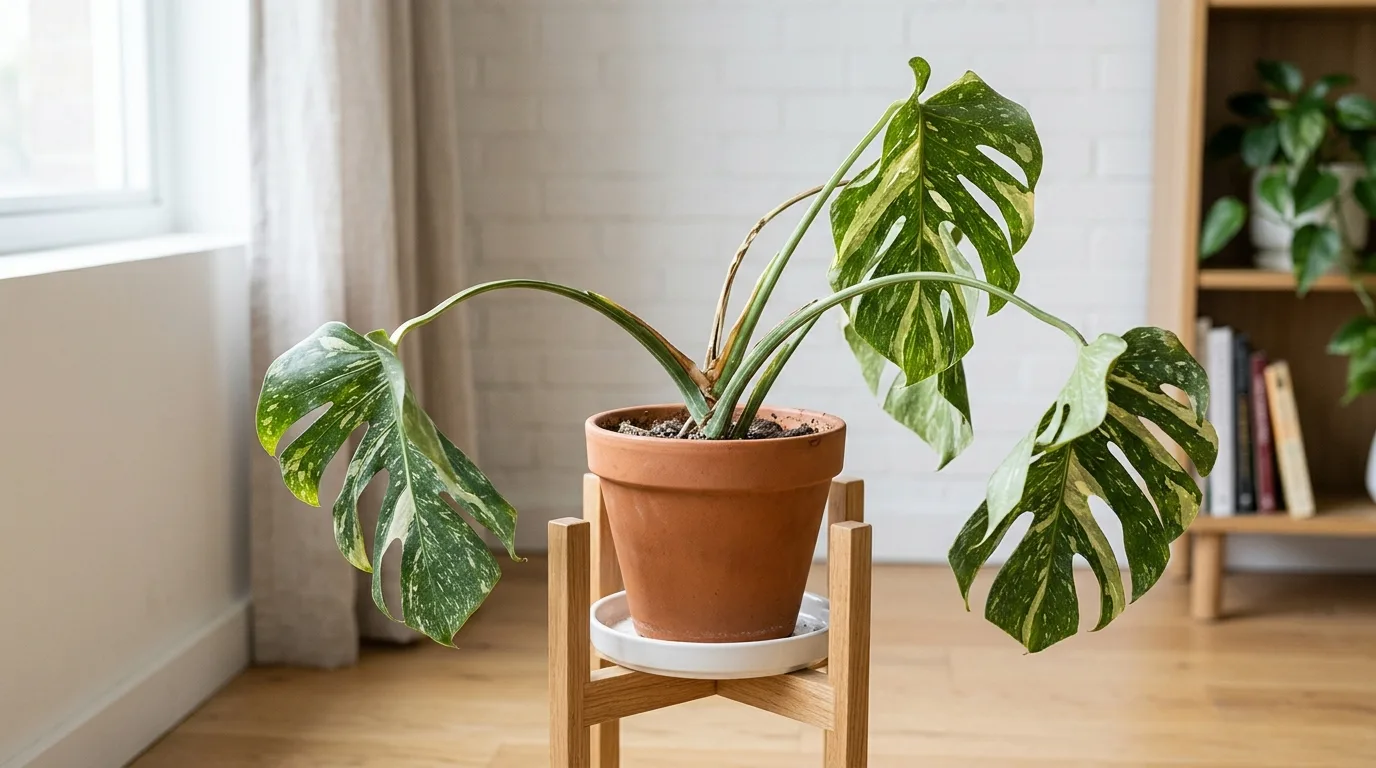
Underwatering on Monstera Thai Constellation causes an acute loss of hydraulic turgor pressure, leading to inward-curling leaf margins, downward-arching petioles with firm (not mushy) bases, and dry, papery brown tips on cream variegation. Severe dry-down causes peat-based potting substrates to become hydrophobic, repelling top-poured water down the inner walls of the container. The primary fix is a deep bottom soak for 30 to 45 minutes to re-saturate the root core, followed by gentle aeration of dense substrate pockets and maintaining a consistent dry-down cycle where only the top third of the mix dries before the next deep drench.
Underwatering on Monstera Thai Constellation: Diagnosis, Rehydration & Root Recovery
This guide covers underwatering on Monstera Thai Constellation. See also the general Underwatering guide, watering, and light pages for this plant.
Underwatering on Monstera Thai Constellation: Diagnosis, Rehydration & Root Recovery
Quick answer
When a Monstera Thai Constellation is severely underwatered, its expansive, cream-marbled leaves undergo an acute collapse of hydrostatic turgor pressure. Turgor pressure is the internal hydraulic force that pushes cell membranes firmly against rigid plant cell walls, holding heavy petioles upright and keeping broad variegated blades spread horizontally. When the root zone exhausts its reservoir of plant-available water, transpirational water loss outpaces water absorption, causing petioles to droop, leaf margins to curl inward, and delicate cream-white sectors to develop papery brown edges.
While houseplant growers are frequently cautioned against overwatering this prized cultivar due to its susceptibility to root rot, extreme underwatering is equally destructive. Prolonged drought shrinks the root ball, damages microscopic feeder root hairs, and turns peat-based potting substrates completely hydrophobic—meaning top-watered moisture simply runs down the sides of the container without hydrating the inner root core. For fundamental principles on how drought stress impacts houseplants across species, refer to our global underwatering guide. On Monstera Thai Constellation, however, the heavy mass of mature foliage and the fragile nature of non-chlorophyllous variegated tissue demand a targeted, systematic approach to rehydration.
First step: Lift the container to check its physical weight and insert a wooden skewer or moisture meter deep into the center of the root ball. If the container is featherlight, the soil has pulled away from the inner pot rim, and petiole bases remain firm and non-mushy, submerge the bottom third of the container in lukewarm water for 30 to 45 minutes to re-saturate the hydrophobic root ball.
When to use this page vs other Monstera Thai Constellation guides
Because drooping and foliage browning can arise from opposing care mistakes, verify your plant’s symptoms using the diagnostic routing table below before applying treatments.
| Observed Symptom Pattern | Primary Root / Substrate State | Guide to Consult |
|---|---|---|
| Inward-curling leaf margins, limp petioles with firm bases, dry contracted soil | Bone-dry, featherlight pot; hydrophobic soil | This guide (Underwatering) |
| Downward-arching petioles with soft leaf blades; soil dry or damp | General loss of hydraulic petiole turgor | Drooping Leaves Guide |
| Crispy, brittle brown tips localized on cream sectors; green tissue firm | Low ambient humidity or erratic moisture cycles | Brown Tips Guide |
| Soft, yellowing lower leaves with black-brown watery lesions; sour soil odor | Saturated, heavy soil; rotted, slipping roots | Root Rot Guide |
| Bleached, faded ivory sectors with paper-dry scorch patches | Intense direct sunlight or uncalibrated grow lights | Light Requirements Guide |
| General care routine, potting substrate recipes, and seasonal watering | Healthy specimen maintenance | Watering Protocol |
What underwatering looks like on Monstera Thai Constellation
Underwatering manifests distinctly on Monstera deliciosa ‘Thai Constellation’ due to its thick, leathery leaf architecture and substantial variegated surface area. Unlike all-green monsteras that may merely exhibit slight petiole sagging, Thai Constellation gives clear anatomical warnings as drought progresses.
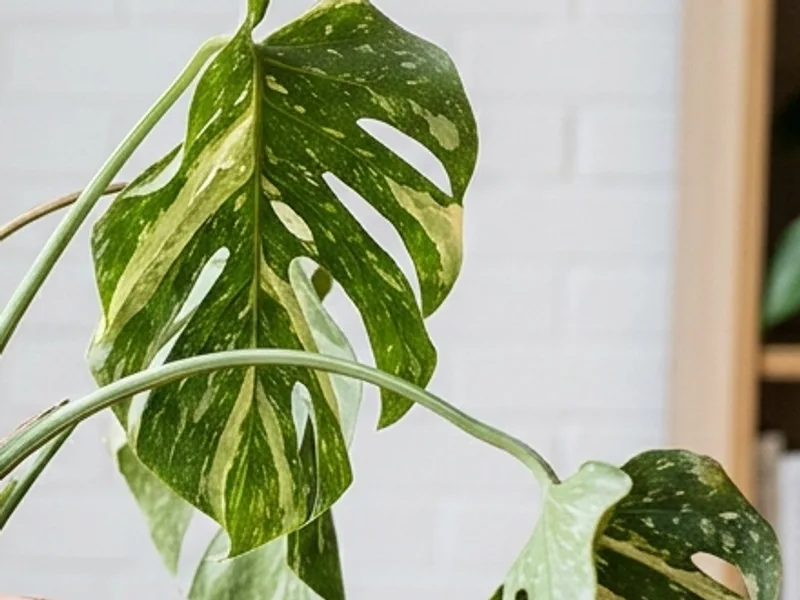
Inward curling along the leaf margins and dry papery edges on Monstera Thai Constellation, signaling advanced cellular water loss and soil desiccation.
Early warning symptoms of underwatering
- Inward rolling of leaf margins: The outer edges of the leaf lobes curl upward and inward toward the central midrib. This curling reduces the total leaf surface area exposed to ambient air currents, directly slowing moisture loss through the stomata located on the lower epidermis.
- Loss of leaf radiance and luster: The rich emerald green and creamy buttermilk sectors lose their semi-gloss sheen, taking on a dull, matte, or grayish appearance.
- Slight softening of the geniculum: The geniculum—the flexible hydraulic joint connecting the petiole to the leaf blade—softens, causing the blade to tilt downward at a steeper angle rather than presenting horizontally toward light sources.
- Featherlight pot weight: Lifting the container reveals an immediate loss of ballast. Dry substrate and dehydrated roots weigh a fraction of an adequately hydrated root ball.
Advanced drought symptoms
- Pronounced petiole drooping with firm bases: Petioles arch downward toward the floor. Crucially, feeling the base of each petiole right where it joins the central climbing stem reveals that the tissue is fibrous, firm, and physically tough—not water-soaked, soft, or squishy as seen in cases of overwatering.
- Substrate shrinkage and potting gaps: The potting medium contracts into a hardened, dense plug, pulling away from the interior walls of the container and leaving a 0.5 to 1.5 cm gap around the perimeter.
- Crisp, papery necrosis on cream sectors: The chlorophyll-free variegated sectors lack substantial epidermal wax and fail to maintain osmotic pressure. As a result, the margins and tips of the cream patches dry out, turning pale tan, brittle, and crispy to the touch.
- Shriveled aerial roots: Aerial roots extending from stem nodes toward the soil or moss pole become brittle, wrinkled, and hollow, losing their firm, fleshy green-brown growing tips.
The botany and cellular mechanics of drought in variegated Monsteras
Understanding why Monstera Thai Constellation reacts severely to prolonged dryness requires examining its unique anatomy and fluid mechanics.
1. Hydrostatic turgor pressure and xylem cavitation
According to University of Wisconsin-Madison Extension, plants lack skeletal systems and depend entirely on hydrostatic turgor pressure to maintain foliar rigidity. Water taken up by active root cells is drawn upward through the xylem vessels by negative pressure generated during leaf transpiration. Inside individual cells, water inflates the large central vacuoles, exerting outward force against the cellulose wall.
When substrate moisture drops below the permanent wilting point, the water potential gradient reverses. The roots can no longer extract water against the high capillary tension of dry soil particles. As water continues to evaporate from broad leaf blades, negative xylem tension increases exponentially, risking xylem cavitation (air bubble formation that breaks continuous water columns). In response, the plant immediately closes its stomata and petiole cells lose their internal pressure, resulting in limp, hanging foliage.
2. Tissue vulnerability of chimeric variegation
The Royal Horticultural Society (RHS) notes that Monstera deliciosa ‘Thai Constellation’ is a genetically stable chimeric cultivar with slower growth and closer leaf spacing than wild-type Monstera deliciosa. The creamy-white and ivory splashes across the leaves are composed of cells that lack functional chloroplasts.
Because these albino cells do not synthesize carbohydrates, they cannot produce the same structural thickness of secondary cell walls or thick cuticular wax layers found in adjacent green parenchyma cells. When water stress hits, the cream sectors lose moisture at an accelerated rate and collapse first. This creates localized cellular necrosis along the margins of variegated sectors long before the resilient green sectors show irreversible damage.
3. The hydrophobic peat phenomenon
Most indoor monsteras are potted in substrates containing sphagnum peat moss or fine coco coir blended with perlite and bark. When peat moss is allowed to dry out completely, its organic surface compounds undergo a chemical transition: non-polar organic molecules reorient outward, rendering the fibers water-repellent (hydrophobic).
When a grower notices drooping leaves on a dry plant and attempts to water it from above with a watering can, the hydrophobic soil sheds the water instantly. The water runs down the contraction fissures along the inside of the pot rim and drains immediately into the drip saucer. The grower assumes the plant has been thoroughly watered, while the internal root ball remains bone-dry dust.
4. Feeder root shriveling and loss of absorptive capacity
As documented by the University of Florida IFAS Extension, aroid root systems consist of thick, fleshy primary structural roots surrounded by delicate, microscopic root hairs and fine feeder roots. These fine feeder roots are responsible for over 90% of actual water and nutrient absorption. During extended drought, the tender root hairs desiccate and die back completely. Even after water is reintroduced, the plant cannot immediately resume full hydration until new root hairs regenerate, explaining why severely underwatered monsteras often take 24 to 48 hours to regain full turgidity.
Differential diagnosis: Underwatering vs. Overwatering
Because both underwatering and overwatering cause drooping foliage, misdiagnosing the problem can lead to fatal consequences. Adding water to an already rotted root system accelerates fungal decay, while withholding water from a parched plant deepens tissue desiccation.
Use this checklist to verify underwatering before taking corrective action:
[Diagnostic Fork: Underwatering vs Overwatering]

Underwatering:
├── Container Weight: Featherlight, effortless to lift
├── Soil Condition: Shrunk away from pot rim; dry dust 3+ inches down
├── Petiole Base: Stiff, firm, fibrous at the soil line (not mushy)
├── Leaf Texture: Thin, papery, margins rolled inward
└── Cream Margins: Crisp, brittle, sharp tan-brown borders

Overwatering / Root Rot:
├── Container Weight: Heavy, waterlogged, cold to touch
├── Soil Condition: Saturated, muddy, stagnant water in saucer
├── Petiole Base: Soft, squishy, dark brown or blackened
├── Leaf Texture: Limp, weeping, blistered edema spots
└── Cream Margins: Soft, water-soaked brown/black lesions with yellow halos
If your plant aligns with the overwatering side of this fork, transition immediately to our Root Rot Guide and review our Watering Protocol.
Step-by-step restoration: How to safely rehydrate a desiccated Thai Constellation
Restoring an underwatered Monstera Thai Constellation requires breaking substrate hydrophobicity without waterlogging the roots, followed by an orderly recovery protocol.
[Rehydration & Recovery Timeline]
Day 1: Capillary Bottom Soak ────► Days 2-5: Turgor Rebound ────► Weeks 2-4: Root Regeneration
• Submerge bottom 1/3 of pot       • Inward leaf curl flattens     • Fine feeder roots rebuild
• 30-45 min slow saturation        • Petioles rise 30°-60°         • Resume 1/3 dry-down cycle
• Allow full 20 min drainage       • Monitor cream sector margins  • Next leaf emerges upright
Phase 1: Breaking soil hydrophobicity through bottom soaking (Day 1)
Surface watering will not penetrate a hydrophobic root ball. Bottom soaking uses capillary pressure to draw moisture evenly into the center of the substrate:
- Prepare a soaking tub: Fill a clean bucket, sink, or basin with 3 to 4 inches of lukewarm, room-temperature filtered or tap water (ideally 68°F–75°F / 20°C–24°C). Avoid ice-cold water, which shocks tropical aroid roots and induces vascular shock.
- Submerge the pot: Set your Thai Constellation container directly into the water. Ensure the water level reaches approximately one-third of the way up the height of the pot.
- Wait for capillary action: Allow the container to sit in the water for 30 to 45 minutes. Watch as water is drawn upward through the drainage holes. The soil surface will gradually darken and expand as moisture penetrates the root core.
- Moisten the upper crust: If the top inch of soil remains dry after 30 minutes, slowly pour 1 to 2 cups of water over the top soil surface to bridge capillary contact.
- Drain completely: Remove the container from the soaking tub and place it on an elevated wire rack or tilt it slightly in the sink for 15 to 20 minutes. All excess gravitational water must drain out completely. Empty the drip saucer thoroughly before placing the plant back in its decorative cachepot. Never leave the pot sitting in standing drainage runoff.
Phase 2: Relieving soil compaction and aeration (Days 2 to 3)
Repeated drying cycles can leave dense pockets of compacted peat within the root ball:
- Probe compacted pockets: Take a clean wooden chopstick or bamboo skewer and gently insert it 3 to 4 inches deep into the potting mix in three or four spots around the perimeter of the root ball.
- Aerate gently: Gently wiggle the skewer back and forth to loosen compressed peat pockets and allow oxygen to reach the rehydrated root system. Penn State Extension emphasizes that maintaining substrate porosity is essential for indoor monsteras, preventing water stagnation after a deep watering.
- Close perimeter gaps: Press the top edges of the soil lightly inward toward the pot rim to seal any lingering perimeter chasms where future water might bypass the roots.
Phase 3: Calibrating the ongoing soak-and-dry cycle (Weeks 2 to 4)
Once turgor pressure is restored, establish a disciplined watering cadence tailored to this cultivar:
- The one-third dry-down rule: Allow only the upper 25% to 35% (top 2 to 3 inches in a 10-inch container) of the substrate to dry out before irrigating again. Insert a wooden skewer into the root zone: if the top 2–3 inches come out clean and dry, but the skewer reveals cool, slightly moist mix at the lower third, it is time to water thoroughly.
- Avoid the extremes: Thai Constellation does not tolerate standing in soggy soil, but allowing it to become bone-dry dust between waterings will repeatedly destroy fragile feeder roots and cause progressive cream sector browning.
- Monitor transpiration: Keep ambient relative humidity at 55% to 65% to reduce moisture loss while damaged root hairs regenerate.
Mistakes to avoid when correcting underwatering
- Mistake 1: Rapid top splashing without breaking hydrophobicity. Pouring a small cup of water over bone-dry soil moistens only the top half-inch, while the rest channels down the sides of the pot. The plant remains in severe drought despite frequent superficial waterings.
- Mistake 2: Leaving the pot submerged in standing water for days. While a 30-to-45-minute bottom soak is therapeutic, leaving the pot sitting in standing water for 24+ hours suffocates roots, inviting anaerobic Pythium or Phytophthora pathogens and triggering catastrophic root rot.
- Mistake 3: Applying chemical fertilizer to dry roots. Never feed a dehydrated plant. Mineral salts in fertilizer draw water out of already shriveled root cells through reverse osmosis, causing chemical root burn and widespread foliar scorch. Withhold all fertilization until the plant has fully stabilized and pushed a healthy new leaf.
- Mistake 4: Misting curled foliage with a spray bottle. Spraying water droplets directly onto curled leaves does nothing to resolve root-zone thirst. Standing water trapped inside the folds of curled cream variegation creates a prime breeding environment for bacterial leaf blight (Pseudomonas or Xanthomonas).
- Mistake 5: Pruning drooping or curled leaves prematurely. Even when curled and drooping, intact leaves continue to photosynthesize and generate vital carbohydrates needed to regenerate desiccated root hairs. Do not prune foliage unless a leaf has turned completely yellow or necrotic.
Monstera Thai Constellation care cross-check
To keep your Thai Constellation vibrant and prevent future drought collapse, align your routine with the plant’s natural epiphytic physiology:
- Watering Protocol: Water thoroughly until water flows freely from the drainage holes, then discard all saucer runoff. Re-water only when the top one-third of the substrate has dried out.
- Soil Mix Requirements: Pot in an open, coarse aroid blend containing 40% chunky orchid bark, 30% perlite or pumice, and 30% coco coir or peat moss. This open structure resists hydrophobic compaction while providing ample oxygenation.
- Light Requirements: Provide 8 to 10 hours of bright, indirect light (2,000–4,000 lux or 200–400 foot-candles). Variegated sectors require ample light for the green sectors to synthesize energy, but intense direct midday sun will scorch un-turgid foliage.
- Support & Climbing Anchors: Secure the central climbing stem to a sturdy moss pole or cedar plank. NC State Extension notes that climbing monsteras rely on support to bear the weight of mature leaves, preventing stem bending during temporary moisture shifts.
- Comprehensive Problems Hub: Routinely inspect foliage for pests like thrips or spider mites, which exploit drought-stressed foliage and accelerate cellular dehydration.
Related tool
To eliminate guesswork and establish a customized moisture schedule based on your specific pot dimensions, container material, room temperature, and lighting levels:
Use the Plant Watering Calculator to calculate precise watering intervals and hydration volumes for your Monstera Thai Constellation.
Related Monstera Thai Constellation guides
Deepen your cultivation knowledge with these targeted guides from our Monstera Thai Constellation care cluster:
- Monstera Thai Constellation Care Overview: Complete botanical care profile, light targets, and cultivar maintenance.
- Watering Guide for Monstera Thai Constellation: In-depth soak-and-dry protocols, seasonal cadence changes, and pot weight checks.
- Aroid Soil & Repotting Guide: How to formulate coarse, high-aeration mixes that prevent hydrophobicity and root rot.
- Light Requirements Guide: Balancing foot-candles and grow lights to support cream variegation without foliar burn.
- Root Rot Treatment & Surgery: Critical steps for diagnosing and treating waterlogged, fungal-infected root systems.
- Monstera Thai Constellation Problems Hub: The complete troubleshooting directory for leaf discoloration, pest attacks, and physiological stress.