Mealybugs on Monstera Thai Constellation: Safe Removal &
Quick answer
Mealybugs (Pseudococcidae) on Monstera deliciosa 'Thai Constellation' conceal themselves within persistent winged petiole sheaths, deep basal leaf sinuses, and wrinkly geniculum creases, siphoning phloem sap and triggering localized necrosis across chlorophyll-free cream variegation. First step: isolate the plant immediately and dab individual pests with a 70% isopropyl alcohol cotton swab. For extensive infestations, deploy diluted insecticidal soap during evening hours with a post-treatment rinse, or apply systemic imidacloprid granules into the chunky aroid substrate to eradicate hidden colonies without risking phototoxic oil burn on delicate cream tissue.
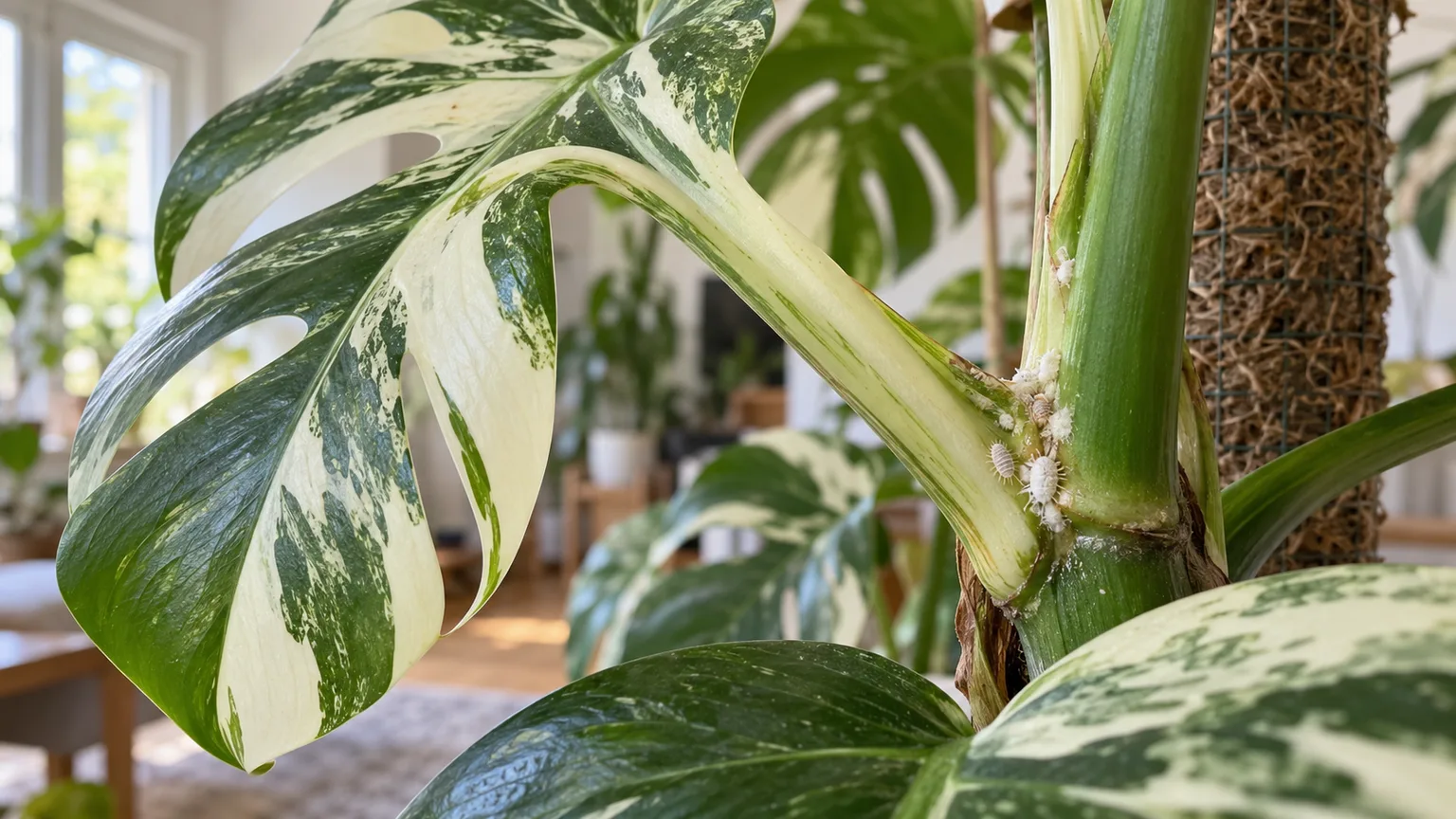
Mealybugs on Monstera Thai Constellation: Identification, Safe Removal & Variegation Protection
This guide covers mealybugs on Monstera Thai Constellation. See also the general Mealybugs guide, watering, and light pages for this plant.
Mealybugs on Monstera Thai Constellation: Identification, Safe Removal & Variegation Protection
Quick answer
Mealybugs (Pseudococcidae) on Monstera deliciosa ‘Thai Constellation’ are soft-bodied, sap-sucking scale insects that conceal themselves beneath dense coatings of white, powdery, hydrophobic wax. While mealybugs plague many common houseplants, an infestation on a Thai Constellation is exceptionally perilous. This prized chimeric cultivar possesses delicate cream-and-ivory variegated sectors that lack chlorophyll, making them far less resilient to vascular sap loss than solid-green monsteras. Furthermore, the species’ distinctive winged petiolar sheaths (vagina), deep basal leaf sinuses, and wrinkly geniculum creases create sheltered architectural cavities where mealybugs establish massive cryptic colonies long before they are noticed on open leaf blades.
For widespread insect mechanics, physiological feeding vectors, and multi-species lifecycle stages, consult our comprehensive global mealybug symptom guide. When treating a Thai Constellation specifically, eradication requires surgical precision: you must eliminate the wax-shielded colonies without dissolving the thin epicuticular waxes of the non-chlorophyllous cream sectors, which easily suffer fatal phototoxic burns from standard horticultural oils or improper soap washes.
First step: quarantine the plant immediately and spot-treat every visible cottony cluster with a cotton swab saturated in 70% isopropyl alcohol. The alcohol instantly penetrates and dissolves the insect’s protective waxy coating, dehydrating and killing both adult females and egg masses on contact without requiring whole-plant chemical drenches. Seal the container with plastic wrap to prevent dislodged nymphs from washing into the chunky aroid substrate, and never expose recently treated foliage to intense grow lights or direct sun.
What mealybugs look like on Monstera Thai Constellation
Detecting mealybugs early on a variegated aroid requires vigilant inspection. Because the foliage is naturally speckled, splashed, and marbled with ivory, cream, and pale yellow flecks, small clusters of cottony white pests can easily blend into the variegation at a casual glance.
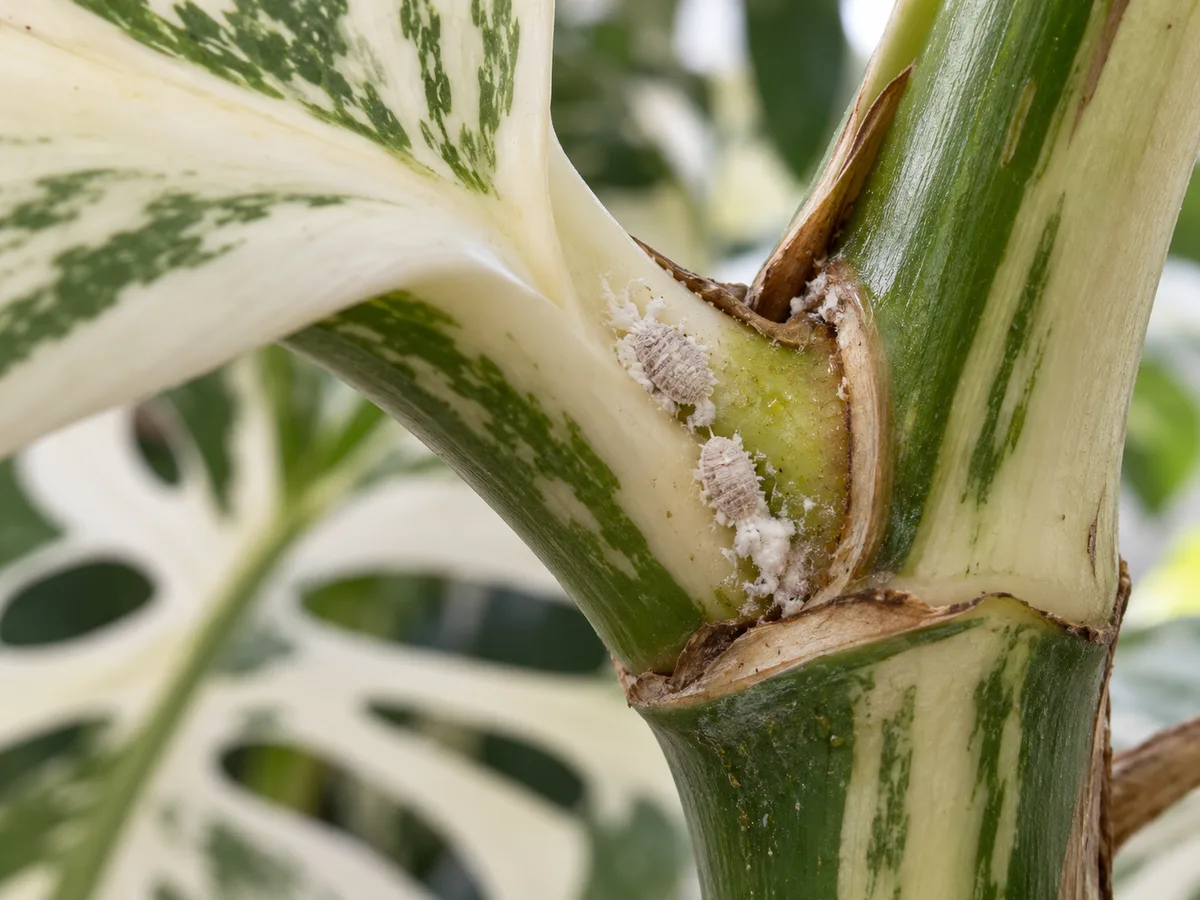
Mealybug colonies, cottony ovisacs, and waxy secretions tucked inside the petiolar sheath fold of a Monstera Thai Constellation.
Key visual indicators on variegated foliage
According to UC IPM guidelines, mealybugs are unarmored, slow-moving scale insects ranging from 1/10 to 1/4 inch (2 to 6 mm) in length. Indoors, infestations on tropical aroids are primarily driven by the citrus mealybug (Planococcus citri) and the long-tailed mealybug (Pseudococcus longispinus). On Monstera Thai Constellation, scout for the following distinctive diagnostic signs:
- Cottony, waxy masses: Adult females and egg sacs (ovisacs) appear as small, dense puffs of brilliant white, web-like cotton nestled tightly into petiole folds, stem nodes, and along the abaxial (underside) midribs.
- Oval, segmented bodies with wax filaments: Beneath the waxy powder, the insects have flattened, oval, distinctly segmented pinkish or yellowish bodies bordered by 17 pairs of short, white, waxy filaments. In long-tailed mealybugs, the caudal (tail) filaments can be as long as or longer than the insect’s entire body.
- Mobile yellow/orange crawlers: Newly hatched first-instar nymphs, known as crawlers, are microscopic (less than 1 mm), smooth, yellow to light orange, and lack the heavy waxy coating of mature adults. They actively scurry along petiole ridges and leaf blades searching for fresh phloem vessels.
- Sticky, lacquered honeydew: Mealybugs ingest vast quantities of plant phloem sap to extract essential amino acids, excreting the excess liquid sugar as clear, sticky honeydew. This sticky substance coats lower leaf surfaces, petiole bases, and even surrounding flooring.
- Opportunistic black sooty mold: Airborne fungal spores of Capnodium spp. germinate rapidly on sugary honeydew deposits. While the mold does not infect living plant tissue directly, the black, powdery fungal crust blankets the cream and green sectors, blocking solar radiation and drastically reducing photosynthetic output.
- Localized chlorosis and sector yellowing: Where mealybugs cluster and feed along the vascular bundles, adjacent cream tissue rapidly turns dull, collapses, and develops bright yellow halos, eventually turning into brown necrotic patches.
- Distorted expanding blades and aborted fenestrations: When mealybugs feed inside an unopened leaf roll or within the tight petiolar sheath during leaf morphogenesis, their toxic salivary secretions stunt cellular expansion. Once unfurled, the newly opened leaf displays asymmetric margins, puckered fenestrations, or deformed cuts.
Prime concealment zones on Monstera Thai Constellation anatomy
A successful diagnosis depends on inspecting specific morphological micro-habitats where mealybugs take refuge. Because Monstera deliciosa possesses complex structural architecture, relying only on broad blade inspections guarantees missing early colonies.
1. Persistent winged petiole sheaths (vagina)
As documented by NC State Extension, Monstera deliciosa features robust, winged petiolar structures (vagina / petiole wings). On Thai Constellation, each successive petiole carries deep, persistent flanking wings that fold inward, forming a tight structural channel that enclosed the prior emerging leaf. These anatomical folds create dark, humid microclimates that are completely shielded from ambient room air currents, grower inspections, and contact pesticide sprays. Mealybugs exploit these crevices as breeding strongholds, multiplying undetected behind the sheath wings until hundreds of crawlers emerge onto the leaf blade.
2. Deep leaf sinuses (basal clefts and fenestration margins)
The cordate (heart-shaped) base of mature Thai Constellation leaves forms deep basal leaf sinuses where the blade tissue overlaps near the petiole apex. Additionally, as the plant matures, dramatic fenestrations (slits and perforations) develop. The interior margins and sharp angles of these leaf sinuses form tight crevices where mealybug crawlers settle. Feeding along the fragile sinus margins often leads to early margin browning and asymmetrical leaf expansion.
3. Geniculum creases and hinge wrinkles
At the junction between the petiole and the broad leaf blade sits the geniculum—a specialized, swollen pulvinoid joint that allows the heavy leaf to articulate, twist, and adjust its orientation toward light sources. As the plant flexes, the epidermis of the geniculum develops micro-wrinkles and transverse creases. Mealybugs wedge themselves tightly into these geniculum folds. Because the geniculum acts as the primary vascular bottleneck delivering sap to the entire leaf blade, heavy pest feeding at this point disrupts water transport, causing premature leaf droop and chlorosis across cream fenestrations.
4. Aerial root nodes and axillary buds
Along the main climbing stem, aerial roots emerge from nodal cushions immediately below dormant axillary buds. Mealybugs congregate in the tight ring where the emerging aerial root meets the stem epidermis. Left unchecked, feeding here can stunt adventitious root formation and introduce opportunistic rot pathogens into vascular nodal plates.
Why Monstera Thai Constellation is exceptionally susceptible to mealybugs
While mealybugs attack many common house plants, several structural and physiological characteristics of Monstera deliciosa ‘Thai Constellation’ make an infestation uniquely severe and difficult to manage.
1. High phloem pressure in climbing stems and succulent petioles
Monsteras are massive hemi-epiphytic climbers equipped with thick, water-storing petioles and robust aerial root nodal cushions. UF/IFAS Extension notes that mealybugs gravitate toward succulent ornamental stems that maintain high vascular turgor pressure. The succulent petioles and nodal junctions of Thai Constellation transport concentrated sucrose and nitrogenous sap from mature leaves to active shoot apices, providing an uninterrupted nutritional reservoir for feeding colonies.
2. Vulnerability of achlorophyllous cream tissue
Monstera deliciosa ‘Thai Constellation’ is a stable chimeric mutation characterized by large sections of cells lacking chloroplasts. According to the Royal Horticultural Society, Thai Constellation exhibits a slower growth rate and distinct leaf architecture compared to the standard wild species. Because the cream sectors contain no chlorophyll, they produce zero carbohydrates of their own and operate with substantially thinner epicuticular wax and fragile cell walls. When mealybugs insert their stylets into the vascular strands supplying these variegated sections, the cream tissue suffers rapid osmotic collapse:
- The lack of stored photosynthetic starches means cream cells have no metabolic reserve buffer against sap extraction.
- Pierced cream tissue quickly turns translucent, then bright sulfur-yellow, and finally collapses into papery brown necrosis within 5 to 7 days of intense feeding.
- Toxins injected in mealybug saliva during feeding disrupt localized hydraulic pressure, accelerating irreversible margin melt across cream fenestrations.
3. Parthenogenesis and rapid indoor multiplication
In typical indoor living conditions (68°F to 82°F / 20°C to 28°C), mealybug lifecycles accelerate dramatically. Wisconsin Extension explains that female mealybugs can lay 300 to 600 eggs within a cottony ovisac over a two-week period. Eggs hatch into mobile crawlers in as little as 6 to 10 days. Indoors, where natural predators like ladybird beetles (Cryptolaemus montrouzieri) and parasitic wasps (Leptomastix dactylopii) are absent, overlapping generations continuously repopulate the vine unless interrupted by systematic interventions.
Foliar vs root mealybugs: assessing below-the-soil risk
Growers facing a persistent mealybug outbreak on Thai Constellation must distinguish between foliar mealybugs and ground-dwelling root mealybugs (Rhizoecus spp.).
| Diagnostic Criterion | Foliar Mealybugs (Pseudococcidae) | Root Mealybugs (Rhizoecus spp.) |
|---|---|---|
| Primary Feeding Zone | Petiolar sheaths, geniculum creases, leaf sinuses, aerial roots | Underground root tips, interior root ball, inside pot drainage holes |
| Visible Residue | Cottony puffs on stems; sticky honeydew on foliage; sooty mold | Chalky, web-like white deposits coating root hairs and inner pot wall |
| Pest Appearance | 2–6 mm, oval, prominent wax filaments, slow crawl | 1–2 mm, slender, pale white or gray, covered in fine waxy meal |
| Initial Plant Symptoms | Yellowing cream sectors, distorted fenestrations, sticky leaves | Generalized slow decline, sudden wilting despite damp soil, pale leaves |
| Substrate Interaction | Crawlers may occasionally cross topsoil to reach adjacent stems | Spend entire lifecycle submerged in the chunky aroid substrate |
If you observe white, chalky, hydrophobic webs clinging to the roots when unpotting or poking through bottom drainage slats, root mealybugs are present. Root mealybugs attack fine root hairs, compromising water intake and mimicking severe root rot or chronic underwatering.
The unique chemical vulnerability of Thai Constellation cream variegation
The single most disastrous mistake a collector can make when combating mealybugs on a Thai Constellation is spraying full-strength horticultural oils, neem emulsions, or harsh chemical detergents across the entire plant.
The phytotoxicity and phototoxicity mechanism
Cream and ivory variegated leaf tissue is fundamentally different from green leaf tissue. Lacking protective pigments and dense cuticular wax, albino sectors cannot dissipate excess thermal or optical energy.
- Wax stripping: Commercial horticultural oils and synthetic dish soaps break down lipids. When applied to cream tissue, they dissolve the fragile outer cuticle, leaving epidermal cells exposed to ambient air and causing catastrophic moisture loss.
- Lens effect under high light: Monsteras with heavy variegation require intense, bright indirect light (250 to 400+ foot-candles) to sustain energy production. If oil or soap droplets remain on cream foliage under grow lights or bright window glass, they act as miniature optical lenses. The trapped heat causes localized phototoxic scald, turning gorgeous cream patches black, mushy, and necrotic within 24 to 48 hours.
- Stomatal blockage: Monstera deliciosa foliage is hypostomatous, meaning stomata reside almost entirely on the leaf underside. Mealybugs congregate along underside veins. Drenching underside surfaces with heavy, non-evaporating oils suffocates these respiratory pores, halting transpirational cooling and gas exchange.
For safe eradication, any topical treatment applied to Monstera Thai Constellation must be diluted, patch-tested, applied strictly during low light or darkness, and thoroughly rinsed off after contact kill time.
How to confirm mealybugs vs lookalike plant issues
Before initiating aggressive treatments, accurately confirm that mealybugs are the true causal agent. Numerous abiotic issues and distinct indoor pests mimic mealybug signs on variegated monsteras.
| Condition / Pest | Primary Visual Clue | Texture / Residue | Key Distinguishing Factor on Thai Constellation |
|---|---|---|---|
| Foliar Mealybugs (Pseudococcidae) | Segmented oval insects under white cottony wax; lateral filaments | Sticky honeydew; cottony ovisacs; dissolves brown with alcohol | Dissolves instantly into a yellowish-brown dot upon contact with 70% alcohol |
| Cottony Cushion / Soft Scale (Coccidae) | Convex, hard or leathery oval domes; white ribbed egg sacs | Heavy honeydew; immobile adult shells; no lateral waxy filaments | Hard protective shell cannot be wiped away with a dry swab; requires scraping |
| Powdery Mildew (Erysiphales) | Powdery, talcum-like circular white dusting across upper leaf blade | Dry, chalky dust; no honeydew; no cottony webbing | Distributed uniformly across flat leaf surface; not concentrated in axils; no insects |
| Spider Mites (Tetranychidae) | Microscopic specks (0.5 mm); fine silken sheets across leaf fenestrations | Dry webbing gathering dust; fine bronze/yellow stippling; no honeydew | Tiny moving dots on fine silk webs; leaves feel gritty like sandpaper |
| Perlite / Soil Debris | Irregular, angular white granules clinging to stems or lower petioles | Hard, mineral, granular; does not smear or crush into moisture | Inanimate volcanic glass particles; easily brushed off dry; no cottony fibers |
| Natural Guttation | Clear water droplets suspended from tips and fenestrations in morning | Pure water; completely non-sticky; evaporates cleanly | Occurs after watering in high humidity; leaves zero sticky residue on fingers |
Step-by-step eradication protocol for Monstera Thai Constellation
Eradicating mealybugs from a prized Monstera Thai Constellation requires a disciplined, multi-phase integrated pest management (IPM) approach that destroys the insects while safeguarding variegated foliage and chunky root substrate.
Phase 1: Immediate isolation and root-zone containment
The moment a cottony mass or sticky honeydew drop is detected:
- Quarantine the plant: Move the Thai Constellation to a dedicated isolation room at least 15 to 20 feet away from other houseplants, especially other aroids like Philodendron, Epipremnum, Syngonium, and other Monstera cultivars.
- Bag the root ball: Wrap the entire pot and the base of the stem tightly in plastic cling wrap or a clean plastic garbage bag. Tie it securely around the lower stem with soft plant velcro. This critical barrier accomplishes two goals: it prevents dislodged mealybugs and crawlers from falling into the potting mix to start a subterranean colony, and it stops excess water and pesticide run-off from waterlogging the chunky aroid mix during washing.
Phase 2: Precision 70% isopropyl alcohol spot swabbing (the primary fix)
For localized colonies, manual spot-swabbing with isopropyl alcohol is the safest, most effective direct-contact kill method.
- Use 70% concentration: Do not use 91% or 99% isopropyl alcohol, as ultra-high concentrations evaporate too quickly to penetrate dense wax and can dehydrate plant cuticle tissue. Do not use rubbing alcohol formulated with wintergreen oils, artificial scents, or skin lubricants.
- Saturate a cotton swab: Dip a precision pointed cotton swab into 70% isopropyl alcohol until moist, but not dripping wet.
- Target and press: Press the swab firmly against every visible mealybug and cottony ovisac. You will observe the white waxy coating instantly dissolve, turning the insect into a pale yellowish-brown or red corpse. Wipe the dead insect and egg residue away cleanly.
- Scout hidden recesses: Carefully pull back the outer edges of winged petiolar sheaths, inspect the wrinkled creases of the geniculum, check basal leaf sinuses, examine aerial root nodes, and swab along the main abaxial leaf veins.
- CRITICAL WARNING FOR UNOPENED LEAF ROLLS: Never insert an alcohol-drenched swab into a tightly rolled, unfurled new leaf or pour alcohol into the deep basin of an emerging petiolar sheath. The enclosed tissue of an expanding leaf has virtually zero cuticular wax and cannot tolerate alcohol exposure; trapped alcohol will cause severe chemical burning, resulting in the emergent leaf rotting or unfurling with pitch-black, dead sectors. For tight sheaths, use dry swabs or lukewarm water rinses instead.
Phase 3: Mechanical dislodging rinse (lukewarm shower)
After swabbing all visible adults, use physical water pressure to wash away microscopic crawlers and invisible eggs.
- Prepare lukewarm water: Regulate water temperature in a walk-in shower or sink to lukewarm (72°F to 78°F / 22°C to 25°C). Cold water shocks tropical roots and leaves, while hot water scalds variegated tissue.
- Rinse with moderate pressure: Using a handheld shower wand or gentle spray nozzle, wash the plant thoroughly from top to bottom. Direct water into the petiolar sheath folds, across leaf sinuses and geniculum creases, over leaf undersides, and around climbing poles. Avoid pinpoint high-pressure streams that could rip fenestrations or bruise tender cream margins.
- Wick trapped water: Once rinsing is complete, take a clean, dry paper towel and gently wick away any water trapped inside the deep recesses of the petiolar sheaths and geniculum folds. Standing water in warm, stagnant petiole axils encourages opportunistic bacterial soft rot (Pectobacterium carotovorum, formerly Erwinia).
Phase 4: Safe topical treatment with dilute insecticidal soap
If mealybugs have spread across multiple leaves and sheaths, a whole-plant topical spray is necessary to kill remaining crawlers. UMass Extension emphasizes that contact sprays like insecticidal soap must directly coat crawler nymphs to disrupt cellular membranes effectively. Follow these strict rules to prevent phytotoxic damage:
- Formulation selection: Use a commercially formulated insecticidal soap containing potassium salts of fatty acids. Avoid harsh household dishwashing detergents, which strip protective cuticular waxes.
- Dilution: Mix the spray at half the standard label concentration (e.g., 0.5% to 1% solution rather than 2%). A weaker concentration is completely lethal to soft-bodied crawlers while drastically reducing chemical stress on unpigmented cream sectors.
- Mandatory patch test: Always apply a small spray test to one lower green leaf sector and an adjacent cream sector. Wait 24 to 48 hours under normal conditions. If the cream tissue becomes watery, translucent, or yellow, discontinue use immediately.
- Timing and lighting: Never spray during daytime or under illumination. Move the plant away from windows and shut off all grow lights. Spray exclusively in the evening or in a dark room. The liquid must remain wet on the pests to dissolve cuticles without solar or optical radiation accelerating chemical burn.
- Targeted coverage: Coat leaf undersides, stem nodes, geniculum joints, and outer sheath margins. Do not drench the plant to excessive runoff.
Phase 5: Post-treatment rinse-off protocol
To guarantee zero delayed phototoxicity once the plant returns to its normal lighting environment:
- Allow contact kill: Allow the diluted soap spray to sit on the plant for 2 to 3 hours in darkness. This provides ample time to dissolve pest cuticles and suffocate crawlers.
- Clean-water rinse: Fill a spray bottle or shower wand with pure, lukewarm distilled or filtered water and thoroughly mist down all treated foliage. Use a soft microfiber cloth to gently wipe residual surfactant films off the broad variegated blades.
- Air dry in low light: Allow the plant to dry completely with the aid of a gentle room oscillating fan before re-engaging grow lights or returning the specimen to sunny filtered windows.
Phase 6: Systemic insecticide application (imidacloprid granules)
For large moss-pole specimens or chronic, recurring mealybug infestations where pests consistently hide inside inaccessible woody stem folds and tight petiole sheaths:
- Systemic mechanism: Systemic insecticides, such as imidacloprid granules (where permitted by local environmental regulations), are absorbed by the plant’s root system and translocated through xylem and phloem vessels directly into leaf tissue. When mealybugs pierce vascular vessels to feed, they ingest the compound and die.
- Application: Sprinkle systemic granules evenly across the surface of the chunky aroid substrate at label rates and water in thoroughly. Because the insecticide is internal, it spares delicate cream foliage from topical chemical contact.
- Ecological caution & spider mite monitoring: Imidacloprid is ineffective against non-insect arachnids. Extensive horticultural research confirms that imidacloprid applications can trigger secondary outbreaks of two-spotted spider mites (Tetranychus urticae) by stimulating mite reproduction and killing off predatory mites. If you apply systemic granules, maintain strict weekly scouting for spider mite webbing and stippling on leaf undersides.
Phase 7: Cleaning honeydew and secondary sooty mold
Leaving sticky honeydew deposits on broad variegated leaves invites fungal growth and attracts household ants (Formicidae) that actively protect mealybugs from eradication.
- Wipe formulation: Mix 1 quart of lukewarm distilled water with 2 drops of mild baby shampoo or unscented castile soap.
- Support the blade: Place your hand flat under the leaf blade to support its weight and prevent creasing the petiole or damaging the geniculum.
- Gentle downward strokes: Moisten a clean microfiber cloth and gently wipe the leaf blade from the central petiole insertion point outward toward the leaf margins and sinuses.
- Removing sooty mold: Never scrape or aggressively scrub dry sooty mold off delicate cream sectors. Lay a warm, damp cloth over the moldy spot for 60 seconds to soften the crust, then wipe it away smoothly.
What heals and what stays permanently damaged
Managing recovery expectations helps avoid panic and prevents unnecessary chemical escalation.
Irreversible damage (what will never heal)
- Piercing scars and necrotic brown spots: Where mealybugs pierced cream tissue, the localized dead cells cannot regenerate. Brown, papery scars on cream margins remain permanently.
- Distorted leaf margins and asymmetrical fenestrations: If a leaf was attacked during unfurling, the missing and stunted cellular sections will never expand or realign. The leaf will retain its crinkled, asymmetric form for its natural lifespan.
- Yellowed cream sectors: Once non-chlorophyllous cream sectors turn bright yellow or brown from vascular depletion, they cannot revert to pristine ivory or white.
Fully recoverable aspects (what will bounce back)
- Subsequent new leaf flushes: The apical meristem remains protected within the stem. Once mealybugs are fully eliminated, the subsequent leaf that emerges will unfurl healthy, symmetrical, and fully fenestrated.
- Photosynthetic recovery: Clearing sooty mold and honeydew from healthy green sectors restores full gas exchange and light capture, enabling the vine to rebuild carbohydrate reserves.
- Root and stem vitality: Halting sap depletion stops progressive wilting, allowing roots to resume active white tip extension in the chunky substrate.
Should you prune damaged variegated leaves?
Unless a leaf is more than 60% to 70% dead and decaying, do not prune it immediately. Even a distorted, scarred leaf with torn fenestrations possesses green chlorophyllous zones that synthesize essential sugars needed to power new leaf development. Removing foliage prematurely robs a slow-growing Thai Constellation of stored vitality. Wait until the vine has produced at least one or two flawless, fully hardened new leaves before considering aesthetic pruning. When you do prune, follow our dedicated Monstera Thai Constellation pruning guide to sterilize shears and protect node margins properly.
Recovery timeline and monitoring checklist
Eradicating mealybugs is an iterative 4-to-6-week process governed by the pest’s reproductive cycle. Track your plant’s recovery with this schedule:
| Timeline | Grower Actions & Interventions | Target Positive Milestones | Warning Signs Requiring Retreatment |
|---|---|---|---|
| Day 1 | Isolate plant; seal root ball in plastic; swab all visible cottony clusters with 70% alcohol; lukewarm shower rinse. | All mature cottony masses dissolved; honeydew rinsed clean from blades. | Mix gets soggy; water pools inside emerging petiole sheaths. |
| Days 3–4 | Hand-lens inspection of winged petiolar sheaths, geniculum creases, and leaf undersides; spot-swab any stragglers. | Zero large adult clusters; no fresh sticky honeydew on foliage below. | Tiny yellow/orange crawlers spotted migrating along petiole wings. |
| Day 7 | Conduct second lukewarm water shower and apply half-strength insecticidal soap spray in darkness. | Foliage remains firm; no new chlorotic yellowing on cream sectors. | Fresh cottony ovisac appearing in petiole axil; soap scorch on cream sectors. |
| Day 14 | Thorough clean-water rinse; inspect all node crevices; apply systemic imidacloprid granules to soil if selected. | Zero active adults or honeydew detected for 7 consecutive days. | Nymphs emerging from deep within newest unfurling leaf roll. |
| Day 21 | Comprehensive scouting with 10x magnifying loupe; wipe mature leaves with clean microfiber cloth. | Emerging leaf shoot pushes cleanly from sheath with crisp, unmarred margins. | Persistent honeydew sheen; presence of spider mite webbing from stress. |
| Day 28–35 | Final quarantine clearance inspection; unwrap container; return plant to display collection if 100% clean. | New variegated leaf unfurls symmetrical, vibrant, and fenestrated. | Re-emergence of cottony masses; repeat entire 14-day protocol immediately. |
Critical mistakes to avoid when treating Thai Constellation
Avoid these five frequent mistakes that transform a manageable mealybug problem into catastrophic leaf loss:
- Spraying full-strength horticultural oils under intense lighting: Applying heavy horticultural oils or neem oil and placing the plant back under bright LED grow lights or sunny windows magnifies heat and burns cream sectors, causing extensive black necrosis within 48 hours.
- Drenching isopropyl alcohol into unopened leaf sheaths: Inserting alcohol swabs deep into tight, unexpanded leaf tubes strips delicate embryonic cells of moisture, causing the emerging leaf to turn black and abort before unrolling.
- Repeatedly soaking the potting medium without a protective seal: Showering the plant multiple times a week without wrapping the pot saturates the chunky aroid substrate, leading to oxygen deprivation and lethal root rot. Always verify moisture levels using our Monstera Thai Constellation watering guide.
- Applying high-nitrogen fertilizers during an active infestation: Feeding a stressed plant with rich nitrogen fertilizer stimulates soft, thin-walled, amino-acid-rich vegetative growth that fuels explosive mealybug reproduction. Withhold fertilizer until pest eradication is confirmed and active root growth resumes.
- Stacking multiple harsh chemical sprays simultaneously: Combining insecticidal soap, neem oil, systemic sprays, and alcohol washes within 72 hours destroys the protective plant cuticle, causing widespread leaf drop and physiological collapse. Implement one targeted measure at a time.
Long-term care cross-check and prevention
Permanent protection against mealybugs requires optimizing environmental conditions that strengthen the plant’s natural physical barriers.
1. Maintain high indirect light to build thick cuticular wax
A Thai Constellation grown in dim light develops thin, soft cell walls and a fragile epidermal layer that mealybugs easily pierce. Provide your plant with 250 to 400+ foot-candles (2,500 to 4,500 lux) of bright indirect light for 12 hours daily. Strong light thickens the waxy cuticle on green tissue, making sap extraction difficult for crawlers. Learn proper placement strategies in our Monstera Thai Constellation light guide.
2. Follow a strict dry-down watering rhythm
Never water on a rigid weekly calendar schedule. Always allow the top 2 to 3 inches (5 to 8 cm) of chunky aroid mix to dry out thoroughly between deep irrigations. Maintaining proper root-zone aeration prevents root dieback and maintains optimal hydraulic pressure, ensuring leaves remain turgid and resistant to pest feeding.
3. Build a coarse, highly oxygenated chunky aroid substrate
Compact, peat-heavy potting soils retain excess moisture and attract root mealybugs and fungus gnats. Plant your Thai Constellation in a custom chunky aroid mix consisting of coarse orchid bark, pumice or coarse perlite, horticultural charcoal, and coco coir. For detailed substrate recipes and component balancing, see our dedicated Monstera Thai Constellation soil guide and Monstera Thai Constellation repotting guide.
4. Enforce strict quarantine and bi-weekly scouting
Most mealybug infestations enter your home via newly purchased plants, cuttings, or plants brought indoors after a summer outdoors. Maintain a mandatory 21-to-30-day quarantine for all new arrivals. Every two weeks, examine your Thai Constellation’s winged petiolar sheaths, geniculum creases, and leaf sinuses with a flashlight and hand lens, and wipe down foliage with a damp microfiber cloth to remove dust and early crawler scouts.
Related Monstera Thai Constellation guides
Deepen your care routine and protect your variegated foliage with our connected cultivar resources:
- Monstera Thai Constellation Overview: Baseline botanical cultivar data, mature growth habit, moss pole mounting, and comprehensive pet toxicity profiles.
- Monstera Thai Constellation Watering Guide: Prevent root rot risks by mastering seasonal dry-down intervals for chunky aroid mix.
- Monstera Thai Constellation Light Guide: Maintain high foot-candle levels (200–400+ fc) to build thick leaf cuticles and prevent scorch.
- Monstera Thai Constellation Soil Guide: Formulate the ultimate chunky aroid substrate with optimal aeration and root drainage.
- Monstera Thai Constellation Repotting Guide: Safely repot without disturbing fragile root systems or stalling variegation.
- Monstera Thai Constellation Pruning Guide: Safely remove scarred leaves and manage vine nodes without sacrificing vigor.
- Monstera Thai Constellation Problems Hub: Complete diagnostic directory for pests, edema, fungal spots, and leaf yellowing.
Related tool
Diagnose pest pressure, leaf symptoms, and environmental stress specific to your variegated aroid with our interactive Plant Problem Diagnosis Tool.