Brown Tips on Monstera Thai Constellation: Causes, Cream
Quick answer
Brown tips on Monstera Thai Constellation occur primarily on cream-variegated sectors because chlorophyll-deficient tissue has weaker cellular walls and desiccates first under dry air or root stress. Crisp, papery margins indicate low humidity (<50% RH) or underwatering, while soft, dark brown edges with yellow halos signal root hypoxia and overwatering edema. Stabilize foliage by maintaining 55–65% humidity and watering only after the top 3–5 cm of chunky aroid mix dries.
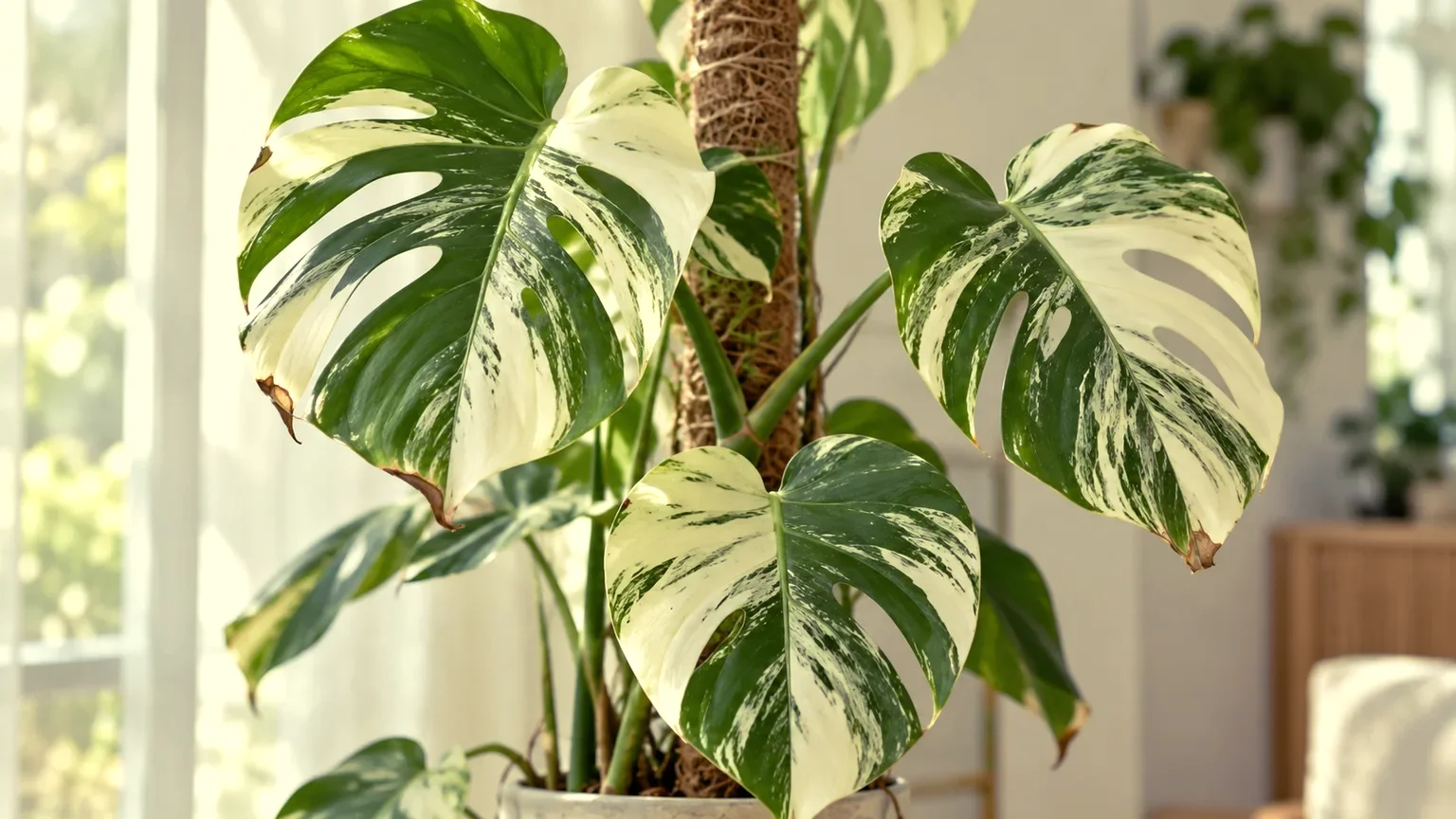
Brown Tips on Monstera Thai Constellation: Causes, Cream Sector Care & Fixes
This guide covers brown tips on Monstera Thai Constellation. See also the general Brown Tips guide, watering, and light pages for this plant.
Brown Tips on Monstera Thai Constellation: Causes, Cream Sector Care & Fixes
Quick answer
Brown tips and margins on Monstera deliciosa ‘Thai Constellation’ are the most common complaint among variegated aroid growers. Unlike solid green monsteras that tolerate wide indoor humidity swings, Thai Constellation carries large sectors of achlorophyllous (cream, ivory, or pale yellow) tissue. These variegated patches possess thinner cell walls and lower mechanical strength, making them the plant’s physiological “canary in the coal mine.” When indoor air dries out, water becomes erratic, or roots suffocate in stagnant moisture, the cream margins desiccate and die first.
For general leaf edge drying across indoor species, review our comprehensive brown tips symptom guide. On Monstera Thai Constellation, however, successful treatment requires immediate triage between two diametrically opposed causes: crisp, brittle margins from dry air (<50% relative humidity) or underwatering, versus soft, water-soaked, dark brown necrosis with yellow halos caused by root hypoxia and edema.
First step: Feel the affected leaf tips. If the brown edges are dry and crunch like autumn leaves, raise ambient humidity to 55–65% and check your dry-down depth. If the edges feel cool, soft, or pliable and display a yellow border on wet potting mix, withhold water immediately and inspect the root zone for oxygen deprivation.
When to use this guide vs other Thai Constellation pages
Because Monstera Thai Constellation represents a significant investment, growers often misdiagnose leaf stress. Use this diagnostic matrix to route your plant’s symptoms:
| Symptom Pattern | Substrate Condition | Root / Stem State | Read Next |
|---|---|---|---|
| Crisp, papery brown tips on cream sectors; green tissue untouched | Dry top 5 cm; pot feels lightweight | Roots firm, tan-white; stem solid | Stay on this guide (Dry air or underwatering) |
| Dark brown to black edge patches with yellow chlorotic halos | Heavy, wet mix for 7+ days | Pot smells sour; lower roots dark | Overwatering guide & this guide |
| Brown tips accompanied by drooping, curled, limp foliage | Bone dry throughout container | Roots shriveled, brittle | Underwatering guide |
| Irregular yellowing on entire lower leaves; mushy petioles | Saturated, compacted soil | Soft, dark, slipping root sheaths | Root rot rescue |
| Bleached, parchment-white or tan scorched patches on upper leaf blades | Normal moisture | Foliage directly exposed to hot glass | Light guide |
| Stippling, fine webbing, or silvery patches preceding browning | Normal moisture | Undersides show tiny moving specks | Spider mites guide |
Why cream variegated sectors brown first: the botany of Thai Constellation
To fix brown tips on Monstera Thai Constellation, you must understand how its tissue is structured. According to the Royal Horticultural Society, Thai Constellation is an evergreen climber featuring creamy-white and pale yellow variegation, closer leaf spacing, and a growth rate that is noticeably slower than wild Monstera deliciosa. Unlike Monstera deliciosa ‘Albo Variegata’—a sectorial chimera prone to reverting or throwing pure white “ghost” leaves—Thai Constellation’s variegation is genetically stable across cell layers.
However, genetic stability does not equal physical resilience. The creamy splash marks, speckles, and large sectoral blocks consist of cells completely devoid of chloroplasts. This cellular architecture creates three distinct vulnerabilities:
- Zero Photosynthetic Energy Production: Because cream sectors produce no sugars, they rely entirely on adjacent green tissue for carbohydrate transport. When the plant experiences environmental stress, it prioritizes energy-producing green foliage and readily sacrifices parasitic cream margins.
- Defective Cuticle and Cell Wall Density: Green leaf tissue possesses robust palisade mesophyll cells protected by a dense waxy cuticle. Variegated albino cells have significantly thinner cell walls and a weaker cuticle, accelerating cuticular transpiration and moisture loss under low ambient humidity.
- Impaired Osmotic Regulation: Normal leaf stomata regulate transpiration through potassium ion exchange driven by photosynthetic energy. In achlorophyllous sectors, guard cell regulation is sluggish, making cream tissue unable to retain internal moisture when dry ambient air demands water faster than root pressure can supply it.
When water loss exceeds hydraulic supply, cells along the leaf margins—the furthest points from the petiole’s vascular bundle—suffer catastrophic cavitation and dehydrate, leaving behind dead, brown cell walls.
What brown tips look like on Monstera Thai Constellation
Diagnosing the precise cause requires close visual examination of the boundary where healthy cream tissue meets the brown necrosis.
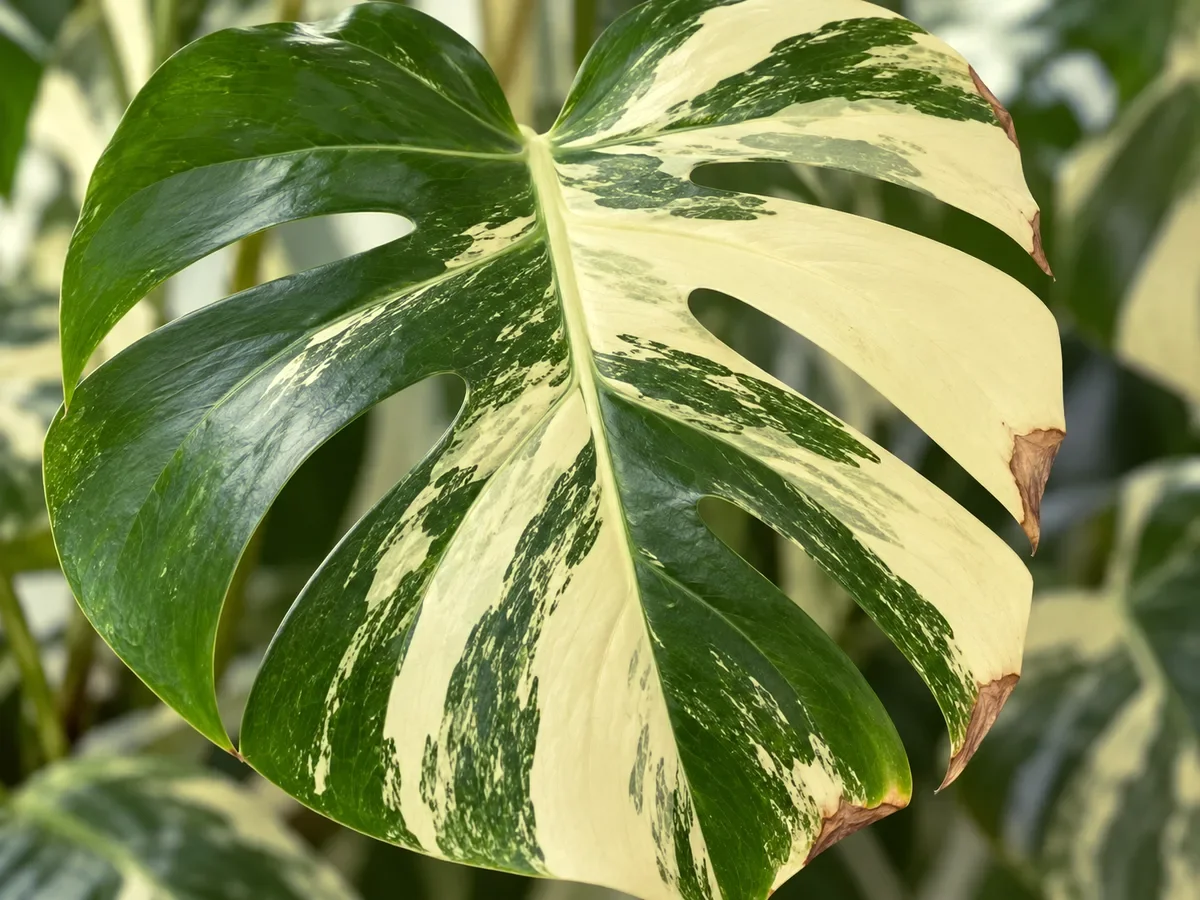
Brown necrotic edges forming along the cream-variegated margin of a Monstera Thai Constellation leaf, where chlorophyll-deficient tissue desiccates before green sectors.
Early warning signs (before extensive necrosis)
- Translucent margins: The outermost 1–2 mm of cream tissue appears faintly transparent or water-soaked before turning tan.
- Micro-curling: The extreme tips of the leaf lobes begin curling inward or downward as cellular turgor drops.
- Loss of cream radiance: Variegated sectors lose their vibrant buttery-cream luster and take on a dull, grayish cast.
- Localized dulling: Green tissue remains dark and glossy, but neighboring cream margins lose firmness.
Advanced symptom progression
- Crisp margin desiccation: Brown tissue turns brittle, papery, and crumbly to the touch. The dead margin stays confined to the cream sector and rarely crosses the vascular vein into dark green tissue unless severe dehydration occurs.
- Edema and black-brown melting: Dark brown or charcoal-colored lesions develop along leaf margins. The affected area feels cool, soft, or damp, and a prominent 2–3 mm yellow halo borders the dying tissue.
- Tip splitting: As mechanical humidity shifts expand and contract brittle dead margins, the leaf tips split along natural venation lines.
The primary causes of brown tips on Thai Constellation
1. Low relative indoor humidity (<50% RH)
Indoor heating in winter and summer air conditioning consistently drive residential relative humidity down to 25–40%. Penn State Extension notes that Monstera prefers humidity above 50%, warning that dry indoor air quickly desiccates foliage. While solid green monsteras adapt to 40% RH with minimal cosmetic damage, Thai Constellation’s fragile cream sectors cannot sustain equilibrium below 50% RH. Moisture is pulled into the dry room air much faster than the plant’s vascular system can pump water through long petioles, resulting in crispy margin collapse.
2. Chronic root hypoxia and overwatering edema
It is a common misconception that all brown tips stem from dry air. In reality, overwatering causes just as many brown margins on Thai Constellation, but through a completely different physiological mechanism. When chunky potting mix breaks down or sits waterlogged in a saucer, soil pore spaces fill with water, stripping roots of gaseous oxygen.
As root hairs die from oxygen starvation, the remaining roots experience irregular hydrostatic pressure. Wisconsin Horticulture Extension explains that edema occurs when roots absorb water faster than leaves can transpire it, causing epidermal cells to swell, burst, and rupture. In variegated monsteras, these ruptured cells collapse into soft, dark necrotic patches accompanied by characteristic yellow halos.
3. Erratic watering cycles and hydrophobic soil
Monstera Thai Constellation despises the “drought-and-deluge” cycle. Allowing a pot to dry out completely until the peat shrinks from the container walls damages root tips. When water is finally applied, the hydrophobic substrate channels moisture down the interior pot walls without saturating the root core. The leaf tips, being the furthest hydraulic termination points, desiccate during the drought phase, while subsequent over-application shocks the damaged root system.
4. Mineral and fertilizer salt accumulation (tap water stress)
Variegated foliage is exceptionally sensitive to dissolved solutes. Tap water high in municipal chlorine, chloramines, fluorine compounds, and dissolved calcium carbonates (hard water above 150 ppm TDS) causes mineral salts to accumulate in the root ball. As Penn State Extension recommends using a balanced fertilizer during active growth, applying full-strength synthetic fertilizers without thorough flushing causes fertilizer salts to build up. These salts create an osmotic imbalance, pulling moisture away from root cells and depositing excess sodium or fluoride ions at leaf tips where they burn tender cream tissue.
5. Sunscorch and excessive thermal radiation
NC State Extension highlights that variegated cultivars need more sunlight than darker green cultivars to power steady growth. However, direct mid-day sun passing through unshaded south- or west-facing window glass creates intense thermal radiation. Because cream tissue lacks protective carotenoid pigments that dissipate excess solar energy as heat, direct sunlight literally cooks the pale cells, leaving bleached, papery brown scorch marks across the variegated leaf face.
Diagnostic checklist: confirm the exact cause
Before altering your plant’s care routine, follow this sequential diagnostic protocol:
[Step 1: Inspect Texture]
   │
   ├─► Crisp, dry, papery, crumbly ──────────► Check Step 2 (Dry Air / Thirst / Salts)
   │
   └─► Soft, cool, limp, yellow halo ────────► Check Step 3 (Root Hypoxia / Edema)

[Step 2: Dry Air vs Underwatering vs Salts]
   │
   ├─► Soil bone-dry, pot light, leaves drooping ──► Underwatering / Erratic hydration
   │
   ├─► Soil properly moist, room RH <45% ────────► Low ambient humidity / draft vent
   │
   └─► White crust on soil/pot rim, tap water ─────► Salt & mineral toxicity

[Step 3: Moisture & Root Evaluation]
   │
   ├─► Substrate soggy 5 cm down, heavy pot ──────► Waterlogged soil / low light
   │
└─► Sour soil odor, dark mushy roots ──────────► Root rot (Requires unpotting)- Perform the Texture Test: Gently pinch the brown margin between your fingers. Crisp and brittle confirms desiccation (humidity, underwatering, or salts). Soft and cool with an oily or translucent border confirms edema and overwatering.
- Inspect the Border Zone: A clean, distinct boundary between brown dead tissue and cream flesh indicates dry air or physical burn. A fuzzy yellow chlorotic halo separating the brown dead zone from living tissue confirms active vascular stress, overwatering, or fungal infection.
- Probe Core Soil Moisture: Insert a clean wooden skewer into the bottom third of the root ball. Pull it out after 10 minutes. If it comes out dark and damp with soil clinging to it while the plant shows brown tips, moisture is excessive. If it emerges dry and clean, the root ball is dehydrated.
- Examine Container Aeration: University of Florida IFAS Extension stresses that proper houseplant containers must have free-draining drainage holes to allow excess water to escape and prevent root rot. If your pot has no drainage holes or sits in standing water inside a decorative cachepot, root suffocation is the underlying culprit.
First corrective fixes: stabilize the plant today
Once you have identified the primary driver, implement these targeted botanical corrections immediately:
If the cause is low humidity or dry air
- Deploy a Cool-Mist Humidifier: Position a dedicated ultrasonic or evaporative humidifier 1.5 to 2 meters away from the foliage. Set your target relative humidity between 55% and 65%. Avoid directing mist plumes directly onto the leaves.
- Eliminate Air Currents: Move the plant away from forced-air heating registers, air conditioners, and drafty window seals. Air velocity dramatically accelerates leaf transpiration.
- Abandon Misting: Discontinue manual spray bottles immediately. Misting provides negligible humidity improvement and leaves moisture droplets on cream margins that invite bacterial spot.
If the cause is overwatering or root hypoxia
- Halt Irrigation: Allow the top 5 cm (2 inches) of soil to dry out thoroughly before introducing any more water. NC State Extension recommends allowing the top quarter to one-third of soil to dry between waterings for Monstera.
- Elevate and Drain: Lift the nursery pot out of its decorative cachepot. Ensure all drainage holes are open. Empty any standing water from saucers within 15 minutes of watering.
- Boost Air Circulation & Light: Increase indirect air circulation around the pot with an oscillating fan set to low, and move the plant closer to bright filtered light to stimulate transpiration and dry down the soil faster.
If the cause is salt accumulation
- Perform a Leaching Flush: Take the plant to a sink or tub. Pour room-temperature distilled water or reverse-osmosis water equal to twice the pot’s volume slowly through the substrate.
- Angle Drain to Break Perched Water: After flushing, tilt the container at a 45-degree angle for 10 minutes over the drain. This shifts the internal perched water table and forces trapped capillary water to escape through the lowest drainage hole, preventing post-flush root edema. Run a gentle oscillating fan nearby to accelerate surface evaporation.
- Switch Water Source: If municipal tap water has high mineral hardness (>150 ppm TDS), transition to rainwater, distilled water, or reverse-osmosis water.
If the cause is opportunistic bacterial or fungal leaf spot
- If brown patches display concentric target-like rings (Colletotrichum anthracnose) or a spreading water-soaked margin with a bright yellow ring (Xanthomonas bacterial leaf spot):
- Isolate the plant and cease all foliar wetting or overhead misting immediately.
- Treat affected leaves with a copper octanoate (copper soap) bactericide/fungicide spray or wipe the margins gently with a 3% hydrogen peroxide solution diluted 1:3 with water.
- Trim diseased tissue following the surgical 1 mm necrotic buffer protocol outlined below to halt pathogen spread without wounding living vascular cells.
Proactive Nutrition: The Soluble Silica Protocol
Variegated aroid growers frequently observe that cream sectors brown even under ideal humidity. A proven horticultural defense is soluble silicon (potassium silicate or monosilicic acid, $\text{H}_4\text{SiO}_4$).
- Mechanism: Silicon deposits within the epidermal apoplast (cell walls) of achlorophyllous tissue, creating an amorphous silica matrix that mechanically reinforces cell walls lacking structural cellulose and lignin. This reduces cuticular transpiration by up to 25% and shields fragile cream margins from collapsing.
- Application: Add 0.5 ml per liter of potassium silicate to your water first, allow it to bind for 10 minutes, adjust the pH to 6.0–6.5 with pH Down, and then mix in your standard low-strength fertilizer. Apply during active vegetative growth.
Environmental Safeguard: Prevent Root-Zone Chilling
Monstera deliciosa roots experience severe hydraulic conductance inhibition below 18°C (64°F). If ambient room temperatures or cold floor drafts drop the root ball to 13–16°C while foliage transpires under grow lights, the plant suffers chilling-induced physiological drought—the chilled roots cannot pump water, rapidly desiccating the fragile cream margins. Elevate pots off cold tile floors or place nursery pots on a thermostatically controlled seedling heat mat set to 21°C (70°F) during winter.
How to trim brown edges without triggering further browning
Trimming brown edges on Monstera Thai Constellation is purely cosmetic; dead tissue does not harm the plant. However, improper trimming often causes fresh browning to spread rapidly.
Follow this surgical trimming procedure:
    CORRECT TRIMMING:
    Leave a 1 mm thin brown margin along the cut.
    ────────────────────────────────────────────
    [ Living Cream Tissue ] │ 1 mm Brown │ (Cut Line) > [ Dead Brown Tissue Discarded ]
    ────────────────────────────────────────────
    Result: Natural wound barrier intact. No fresh weeping or necrosis.

    INCORRECT TRIMMING:
    Cutting straight into living cream or green tissue.
    ────────────────────────────────────────────
    [ Living Tissue ] > (Cut Line) < [ Cut edge browns within 48 hours ]
    ────────────────────────────────────────────
Result: Cellular trauma, sap bleed, bacterial infection pathway.- Sterilize Equipment: Clean sharp precision shears or bonsai scissors with 70% isopropyl alcohol. Pathogens readily transmit across succulent aroid leaves.
- Follow Natural Leaf Contours: Trim along the curved shape of the lobe to maintain the leaf’s aesthetic symmetry.
- Preserve the 1 mm Dead Margin: Crucial rule: Never cut into healthy cream or green tissue. Always leave a paper-thin 1 mm sliver of dead brown tissue intact. Cutting living variegated cells ruptures cell membranes, causing sap oxidation and triggering an immediate defensive dieback that creates a new, wider brown border within 48 hours.
- Resist Total Leaf Removal: Unless more than 60% of an individual leaf is necrotic, do not cut off the leaf at the petiole. The remaining green portions continue conducting photosynthesis to generate energy for root recovery.
Long-term recovery timeline and leaf expectations
Variegated foliage cannot heal old wounds. Once cells turn brown, they are structurally dead. Recovery on Monstera Thai Constellation is defined by arresting existing necrosis and producing flawless new growth.
| Phase | Timeframe | Observable Plant Milestones | Action Required |
|---|---|---|---|
| Phase 1: Stabilization | Days 1–14 | Existing brown margins cease expanding; yellow halos fade into neutral tan; core soil moisture stabilizes. | Monitor humidity levels daily with a digital hygrometer; verify pot dry-down rate. |
| Phase 2: Root Restoration | Weeks 3–6 | Healthy white root tips emerge in the substrate; aerial roots firm up and begin extending toward supports. | Resume weak, balanced fertilizer (1/4 strength) only if new growth points activate. |
| Phase 3: Shoot Activation | Weeks 6–10 | The newest petiolar sheath swells; a fresh leaf spike emerges from the previous leaf stem. | Maintain stable 55–65% RH and ensure bright, indirect light exposure. |
| Phase 4: Flawless Unfurling | Months 2–3+ | New leaf unfurls with crisp cream sectors, zero brown margins, and well-developed fenestrations. | Continue calibrated watering routine and secure stem to vertical support. |
Critical mistakes to avoid
- Misting the foliage daily: Spraying water directly onto cream variegated leaves creates a microclimate for fungal Colletotrichum and bacterial Xanthomonas leaf spots. Cream tissue is structurally weaker and succumbs to foliar pathogens rapidly.
- Fertilizing a stressed, browning plant: When leaf margins brown, growers often assume a nutrient deficiency and apply heavy plant food. Fertilizing damaged roots burns root hairs and exacerbates tip necrosis. Withhold fertilizer until new root and shoot growth resumes.
- Repotting into an oversized container: Up-potting a struggling plant into a large pot creates an expansive “wet zone” around the roots that stays waterlogged for weeks, accelerating root rot. Keep the root ball snug in a well-draining pot.
- Using cold tap water straight from the faucet: Cold water shocks tropical aroid roots, while tap fluorides and chloramines accumulate in cream leaf margins. Always use tepid, room-temperature water.
- Moving the plant into deep shade: While direct sun scorches cream tissue, placing Thai Constellation in a dim corner prevents the green leaf sections from generating sufficient energy, drastically slowing water uptake and inviting soil waterlogging.
Monstera Thai Constellation care cross-check
To ensure brown tips never return, align your ongoing care with these verified species parameters:
- Light: Provide generous bright, indirect light (10,000–20,000 lux or 1,000–2,000 foot-candles). Place the plant 1–2 meters from an unshaded east-facing window or behind a sheer curtain on south- or west-facing glass. See our comprehensive Monstera Thai Constellation light guide for seasonal positioning.
- Watering: Follow a strict dry-down rhythm rather than a calendar schedule. Check the upper 3–5 cm (1–2 inches) of substrate with your finger or a wooden skewer. Water thoroughly until it flows freely from drainage holes, then discard all runoff. In summer active growth, this typically occurs every 7–10 days; in winter, every 10–14 days. Review the watering guide for step-by-step depth checks.
- Soil: Thai Constellation demands an open, chunky aroid mix that balances aeration with moisture retention. Combine 40% high-quality potting soil, 30% medium orchid bark, 20% coarse perlite or pumice, and 10% horticultural charcoal or coco coir chunks. Explore ideal blend ratios in our soil mix guide.
- Climbing Support: NC State Extension notes that sturdy support is necessary to prevent heavy climbing stems from breaking. Affixing your Thai Constellation to a moist sphagnum moss pole or cedar plank encourages aerial root anchoring, stabilizes sap flow, and stimulates larger leaves with mature fenestrations.
- Troubleshooting Other Issues: If your plant displays symptoms beyond margin browning—such as yellowing leaves or pests—consult the Monstera Thai Constellation problems hub.
Related Monstera Thai Constellation guides
- Monstera Thai Constellation Overview — Botanical profile, cultivar stability, and complete care requirements.
- Watering Guide — Soak-and-dry protocols, seasonal adjustments, and pot weight checks.
- Light Requirements — Lux targets, window placement, and preventing variegated leaf scorch.
- Soil & Potting Mix — Chunky aroid substrate recipes that prevent root hypoxia and edema.
- Problems Index — Symptom triage covering yellow leaves, pests, and growth stalls.
- Repotting Guide — Container sizing, root inspection, and safe transplant steps.
Conclusion
Brown tips on Monstera Thai Constellation are an environmental feedback mechanism, not an incurable disease. The plant’s stunning cream-variegated sectors inherently possess less cellular defense, meaning they react immediately when room humidity drops below 50% or soil moisture suffocates roots. By feeling the margin texture, assessing border halos, maintaining 55–65% humidity with a cool-mist humidifier, and allowing the top 25–35% of container depth (5–8 cm in mature pots) to dry before deep watering, you can halt leaf browning permanently and enjoy vibrant, immaculate variegated foliage.
Related tool
Calculate your plant’s precise watering schedule based on pot volume, soil type, and room conditions using the Plant Watering Calculator before adjusting multiple care variables at once.