Overwatering on Monstera Thai Constellation: Signs, Edema &
Quick answer
Overwatering on Monstera Thai Constellation causes acute root hypoxia and cellular edema because its chlorophyll-deficient variegated sectors transpire significantly less moisture than wild green monsteras. Key symptoms include lower leaves turning translucent yellow with soggy, water-soaked brown centers, excessive morning guttation along margins, spongy petioles, and dark mushy aerial root tips. First step: halt all watering immediately, probe the root ball to verify saturation, and aerate the substrate with a chopstick to reintroduce oxygen channels.
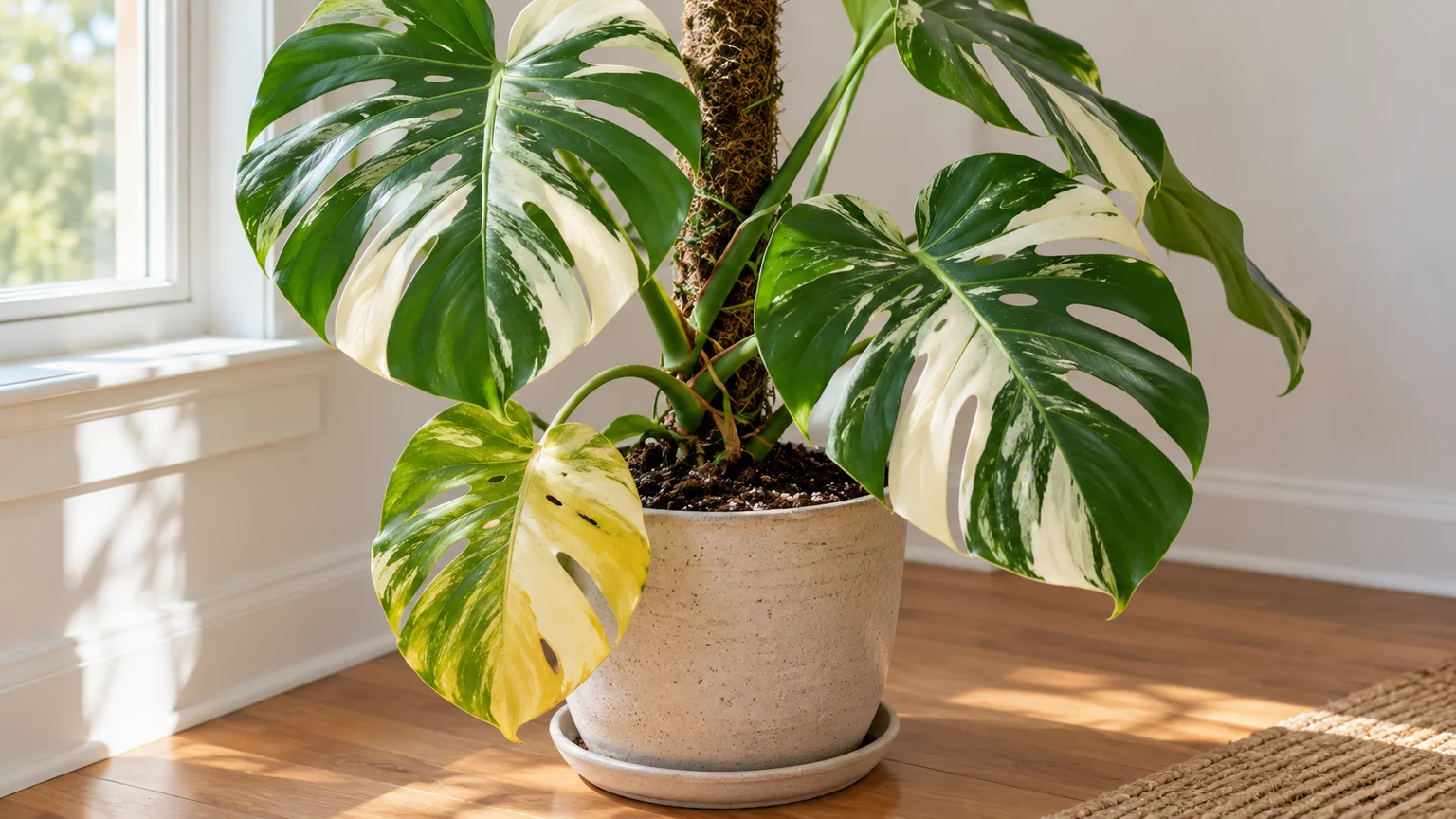
Overwatering on Monstera Thai Constellation: Edema, Root Hypoxia & Substrate Recovery
This guide covers overwatering on Monstera Thai Constellation. See also the general Overwatering guide, watering, and light pages for this plant.
Overwatering on Monstera Thai Constellation: Edema, Root Hypoxia & Substrate Recovery
Quick answer
Overwatering is the single most common cause of decline in Monstera Thai Constellation. Unlike wild-type Monstera deliciosa, which can tolerate brief periods of excess substrate moisture, this tissue-culture chimera has distinct physiological handicaps. Its cream-and-white variegated sectors lack functional chloroplasts, resulting in a dramatically reduced metabolic rate and slower transpiration demand. When soggy potting medium saturates the container, substrate macropores become waterlogged, suffocating root hairs within 24 to 48 hours.
The definitive indicators of an overwatered Thai Constellation include lower leaves turning translucent yellow with soggy, water-soaked brown centers, persistent morning guttation with water-soaked margins, soft, spongy petioles, and dark, mushy aerial root tips. For general physiological concepts of overwatering across houseplant families, consult our overwatering symptom guide. On Thai Constellation, however, immediate intervention is non-negotiable to prevent irreversible stem and vascular necrosis.
First step: Halt all watering immediately and assess the moisture profile of the root ball. Insert a dry wooden chopstick deep into the bottom third of the container. If it emerges damp and coated in dark soil, gently aerate the substrate by poking 8 to 12 vertical air chimneys into the root zone, and withhold water until 50% to 70% of the root ball dries completely.
When to use this guide vs other Thai Constellation problem pages
Because moisture imbalances trigger overlapping foliar symptoms, use this diagnostic matrix to confirm whether overwatering is the primary stressor or if your plant requires a different intervention:
| Observed Symptom Pattern | Substrate Moisture & Pot Weight | Root & Stem Condition | Recommended Guide |
|---|---|---|---|
| Translucent yellow lower leaves; soggy brown patches; constant guttation | Heavy, wet soil throughout; slow drying (>10 days) | Mushy aerial roots; sour soil odor; soft petioles | This guide (Overwatering) |
| Rapidly spreading black mushy stem base; foul odor; slipping root sheaths | Saturated, anaerobic, stagnant soil core | Completely decayed, hollow, or black roots | Root rot rescue guide |
| Uniform yellowing of oldest single leaf; green tissue remains firm | Normal dry-down cycle (upper 50% dry) | Firm, white-to-tan roots; rigid stem | Yellow leaves diagnosis |
| Crispy, paper-thin tan or brown margins restricted to cream sectors | Substrate dries rapidly; pot is lightweight | Roots intact; low indoor humidity (<45% RH) | Brown tips guide |
| Downward-arching petioles; limp leaves; soil bone-dry to the base | Feather-light pot; soil pulled from container rim | Shriveled, brittle root tips | Underwatering recovery |
| Bleached, parchment-colored dry patches on upper leaf surfaces | Moderate, balanced moisture | Healthy root system; leaf exposed to hot glass | Light care guide |
Why Monstera Thai Constellation is exceptionally prone to overwatering and hypoxia
To successfully manage moisture for Monstera deliciosa ‘Thai Constellation’, one must understand its unique botanical architecture. According to the Royal Horticultural Society (RHS), Thai Constellation is a genetically stable chimera with creamy-white speckling and sectoral marbling across its foliage. However, this aesthetic brilliance comes with steep physiological trade-offs.
1. Reduced photosynthetic surface area and hydraulic throughput
In an all-green Monstera deliciosa, every square centimeter of leaf blade contains chlorophyll-packed palisade and spongy mesophyll cells. These cells harness light energy to power photosynthesis, opening their stomata to transpire vast quantities of water daily.
On a Thai Constellation, 20% to 50% of each leaf blade is achlorophyllous (devoid of chlorophyll). Because these cream and ivory sectors do not participate in active carbon fixation, the plant’s overall photosynthetic engine operates at a fraction of wild-type capacity. Consequently, the root system’s hydraulic uptake demand is much lower. If you water a Thai Constellation on the same schedule as an all-green Monstera of identical size, the substrate remains saturated for two to three times longer, creating an ideal environment for anaerobic stagnation.
2. Acute root hypoxia in dense substrates
Monstera deliciosa is naturally a hemi-epiphyte. In the rainforests of Central America, it germinates on the forest floor and ascends tree trunks using aerial roots, keeping its root system bathed in humid air and coarse organic debris. As NC State Extension highlights, its roots are adapted to high-porosity environments where water drains away instantly.
When grown indoors in standard peat- or coco-based potting soils, water fills the interstitial macropores between soil particles. Roots require gaseous oxygen ($O_2$) to conduct aerobic cellular respiration, which produces adenosine triphosphate (ATP) to power active nutrient and water uptake. When oxygen levels drop below critical thresholds (hypoxia), root cells switch to anaerobic fermentation. This generates toxic byproducts such as ethanol and lactic acid, resulting in root cell lysis (cellular rupture) within 48 hours. Research by the University of Florida IFAS Extension documents that in waterlogged, hypoxic container substrates, rapid root cell death creates ideal infection avenues for opportunistic oomycete pathogens like Pythium.
3. Edema: Cellular blowout under hydrostatic pressure
Overwatering does not simply drown roots; it physically destroys leaf tissue from the inside out. Wisconsin Horticulture Division of Extension explains that edema occurs when root pressure forces water into foliar tissues faster than stomata and hydathodes can transpire it into the surrounding air.
Because Thai Constellation’s cream sectors have thinner cell walls and weaker cuticular waxes than green sectors, they cannot withstand excessive turgor pressure. Water accumulates in the intercellular spaces of the leaf, causing epidermal cells to swell, burst, and collapse. These ruptured zones manifest initially as translucent, water-soaked blisters that quickly oxidize into soggy, dark brown necrotic lesions.
What overwatering looks like on Monstera Thai Constellation
Recognizing overwatering in its earliest stages allows you to intervene before fungal root pathogens take hold.
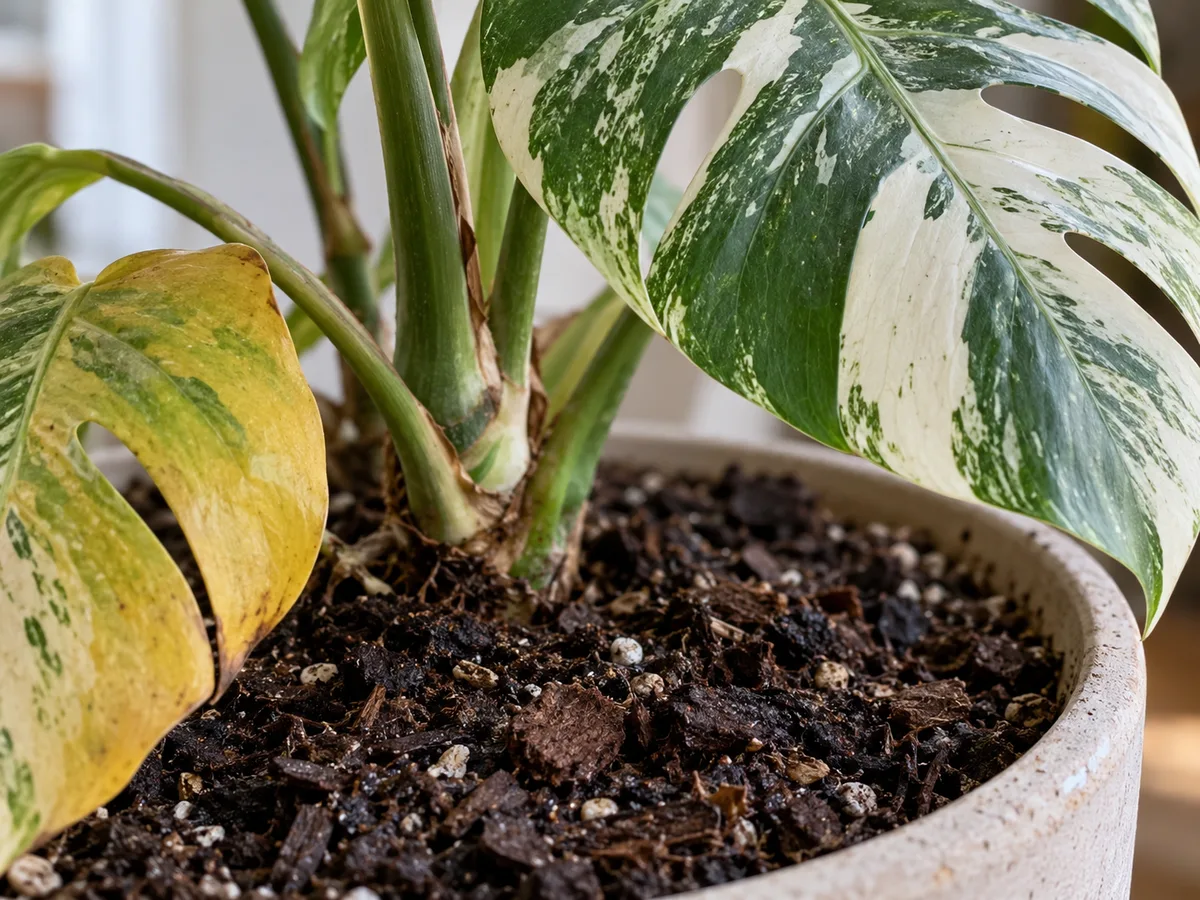
Water-soaked edema blisters and soggy necrotic margins along the cream-variegated edge of a Monstera Thai Constellation leaf.
1. Persistent guttation with water-soaked margins
Under normal conditions, Monsteras release excess water droplets from specialized leaf pores called hydathodes along the margins—a natural process known as guttation. However, in an overwatered Thai Constellation:
- Guttation occurs continuously, not just for a few hours after watering.
- The leaf margins surrounding the hydathodes turn translucent, dark green, and water-soaked as fluid leaks into surrounding intercellular spaces.
- Droplets lingering on fragile cream tissue create localized moisture pockets that foster fungal and bacterial leaf blights.
2. Translucent yellowing of lower leaves with soggy brown centers
Unlike natural senescence (where an old leaf gradually turns a uniform, dry golden-yellow), overwatering yellowing has distinct characteristics:
- The chlorosis begins on the oldest basal leaves and advances rapidly upward.
- The yellow tissue feels cool, limp, and watery rather than papery.
- Distinct soggy, dark brown or charcoal-colored lesions form in the interior of the blade or along cream margins, surrounded by an active, vibrant yellow chlorotic halo.
3. Soft, spongy petioles and petiolar wings
Healthy Thai Constellation petioles are thick, rigid, and fibrous. As root hypoxia sets in and xylem vessels lose structural integrity:
- The lower third of the petiole and the petiolar sheath (vagina) soften and feel spongy when squeezed between your thumb and forefinger.
- Heavy variegated leaves begin to bow downward under their own weight as turgor becomes irregular.
4. Dark, mushy aerial root tips
Aerial roots are excellent diagnostic barometers for subterranean root health:
- Healthy aerial root tips are firm, rigid, and light green, tan, or creamy white.
- In an overwatered plant, aerial root tips turning into the soil become black, slimy, and soft to the touch. The outer cortex slips off easily under light pressure, leaving behind a thin, thread-like vascular core.
The primary causes of overwatering in Thai Constellations
Overwatering is rarely just a matter of pouring water too frequently. It is almost always a systemic mismatch between potting medium, container mechanics, environmental light, and watering technique.
1. Dense, peat-heavy soil mixes lacking macropores
Standard commercial potting soils formulated for general foliage plants contain heavy proportions of fine peat moss, compost, and fine perlite. These substrates hold far too much gravitational water and lack the structural air pockets that aroid roots demand. Without coarse aggregates, the mix packs down tightly around the root system, creating an impenetrable anaerobic barrier. Thai Constellation requires an open, chunky aroid medium to thrive—review our specialized guide on Monstera Thai Constellation soil mix.
2. Inadequate drainage holes and decorative cachepot traps
A pot with a single central drainage hole is easily clogged by loose bark or compacted peat. Furthermore, placing a nursery pot inside a decorative cachepot without emptying the drainage saucer leaves the lower 2 to 3 inches of the root ball submerged in stagnant runoff water (“wet feet”). Penn State Extension notes that Monsteras grown indoors require containers with unobstructed drainage holes and porous potting media to ensure rapid gravitational drainage and prevent moisture stagnation around the root ball. The lower root zone drowns while the topsoil may feel deceptively dry.
3. Oversized pots and excessive soil volume
Planting a small or medium Thai Constellation into a container that is too large is a recipe for disaster. Excess soil that is not occupied by active root hairs acts as a giant sponge, retaining water for weeks. The plant simply cannot consume that volume of water before microbial decomposition depletes all available oxygen in the core.
4. Low light environments reducing transpiration
Variegated monsteras require significantly more ambient light than all-green monsteras to drive photosynthesis and transpiration. When placed in low-light corners (under 100 foot-candles or 1,000 lux), the plant enters a semi-dormant state. Stomata remain largely closed, transpiration drops to near zero, and the potting mix stays saturated for weeks on end. Proper illumination is critical—read our comprehensive Monstera Thai Constellation light requirements guide.
5. Rigid calendar-based watering
Watering on a strict schedule (such as “every Sunday”) ignores indoor humidity fluctuations, seasonal growth cycles, and temperature changes. In winter, or during humid rainy spells, a Thai Constellation may need water only once every 14 to 21 days, whereas during active summer growth under bright light it might dry out in 7 to 9 days.
Step-by-step recovery protocol for overwatered Thai Constellations
If your Monstera Thai Constellation is showing symptoms of overwatering, act methodically. Do not panic and combine multiple extreme treatments on the same day. Follow this proven 5-step botanical triage protocol:
Step 1: Immediate moisture audit and chopstick aeration
- Cease watering immediately: Do not add a single drop of water, liquid fertilizer, or foliar spray.
- Remove the cachepot: If the plant is seated inside a decorative outer pot, pull it out immediately and inspect the bottom. Empty any standing water from saucers or trays.
- Elevate the container: Rest the nursery pot on a wire cooling rack or bottle caps so air circulates freely beneath the bottom drainage holes.
- Mechanical chopstick aeration: Take a smooth, clean wooden chopstick or bamboo skewer. Gently insert it 4 to 6 inches deep into the potting mix between the vine and the rim, avoiding the main central root crown. Slowly twist and withdraw the chopstick. Create 8 to 12 vertical “breathing chimneys” around the perimeter of the root ball. This introduces atmospheric oxygen directly into suffocated lower soil layers, accelerating evaporative drying without disturbing the delicate root structure.
Step 2: Root inspection and rot triage
If foliar yellowing is accompanied by a sour or sulfurous odor, or if petioles are noticeably soft, you must inspect the subterranean root system:
- Gently extract the root ball: Lay the pot on its side, support the main vine with one hand, and squeeze the flexible plastic container sides until the root ball slides out intact.
- Wash away saturated substrate: Use a gentle stream of lukewarm tap water to rinse dense, muddy soil from the roots so you can clearly view the tissue.
- Differentiate healthy vs rotten roots:
- Healthy roots: Firm, plump, light tan, creamy white, or orange-tinged, with a crisp snap when bent.
- Hypoxic / rotted roots: Dark brown or black, water-soaked, limp, and mushy. The outer cortex will slide off like a loose sleeve when pulled gently, exposing a stringy vascular wire.
- Surgical root pruning: Using shears sterilized with 70% isopropyl alcohol, excise all rotted, mushy, or hollow roots back into healthy, firm white tissue.
- Antimicrobial bath (optional for active rot): Submerge the remaining healthy root system in a 3% hydrogen peroxide solution diluted 1:4 with room-temperature water for 10 minutes to oxygenate the tissue and eliminate anaerobic spores, then pat dry with clean paper towels.
Step 3: Repot into a high-aeration chunky aroid substrate
Never return an overwatered Thai Constellation to fine, peat-heavy potting mix. Prepare an open, fast-draining aroid formulation with the following volumetric ratios:
- 40% Coarse Douglas Fir Bark or Orchid Bark: Provides large structural voids and prevents soil compaction.
- 25% Coarse Horticultural Pumice or Perlite (#3 coarse grade): Creates rigid, non-degrading aeration channels.
- 20% Coarse Coconut Husk Chunks or Fibrous Coir: Retains minimal moisture while allowing maximum airflow.
- 10% Horticultural Charcoal: Absorbs organic impurities, deters anaerobic bacteria, and promotes air porosity.
- 5% Worm Castings: Delivers a gentle, non-burning baseline of organic micronutrients.
For step-by-step pot selection and repotting mechanics, refer to our Monstera Thai Constellation repotting guide.
Step 4: Container selection and drainage optimization
- Multiple drainage holes: Ensure the container features a minimum of 4 to 8 large drainage holes. Slotted clear plastic nursery pots (orchid-style aroid pots) are ideal because they allow you to visually monitor root health and substrate moisture without unpotting.
- Proper sizing: Choose a pot that fits the pruned root ball snugly, leaving no more than 1 to 2 inches of space between the roots and the container wall.
- Unglazed terracotta: If you have a chronic tendency to overwater, consider an unglazed terracotta container. Its porous clay walls allow moisture to evaporate laterally through the sides, significantly shortening the dry-down cycle.
Step 5: Environmental stabilization and light calibration
Following root triage, place your Thai Constellation in an optimized recovery environment:
- Light: Position the plant in bright, indirect light receiving 200 to 400 foot-candles (approx. 2,000 to 4,500 lux) for 12 to 14 hours per day. Ample light signals the remaining healthy leaf cells to open stomata and drive water uptake.
- Airflow: Provide gentle, continuous room air circulation using an oscillating fan set to low. Good airflow thins the boundary layer of air on the leaf surface, encouraging steady, safe transpiration.
- Temperature: Maintain stable ambient temperatures between 70°F and 82°F (21°C to 28°C). Avoid cold window drafts or air conditioning vents, which paralyze root metabolism.
Prevention: The 50–70% dry-down rule
Preventing future overwatering on Monstera Thai Constellation requires replacing calendar routines with physical substrate testing. Follow these essential watering best practices:
The 50% to 70% root ball dry-down threshold
Never water a Thai Constellation while the upper half of the container remains moist. Allow the top 50% to 70% of the root ball volume to dry before offering water again:
- In a 6-inch pot, wait until the top 3 to 4 inches of mix are bone-dry.
- In an 8-to-10-inch pot, wait until the top 4 to 6 inches are completely dry.
- When in doubt, wait two more days. A Thai Constellation will effortlessly tolerate slight drought, but a single instance of prolonged root saturation can trigger irreversible hypoxia.
Reliable methods to verify moisture depth
- The Wooden Skewer Test: Insert an untreated wooden skewer all the way to the bottom of the container and leave it for 5 minutes. Pull it out: if the bottom half looks dark, damp, or feels cool against your wrist, do not water.
- The Container Lift Test: Learn the weight difference between a freshly saturated pot and one whose chunky substrate is 60% dry. Chunky aroid bark becomes noticeably light when dry.
- Clear Slotted Pots: Look through the transparent container walls. Condensation on the plastic and dark bark indicates moisture; when the upper two-thirds turn light tan and condensation vanishes, it is safe to water.
For comprehensive watering instructions, including seasonal schedules and municipal water chemistry guidelines, read our dedicated Monstera Thai Constellation watering guide.
Calculate custom watering intervals
Because container material, substrate porosity, room temperature, and seasonal light levels dictate how fast your potting medium dries, use our interactive tool:
Calculate your plant’s custom schedule: Use the LeafyPixels Thai Constellation Watering Calculator to generate dynamic, season-specific watering frequencies based on your pot diameter, medium composition, and indoor light intensity.
Critical mistakes to avoid when treating overwatered Thai Constellations
Avoid these five common pitfalls, which turn a manageable case of overwatering into fatal root loss:
1. Fertilizing a stressed, hypoxic plant
Never apply synthetic fertilizers to an overwatered Thai Constellation. Stressed roots with damaged root hairs cannot absorb mineral salts. Unused nitrogen and potassium salts accumulate around the root zone, creating osmotic shock that pulls remaining moisture out of root cells and burns tissue. Wait until the plant has fully recovered and produced at least one healthy new leaf before resuming light fertilization.
2. Stacking multiple severe treatments on the same day
Growers frequently panic and simultaneously repot the plant, prune off all yellowing leaves, wash roots in heavy chemicals, and spray systemic pesticides. This shock cascade overwhelms the plant’s depleted metabolic reserves. Focus first on root aeration and moisture reduction.
3. Misting foliage to “help” limp leaves
Misting saturated plants does not restore leaf turgor. In fact, standing water droplets on fragile cream variegation block stomatal gas exchange and encourage opportunistic pathogens like Xanthomonas and Pseudomonas bacterial leaf spots. Maintain moderate ambient humidity (55% to 65% RH) using an evaporative cool-mist humidifier placed several feet away.
4. Moving the plant into direct, scorching sun
While bright indirect light aids recovery, exposing a water-stressed Thai Constellation to direct unfiltered sunlight will quickly overheat and scorch tender cream-variegated sectors, causing irreparable black sunscorch.
5. Relying on cheap two-prong metal moisture meters
Prong meters measure electrical conductivity, not actual volumetric water content. In coarse, chunky aroid mixes with large bark chunks and air gaps, metal prongs frequently fail to make uniform contact with soil particles, registering “dry” when the inner root core is actually soaking wet. Always rely on a wooden skewer or physical pot lift.
Expected recovery timeline and prognosis
| Phase | Timeframe | Observable Physiological Indicators | Grower Action Required |
|---|---|---|---|
| Stabilization | Days 1–7 | Edema stops spreading; guttation diminishes to normal morning levels; substrate dries out. | Maintain bright indirect light; avoid all watering; ensure continuous air circulation. |
| Root Regeneration | Weeks 2–4 | Surviving roots push fresh white feeder tips; petioles regain structural turgor; yellowing halts. | Water sparingly only when upper 60% dries; do not disturb or unpot the plant. |
| Vegetative Recovery | Weeks 5–8+ | The apical growth point activates; a new leaf shoot emerges from the petiolar sheath. | Maintain standard 50–70% dry-down routine; introduce diluted organic fertilizer at 1/4 strength. |
| New Foliage Unfurling | Months 2–3 | Pristine, fenestrated leaf unfurls with crisp cream variegation and zero water-soaking. | Plant is fully recovered; return to normal care and vertical moss pole training. |
With timely aeration, an open chunky substrate, and adherence to the 50% to 70% dry-down rule, your Monstera deliciosa ‘Thai Constellation’ will rebuild its root architecture and continue unfurling spectacular, fenestrated variegated foliage for years to come.