Not Enough Light on Oleander: Bloom Failure, Floppy Stems &
Quick answer
Not enough light on Oleander (Nerium oleander) triggers total bloom failure, weak floppy canes that sag under their own weight, and sparse foliar density along woody stems. Because oleander is an obligate full-sun Mediterranean shrub requiring 6 to 8+ hours of direct sunlight daily, shade starves terminal shoots of photosynthates needed to initiate flower buds. First step: audit your shrub's daily direct solar hours and gradually relocate it to an unshaded outdoor position over a 10-to-14-day acclimation schedule before attempting heading pruning cuts or fertilizer adjustments.
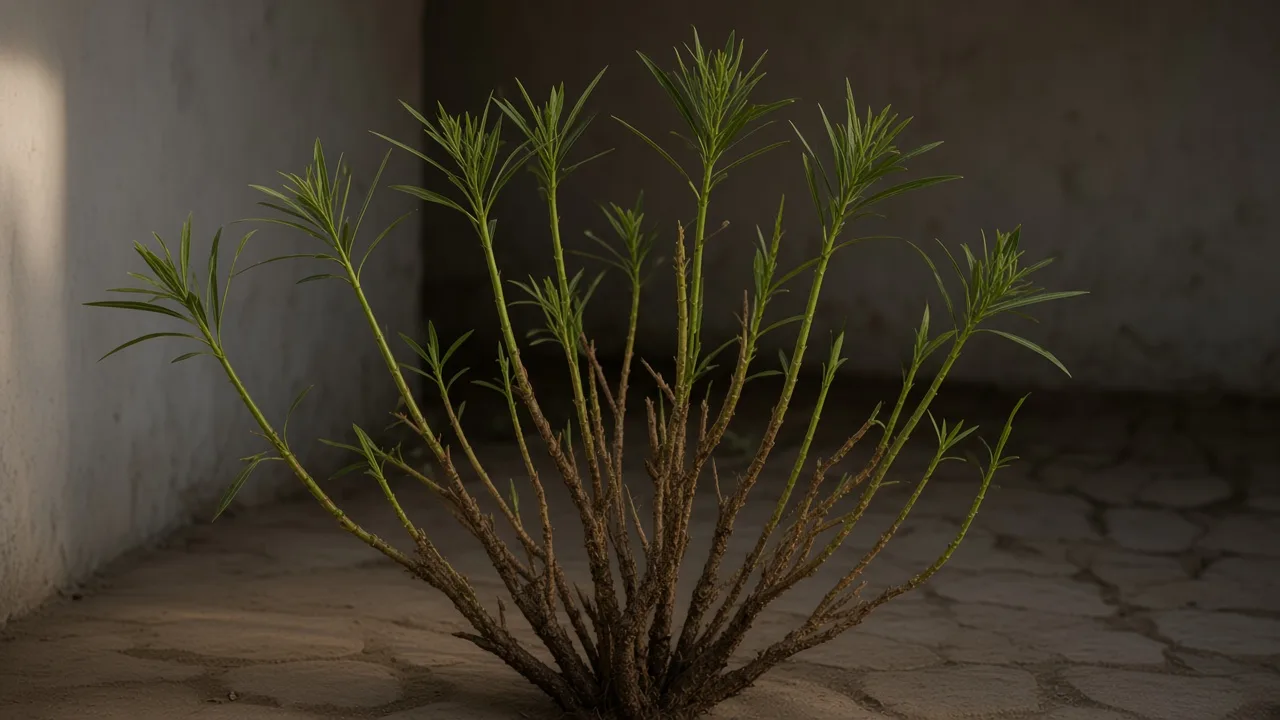
Not Enough Light on Oleander: Bloom Failure, Floppy Stems & Sun Recovery
This guide covers not enough light on Oleander. See also the general Not Enough Light guide, watering, and light pages for this plant.
Not Enough Light on Oleander: Bloom Failure, Floppy Stems & Sun Recovery
Quick answer
Insufficient light on Nerium oleander is a physiological crisis characterized by complete bloom failure, weak floppy canes that droop under foliage weight, and sparse foliar density that strips lower woody canes of their signature whorls. Oleander is an obligate Mediterranean sun shrub adapted to open coastal plains and rocky washes; it requires 6 to 8 or more hours of direct, unfiltered sunlight daily to produce the carbohydrate reserves necessary for terminal flowering and robust stem lignification. When positioned in dappled tree shade, under covered porches, or indoors, the plant shifts into survival mode—sacrificing floral bud initiation, aborting interior leaves, and producing soft, rubbery shoots.
For universal photobiological mechanics of light deprivation across woody plants, review our insufficient light guide.
The critical first action is to audit daily solar exposure and initiate a gradual 10-to-14-day transition toward full outdoor direct sun. Do not apply fertilizer or prune severely while the root system is light-stressed, as forced flushes in dim conditions accelerate vascular collapse.
When to use this page vs other Oleander guides
Because poor light interacts with watering rates, canopy architecture, and growth speed, use this triage matrix to confirm whether light deprivation is your shrub’s primary bottleneck:
| Primary Symptom Observed | Root Condition / Care Context | Recommended Guide |
|---|---|---|
| No flowers, floppy canes, bare lower stems | Firm dry-down; shrub in shade, porch, or indoors | This Guide |
| Rapid vertical stretch with wide internodes | Green whippy shoots reaching toward distant window | Oleander Leggy Growth |
| Stalled growth, no new flushes, pale leaves | Pot dry-down takes >10 days; cool temperatures | Oleander Slow Growth |
| Yellowing lower leaves with soft stem base | Soil persistently soggy; sour odor at drainage holes | Oleander Overwatering |
| Leaf scorch, crispy tips after moving to sun | Moved outdoors suddenly without 14-day hardening | Oleander Brown Tips |
| Planning seasonal shaping after light fix | Shrub stabilized in 6–8+ hours sun; early spring | Oleander Pruning |
For general cultural baselines, consult our Oleander overview and check our specific guides on Oleander light requirements, Oleander watering guidelines, Oleander soil mixes, and the comprehensive Oleander problems hub.
What light deprivation looks like on Oleander
Healthy Nerium oleander produces thick, woody upright canes densely populated by stiff, leathery lance-shaped leaves arranged in rigid whorls of three, culminating in dense terminal cymes of fragrant summer flowers. When deprived of adequate irradiance, the shrub exhibits distinct diagnostic deformities:
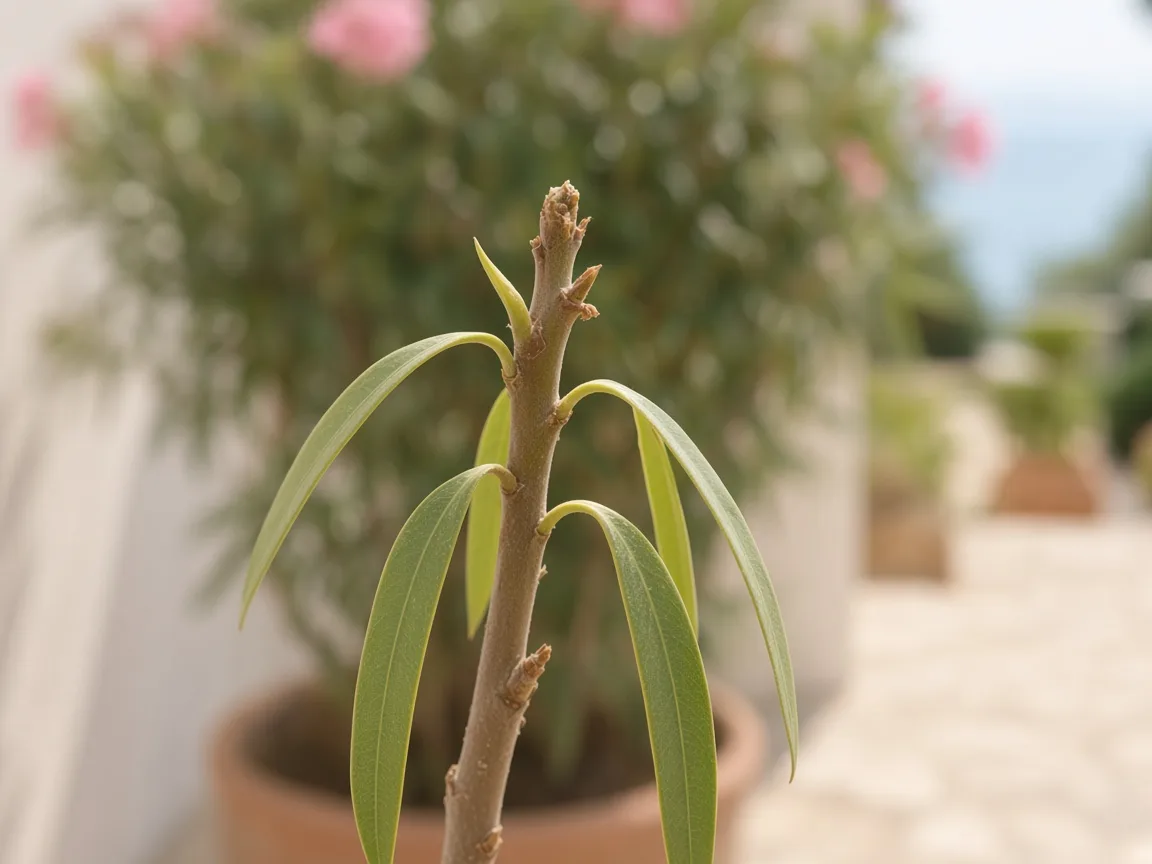
Close-up of Nerium oleander showing sparse leaf whorls along woody canes and complete absence of terminal flower buds under chronic light deprivation.
- Complete bloom failure (floral bud abortion): Oleander flowers exclusively on sturdy, current-season terminal wood. In insufficient light, terminal shoot apexes produce only weak vegetative leaves without ever developing floral trusses or bud bracts.
- Weak, floppy, weeping canes: Stems fail to deposit structural lignin and secondary cellulose. Canes remain rubbery, flexible, and lime-green, arching downward or splaying outward under the light weight of their own terminal leaves.
- Sparse foliar density (“poodle-tail” defoliation): To balance its respiratory deficit, oleander systematically drops older, shaded leaves along lower and interior canes. Canes become bare and woody along 70% to 90% of their length, retaining sparse foliage tufts solely at the tips.
- Thinned, fragile leaf blades: Foliage loses its characteristic rigid, coriaceous (leathery) texture. Shade leaves develop a papery, flexible feel and an abnormally deep or washed-out green hue due to altered chlorophyll a to b ratios.
- Prolonged soil dry-down: In low light, transpiration rates plummet. Containers that normally dry out every 3 to 4 days remain damp for weeks, predisposing compromised roots to opportunistic pathogen decay.
Why Oleander shrubs suffer under inadequate light
Nerium oleander evolved throughout the Mediterranean Basin, Portugal, North Africa, and Southwest Asia, occupying exposed riparian gravel bars and sun-baked coastal scrublands, as documented by NC State Extension. Its physiology is hardwired for intense solar exposure:
1. High light compensation and saturation thresholds
Oleander is a C3 sun shrub with exceptionally high photosynthetic capacity. Horticultural benchmarks from the Missouri Botanical Garden emphasize that oleander demands full direct sun to fuel summer-to-autumn flower clusters. In light levels below 6 hours of direct sun (under 4,000 to 5,000 foot-candles / 40,000 to 50,000 lux), gross photosynthetic carbon assimilation barely covers baseline dark respiration. There is zero surplus energy available for flower bud differentiation.
2. Etiolation and suppression of secondary stem lignification
When phytochrome receptors detect a low red to far-red light ratio typical of shade, they trigger endogenous gibberellin synthesis. Stem cells elongate rapidly in an evolutionary effort to overtop competing vegetation. As highlighted by UF IFAS Extension Gardening Solutions, too little light causes oleander to develop a lanky, open framework with severely reduced flowering. Because energy is diverted toward vertical reach rather than secondary cambial division, canes lack the structural girth needed for upright vase architecture.
3. Indoor and porch microclimate traps
While oleanders tolerate urban pollution, wind, and rocky soils, they are poorly suited as permanent indoor houseplants. UF IFAS Extension confirms that oleander thrives under full, unshaded outdoor sun. Window glass filters out 20% to 50% of usable photosynthetic active radiation (PAR) and eliminates ultraviolet wavelengths, creating an artificial microclimate where oleanders slowly decline.
4. Overwintering carbohydrate drain
In temperate zones where container oleanders are sheltered indoors from freezing weather, warm room temperatures (68°F–75°F / 20°C–24°C) keep the plant’s metabolic engine running hot. Paired with dim winter window light, the shrub burns through stored starch reserves in its woody canes, emerging into spring completely drained of energy.
Confirmation checks: testing light intensity and plant vitality
Before altering care routines, conduct these four diagnostic checks:
- Direct solar audit: On a clear day, record the exact time direct, unshaded sunlight strikes the shrub’s foliage and when it passes out of direct exposure. If total duration is less than 6 hours, light deprivation is confirmed.
- The terminal apex check: Inspect the tips of current-season branches with a hand lens. Healthy sun-grown canes display plump, multi-branched floral bud clusters forming in late spring. Light-starved canes show only tiny, flattened, leafy terminal buds or bare vegetative growth points.
- Cane flex and caliper test: Gently press a mature 1-year-old cane between your fingers. It should feel rigid, stiff, and fibrous. If the branch flexes like soft rubber tubing or snaps with minimal resistance, vascular lignification is deficient.
- Soil moisture dry-down test: Push a wooden dowel or soil probe 5 to 8 centimeters into the potting substrate. If soil stays saturated beyond 7 to 10 days in warm weather, the plant is transpiring at a fraction of its normal capacity due to insufficient photon capture.
Step-by-step recovery and relocation protocol
Restoring vigor, thick woody canes, and prolific floral clusters requires a structured remediation protocol:
Step 1: The First Fix — Relocate to maximum available light
- Move container plants out from under deep overhangs, covered porches, or dim interiors to the brightest open spot available.
- For landscape shrubs shaded by overhanging trees, selectively prune competing tree limbs to open a skyward sun window of at least 6 to 8 continuous hours.
Step 2: Spring outdoor acclimation schedule (Hardening off)
Foliage grown under low light or indoors lacks the thick cuticular wax layer and dense carotenoid pigments needed to disperse intense solar radiation. Moving a shade-grown oleander directly into full summer sun causes severe photo-oxidation (foliar sunburn), turning leaf blades bleached white or scorch-brown. Follow this 14-day acclimation ladder:
- Days 1–3: Position the container in bright, open shade (e.g., the north side of a building or beneath a high-canopy shade tree) receiving zero direct midday sun.
- Days 4–7: Shift the shrub into gentle, unfiltered early morning sun (2 to 3 hours of direct sun before 10:00 AM), returning it to open shade for the hot afternoon.
- Days 8–10: Advance to 4 to 5 hours of morning-to-midday sun, monitoring leaf blades for any fading or bleaching.
- Days 11–14: Move the container into all-day, unrestricted full sun (6 to 8+ hours).
Step 3: Calibrate irrigation to solar intensity
As sunlight exposure increases, oleander’s photosynthetic and transpiration rates surge. Transition watering to match the Oleander watering guide: soak the container deeply until runoff flows from bottom drainage holes, then allow the top 5 centimeters of substrate to dry before re-watering. Established plants in full summer sun may require irrigation every 2 to 3 days, but never let pots sit in standing saucers.
Step 4: Pruning and structural caliper restoration
Existing elongated, bare canes will not regenerate foliage along old, barren wood. Structural rejuvenation must be coordinated with seasonal biology, as detailed by Clemson Cooperative Extension:
- Safety equipment: Put on heavy waterproof nitrile or leather gloves, long sleeves, and eye protection. All parts of Nerium oleander contain toxic cardenolides, as confirmed by ASPCA Animal Poison Control. Milky sap causes contact dermatitis and severe eye inflammation.
- Seasonal timing: Wait until late winter or early spring, just before the first burst of new growth.
- Heading cuts: Using sterilized bypass pruners, cut floppy, barren canes back by one-third to one-half their height. Make each cut 5 to 7 millimeters above an outward-facing leaf whorl or dormant nodal ring at a 45-degree angle.
- Hormonal response: Cutting the stem apex breaks apical dominance and eliminates downward auxin flow, forcing dormant adventitious buds along the lower woody cane to sprout into multiple dense, upright shoots.
- Safe waste disposal: Bag and dispose of all cuttings in municipal trash. Never burn oleander trimmings, as aerosolized cardiac glycosides in smoke can cause severe pulmonary and cardiac distress.
Winter dormancy light and temperature synchronization
Container oleanders grown in USDA Zones 7 and below must be brought indoors before hard freezes (sub-25°F / -4°C). The single most common indoor winter mistake is keeping the plant in a heated, low-light living room:
- The temperature-light mismatch trap: When kept at 70°F (21°C) in ambient room lighting (50–100 foot-candles), respiration outpaces photosynthesis. The plant produces sickly, pale, etiolated winter flushes that sap energy and collapse.
- The cool dormancy solution: Place overwintered oleanders in a cool, bright location kept between 38°F and 50°F (3°C to 10°C), such as an unheated sunroom, cool greenhouse, or enclosed bright porch.
- Light thresholds in cool rest: At 40°F (4°C), oleander enters semi-dormancy, drastically slowing respiration. In this state, it can thrive with 3 to 4 hours of direct window sun or bright indirect light.
- Supplemental grow lighting: If cool storage is unavailable and the shrub must remain in a heated room, install a high-output full-spectrum LED grow light suspended 12 to 18 inches above the canopy, operating on a 12-hour daily timer.
Recovery timeline and signs of success
Reversing light deprivation on Nerium oleander is a multi-stage botanical process:
- Weeks 1–2 (Acclimation & stabilization): In full sun, premature interior leaf shedding halts. Stomata resume normal gas exchange, and container dry-down accelerates.
- Weeks 3–5 (New nodal emergence): Terminal buds produce fresh leaf whorls. New foliage emerges thick, rigid, dark green, and tightly spaced, with internodes measuring only 2 to 4 centimeters.
- Months 2–3 (Secondary caliper thickening): Pruned canes push vigorous lateral branches from dormant lower nodes. Main canes begin depositing secondary xylem rings, firming up from flexible green shoots into stiff, gray-barked woody trunks.
- Next active blooming cycle (Full floral flush): With carbohydrate reserves restored, sturdy terminal shoots initiate dense floral cymes, producing abundant summer blooms that persist through autumn.
Mistakes to avoid
- Drenching with high-nitrogen fertilizer: Applying synthetic fertilizer to a light-deprived oleander will not compensate for missing photons. Excess nitrogen forces soft, watery shoots that flop even worse and scorches delicate feeder roots.
- Abrupt sunburn shock: Moving a shrub from a dark hallway or porch directly into 90°F (32°C) midday sun destroys unadapted chloroplasts within hours. Always respect the 14-day acclimation schedule.
- Pruning in late summer or autumn: Late-season pruning stimulates soft, tender vegetative growth that lacks time to mature, destroying next season’s flower bud wood and increasing vulnerability to winter cold injury.
- Overpotting a weakened shrub: Never move a struggling, light-starved oleander into a larger container. The excess uncolonized wet potting mix will stay damp indefinitely, triggering root rot.
Related tool
Accurately quantify your outdoor or indoor solar intensity and verify daily sun hours with our Light Meter Calculator.