Slow Growth on Oleander: Causes, Root Checks & Growth Fixes
Quick answer
Slow growth on Oleander (Nerium oleander) during warm weather is typically triggered by insufficient direct sunlight, severe root binding in containers, cold soil temperatures below 60°F (15°C), or alkaline nutrient lockout. During late autumn and winter, growth naturally pauses in seasonal dormancy. To fix stalled growth during the active growing season, verify the shrub receives at least 6 to 8 hours of unfiltered direct sunlight, inspect the root ball for circling root congestion, and test soil pH to ensure it sits between 6.0 and 8.0 before applying any fertilizer.
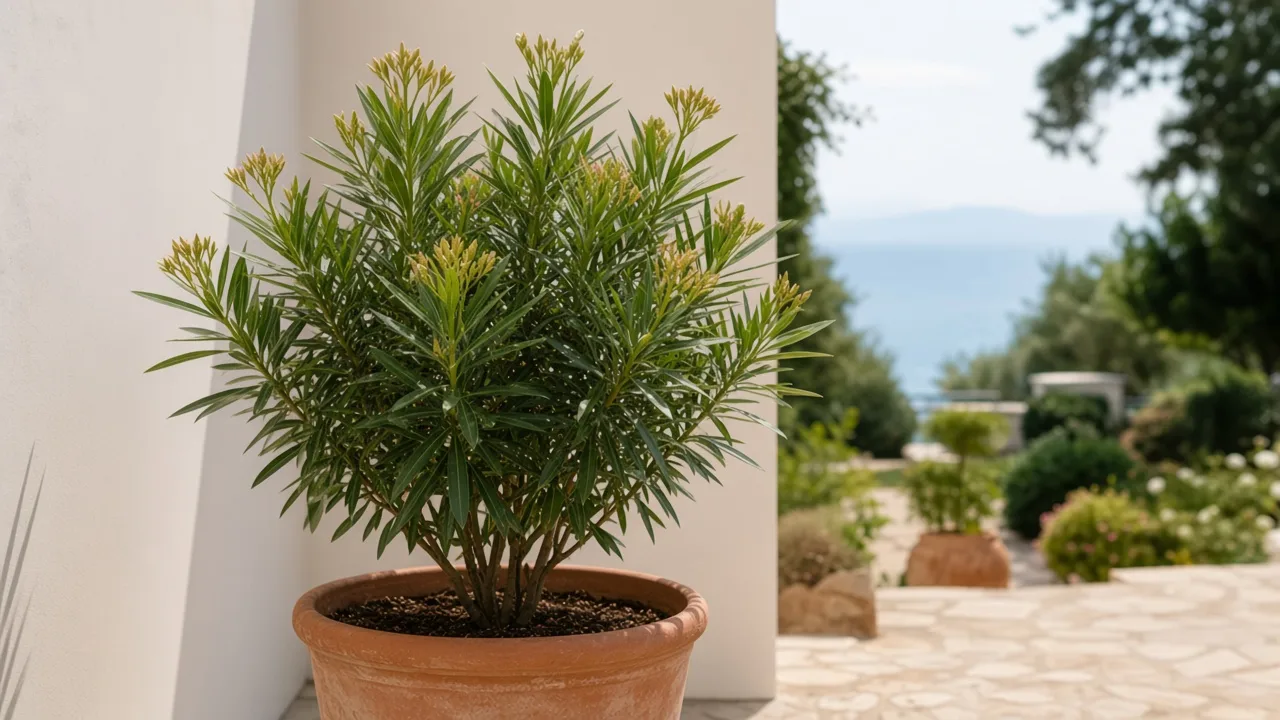
Slow Growth on Oleander: Causes, Root Checks & Growth Fixes
This guide covers slow growth on Oleander. See also the general Slow Growth guide, watering, and light pages for this plant.
Slow Growth on Oleander: Causes, Root Checks & Growth Fixes
Quick answer
Under standard Mediterranean or subtropical conditions, Nerium oleander is a fast-growing, woody evergreen shrub capable of extending branches by 30 to 60 centimeters in a single warm summer season. When an oleander suddenly stalls, fails to produce new terminal whorls, or sits static across spring and summer, the slowdown is not random: it signals an environmental, cultural, or subterranean bottleneck. During the active growing period, the leading causes of slow growth are insufficient direct sunlight, severe root-bound container conditions, cold root-zone soil temperatures below 60°F (15°C), and alkaline soil nutrient lockout or depleted fertility. In contrast, if your plant pauses growth between late autumn and early winter, this represents natural seasonal dormancy rather than cultivation failure.
To resolve stunted growth during the warm season, take one focused first step: inspect the container and sun exposure before altering chemical treatments. Ensure your shrub receives at least 6 to 8 hours of unfiltered direct sunlight daily, and check whether roots have congested into a solid impenetrable mass. For universal physiological mechanisms causing developmental delays across ornamental plant families, consult our global guide on slow growth.
What slow growth looks like on Oleander
Oleander foliage develops in tight whorls of three to four thick, leathery, lanceolate leaves along stout, upright cane-like stems. Recognizing abnormal growth arrest requires comparing current vegetative behavior against the plant’s seasonal biological schedule.
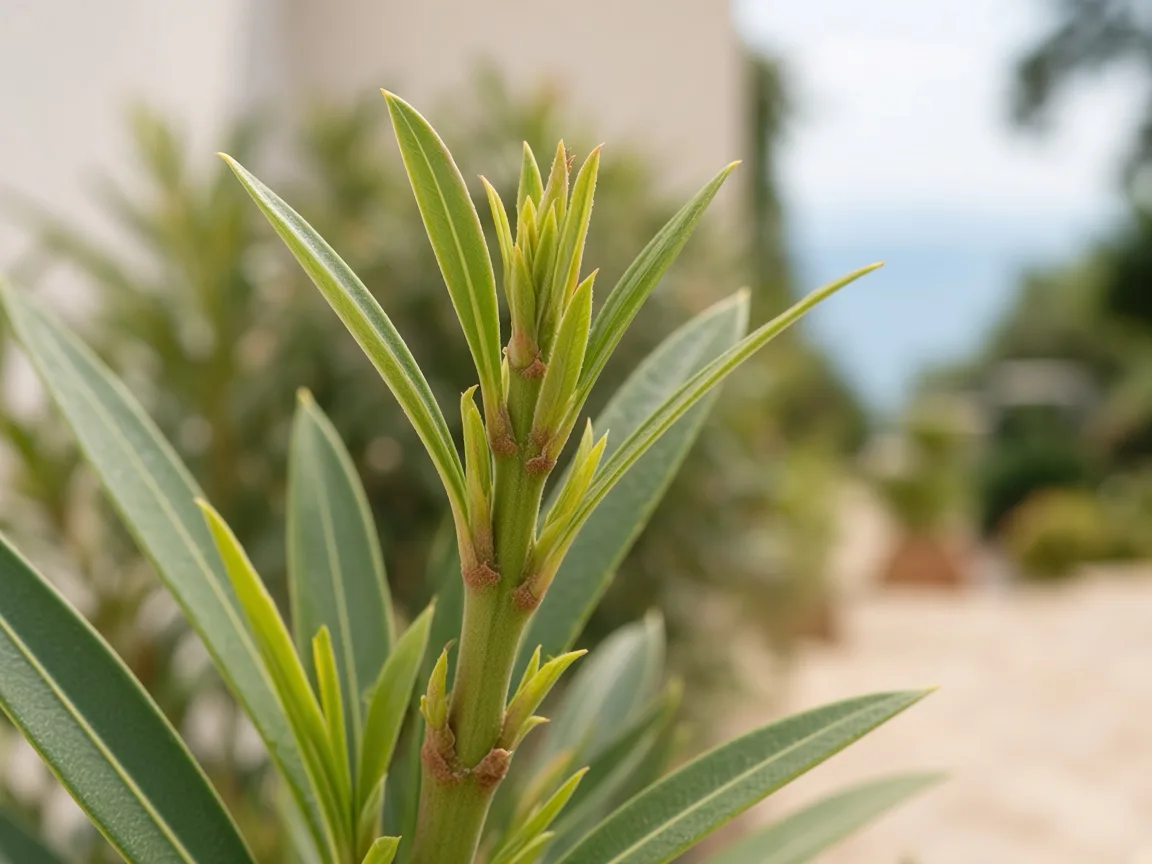
Close-up of Nerium oleander terminal shoot showing arrested internodal elongation, small pale leaves, and absence of flower bud trusses.
Key visual and tactile symptoms of stalled oleander growth include:
- Arrested terminal shoots: Shoot tips remain completely static for weeks during peak warmth (late spring to mid-summer), failing to unfurl fresh leaf whorls or expand branch calipers.
- Microphylla (undersized foliage): Leaves emerging from terminal buds appear significantly smaller, narrower, and paler green than the mature foliage below, often exhibiting interveinal chlorosis if nutrients are chemically locked.
- Compressed internodes without branching: Stems produce tight clusters of stunted leaves at the tip without lengthening the internodes, giving the cane tips a bunched, tufted appearance.
- Absence of flower cymes: Terminal blossom trusses fail to initiate, or embryonic flower buds abort and desiccate before opening.
- Premature lower canopy leaf drop: The shrub sheds older interior foliage while producing zero replacement growth at the branch tips, gradually exposing bare, woody lower canes.
- Hydrophobic container dry-down: In container-grown shrubs, irrigation water runs down the inside pot walls and drains out within seconds, leaving the dense central root core bone dry.
These symptoms differ sharply from leggy growth on Oleander, where stems elongate rapidly with weak, spindly internodes due to light-seeking etiolation. In true slow growth, cellular expansion and cell division come to a full stop.
Seasonal growth cycles: flush vs. dormancy
To accurately evaluate oleander growth rates, you must align your expectations with the plant’s natural phenology documented by the Missouri Botanical Garden.
flowchart TD
    A["Early Spring (Mar-Apr)"] -->|"Day temps >65°F (18°C), soil warms"| B["Vegetative Flush"]
    B --> C["Late Spring & Summer (May-Aug)"]
    C -->|"6-8+ hrs full sun, deep watering"| D["Peak Flowering & Shoot Extension"]
    D --> E["Late Autumn (Oct-Nov)"]
    E -->|"Day lengths shorten, temps <60°F (15°C)"| F["Metabolic Slowdown / Quiescence"]
    F --> G["Winter (Dec-Feb)"]
    G -->|"True Dormancy: minimal water, zero fertilizer"| H["Winter Rest"]
    H -->|"Spring warmth returns"| A
1. Active flush (late spring through late summer)
From April through August, healthy oleanders channel photosynthetic sugars into explosive cane growth and terminal flower cymes. Shoots lengthen rapidly, foliage turns deep olive-green, and new root tips actively branch through the substrate. In this window, lack of new shoots indicates an active cultural problem.
2. Autumn transition (September through October)
As photoperiods shorten and night temperatures begin to drop, shoot extension naturally tapers off. Foliage thickens and lignifies to prepare for cooler conditions. Terminal buds become dormant. Applying fertilizers or heavy pruning during this transition can force tender vegetative shoots that will suffer winter cold damage.
3. Winter dormancy (November through February)
Oleander enters a necessary rest period. While the plant remains evergreen, root respiration and sap flow drop to baseline maintenance levels. If your shrub is overwintering indoors, on a cool sun porch, or outdoors in USDA Hardiness Zones 8 to 11, do not expect visible growth. Stagnation during winter is physiologically normal and protective.
Primary causes of slow growth on Oleander
When warm spring and summer conditions fail to stimulate new shoots, investigate the following specific root, soil, and environmental stressors:
1. Severely root-bound container conditions
Oleander possesses a vigorous, fibrous, and woody root system designed to anchor large shrubs in rocky, alluvial Mediterranean riverbeds. When confined to a nursery pot or decorative container, roots rapidly fill all available pore space. Within 2 to 3 years, the root ball forms a dense, impenetrable cylinder of woody coils. In this root-bound state:
- Soil substrate decomposes and washes away, leaving virtually no organic matter to retain water or exchange cation nutrients.
- Feeder roots on the interior die from oxygen starvation and compaction, while perimeter roots suffer thermal shock against hot container walls.
- Water bypasses the compressed root core through perimeter gaps, causing chronic subterranean dehydration that prevents cell turgor expansion.
2. Cold soil temperatures below 60°F (15°C)
While established oleanders tolerate brief winter frosts down to 20°F (-7°C), their root systems are warm-adapted, as noted by Clemson Cooperative Extension. Root metabolic activity, water absorption, and nutrient transport require substrate temperatures of at least 60°F (15°C), with optimum root kinetics occurring between 70°F and 85°F (21°C to 29°C). If container oleanders are set out on cold concrete patios early in spring, or if chilly soil persists during unseasonable weather, root hairs cannot actively absorb nitrogen, phosphorus, or water, holding the canopy in metabolic stasis.
3. Depleted or alkaline soil nutrients (pH lockout)
In native habitats, oleanders thrive in neutral to moderately alkaline soils (pH 6.0 to 8.0), as confirmed by UF IFAS Extension. However, extreme pH levels or aged potting mix create severe nutritional blocks:
- Alkaline induced chlorosis (pH > 8.0): In limestone-rich soils or pots watered with high-bicarbonate municipal tap water, iron and manganese become insoluble. The shrub suffers iron chlorosis, producing bleached new foliage and arrested vegetative growth.
- Severely depleted soil: Potted oleanders exhaust soluble nitrogen, phosphorus, and potassium within months of active summer watering. Without regular nutritional replenishment, the shrub enters starvation-induced stasis.
4. Insufficient solar radiation
Nerium oleander is an obligate heliophyte requiring full, unfiltered sun, as detailed by NC State Extension. It needs an absolute minimum of 6 hours of direct solar radiation daily, though 8 to 10 hours yields maximum vigor. When shaded by mature landscape trees, porch roofs, or indoor window glazing, photosynthetic carbon assimilation drops below the threshold needed for vegetative extension and flower initiation. Rather than stretching, mature container oleanders often respond to chronic shade by shutting down growth entirely.
5. Root-knot nematode infestations (Meloidogyne spp.)
In warm, sandy coastal and southern soils, plant-parasitic nematodes pose a serious hidden threat. Microscopic root-knot nematodes (Meloidogyne species) penetrate tender oleander root tips, inducing giant cell formation and causing swollen root galls, according to UC IPM nematode guidelines. These galls disrupt the xylem and phloem transport tubes, severing water and nutrient supply to the canopy. Aboveground, the shrub exhibits stunted, unthrifty growth, sparse foliage, and persistent midday wilting despite wet soil.
| Cause of Stunted Growth | Root-Zone Symptoms | Canopy Appearance | Corrective First Action |
|---|---|---|---|
| Root-Bound Container | Solid woody root ring; soil absent; water runs straight through | Stagnant shoots; quick daily wilt; small pale leaves | Unpot and root prune or shift to a container 5–10 cm larger |
| Cold Soil (<60°F / 15°C) | Roots firm and white but metabolically inactive | Uniform halt in new growth; foliage dull dark green | Elevate pots off cold ground; wait for spring soil warmth |
| Nutrient Depletion | Roots healthy, light brown, well-branched | Overall pale green or yellowing lower leaves; no new flushes | Apply a balanced slow-release fertilizer or diluted liquid feed |
| Alkaline Lockout (pH > 8.0) | Healthy root structure; white lime crusts on pot rim | Interveinal chlorosis on new foliage; tip stunting | Flush with acidified water; apply chelated iron (Fe-EDDHA) |
| Root-Knot Nematodes | Swollen nodules, galls, stubby decayed root tips | Chronic stunting; midday droop; yellowing; dieback | Improve organic matter; solarize soil; use nematode-free media |
| Insufficient Sunlight | Soil remains wet for weeks; roots cold | Dark, limp foliage; no floral buds; zero shoot expansion | Move gradually to 6–8+ hours of direct unfiltered sunlight |
Diagnostic inspection checklist
Before altering multiple care routines at once, systematically work through this diagnostic sequence:
- Verify the calendar season and ambient temperature: Is it between November and February? If outdoor temperatures average below 60°F (15°C), the plant is resting. Do not treat dormancy as a disease.
- Measure direct daily sunlight: Count the hours of direct, unfiltered sun hitting the foliage. If the plant receives less than 6 hours of full direct sun, light is your limiting factor. Use our Light Meter Calculator to verify solar irradiance.
- Conduct an unpotting root check: For container plants, lay the pot on its side, gently tap the rim, and slide the root ball free. Inspect whether woody roots circle the bottom tightly, forming a root-bound basket that squeezes out all soil.
- Inspect root tips for nematode galls: Look for irregular, bead-like swellings or nodules along the fine feeder roots that cannot be rubbed off. Smooth, uniform root tips are healthy; lumpy, galled roots indicate nematodes.
- Test soil moisture and drainage: Probe 5 to 7 centimeters into the core. Does water pool for hours (root rot risk), or does dry potting mix repel water entirely? Compare findings with our Oleander watering guide.
- Check soil pH and mineral deposits: Use a reliable soil test kit to verify pH is between 6.0 and 8.0. Check for chalky white mineral crusts on the soil surface that indicate tap water salinity or extreme alkalinity. Review Oleander soil guide for proper substrate parameters.
The first fix for Oleander
When slow growth strikes during the warm growing season, implement one targeted environmental correction first: move the shrub into at least 6 to 8 hours of direct, unfiltered sun, and evaluate the root zone for container binding before applying any chemical fertilizers.
flowchart TD
    A["Oleander Growth Stalled in Warm Weather"] --> B{"Is it receiving 6-8+ hours direct sun?"}
    B -- "No" --> C["Move to Full Unfiltered Sunlight"]
    B -- "Yes" --> D{"Is container severely root-bound?"}
    D -- "Yes" --> E["Root Prune or Repot into Fresh Mix"]
    D -- "No" --> F{"Is soil pH between 6.0 and 8.0?"}
    F -- "No (Alkaline >8.0)" --> G["Acidify Substrate & Apply Chelated Iron"]
    F -- "Yes" --> H["Feed with Balanced Slow-Release Fertilizer"]
Pumping fertilizer into a light-starved or root-bound oleander will only burn roots and worsen stress. Providing full solar energy and unblocking compressed roots allows the plant’s vascular system to resume natural nutrient processing.
Step-by-step recovery process
Follow these sequential steps to safely reactivate dormant or stunted oleander shrubs:
Step 1: Relocate to maximum solar exposure
Move container oleanders to a sunny south- or west-facing patio, courtyard, or rooftop that receives intense sun. If transitioning a shrub that was kept indoors or under shade cloth, acclimate it over 7 to 10 days by moving it first to morning sun, then midday light, to prevent foliage scorch.
Step 2: Repot or root-prune root-bound containers
If the root ball has formed an impenetrable woody coil:
- Prepare a container 5 to 10 centimeters wider than the current pot with generous drainage holes.
- Mix a well-draining substrate: 50% premium potting soil, 25% coarse horticultural sand or fine pine bark, and 25% perlite or pumice, matching recommendations in our Oleander repotting guide.
- Always wear waterproof gloves, eye protection, and long sleeves to avoid contact with oleander’s toxic latex sap.
- Use a sharp, sterilized root saw or shears to shave 2 to 3 centimeters off the bottom and sides of the root cylinder. Make three to four vertical slices 1 centimeter deep along the outer root ball to sever circling roots and force lateral branching.
- Settle the root ball into fresh potting mix at the original planting depth, firm the soil gently, and water thoroughly until water flows freely from the base.
Step 3: Warm cold root zones
If unseasonable spring chills keep container substrate below 60°F (15°C):
- Elevate pots off cold stone, tile, or concrete surfaces using decorative pot feet or wooden risers to promote warm airflow beneath the container.
- Use dark-colored plastic or glazed ceramic pots that absorb radiant solar heat during daylight hours.
- Withhold heavy watering until the substrate warms, as soggy cold soil invites root rot pathogens.
Step 4: Correct alkaline soil lockout
If testing reveals soil pH exceeding 8.0 with interveinal chlorosis:
- Flush the container thoroughly with pure rainwater, distilled water, or acidified water (using agricultural sulfur or elemental sulfur top-dressing) to dissolve accumulated carbonates.
- Drench the soil with a chelated iron solution formulated with Fe-EDDHA, which remains plant-available in alkaline soils up to pH 9.0.
- Avoid watering with hard municipal tap water where possible.
Step 5: Resume balanced feeding after growth breaks
Once new terminal shoots visibly begin to unfurl (typically 2 to 4 weeks after correcting light and root space):
- Apply a balanced, slow-release granular fertilizer (such as 10-10-10 or 14-14-14 formulated for woody ornamentals) once in spring and once in mid-summer.
- Alternatively, apply a water-soluble balanced fertilizer diluted to half strength every 3 to 4 weeks during peak flowering. Follow feeding guidelines in our Oleander fertilizer guide.
- Stop all fertilizer applications by late August to allow new wood to harden before winter.
Recovery timeline: what to expect
Oleander’s response depends on the underlying stressor:
- After light correction: Within 14 to 21 days in full sun, apical buds swell, deepen in green pigmentation, and begin pushing new terminal leaf whorls.
- After repotting a root-bound shrub: Top growth often pauses for 2 to 3 weeks while root tips establish into fresh potting mix. Vigorous cane extension and branch thickening resume by week 4.
- After warming cold soil: Once substrate temperatures stabilize above 65°F (18°C), metabolic uptake reactivates within 7 to 10 days, followed rapidly by new leaf production.
- After correcting alkaline chlorosis: Chelated iron greening becomes noticeable in emerging foliage within 10 to 14 days, though severely yellowed older leaves will retain partial chlorosis.
- Floral recovery: Terminal flower cymes form on current-season wood; expect heavy blooming within 6 to 8 weeks following cultural restoration.
Signs that recovery is succeeding include firm, erect shoot tips, glossy olive-green leaf whorls, and tight flower bud development. If foliage continues wilting or stems darken, check for Oleander root rot or Oleander overwatering.
Lookalike symptoms and differential diagnosis
Slow growth can easily be confused with other common oleander disorders:
- Normal winter dormancy vs. stunting: In winter, growth pauses across the entire plant while leaves remain firm and healthy. In pathological slow growth during summer, foliage yellows, drops, or emerges deformed.
- Oleander Leaf Scorch (Xylella fastidiosa) vs. drought stunting: Bacterial leaf scorch produces distinct brown margins separated by a vibrant neon-yellow halo, usually starting on a single isolated branch. Cultural drought or root binding causes uniform tip drying and canopy-wide stunting.
- Leggy growth on Oleander vs. slow growth: Leggy shrubs grow rapidly but develop stretched, thin canes with wide gaps between nodes due to etiolation. Stunted shrubs exhibit shortened internodes and complete bud inactivity.
- Drooping leaves on Oleander vs. root congestion: Limp foliage accompanied by soggy soil indicates root rot or suffocation, whereas drooping foliage in a root-bound plant occurs because the root mass dries out within hours of watering.
Critical mistakes to avoid
- Force-feeding fertilizer to stalled shrubs: Never apply high-nitrogen fertilizers to an oleander that is not actively growing. Without active cell division to utilize nitrates, excess fertilizer salts accumulate in the root zone, causing osmotic root burn and further stunting.
- Overwatering dormant or cold plants: Saturated soil combined with soil temperatures below 60°F (15°C) rapidly induces root rot, as chilled roots cannot respire or uptake moisture efficiently.
- Ignoring root-bound symptoms: Adding liquid fertilizer to a severely root-bound shrub in a small container will not fix growth; roots must have physical space to expand.
- Neglecting personal safety: All parts of Nerium oleander contain lethal cardiac glycosides, primarily oleandrin, as warned by NC State Extension. Always wear puncture-proof gloves when root pruning or trimming, avoid touching face or eyes, and never compost or burn root trimmings.
- Severe out-of-season pruning: Pruning severely in late autumn removes cold-hardy wood and forces late tender flushes that freeze in winter. Always follow the seasonal timing outlined in our Oleander pruning guide.
Long-term cultural practices to maintain vigorous growth
Keep your oleanders thriving with dense foliage and profuse blooms season after season:
- Annual root inspection: Slide container oleanders out of their pots every spring before bud break. If roots form a solid outer cage, pot up one size or prune the root perimeter.
- High-porosity potting mix: Always use a coarse, open substrate that balances moisture retention with rapid drainage, preventing compaction and salt buildup.
- Full solar positioning: Place plants where they receive unobstructed direct sun from morning until late afternoon.
- Seasonal irrigation adjustments: Soak deeply during hot summer heat waves when pots dry rapidly, but reduce watering significantly during cool autumn and winter months, as detailed in our Oleander watering guide.
- Nematode sanitation: In nematode-prone regions, keep container shrubs elevated on pot feet or saucers above bare garden soil to prevent root-knot nematodes from migrating into drainage holes.
When to use this page vs other Oleander guides
- Oleander Overview: Use for general botanical characteristics, landscape spacing, hardiness ranges, and cultivar choices.
- Oleander Light Guide: Use to assess minimum foot-candles, daily solar hours, and indoor grow light overwintering setups.
- Oleander Soil Guide: Use for precise container potting recipes, soil pH testing, and soil amendment strategies.
- Oleander Watering Guide: Use to balance moisture during summer heat waves and dry-down intervals during dormancy.
- Oleander Problems Hub: Browse all common physiological disorders, leaf spots, and insect pests affecting this species.
Related Oleander guides
- Oleander overview
- Oleander watering
- Oleander light
- Oleander soil
- Oleander repotting
- Oleander fertilizer
- Oleander pruning
- Oleander problems hub
Related tool
Measure solar irradiance and verify your shrub receives adequate direct daily sunlight with our Light Meter Calculator.