Wilting Panda Plant: Causes, Turgor Loss & Recovery
Quick answer
A wilting Panda Plant (Kalanchoe tomentosa) presents the classic succulent wilt paradox: it can be caused by severe underwatering (drought turgor loss) or severe overwatering/root rot (destroyed roots unable to take up water). First step: test the soil and stem collar immediately. If the soil is bone-dry and the stem is rigid, bottom-water thoroughly. If the soil is damp and the stem base is soft or squishy, unpot immediately to rescue rotted roots or behead the plant.
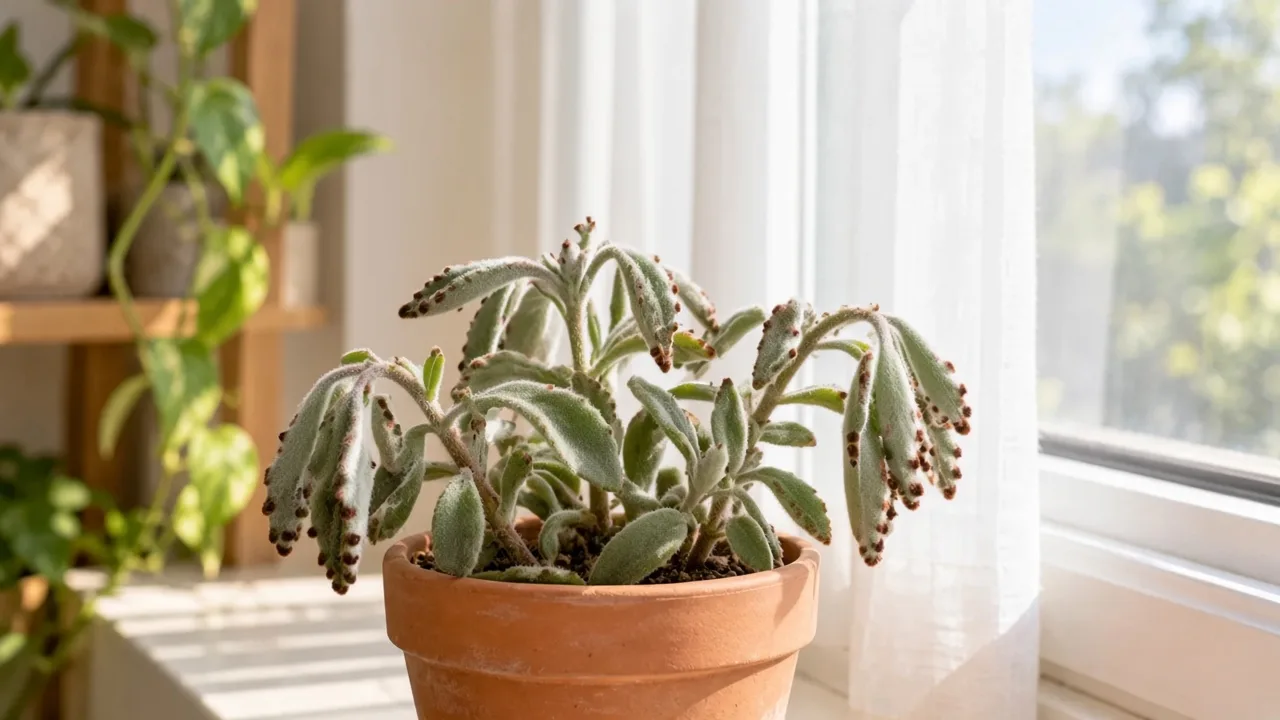
Wilting Panda Plant: Diagnosing the Succulent Wilt Paradox & Urgent Fixes
This guide covers wilting on Panda Plant. See also the general Wilting guide, watering, and light pages for this plant.
Wilting Panda Plant: Diagnosing the Succulent Wilt Paradox & Urgent Fixes
Quick answer
A wilting Panda Plant (Kalanchoe tomentosa) presents what botanists term the succulent wilt paradox: because the fleshy leaves rely on high internal hydraulic pressure to remain stiff and upright, foliage will wilt and sag when deprived of water—but that moisture deficit can be caused either by bone-dry soil or by rotted, suffocated roots unable to absorb water from soggy soil. For universal hydraulic wilt mechanics and cross-species diagnostic protocols, explore our global wilting guide.
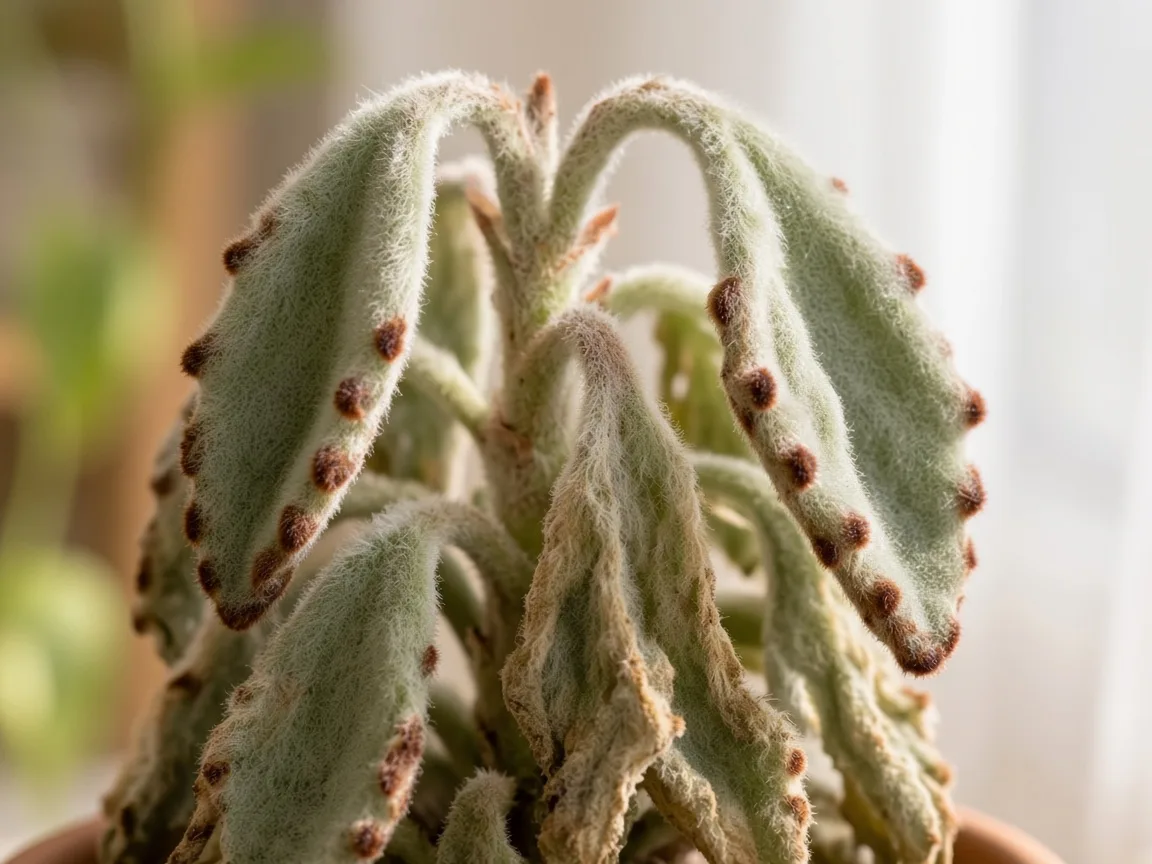
Limp, wilted Panda Plant leaves bending downward from lost hydraulic turgor. Your immediate first move is the Skewer and Stem Test: insert an unvarnished wooden skewer deep into the center of the rootball and gently squeeze the stem collar right at the soil line. If the skewer is completely dry and the stem is solid and woody, you are dealing with simple drought: bottom-soak the container for 30 to 45 minutes. If the skewer emerges wet, cool, or dark, or the stem base feels soft or squishy, cease all watering immediately and follow our root rot emergency protocol.
The succulent wilt paradox: why wet plants wilt
Understanding the hydraulic mechanics of Kalanchoe tomentosa reveals why identical limp foliage can arise from opposite extremes:
1. Drought wilt (Cellular plasmolyis)
In true underwatering, the potting substrate runs out of accessible capillary water. As the succulent continues basic respiratory transpiration, water is drawn from the large vacuoles of the parenchymal leaf cells. Cellular turgor pressure drops to zero, and the thick leaf tissue deflates, wrinkles, and wilts downward against the pot rim. Stems remain firm and fibrous, and the root system remains completely healthy.
2. Saturated root-rot wilt (Vascular occlusion)
As explained by Clemson Cooperative Extension, chronic overwatering fills every microscopic soil pore with water, suffocating root cells. Opportunistic pathogens (Pythium and Fusarium) invade the dying roots, dissolving feeder hairs and entering the xylem tubes. Fungal mycelium physically blocks water transport from the soil to the leaves. The top of the plant experiences acute dehydration even though its roots are soaking in water.
3. Thermal wilt (Transpiration outstripping uptake)
During intense summer heat waves or sudden hot drafts from heating registers, water evaporates from the foliage faster than succulent roots can pull it from the substrate. In response, leaves sag temporarily to reduce surface area exposed to sunlight.
4. Fertilizer salt burn (Reverse osmosis wilt)
Heavy synthetic fertilizers leave residual mineral salts in gritty succulent media. When salt concentrations in the soil exceed internal root cell concentrations, water is pulled out of the roots via reverse osmosis. Cells collapse and leaves wilt despite damp potting soil.
Diagnostic triage: Pinpointing the cause of wilt
| Diagnostic Marker | Drought Wilt | Overwatering / Rot Wilt | Thermal Heat Wilt | Fertilizer Salt Wilt |
|---|---|---|---|---|
| Soil Moisture | Bone-dry, dusty, feather-light | Wet, heavy, saturated | Variable (dry or damp) | Damp to moist |
| Stem Collar Feel | Rigid, woody, firm | Squishy, spongy, or black | Firm and upright | Rigid and firm |
| Leaf Texture | Wrinkled, deflated, leathery | Translucent, soft, mushy | Limp, warm, but full | Tip-scorched, crispy |
| Root Inspection | Pale tan, dry, healthy | Black, slimy, foul odor | Healthy, intact | Brown root tips, crusty pot rim |
| Urgency | Low to medium | Critical emergency | Low | Medium |
Step-by-step remediation protocols
Select the targeted treatment protocol based on your diagnostic findings:
Scenario A: True drought wilt (Dry soil & firm stem)
- Set the potted plant in a basin containing 2 to 3 inches of room-temperature water.
- Allow capillary action to draw water upward through the drainage hole for 30 to 45 minutes until the topsoil feels damp.
- Remove the pot and allow it to drain thoroughly in an empty sink for 20 minutes before returning it to its saucer.
- Leaves will re-absorb moisture, smoothing out wrinkles and stiffening within 24 to 48 hours. Review our Panda Plant watering guide.
Scenario B: Saturated root-rot wilt (Wet soil or soft stem)
- Slide the plant out of its container immediately.
- Rinse away old saturated substrate under gentle running water to inspect root health.
- If roots are black and disintegrating but the stem collar is solid: trim away all dead roots, disinfect remaining roots with 3% hydrogen peroxide, let them callous for 24 hours, and repot into dry 70% mineral pumice mix.
- If the stem collar at the soil line is soft, discolored, or squishy: execute an emergency apical beheading. Cut the stem with a sterile blade 1 to 2 inches above all discolored tissue, callous the cutting for 5 to 7 days, and re-root in dry pumice per our root rot guide.
Scenario C: Fertilizer salt wilt (Mineral crust on pot)
- Take the pot to a sink and slowly pour room-temperature distilled or reverse-osmosis water—equal to roughly 3 times the pot volume—through the soil to dissolve and flush out accumulated mineral salts.
- Allow to drain completely. Withhold all fertilizers for 8 to 12 weeks.
How to permanently prevent wilting on Panda Plant
- Use porous unglazed terracotta: Clay pots allow lateral air exchange and water evaporation through the walls, preventing the saturated soil conditions that cause root-rot wilt.
- Formulate high-grit mineral soil: Blend 60% to 70% coarse inorganic amendments (pumice, perlite, granite grit) with 30% to 40% organic cactus mix, as detailed in our Panda Plant soil guide.
- Follow the soak-and-dry irrigation routine: Always confirm complete pot dry-down with a wooden skewer before watering. Never water on a fixed calendar schedule.
- Provide bright indirect to gentle morning sun: Ensure 4 to 6 hours of good light to fuel metabolic transpiration and keep root zones oxygenated, per our Panda Plant light guide.
Related tool
Use our Drooping Leaves Diagnosis Tool to cross-examine soil moisture, stem texture, and leaf color to determine whether your Panda Plant needs immediate watering or urgent root rescue.
Related Panda Plant guides
- Panda Plant overview — comprehensive natural history and species care requirements
- Watering guide — soak-and-dry irrigation practices to keep succulents turgid
- Soil guide — custom mineral pumice and grit formulations for succulent drainage
- Light guide — sunlight intensity thresholds to support transpiration
- All Panda Plant problems — complete diagnostic troubleshooting directory