Fungus Gnats on Philodendron Florida Beauty: Causes, Checks
Quick answer
Fungus gnats on Philodendron Florida Beauty mean the top layer of mix is staying wet enough for larvae to breed. First step: stop watering and let the top 3–5 cm of mix dry fully, then water with a Bti drench and set a yellow sticky trap. Adults die off within days; larvae clear in 2–3 weeks.
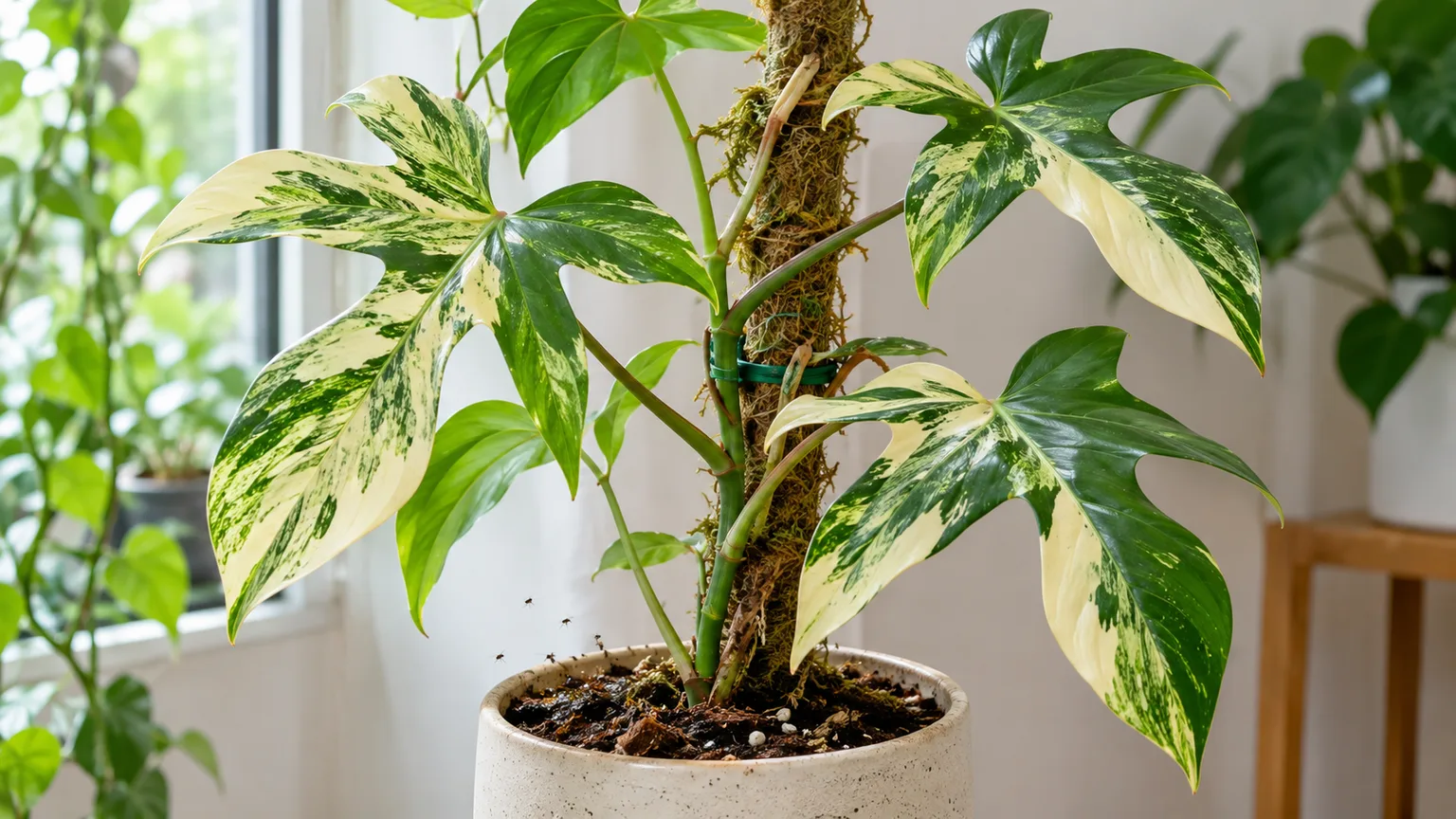
Fungus Gnats on Philodendron Florida Beauty: Causes, Checks & Fixes
This guide covers fungus gnats on Philodendron Florida Beauty. See also the general Fungus Gnats guide, watering, and light pages for this plant.
Fungus Gnats on Philodendron Florida Beauty: Causes, Checks & Fixes
Quick answer
Fungus gnats on Philodendron Florida Beauty are a moisture signal, not a plant disease. The tiny dark flies breed in the damp top layer of mix, where their larvae feed on fungi and decaying organic matter. First step: stop watering and let the top 3–5 cm (1–2 inches) of mix dry fully. Then resume with a Bti soil drench, set a yellow sticky trap to catch egg-laying adults, and keep the surface on a real wet-dry cycle. Expect adults to fade within days and larvae to clear over 2–3 weeks.
For how fungus gnats live and breed in general, see our fungus gnats guide. On Florida Beauty, the pattern usually shows up as flies hovering over chunky aroid mix that never dries at the surface — often in a cachepot setup, an oversized collector pot, or around a constantly damp moss pole.
What fungus gnats look like on Florida Beauty
Adult fungus gnats are delicate dark brown or black flies about 2–3 mm (roughly 1/8 inch) long, with long legs and a weak, fluttery flight in short hops just above the pot. The RHS fungus gnats guide describes adults running across compost surfaces and slow-flying around pots, with slender whitish larvae up to 6 mm long sporting distinct black heads in damp compost. On Florida Beauty you will notice them most after watering or when you brush the lobed leaves — a small puff of flies rises from the soil line, settles, and returns within minutes.
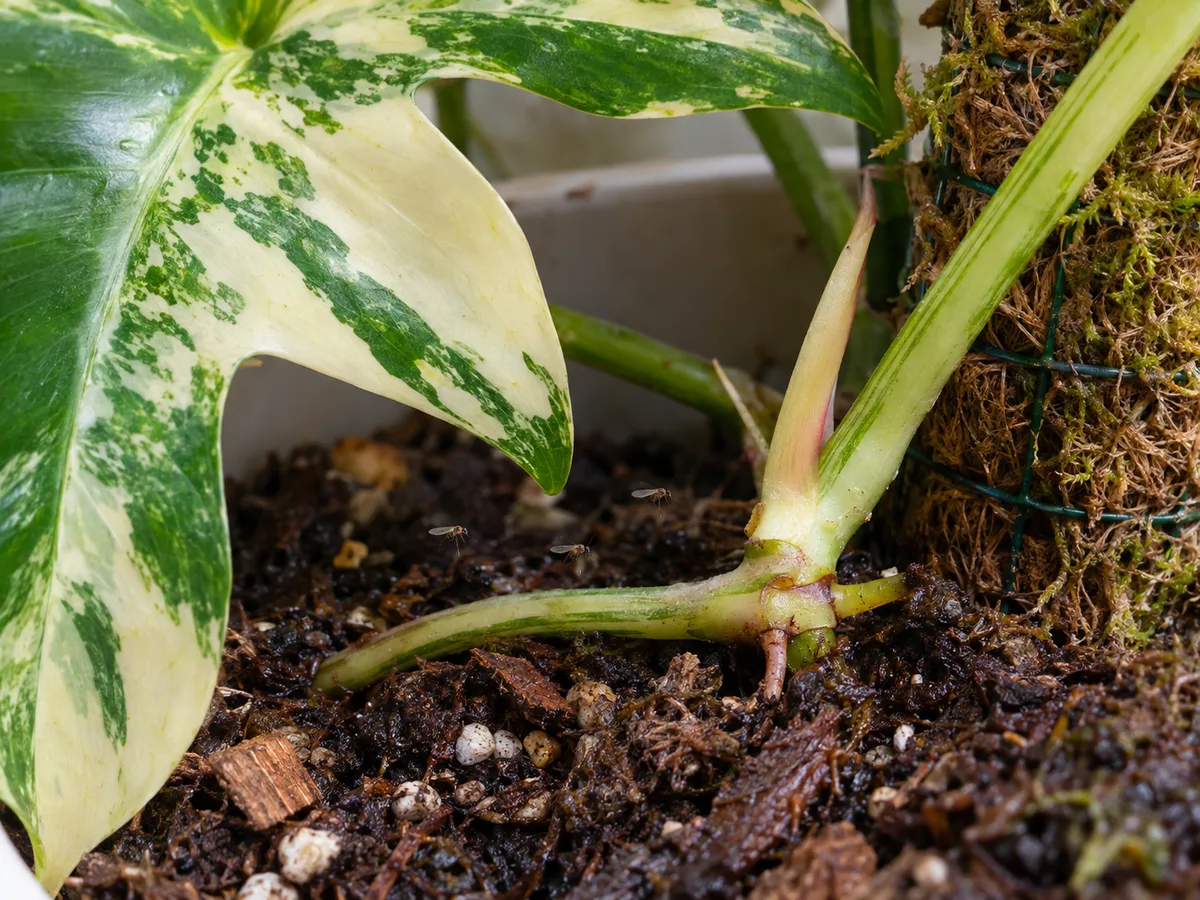
Adult fungus gnats hover close to damp potting mix; the plant’s marbled leaves are usually unaffected.
Larvae live in the top few centimetres of mix, feeding mainly on dead roots, decaying bark fines, and associated fungal growth. The RHS notes that larvae feed mostly on dead material and fungal growth, with established plants unlikely to be damaged except in heavy infestations. Your mature Florida Beauty will usually keep pushing normal lobed leaves while gnats swarm — the flies are the complaint, not leaf damage. Seedlings, fresh moss-to-mix cuttings, and plants already sitting in soggy soil are the exception, where larvae can chew fine root hairs and stall new growth.
Do not confuse the symptom with leaf pests. Fungus gnats never cluster on leaf undersides, never leave stippling or webbing, and never chew holes in the lobed foliage. If the damage is on the leaves themselves rather than flies over the soil, check the Philodendron Florida Beauty overview for the moisture-first diagnostic order before treating.
Why Florida Beauty pots breed gnats so readily
Florida Beauty is a climbing tropical aroid that wants evenly moist but never soggy mix — NC State Extension lists moist, well-drained soil for its close climbing-philodendron relatives, and Clemson HGIC warns that philodendrons must never stand in water. Gnat larvae need exactly what overwatered Florida Beauty provides: constantly damp organic matter in the top layer. Three features of typical Florida Beauty setups make this worse than on an average pothos.
First, variegated foliage drinks slower. Cream and yellow sectors photosynthesize less efficiently than green lobes, so a heavily variegated Florida Beauty transpires somewhat less than an all-green vine in the same light. Growers who water it on the same schedule as faster-drinking green plants keep the surface permanently damp — ideal egg-laying ground. Our watering guide covers why the top 3–5 cm must actually dry between soaks rather than following a calendar.
Second, chunky aroid mix stays wet on top in dim rooms. Bark and peat fines hold surface moisture for days when light is low and airflow is poor, even though the recipe drains well in bright conditions. A Florida Beauty parked in a dim corner for variegation protection paradoxically keeps wetter longer — see the light guide for placement that balances brightness with dry-down speed.
Third, moss poles and cachepots trap surface damp. The RHS philodendron growing guide notes climbing philodendrons root into moist moss poles — but a pole misted daily while the pot surface also stays wet creates two damp breeding zones instead of one. Decorative cachepots without drainage hide standing runoff at the bottom, so the grower sees a dry-looking surface, waters again, and the lower root zone never breathes. Guidance on pot and pole setup lives in the soil guide.
How to confirm the cause
Confirm gnats before buying any treatment. Work through these checks in order:
- Flight test. Tap the pot rim and watch. Fungus gnats rise in a loose cloud, hover just above the soil, and settle back onto the mix within a minute. Fast straight-line fliers around fruit bowls are fruit flies; fuzzy moth-like flies near drains are drain flies — different pests, different fixes.
- Trap count. Push one yellow sticky trap into the mix near the soil line. UW-Madison Extension recommends monitoring adults with yellow sticky traps placed just above the crop canopy. A dozen or more tiny dark flies within 48 hours confirms an active breeding population, and the trap doubles as ongoing control.
- Surface moisture read. Push your finger 3–5 cm into the mix. Cool, clinging soil plus a heavy pot days after watering confirms the wet-surface conditions larvae need. Adult females lay eggs in the top 1–2 inches of moist mix, so a surface that never dries is the diagnostic smoking gun.
- Larvae check. Scoop a teaspoon of surface mix onto white paper, or lay a raw potato slice on the soil overnight. Translucent thread-like maggots with shiny black heads confirm larvae. Springtails — tiny white jumpers with no wings — are harmless decomposers, not gnat larvae.
- Pole and saucer audit. Squeeze the moss pole: if water drips out days after misting, it is part of the breeding habitat. Lift the nursery pot out of its cachepot and check for pooled runoff or a sour smell, which signals anaerobic conditions that need the repotting guide rather than traps alone.
The first fix to try
Stop watering and let the top 3–5 cm of mix dry fully. Do nothing else on day one — no repot, no spray, no fertilizer. This single action breaks the breeding cycle because eggs and young larvae desiccate when the surface dries, while Florida Beauty’s established root system tolerates a few extra dry days far better than chronic wet feet.
Lift the pot daily to learn the weight change. When the top layer feels dry and crumbly at finger depth and the pot feels noticeably lighter, the surface is ready — even if deeper mix still holds some moisture. Empty the saucer and cachepot completely, and pause moss-pole misting until the pole surface dries too. Make this one correction first so you can read the plant’s response before stacking treatments.
Step-by-step recovery
After the first dry-down, layer controls in this order over the next 3–4 weeks:
- Trap the adults. Keep one or two yellow sticky traps at soil level. Traps alone will not end an infestation, but they cut egg-laying immediately and show whether numbers are falling week to week.
- Drench larvae with Bti. Water the next cycle with Bacillus thuringiensis israelensis (sold as Mosquito Bits or similar) soaked per label directions, applied as a soil drench so the bacteria reach the top few centimetres where larvae feed. Practical sequencing for Bti drenches plus traps is well covered in Epic Gardening’s fungus gnats guide. Repeat on the following watering 7–10 days later to catch newly hatched larvae, since the gnat life cycle runs roughly 3–4 weeks at room temperature — UW-Madison Extension describes females laying up to 200 eggs with larvae developing over one to two weeks before pupating.
- Water from the top but on check-first rhythm. Return to the watering guide rhythm: thorough soak until drainage, then nothing until the top 3–5 cm dry and the pot lightens. Bottom-watering keeps the surface drier but risks salt buildup in chunky mix; either method works if the surface genuinely dries.
- Fix the container. If the pot has no drainage hole, move the plant to a nursery pot that fits inside the decorative shell. If the pot is more than 5 cm wider than the root ball, downsize at the next repot — excess mix volume stays wet for days and re-invites gnats. Mix and pot detail is in the soil guide.
- Dry the moss pole cycle. Mist the pole only when its surface feels dry to the touch, not on a daily schedule. A pole that stays soggy while the pot also stays wet gives gnats a second nursery; moist pole plus drying pot surface is the target balance.
Recovery timeline
Adults trapped and starved of wet egg-laying sites usually thin out within a week. Larvae take longer: with Bti drenches and real surface dry-down, expect a steep drop by week two and near-zero trap catches by weeks three to four — one full life cycle. Judge progress by falling trap counts and clean new growth, not by zero flies on any single day; a few stragglers from neighbouring pots are normal.
If trap counts are unchanged after three weeks, the surface is still not drying. Re-audit light, pot size, and cachepot pooling rather than adding stronger chemicals. If the plant wilts in wet soil, lower leaves yellow, or petioles soften at the base, larvae are no longer the main problem — inspect roots for rot using the steps in the repotting guide.
Lookalike symptoms on Florida Beauty
| What you see | Likely cause | How to tell |
|---|---|---|
| Tiny dark flies over soil, worst after watering | Fungus gnats | Weak fluttery flight, return to soil surface; larvae with black heads in top mix |
| Fast tan flies with red eyes near kitchen, not soil | Fruit flies | Hover around produce and vinegar, ignore the pot |
| Fuzzy moth-like flies near sink or drain | Drain flies | Hang around plumbing, not houseplant soil |
| Tiny white jumpers in damp mix, no wings | Springtails | Jump when disturbed; harmless decomposers in wet mix |
| Stippling plus fine webbing on lobed leaves | Spider mites | Damage on foliage in dry air, not flies over soil |
Mistakes to avoid
- Fogging or spraying adults only. Killing visible flies without drying the surface or treating larvae restarts the cycle within days — females lay up to 200 eggs per cycle.
- Repotting on day one. Fresh mix stays wet while disturbed roots drink slowly, which can worsen breeding. Repot only for confirmed rot or collapsed, sour mix.
- Daily peroxide drenches. Occasional dilute hydrogen peroxide can knock back larvae, but repeated use harms fine root hairs and beneficial microbes. Prefer Bti plus dry-down.
- Sealing the surface with thick sand or gravel. A thin coarse top dressing can deter egg-laying, but a deep sealed layer traps moisture underneath and hides the finger test. Fix watering first.
- Fertilizing a stressed, gnat-ridden plant. Salts accumulate in wet mix and burn weakened roots. Hold feed until trap counts fall and new growth looks clean, per the fertilizer guide timing.
How to prevent it next time
Prevention is the same check-first routine that fixes the outbreak. Water only when the top 3–5 cm are dry and the pot feels light; empty saucers and cachepots within 30 minutes of every soak. Keep the chunky aroid mix airy with perlite and bark, refreshing it every 1–2 years before peat fines compact into a gnat-friendly sponge — the soil guide has the recipe and cup test.
Give the plant bright filtered light so it actually drinks what you pour; a Florida Beauty moved closer to an east window dries measurably faster, as the light guide explains. Let the moss pole surface dry between mistings, quarantine new plants for two weeks, and keep one sticky trap in the pot for a month after the outbreak as an early-warning sentinel.
When to use this page vs other Philodendron Florida Beauty guides
- Philodendron Florida Beauty overview — Start here for whole-plant context and the moisture-first diagnostic order.
- Philodendron Florida Beauty watering — Use when the real problem is schedule watering or confusing wet-soil wilt with thirst.
- Philodendron Florida Beauty soil — Use when mix stays wet for days, smells sour, or needs a perlite-and-bark rebuild.
- Philodendron Florida Beauty repotting — Use when roots are rotted, the pot is oversized, or the mix has collapsed.
Related Philodendron Florida Beauty guides
- Philodendron Florida Beauty overview
- Philodendron Florida Beauty watering
- Philodendron Florida Beauty soil
- Philodendron Florida Beauty light
- Philodendron Florida Beauty repotting
- Philodendron Florida Beauty propagation
- Philodendron Florida Beauty fertilizer
Related tool
Use the Pest Identifier with philodendron-florida-beauty pre-selected to confirm fungus gnats versus lookalike pests before treating.