Leggy Florida Beauty: Light, Moss Pole & Pruning Fixes
Quick answer
Compare the newest stem sections with older growth on your Philodendron Florida Beauty. If recent gaps are lengthening while new lobed leaves shrink, fade, or lean toward a window, move the plant one step closer to bright indirect light before pruning. A moss pole steadies the climb but cannot replace light or tighten gaps already formed.
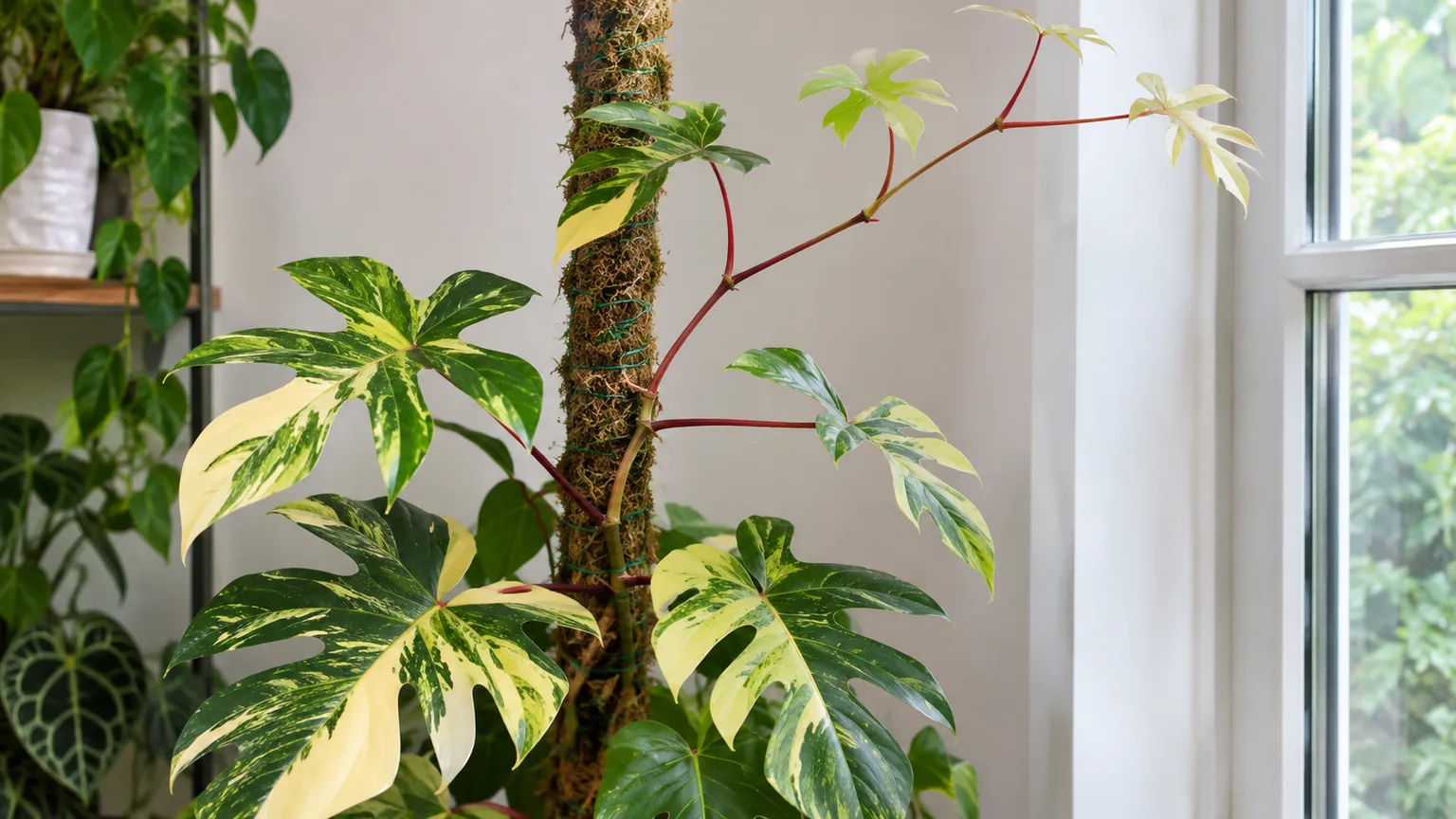
Leggy Growth on Philodendron Florida Beauty: Causes, Checks & Fixes
This guide covers leggy growth on Philodendron Florida Beauty. See also the general Leggy Growth guide, watering, and light pages for this plant.
Leggy Growth on Philodendron Florida Beauty: Causes, Checks & Fixes
Quick answer
On Philodendron Florida Beauty, “leggy” means the newer stem sections are growing longer and sparser than the plant’s earlier growth, usually with smaller or paler lobed leaves and a lean toward the brightest window. For how this stretching works in houseplants generally, see our leggy growth guide. On Florida Beauty, the pattern usually shows up as widening gaps between leaves that unfurl smaller, while cream splashes fade toward plain green and the vine reaches sideways off its support.
First fix: if the latest internodes are lengthening and the newest leaves are shrinking or fading, move the plant one step closer to bright filtered light before pruning. A moss pole can steady a loose vine but cannot replace missing light or close gaps that already formed.
This page covers true legginess: lengthening internodes with weakening new leaves. If the vine is long but its spacing and leaf size are steady, start with the support section below rather than a light overhaul.
What leggy growth looks like on Philodendron Florida Beauty
Florida Beauty (Philodendron ‘Florida Beauty’) is a climbing hybrid of Philodendron pedatum and Philodendron squamiferum with deeply lobed green leaves splashed in cream and yellow on distinctive red petioles. The diagnosis that matters is change over time on your own plant, not total vine length. Look at the last three or four stem sections that have finished extending and compare them with older growth lower down. If each recent gap is longer while each new leaf is smaller, narrower, or less lobed than the ones before it, the plant is producing weaker, more open growth than it used to.
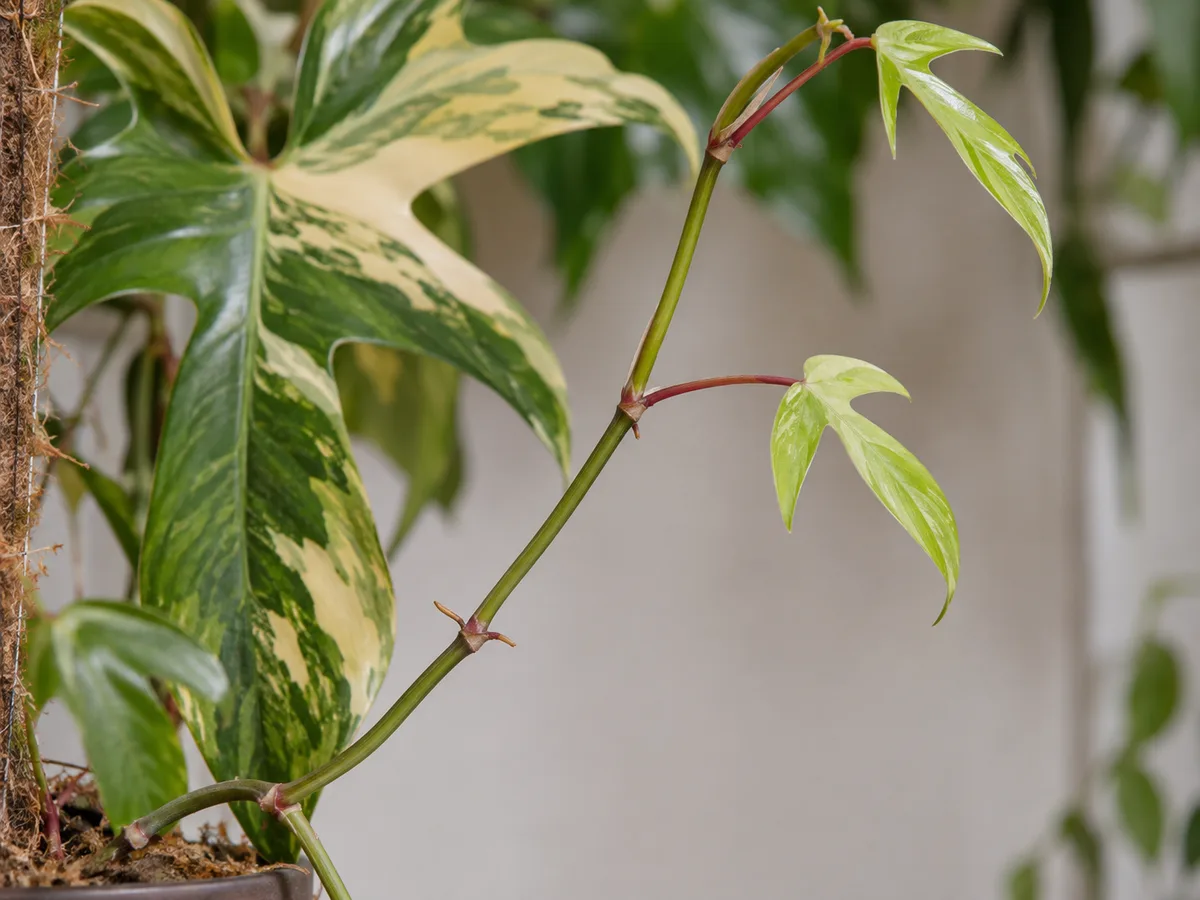
Lengthening spaces between nodes and shrinking new leaves reveal low-light legginess more clearly than total vine length.
Low light is the usual driver. The Royal Horticultural Society describes weak, pale, spindly shoots as a possible result of low light, and Florida Beauty-specific guidance puts insufficient light first among leggy causes, noting the plant stretches toward the nearest light source when it cannot get enough (Cafe Planta leggy guide). Too little indirect sunlight shows up as a recognizable trio on this cultivar: fading variegation, leggy growth, and smaller new leaves (Everdayglow Florida Beauty guide). A plant sitting several feet from a window, behind a heavy curtain, or shaded by furniture can look fine from across the room while its growing tip works in genuinely dim conditions.
A single long section does not settle the diagnosis. The vine may have reached past a nearby object or grown sideways off its support. The pattern worth acting on is successive new sections getting longer and sparser together, especially when the newest leaves also trend smaller or less variegated.
Florida Beauty climbs, so check the support before blaming the light
Florida Beauty is a natural climber that in the wild latches onto tree trunks for support, using them to ascend and display its leaves (Cafe Planta moss pole guide). Indoors it needs a textured moss or coco pole installed while the plant is still small, with stems tied loosely at nodes and aerial roots facing the support. Without that structure it gets leggy and its leaves stay small, while a supported plant produces progressively bigger, more dramatic foliage (Everdayglow Florida Beauty guide).
That habit confuses the legginess diagnosis in both directions. A healthy climbing stem is naturally long, so vine length alone proves nothing. But a plant left to sprawl without a pole also makes smaller, less lobed leaves, which can look like light-driven decline even when light is adequate. Before concluding the plant is stretching for light, check whether it has a stable support at all and whether the stem is secured to it. The Philodendron Florida Beauty overview describes this climbing requirement and how it differs from self-supporting philodendrons that never need a pole.
Use the combination, not either trait alone:
| What you notice | What it points toward | What to check next |
|---|---|---|
| Newer internodes lengthen and new leaves shrink, fade, or lose lobing | Light may be inadequate for compact variegated growth | Window distance, curtains, furniture shade, and which way the growing tip faces |
| The vine sprawls or tangles but spacing and leaf size stay steady | Missing or outgrown support on a natural climber | Install or extend a moss pole and tie stems loosely at nodes |
| Leaves stay small without lengthening gaps, or older leaves yellow while the stem stretches | Support, maturity, water, or mix rather than legginess | Work through the light, water, and mix checks below before changing anything |
Read the cream variegation as a light meter
Florida Beauty’s cream and yellow sectors carry less chlorophyll than the green tissue, so they cannot pull their weight in dim conditions. That makes variegation your most honest light gauge: when plant-facing light falls short, new leaves come in with less cream, and the plant compensates by packing in more green chlorophyll per leaf. Expect the sequence of fading splashes, then longer gaps, then smaller blades — and treat the first fading leaf as an earlier warning than the stretch itself.
Two distinctions keep this reading honest. First, juvenile Florida Beauty leaves are naturally narrower and less lobed than mature ones, so compare new growth with the plant’s own recent leaves rather than with a mature specimen photo. Second, fading cream across several new leaves with longer internodes usually means insufficient light, while three or more consecutive mostly green leaves on one stem suggest node-level reversion — in that case pruning the green section back to a variegated leaf is the documented correction (Simplify Gardening Florida Beauty care). Light alone may not restore color on a reverted runner. At the other extreme, bleached or crispy cream patches mean too much direct sun rather than too little, so more light is not always the answer.
Check the light at the growing tip before changing anything else
Reconstruct the conditions that produced the newest stem sections. Note which window the plant faces, how far the leaves sit from it, whether a sheer curtain or a neighboring building filters the light, and whether the pot was recently moved. What matters is exposure at the vine’s growing tip, not how bright the room feels from the doorway. NC State Extension gives bright indirect sunlight as the baseline for philodendrons with a warning that direct sun scorches leaves, and the RHS growing guide agrees on bright but indirect positioning kept out of direct summer sun. The Philodendron Florida Beauty light guide translates that balance to real windows.
Then check direction. If the newest petioles and the growing tip repeatedly face one side, the plant is reaching toward a stronger source. On a single-window setup, small regular turns distribute growth more evenly, but rotation cannot fix a genuinely dim position. Also glance at feeding: heavy fertilizer in dim light pushes soft elongated growth rather than compact foliage, so hold off on feeding while diagnosing and keep any future schedule measured and tied to active growth, as the fertilizer guide covers.
Do not treat watering or repotting as stand-ins for a light diagnosis. Legginess describes stem and leaf spacing; it does not prove the roots are dry or the pot is wrong. If the mix stays heavy for days after watering, address a failing mix separately through the soil guide rather than stacking a repot on top of a light move.
First fix: give confirmed low-light growth brighter filtered light
If the latest internodes are longer and the newest leaves are getting smaller or less variegated, move the plant one step closer to a bright window or remove one layer of shading, keeping it out of harsh direct sun. This is the first correction because the references consistently identify low light as the cause of stretched, weak growth and recommend bright filtered positions. An east-facing window with gentle morning sun suits this cultivar well, and where natural light falls short a full-spectrum LED grow light run 10 to 12 hours a day bridges the gap through winter.
Make one change you can keep stable, in steps if the move is large. Shifting a plant straight from a dim corner into strong midday sun risks scorching the cream sectors it was meant to help, so stage a big move over several days. After the move, keep leaves off hot glass and watch the pale sections for fresh bleached or crispy patches. If no scorch appears but new stems keep reaching, move one more small step brighter or add supplemental light. Do not feed extra fertilizer to force compact growth; better light is the relevant correction, and heavy feeding cannot recreate sunlight.
Avoid stacking repotting, hard pruning, and a watering overhaul on the same day unless a separate urgent root problem is present. Multiple simultaneous changes make it impossible to tell what helped.
Support steadies the vine but does not shorten internodes
Even when light is the confirmed cause, Florida Beauty still needs its climbing structure sorted. Place a stable moss or coco pole close behind the stem with the aerial-root side facing it, and secure the stem with soft ties at nodes, loose enough to avoid pinching as the stem thickens. Water the pole when you water the pot so aerial roots can grip, and never cinch the leaf stalks themselves into position; let each blade sit naturally. The RHS growing guide lists moss pole support among its core philodendron recommendations, and NC State Extension describes climbing types attaching by aerial roots to a pole or trellis.
A pole stops an unsupported vine from slumping across the pot and holds the stem in one plane so future spacing is easier to inspect. It cannot change the length of sections already formed, and a pole in a dim corner will not supply the light the leaves need. If the vine is mostly healthy with steady spacing, support alone may be the whole correction. If the stem keeps stretching with the pole in place, return to the light check rather than tightening ties. When the top outgrows the pole, extend or replace the support before it turns top-heavy; you do not need a full repot just to add support if there is room to insert it safely, and the repotting guide covers the cases where the pot itself is the problem.
Pruning tradeoffs for a variegated climbing philodendron
Pruning is optional. Use it to reduce an awkward length, remove a damaged or fully reverted section, or make a plant that already has better light fit its support. It is not the first fix for low-light stretch: cutting first removes working leaves without correcting the conditions that shaped the stem, so regrowth can repeat the same pattern. The Philodendron Florida Beauty pruning guide has the plant-specific choices for shortening or shaping the vine.
If you prune, take one section rather than cutting the plant back hard, and remove no more than about a third of the foliage at once. Cut just below a node so any saved piece carries the tissue it needs to root; Gardening Know How describes cutting below the node for propagation material, and NC State Extension lists stem cuttings and layering as philodendron propagation methods. The propagation guide covers rooting cuttings in the warm, humid conditions this species prefers. Always work with clean, sharp scissors or shears to avoid transmitting disease, and wear gloves, since aroid sap can irritate skin (Gardening Know How).
A cut makes the vine shorter but never contracts existing internodes. Plan for a shorter plant or a cutting to root, not a guaranteed flush of dense basal growth; leave enough healthy foliage for the plant to keep growing and keep expectations modest while the next leaves form under the corrected light.
How to judge recovery without expecting old stems to change
Stretched sections record the conditions they formed under and stay long after light improves, so compare the next fully developed leaf and the next completed internode against the stretched ones. Improvement means the pattern stops worsening: new gaps are less extended, new blades stop trending smaller, and cream splashes return on leaves that finish cleanly. The return of firmer, better-proportioned new growth matters more than any visual change to old tissue.
Do not set a fixed calendar deadline for the next leaf. Florida Beauty is a slow grower even in good conditions, and timing depends on season, warmth, and overall vigor; the RHS growing guide notes philodendrons need to stay above 15 degrees C, and cool, short winter days slow everything down. Photographing the last formed node when you move the plant beats relying on memory. If the next growth is still unusually extended, repeat the light check and confirm the leaves themselves get brighter filtered light, not just the pot. Keep the watering rhythm steady while you wait, since erratic watering adds stress without fixing spacing.
Prevent another stretch of sparse growth
Choose a bright filtered position the plant can keep as it climbs, following the bright-without-direct-sun guidance cited above, and adjust for your actual windows, curtains, and season. If the only available spot sits far from a window, a suitable grow light is more practical than repeatedly shuttling the plant into scorching sun.
Check the stem each time a new leaf hardens. Compare a few internodes rather than judging density from one leaf or overall height, and note whether new growth consistently faces one direction. Turn the pot a little at a time under strongly one-sided light, leaving enough time between adjustments to read the next leaf. Keep furniture and neighboring plants from casting a permanent shadow over the growing tip, and keep the vine tied to its pole before it sprawls beyond easy management.
Related tool
Use the Plant Problem Diagnosis Tool to compare leggy growth with other symptoms on this plant before making several changes at once.
Related Philodendron Florida Beauty guides
- For light: use the Philodendron Florida Beauty light guide to choose a filtered position you can keep long term.
- For posture and sprawl: use the Philodendron Florida Beauty overview for the climbing habit and moss pole setup; use the pruning guide once light and support are stable and the vine needs reshaping.
- For cuttings from pruned sections: use the propagation guide to root node cuttings in warm humidity.
- For water, mix, and feeding alongside stretch: use the watering guide, soil guide, repotting guide, and fertilizer guide depending on what you find in the pot.
- Scope note: this page covers lengthening internodes with weakening new leaves. General houseplant stretch mechanics live in the global symptom hub linked in the Quick answer above; the sections here stay inside Florida Beauty-specific care.