Raat Rani Light Needs: Sun, Shade and Placement
Raat Rani Light Needs: Sun, Shade and Placement
Raat Rani Light Needs: Sun, Shade and Placement
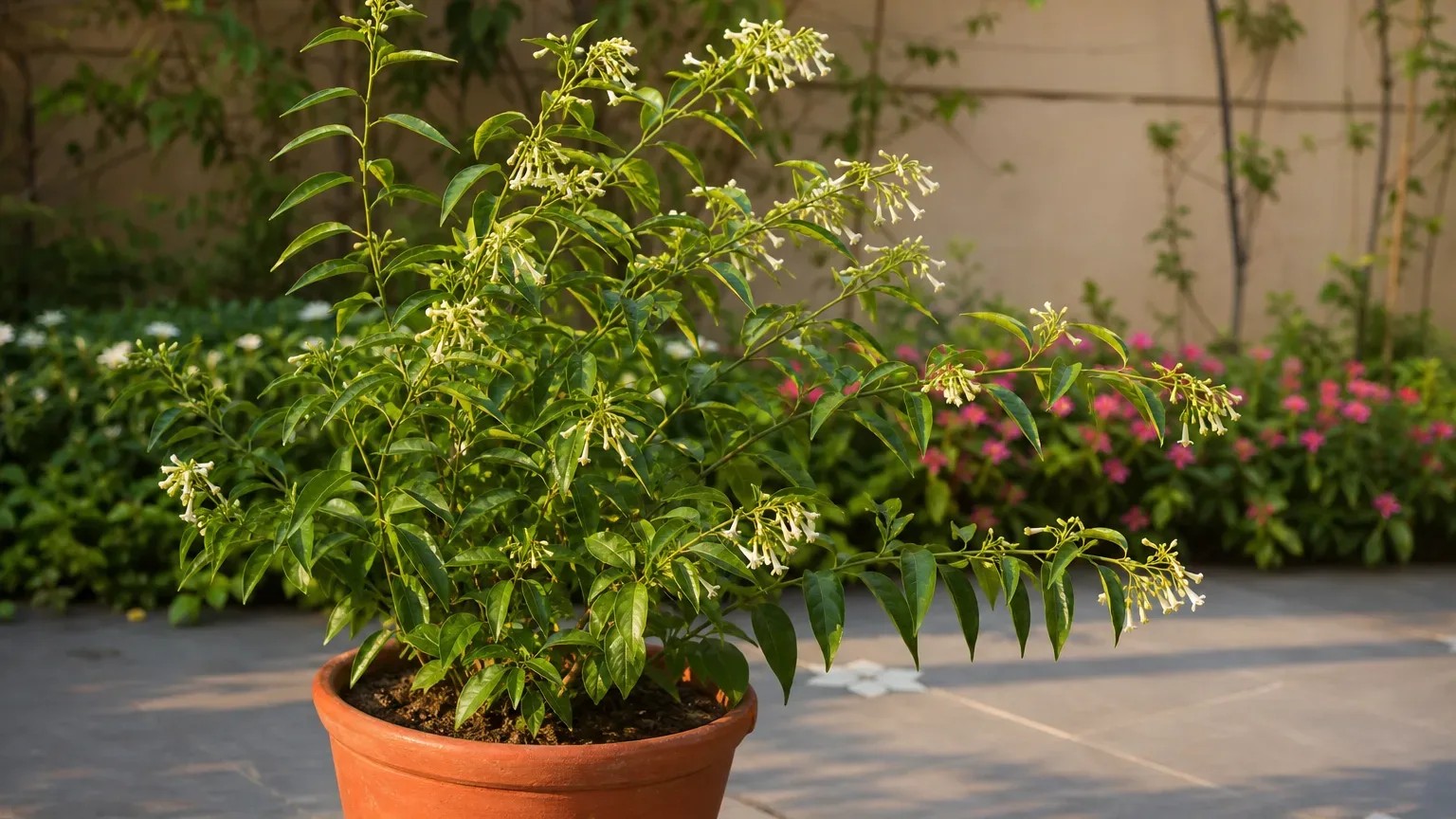
Raat Rani grows and flowers best in strong outdoor light, usually full sun to partial shade. For a container in most Indian climates, use four to six hours of direct sun as a practical starting range, favouring morning light, then judge the newest shoots. In exceptionally hot inland summers, light shade during the fiercest afternoon hours can protect foliage without turning the entire day dim.
This is Cestrum nocturnum, a large woody nightshade shrub rather than a true jasmine. The RHS species profile lists both full sun and partial shade, recommends full light under glass with shade from hot sun, and suggests a sheltered sunny site outdoors. That range is useful: Raat Rani adapts to different exposures, but the placement that keeps an established shrub alive may not produce dense growth or satisfying flower flushes.
Quick answer: how much light Raat Rani needs
Give an established Raat Rani a bright, open position with substantial direct sun. Four to six hours is a practical trial range for a pot, not a scientifically fixed threshold for every climate; the RHS documents exposure categories rather than an hourly minimum. An east-facing balcony, a bright south-facing terrace, or an open garden position with morning-to-midday sun is a reliable starting point.
Do not interpret partial shade as a dark veranda or an interior room. NSW Government records that the species can tolerate both dense shade and sunny sites, but ecological tolerance includes survival and spread, not a promise of compact container growth or abundant flowers. If stems become long, thin, and widely spaced, improve light before adding fertilizer.
Raat Rani is a Cestrum, not true jasmine
The common name “night-blooming jasmine” is misleading. The Royal Botanic Garden Sydney record places Cestrum nocturnum in the Solanaceae family, whereas true jasmines are Jasminum species in Oleaceae. Care labels and online advice can mix these unrelated plants, so confirm the botanical name before applying light or safety guidance.
That identity also changes where the plant belongs in a home. Raat Rani is a woody shrub that can approach several metres outdoors, not a compact windowsill jasmine. Its arching canopy needs even illumination and enough space that one bright window does not light only the nearest branch.
Why strong light matters to this flowering shrub
Strong light supports compact new shoots, a dense canopy, and the energy required to form flower clusters. In weak light, a Raat Rani commonly lengthens the spaces between leaves and leans toward the brightest opening. The result is a loose outline with fewer well-lit shoot tips, even when the existing leaves remain green.
Light is not the only reason a shrub fails to bloom. Hard pruning, excess nitrogen, drought, root stress, or cool weather can also delay flowers. Use the Raat Rani fertilizer guide if the plant is already in strong light but produces soft leafy growth, and check the Raat Rani pruning guide before making cuts that could remove developing shoots.
Shade tolerance is not the same as best flowering light
Government weed records show Cestrum nocturnum growing under rainforest canopies as well as in gardens and parks. That flexibility explains why an established shrub may remain green in shade. It does not mean every shaded balcony delivers equal growth or flowering.
Judge the site by new growth and bloom, not by whether old leaves survive. A well-lit plant should produce firmer shoots, shorter spaces between leaves, and a fuller outline. A shade-bound plant gradually leans, opens gaps through the canopy, and may keep making leaves without useful flower clusters.
Full sun or partial shade outdoors
Use full sun where mornings are bright, air moves freely, and the pot does not bake against concrete or dark glass. Use partial shade where summer afternoons are severe, the container sits on a heat-reflecting terrace, or a newly purchased plant was raised under nursery shade cloth. Avoid an all-or-nothing response: a short period of afternoon screening can reduce heat while preserving strong light through the rest of the day.
Garden-grown shrubs usually handle stronger exposure than small containers because their roots occupy a larger, cooler soil volume. A black nursery pot on a west balcony can overheat even when the same sunlight suits a shrub in the ground. Light, root temperature, wind, and water demand rise together, so inspect moisture more often after moving a pot sunnier using the Raat Rani watering guide.
When afternoon shade helps in India
In coastal or humid tropical cities, open sun with moving air may work through much of the year. In hot, dry inland conditions, protect the plant from the most punishing mid-to-late-afternoon exposure during peak summer. A slatted screen, a taller companion plant, or moderate shade cloth can reduce radiant heat while preserving a bright day.
Avoid deep overhead shade all day. A site that receives two gentle morning hours and then darkens behind walls is usually weaker than a site receiving morning sun plus bright open sky. If you add shade for peak summer, reduce it once temperatures moderate so the shrub does not remain unnecessarily dim through the next growth cycle.
Best balcony, terrace, and garden exposures
Choose a position with an open view of the sky and enough space for air to circulate around the mature shrub. Keep flowering plants away from bedroom windows and enclosed sitting areas because Queensland Poisons Information Centre says the nocturnal fragrance can irritate the respiratory tract and trigger symptoms in sensitive people. The same authority identifies all parts as toxic, especially the fruit, so placement must keep foliage and fallen berries away from children and animals.
In a garden, avoid planting beneath a dense evergreen canopy merely because the species survives there as a weed. A sunny boundary with shelter from strong wind is more useful for flowering. Leave enough clearance for a woody shrub; the New Zealand Plant Conservation Network describes a terrestrial shrub with nocturnally fragrant flower panicles, not a small indoor vine.
East, south, west, and north compared
East is the safest default for pots because it provides morning sun before the strongest heat. South can provide the longest exposure in much of the Northern Hemisphere and suits Raat Rani when summer pot heat is monitored. West offers strong afternoon light but carries the greatest heat load on walls, glass, and containers, while north is often too dim when buildings or overhangs block the sky.
Compass direction is only a starting point. Tree shade, balcony depth, neighbouring towers, tinted glazing, and monsoon cloud can matter more. Observe where a direct sunbeam actually reaches the leaves and for how long; do not call a room “bright” based on human vision alone.
Can Raat Rani grow indoors?
Raat Rani can be kept indoors temporarily, but it is a poor long-term choice for an ordinary living-room corner. It wants high light, grows into a large shrub, and releases powerful fragrance after dusk. A sunny conservatory, greenhouse, or very bright enclosed balcony is more realistic than a spot several metres from a window.
University of Georgia Extension explains that indoor light falls sharply compared with open sun and that window exposure, overhangs, trees, wall reflectance, season, and distance all change what reaches a leaf (UGA Extension). If a cold spell forces a container inside, place it at the brightest safe window, reduce watering to match slower drying, and return it outdoors gradually when conditions improve. The Raat Rani overview covers temperature, toxicity, and whole-plant placement constraints.
Using a grow light when window light is weak
A strong full-spectrum LED can supplement a bright window, but it must illuminate the whole canopy rather than one branch. University of Minnesota Extension recommends choosing artificial lighting by intensity, duration, and distance from the foliage rather than relying on a room fixture (UMN Extension). Start with the fixture maker’s distance guidance and a consistent timer, then adjust according to the plant’s new growth.
Artificial light is most practical for a young, pruned container plant. As the shrub reaches one or two metres, evenly lighting the complete canopy becomes inefficient. If new shoots still stretch toward the window, improve useful intensity within the lamp’s safe range or return the plant outdoors.
Acclimatise Raat Rani before increasing sun
A nursery plant raised under shade cloth can scorch when moved directly into open terrace sun. The RHS recommends gradually acclimatising tender indoor-raised plants over about two to three weeks, beginning in a sheltered position. For Raat Rani, begin with morning sun and bright shade, then extend exposure every few days.
Pause the increase if pale patches or crisp margins appear on sun-facing leaves. Do not combine repotting, hard pruning, heavy feeding, and a sudden light change; changing one major condition at a time makes the response readable. Existing scorched tissue will not turn green again, so assess the next leaves after correcting placement.
Seasonal light changes in India
During spring, increase exposure gradually as growth accelerates. In peak summer, keep the total day bright but provide afternoon relief where leaf temperature and pot heat become excessive. During monsoon, clouds and nearby fast growth can reduce light sharply even though days remain long; trim obstructing plants and avoid pushing Raat Rani deep under cover solely to keep rain off it.
Winter light may become gentler and arrive at a lower angle. Move a portable pot into a sunnier position if cool weather and shade combine to stall growth. Do not compensate for seasonal dimness with extra water or fertilizer; first improve placement, then let other care inputs follow the plant’s actual growth rate.
Signs of too little light
Too little light produces long internodes, thin leaning stems, sparse lower foliage, slow drying soil, and few flowers. UGA Extension lists elongated spaces between leaves, smaller new leaves, stalled growth, and loss of older foliage among the general signs of inadequate indoor light. New leaves can remain green, so overall architecture is often more useful than colour alone.
Move the plant brighter in stages, rotate the pot a quarter turn weekly while new growth evens out, and avoid a heavy feed as the first fix. Old lanky stems will not shorten, but better-lit replacement shoots should emerge more compact. If the plant stays sparse after light improves, check root condition and drainage in the Raat Rani soil guide.
Signs of too much sun
Excessive exposure usually appears as bleached yellow-tan patches, crisp brown margins, or damage concentrated on the side facing hot afternoon sun. Sudden symptoms soon after a move strongly suggest acclimation failure. Uniform yellowing while the soil stays wet points more toward root stress than sunlight.
Shift the pot out of the hottest beam, preserve bright morning light, and leave damaged foliage until enough healthy growth replaces it. Do not move a scorched plant into deep shade; that trades one extreme for another. Check water demand after changing exposure because the pot will dry at a different rate.
A practical placement test
Record four observations for two weeks: direct-sun hours, the direction of new shoots, how quickly the pot dries, and whether new nodes are closer together. Then change only one factor. Moving the pot toward an open balcony edge can be more useful than adding fertilizer, while a sheer screen during a heat wave can solve scorch without sacrificing the whole day’s light.
Flowers take longer to judge than shoot form. Give the plant time to make a fresh flush after correction, provided other care is sound. If growth becomes compact but buds still fail, review pruning timing, nutrition, and seasonal temperature rather than intensifying sun indefinitely.
When to use this page vs other Raat Rani guides
Use this page to choose exposure, acclimatise the shrub, and distinguish low-light stretch from sun scorch. Use the watering guide when soil stays wet or leaves wilt, the fertilizer guide for feeding decisions, and the repotting guide when a crowded or unstable root ball limits growth.
For structural cuts and flower-timing questions, use the pruning guide. For starting a new plant, use the propagation guide. Light interacts with each topic, but changing exposure will not repair waterlogged roots or replace flower-bearing growth removed by badly timed pruning.
Related Raat Rani guides
Start with the complete Raat Rani care overview if you are identifying the plant or planning a safe location. Pair this light guidance with Raat Rani watering and Raat Rani soil because sunnier plants use water faster while dense mixes can remain wet despite a bright site.
Use Raat Rani fertilizer only after light and root health are sound. Consult Raat Rani repotting for an overcrowded container and Raat Rani pruning to keep this naturally large shrub manageable without repeatedly removing developing growth.
Conclusion
Raat Rani needs a bright outdoor position with substantial direct sun, not a dim indoor corner. Begin with morning-to-midday sun, use four to six hours as a practical trial for a container rather than a rigid species rule, and provide light afternoon protection only when extreme heat or reflected radiation causes stress.
Read the newest shoots: compact growth and flower clusters support the placement, stretched stems call for more light, and one-sided bleaching calls for gentler acclimation. Keep the toxic shrub and its strongly scented flowers away from children, pets, bedrooms, and enclosed sitting areas, and remember that it is a Cestrum nightshade rather than a true jasmine.