Raat Rani Care Guide: Sun, Water, Soil & Blooms
Cestrum nocturnum
Grow Raat Rani (Cestrum nocturnum) in sun, free-draining soil, and steady moisture. Learn pruning, flowering, winter care, and essential toxicity precautions.
Raat Rani Care Guide: Sun, Water, Soil & Blooms
Start with wateringThe most common care mistake for Raat RaniWatering guide →Raat Rani care essentials
Light
Water
Water deeply when the top 2–3 cm of soil dries. Keep the root zone evenly moist during active growth and flowering, but never waterlogged. Reduce watering sharply during cool, slow winter growth.
Soil
Fertile, loose, well-draining potting mix that holds moderate moisture without becoming soggy; target pH 6.0–7.5.
Humidity
Temperature
Fertilizer
A light application of balanced slow-release fertilizer in spring, or a diluted balanced liquid feed every 4–6 weeks through the warm season, is sufficient for most containers.
About Raat Rani
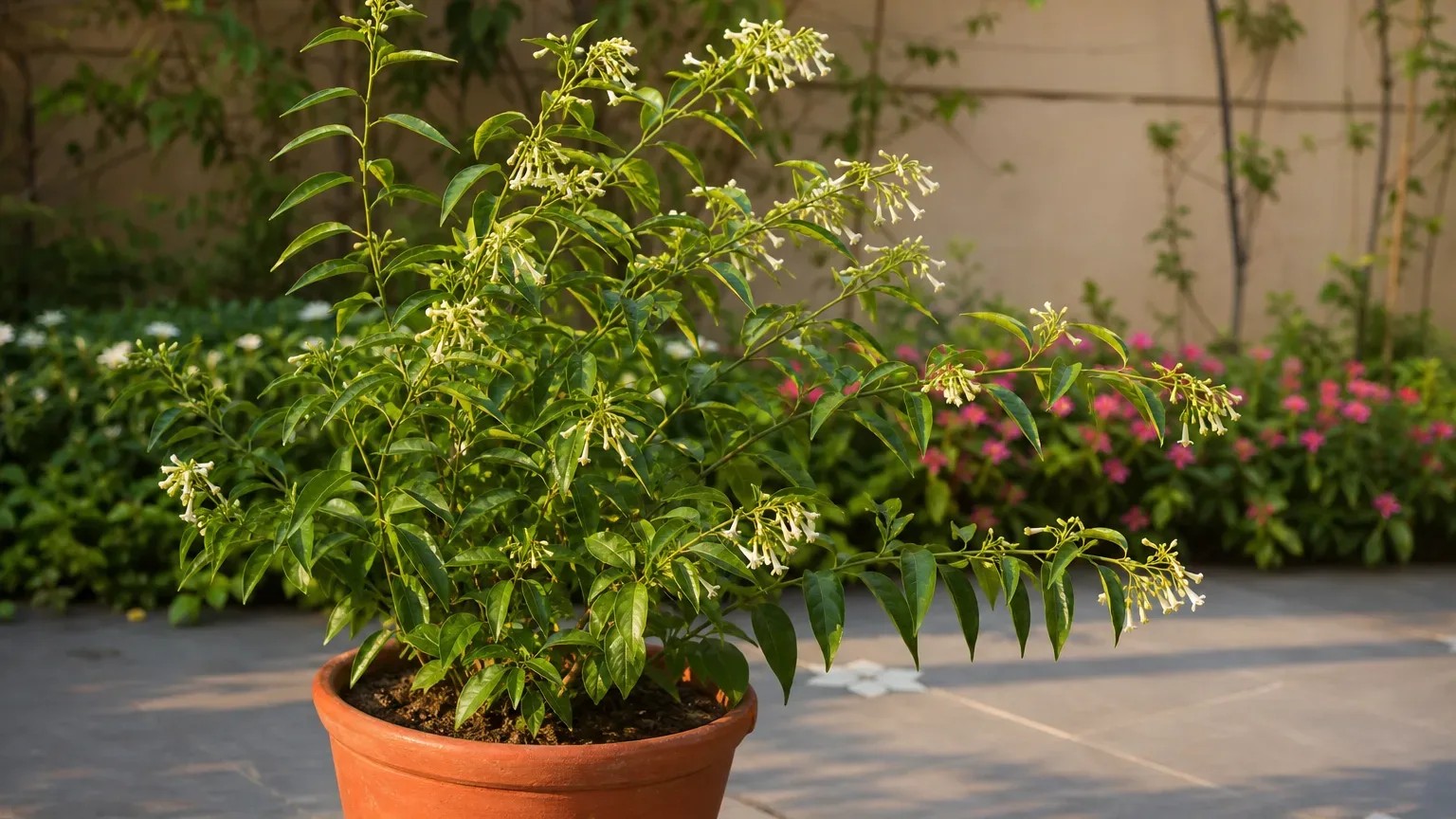
Raat Rani is native to Mexico, Central America, and northern South America; naturalised across tropical and subtropical regions including South Asia, typically reaches 2–4 m tall and 1–2 m wide outdoors; 1–2 m in a large container with regular pruning indoors, with fast in warm weather once established growth. Raat Rani has a evergreen shrub growth habit and part of the Solanaceae family. It is also known as Night-Blooming Jasmine, Night-Blooming Jessamine, Lady of the Night, Queen of the Night, Raat Ki Rani, and Night-Scented Cestrum.
| Detail | Information |
|---|---|
| Also known as | Night-Blooming Jasmine, Night-Blooming Jessamine, Lady of the Night, Queen of the Night, Raat Ki Rani, Night-Scented Cestrum |
| Native region | Mexico, Central America, and northern South America; naturalised across tropical and subtropical regions including South Asia |
| Mature size | 2–4 m tall and 1–2 m wide outdoors; 1–2 m in a large container with regular pruning |
| Growth rate | Fast in warm weather once established |
| Growth habit | Evergreen Shrub |
| Scientific name | Cestrum nocturnum |
| Family | Solanaceae |
Raat Rani Care Guide: Sun, Water, Soil & Blooms
Raat Rani is a fast-growing outdoor shrub whose small, greenish-white flowers release their strongest perfume after dusk. It needs more sun, root room, and pruning than the word “jasmine” suggests. Give it a bright outdoor position, fertile soil that drains freely, and water based on actual dryness rather than a fixed calendar.
The botanical name is Cestrum nocturnum. For an Indian balcony or garden, the priorities are straightforward: protect the roots from stagnant monsoon water, allow room for woody growth, prune at a time that preserves new flowering shoots, and place the plant where its powerful night fragrance can disperse. If growth is weak or flowers are scarce, check light and roots before adding fertilizer.
Raat Rani care at a glance
Raat Rani grows best in full sun to partial shade and moist but well-drained soil. The Royal Horticultural Society lists full sun or partial shade and loam, sand, or chalk for Cestrum nocturnum, while NC State Extension describes Cestrum shrubs as heat- and humidity-tolerant. In very hot climates, light afternoon shade can protect a container plant while still allowing strong morning sun.
Water deeply when the top 2–3 cm of mix has dried, then let excess escape completely. Feed lightly during active warm-season growth, provide a stable pot or generous garden space, and reduce both water and fertilizer when cool weather slows the plant. Do not treat it as a permanent indoor flowering plant: light is usually inadequate, and the fragrance can be overwhelming in enclosed rooms.
Raat Rani identity: a Cestrum, not true jasmine
Raat Rani belongs to the Solanaceae, or nightshade family, not the true-jasmine genus Jasminum. Both ITIS taxonomy and the USDA classification place Cestrum nocturnum in Solanaceae. That identity matters because true jasmines and Cestrum do not share the same toxicity profile.
Common names include night-blooming jasmine, night jessamine, lady of the night, and Raat Ki Rani. A scientific label is the safest way to confirm what you own, especially when nurseries use “queen of the night” for several unrelated plants.
Flowers, fragrance, and growth habit
The plant carries clusters of narrow tubular flowers that are greenish-white to cream and become intensely fragrant at night. Queensland’s species profile describes an evergreen ornamental shrub to about 4 m, with roughly 2.5 cm flowers clustered in the leaf axils (Queensland Poisons Information Centre). Closed or inconspicuous flowers by day are therefore normal, not evidence that the plant has stopped blooming.
The scent can travel well beyond the pot on still evenings. Place the shrub near a path or open terrace where you can enjoy it at a distance, rather than beside a bedroom window, air intake, or enclosed sitting area.
How large Raat Rani gets
This is a woody shrub, not a compact windowsill plant. The RHS describes it as a bushy evergreen shrub reaching about 2.5–4 m, with a spread of 1.5–2.5 m (RHS plant profile). Regular pruning and restricted roots can keep a container specimen nearer 1–2 m, but it still needs a stable pot and room for arching stems.
Give it clearance from narrow paths and walls, and expect a young plant to make long shoots quickly in warm weather. Pinching and selective pruning create a branched framework; repeatedly shearing only the outside produces dense tips over bare inner stems.
Light: choose an outdoor position
Aim for around six hours of direct sun where practical. Morning sun with light afternoon shade works well for containers in punishing summer heat, while mild climates can support all-day sun. Deep shade usually produces long internodes, sparse leaves, and fewer flower clusters.
Move a shade-grown nursery plant into direct sun gradually over one to two weeks. Begin with morning exposure and increase it as new leaves harden. Use the Raat Rani light guide when choosing between balcony exposures or diagnosing stretched growth and weak flowering.
Watering: steady moisture without stagnant soil
During active growth, check the upper 2–3 cm of soil and water when that layer feels dry. Soak the complete root ball until runoff appears, empty the saucer, and wait for the next dryness check. A small summer pot may need checking every two or three days, but checking is not the same as automatically watering.
Monsoon rain changes the decision completely. Stop routine irrigation when the pot remains damp, keep drainage holes clear, and prevent runoff collecting in an outer pot. In cooler weather, reduce watering as growth slows without leaving the entire root ball dry for long periods. The Raat Rani watering guide explains how pot size, weather, and root condition change the interval.
Soil and drainage for pots and ground
Use a fertile, loose medium that holds moderate moisture but releases surplus water. A practical container starting point is 50% quality potting soil, 30% compost or coco coir, and 20% perlite or coarse sand. The exact percentages can change with climate; the test is whether water spreads through the mix and drains promptly without leaving it swampy.
NC State lists moist, well-drained loam or sandy soil for the genus and notes broad pH tolerance (cultivation record). For containers, a mildly acidic to neutral mix around pH 6.0–7.5 is a useful target. In heavy garden clay, plant slightly high and improve a broad area rather than making a compost-filled hole that traps water. See the Raat Rani soil guide for mix adjustments.
Feeding for balanced growth and flowers
Feed only when the plant is actively making shoots. A modest spring application of balanced slow-release fertilizer or a diluted balanced liquid feed every four to six weeks through warm growth is a practical starting point for a container. Established plants in fertile ground may need only compost and correction of a confirmed deficiency.
Do not use extra nitrogen as the first response to poor bloom. A dark-green plant with long soft shoots but few flowers usually needs stronger light or different pruning timing, not more leaf growth. Never fertilize dry, waterlogged, recently repotted, or cold-stalled roots; use the Raat Rani fertilizer guide for timing and dilution.
Raat Rani in a pot versus open ground
A pot controls soil and allows a plant to be moved out of cold wind or relentless rain. It also dries faster in summer, restricts a naturally large shrub, and can become top-heavy. Choose a stable container with unrestricted drainage and increase only one size when roots circle densely or emerge from the holes.
Open ground supports fuller size and steadier moisture where winters are mild and the site drains, but local weed status must be checked before planting. UF/IFAS assesses the species as predicted invasive in Florida, and NSW WeedWise warns that it can form thickets that outcompete native plants. These classifications are regional, not proof that it is legally restricted everywhere; check local rules and remove spent flower clusters before white berries ripen, especially near natural areas.
Pruning and propagation basics
Raat Rani flowers on fresh growth, so make structural cuts in late winter or very early spring before the main flush. Remove dead, crossing, weak, and excessively long stems, then use light trimming after a bloom flush to maintain shape. Avoid repeated hard cuts while buds are forming.
Stem cuttings are the most practical way to reproduce a selected plant; NC State lists stem cuttings as the recommended strategy for the genus. The species can also spread by seed and vegetative growth, as summarized by Hawaiian Ecosystems at Risk. Follow the Raat Rani propagation guide and Raat Rani pruning guide for task-specific steps.
Seasonal care in India
During hot, dry spring and summer weather, check small containers frequently and shield newly acclimated foliage from reflected western heat. When monsoon humidity and rainfall arrive, prioritize drainage and airflow; stop calendar watering and remove fallen material from the soil surface.
Cool winter weather slows growth even where frost is uncommon. Reduce watering, stop routine feeding, and move a container to a bright sheltered position when cold weather stalls growth. Leaf drop after cold exposure can be stress rather than death, so wait for warmth and inspect stems before pruning everything back.
Safety around people and animals
All parts should be treated as toxic if eaten, especially the fruit. Queensland Poisons Information Centre advises urgent medical attention for ingestion and lists elevated temperature, rapid pulse, excess salivation, and gastritis among reported effects (species-specific poison guidance). Keep the plant and fallen berries beyond the reach of children, pets, and grazing animals, and seek professional medical or veterinary advice after suspected ingestion.
The fragrance itself can cause breathing difficulty, nose or throat irritation, headache, nausea, or dizziness in sensitive people, according to the poison-centre record; NSW government guidance also notes irritation and breathing difficulties in some people. Grow Raat Rani outdoors, allow air movement, and relocate it if anyone nearby reacts.
Read the plant: healthy signs and warning signs
Healthy Raat Rani makes firm leafy shoots, branches after pinching, and produces clusters of slim buds that open after dusk. A mature plant with vigorous but compact new growth is responding well to its light and roots. Flowering may come in flushes rather than continuously.
Long bare stems and sparse flowers point first to weak light. Yellowing and leaf drop while the soil stays wet suggest excess moisture; a sour smell or soft lower stem requires a root check. Limp tips, crisp margins, and soil pulling from the pot indicate prolonged dryness. Water racing through a root-packed pot or growth stalling in warm bright conditions points toward the Raat Rani repotting guide.
Common Raat Rani care mistakes
The most common mistake is treating Raat Rani like a small indoor jasmine. A bright room rarely matches outdoor sunlight, while an enclosed room concentrates the fragrance. Other mistakes include watering by weekday, leaving runoff in a cachepot, planting in dense clay, and moving a shade-grown plant directly into fierce afternoon sun.
Stacking interventions also causes setbacks. Do not repot, hard-prune, feed, and change placement on the same day unless an emergency requires it. Correct the most likely limiting condition, then watch the next growth for evidence before making another major change.
When to use this page vs other Raat Rani guides
Use this overview to identify the plant, choose a site, understand its mature habit, and triage broad care problems. Go to the light guide when placement or flowering is the main concern, the watering guide for moisture decisions, and the soil guide when drainage or compaction is suspect.
For a specific job, use the dedicated fertilizer, repotting, propagation, or pruning page. Those guides cover timing and technique in more detail than an overview can.
Related Raat Rani guides
- Raat Rani fertilizer guide — feed active growth without pushing soft leafy stems.
- Raat Rani repotting guide — assess crowded roots, pot size, and aftercare.
- Raat Rani propagation guide — root stem cuttings and care for new plants.
- Raat Rani pruning guide — shape the shrub while preserving flowering growth.
- Raat Rani plant hub — review the species profile and complete care cluster.
Conclusion
Successful Raat Rani care begins with recognizing it as a vigorous, toxic Cestrum shrub rather than a true jasmine or indoor tabletop plant. Give it strong outdoor light, deep but conditional watering, fertile free-draining soil, restrained feeding, and enough space for woody growth.
When growth or flowering declines, check sun, root moisture, drainage, and pruning timing before adding fertilizer. Place the shrub where its night fragrance can disperse, prevent access to berries, and remove fruit where local guidance identifies an escape risk.
How to care for Raat Rani?
When should you water Raat Rani?
Water deeply when the top 2–3 cm of soil dries. Keep the root zone evenly moist during active growth and flowering, but never waterlogged. Reduce watering sharply during cool, slow winter growth.
- Test the top 2–3 cm with a finger - Water deeply when the top 2–3 cm of soil dries.
- water thoroughly only when it feels dry - Water deeply when the top 2–3 cm of soil dries.
- then empty the saucer - Water deeply when the top 2–3 cm of soil dries.
- Drain excess water - Water deeply when the top 2–3 cm of soil dries.
What soil works best for Raat Rani?
Fertile, loose, well-draining potting mix that holds moderate moisture without becoming soggy; target pH 6.0–7.5.
- 50% quality potting soil - Fertile, loose, well-draining potting mix that holds moderate moisture without becoming soggy; target pH 6.0–7.5.
- 30% compost or coco coir - Coconut-fiber potting ingredient that holds moisture without packing as densely as peat.
- 20% perlite or coarse sand - Light white granules that keep soil airy and help prevent compaction.
Grower notes for Raat Rani
What matters most with Raat Rani
Raat Rani is Cestrum nocturnum, a fast-growing nightshade shrub—not a true Jasminum jasmine. Give it 6 or more hours of sun for compact growth and reliable flower flushes, with light afternoon shade in punishing summer heat. Pair that light with fertile, freely draining soil and steady moisture; deep shade produces lanky stems and few flowers.
Best placement in a real home
Place Raat Rani outdoors on a sunny balcony, terrace, or garden edge where its powerful night fragrance can disperse. Do not position a flowering plant beside a bedroom window or in an enclosed room: the scent can trigger headache, nausea, or breathing irritation in sensitive people. Protect it from frost and cold drying winds.
Before you buy this plant
Choose a bushy plant with firm green stems, clean leaf undersides, and a mix that smells fresh rather than sour. Check the botanical label: Cestrum nocturnum belongs to Solanaceae and is toxic if eaten, unlike many true jasmines. Avoid plants with yellow leaves in wet soil, scale insects, whiteflies, or long bare stems.
First month after bringing it home
Quarantine the plant, keep it in bright filtered light for several days, then acclimatise it gradually to direct sun. Learn how quickly its nursery pot dries before changing the watering rhythm. Repot only if the mix is waterlogged, the roots are tightly bound, or the container is unstable; avoid combining repotting, hard pruning, and feeding at once.
Keep berries away from children and pets
All parts are potentially toxic, especially the fruit. Remove spent flower clusters before berries develop, wear gloves when pruning, and place the pot beyond chewing or play areas. Seek urgent medical or veterinary advice after ingestion; do not wait for symptoms such as salivation, vomiting, rapid pulse, or stomach irritation.
How to tell Raat Rani is settling in
Healthy new shoots should be firm and leafy, followed by clusters of narrow greenish-white buds that open after dusk. Sparse flowers usually point first to weak light, late pruning, or excess nitrogen. The shrub flowers on new growth, so make major size cuts in late winter or very early spring and only lightly trim after a bloom flush.
Is Raat Rani safe for pets?
No. Raat Rani (Cestrum nocturnum) is not true jasmine. All parts are potentially toxic, especially the berries, and ingestion requires urgent veterinary advice. Keep the plant and fallen fruit completely out of reach.
Queensland Poisons Information Centre identifies all parts of Cestrum nocturnum as toxic, especially the fruit. Reported effects include elevated temperature, rapid pulse, excess salivation, and gastritis; its intense nocturnal fragrance may also irritate the respiratory tract.
Watering Raat Rani
For Raat Rani, test the top 2–3 cm with a finger; water thoroughly only when it feels dry, then empty the saucer and water check every 2–3 days in hot summer containers and water when the surface dries; usually every 7–10 days in cooler weather. Water more often through hot spring, summer, and monsoon growth; reduce during cool winter weather while keeping the root ball from drying completely.
| Detail | Information |
|---|---|
| How often | Check every 2–3 days in hot summer containers and water when the surface dries; usually every 7–10 days in cooler weather |
| How to check | Test the top 2–3 cm with a finger; water thoroughly only when it feels dry, then empty the saucer |
| Seasonal changes | Water more often through hot spring, summer, and monsoon growth; reduce during cool winter weather while keeping the root ball from drying completely |
Signs of overwatering
- yellowing leaves
- sudden leaf drop while soil remains wet
- soft lower stems
- sour-smelling mix or root rot
Signs of underwatering
- limp leaves and soft shoot tips
- crisp leaf edges
- flower buds dropping before opening
- soil pulling away from the pot
Soil & potting for Raat Rani
Use a mix of 50% quality potting soil, 30% compost or coco coir, 20% perlite or coarse sand for Raat Rani. Good drainage is essential; use a pot with generous drainage holes and never leave the roots standing in water. Target soil pH around 6.0–7.5. Repot every 1–2 years while young; thereafter when root-bound, ideally in late winter to early spring, just before strong new growth.
| Detail | Information |
|---|---|
| Recommended mix | 50% quality potting soil, 30% compost or coco coir, 20% perlite or coarse sand |
| Drainage | Good drainage is essential; use a pot with generous drainage holes and never leave the roots standing in water |
| Soil pH | 6.0–7.5 |
| Repotting frequency | Every 1–2 years while young; thereafter when root-bound |
| Best season to repot | Late winter to early spring, just before strong new growth |
Signs it needs repotting
- roots circling inside the pot or emerging from drainage holes
- water running straight through a tightly packed root ball
- soil drying within a day despite thorough watering
- stalled growth in warm, bright conditions
Humidity & temperature for Raat Rani
Fertilizer & pruning for Raat Rani
Use a light application of balanced slow-release fertilizer in spring, or a diluted balanced liquid feed every 4–6 weeks through the warm season, is sufficient for most containers. for Raat Rani.
| Detail | Information |
|---|---|
| Fertilizer type | A light application of balanced slow-release fertilizer in spring, or a diluted balanced liquid feed every 4–6 weeks through the warm season, is sufficient for most containers. |
Common problems on Raat Rani
Yellow Leaves
MediumLikely cause: Common on this plant type; confirm with recent watering, light, and root checks.
Quick fix: Inspect the plant and correct the most likely care stressor before stacking treatments.
Full fix guide →Brown Tips
MediumLikely cause: Common on this plant type; confirm with recent watering, light, and root checks.
Quick fix: Inspect the plant and correct the most likely care stressor before stacking treatments.
Full fix guide →Root Rot
MediumLikely cause: Common on this plant type; confirm with recent watering, light, and root checks.
Quick fix: Inspect the plant and correct the most likely care stressor before stacking treatments.
Full fix guide →Overwatering
MediumLikely cause: Common on this plant type; confirm with recent watering, light, and root checks.
Quick fix: Inspect the plant and correct the most likely care stressor before stacking treatments.
Full fix guide →Underwatering
MediumLikely cause: Common on this plant type; confirm with recent watering, light, and root checks.
Quick fix: Inspect the plant and correct the most likely care stressor before stacking treatments.
Full fix guide →Spider Mites
MediumLikely cause: Common on this plant type; confirm with recent watering, light, and root checks.
Quick fix: Inspect the plant and correct the most likely care stressor before stacking treatments.
Full fix guide →Mealybugs
MediumLikely cause: Common on this plant type; confirm with recent watering, light, and root checks.
Quick fix: Inspect the plant and correct the most likely care stressor before stacking treatments.
Full fix guide →Aphids
MediumLikely cause: Common on this plant type; confirm with recent watering, light, and root checks.
Quick fix: Inspect the plant and correct the most likely care stressor before stacking treatments.
Full fix guide →Leggy Growth
MediumLikely cause: Common on this plant type; confirm with recent watering, light, and root checks.
Quick fix: Inspect the plant and correct the most likely care stressor before stacking treatments.
Full fix guide →Slow Growth
MediumLikely cause: Common on this plant type; confirm with recent watering, light, and root checks.
Quick fix: Inspect the plant and correct the most likely care stressor before stacking treatments.
Full fix guide →Wilting
MediumLikely cause: Common on this plant type; confirm with recent watering, light, and root checks.
Quick fix: Inspect the plant and correct the most likely care stressor before stacking treatments.
Full fix guide →Drooping Leaves
MediumLikely cause: Common on this plant type; confirm with recent watering, light, and root checks.
Quick fix: Inspect the plant and correct the most likely care stressor before stacking treatments.
Full fix guide →Low Humidity
MediumLikely cause: Common on this plant type; confirm with recent watering, light, and root checks.
Quick fix: Inspect the plant and correct the most likely care stressor before stacking treatments.
Full fix guide →Not Enough Light
MediumLikely cause: Common on this plant type; confirm with recent watering, light, and root checks.
Quick fix: Inspect the plant and correct the most likely care stressor before stacking treatments.
Full fix guide →Fungus Gnats
MediumLikely cause: Common on this plant type; confirm with recent watering, light, and root checks.
Quick fix: Inspect the plant and correct the most likely care stressor before stacking treatments.
Full fix guide →Mold on Soil
MediumLikely cause: Common on this plant type; confirm with recent watering, light, and root checks.
Quick fix: Inspect the plant and correct the most likely care stressor before stacking treatments.
Full fix guide →