Mealybugs on Raat Rani: Causes, Checks & Fixes
Quick answer
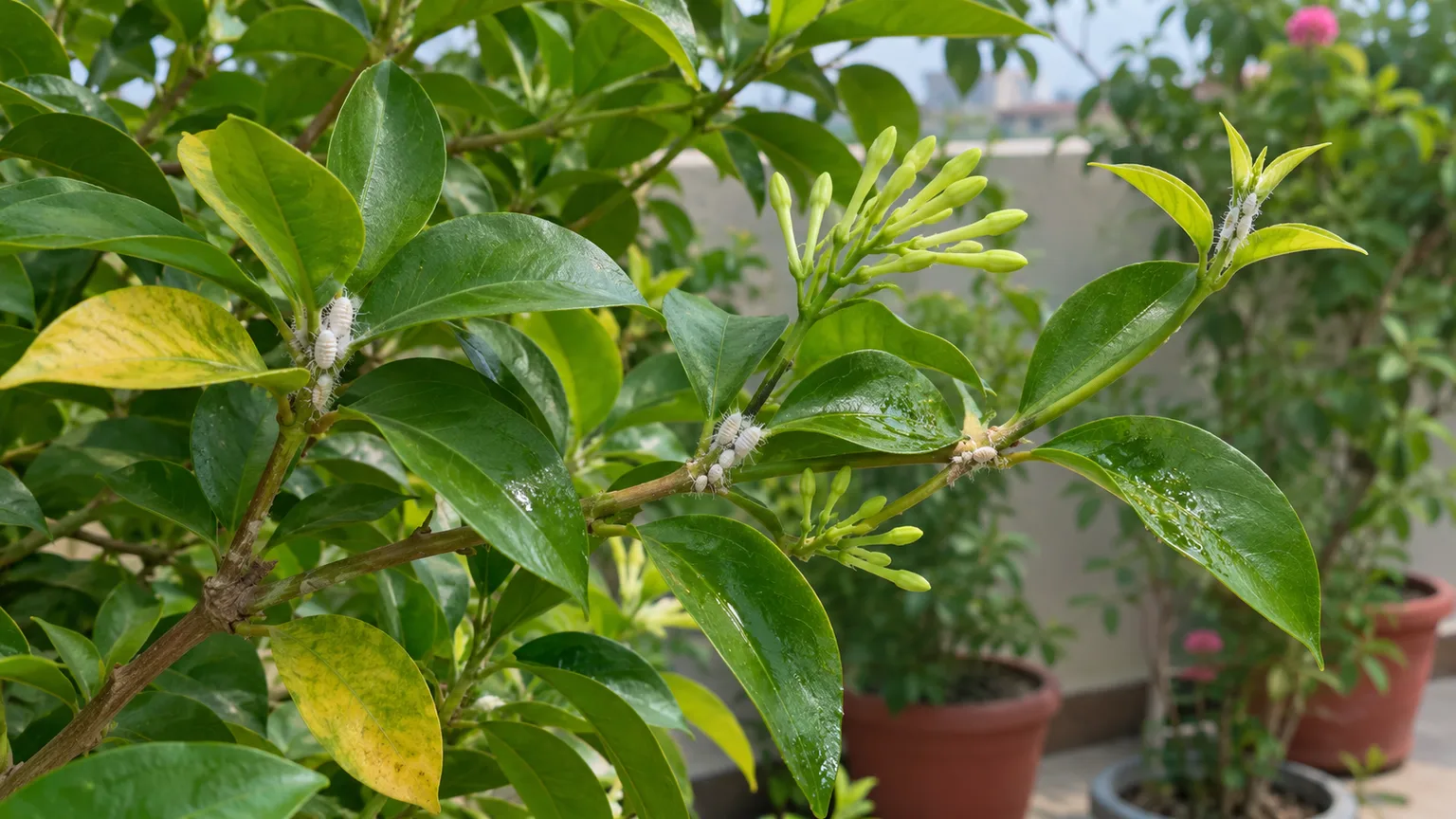
Mealybugs on Raat Rani show up as white cottony clusters in leaf axils, on tender shoot tips, and around flower buds. First step: isolate the plant from nearby plants; then test a small leaf area before dabbing visible clusters with diluted isopropyl alcohol.
Mealybugs on Raat Rani: Causes, Checks & Fixes
This guide covers mealybugs on Raat Rani. See also the general Mealybugs guide, watering, and light pages for this plant.
Mealybugs on Raat Rani: Causes, Checks & Fixes
Quick answer
Mealybugs on Raat Rani (Cestrum nocturnum) appear as white, cottony clusters tucked into leaf axils, along the veins on leaf undersides, and on the tender shoot tips and bud clusters where the shrub does its newest growing. Leaves below a colony may feel sticky with honeydew and develop a black sooty coating. First step: isolate the Raat Rani from nearby plants. Once isolated, dab visible clusters with a cotton swab dipped in 70% or weaker isopropyl alcohol, after testing one leaf a day or two beforehand for burn.
For general mealybug biology across houseplants, see our mealybugs guide. On Raat Rani, the pattern usually shows up as stalled shoot tips and bud drop on a shrub that otherwise wants to grow fast and flower in flushes.
What mealybugs look like on Raat Rani
Adult female mealybugs are oval, roughly one-fifth to one-third of an inch long, with a waxy, white, cottony covering, and they sit in slow-moving clusters along veins, on leaf undersides, and in hidden joints (Missouri Botanical Garden). They are piercing-sucking insects that feed on sap, so an infested Raat Rani weakens from the tips inward: new leaves emerge small and distorted, buds dry before opening, and lower leaves yellow and drop.
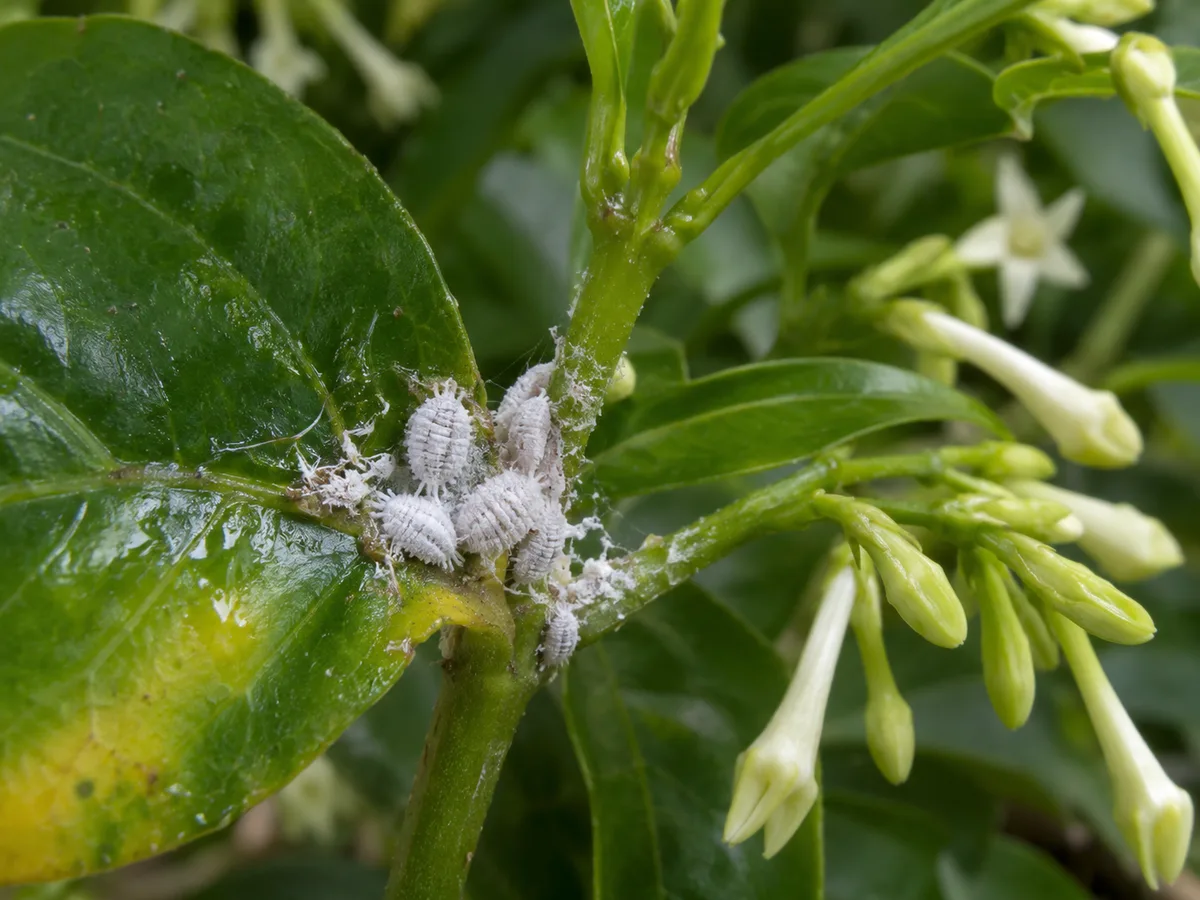
Check leaf joints and shoot tips for cottony, segmented colonies and sticky honeydew.
The giveaway trio is cottony wax plus stickiness plus blackening. Mealybugs excrete honeydew that coats the foliage below the colony, and a black sooty mold grows on that residue (RHS). On Raat Rani’s dense framework this often reads as grimy lower leaves beneath a shoot tip that looks white-fluffed at the top.
Why this shrub invites mealybugs
A branching framework full of hiding joints
Raat Rani grows fast into a twiggy, many-branched shrub, and every branch fork, leaf axil, and spent flower cluster is a sheltered crevice. Mealybugs favour exactly these protected spots, settling in the crown, in branch crotches, or on stems near the soil where sprays and casual glances miss them (UC IPM). A quick overhead glance at a Raat Rani tells you little. Part the branches and look into the joints.
Soft new growth is the target, and blooms pay for it
Raat Rani flowers on new growth in flushes, pushing tender shoot tips through spring, summer, and the monsoon months. Mealybugs colonise that same soft tissue first, and heavy feeding slows growth and causes leaf drop (UC IPM). The practical consequence is specific to this plant: colonies on bud-bearing tips mean fewer of those night-fragrant flower clusters opening, and the flush you waited for arrives thin and ragged.
Warm terrace conditions with few natural enemies
Container Raat Rani on sunny balconies and terraces sits in year-round mild warmth with steady moisture, which is ideal mealybug territory. Plants kept indoors or in sheltered warmth are especially vulnerable because mild temperatures run all year and the natural enemies that check mealybugs outdoors rarely reach them (UC IPM). Overfeeding with nitrogen makes it worse by pushing exactly the soft sappy growth mealybugs want, so keep feeding to a modest warm-season rhythm rather than forcing extra flushes.
How to confirm the cause
Work through these checks on a bright terrace before treating:
- Inspect the axils and tips. Bend shoot tips gently and look into each leaf axil, the undersides along the midrib, and the base of every bud cluster. White cottony tufts that wipe away to reveal a segmented oval insect confirm mealybugs.
- Touch-test for honeydew. Run a finger over leaves below the suspect colony. A sticky film, sometimes already dusted black, points to sap feeders rather than dust or spray residue.
- Check for ants. Ants collect honeydew and guard colonies, and their trails up the pot are a reliable secondary signal (Missouri Botanical Garden). If ants are farming the colony, deal with the ants too or reinfestation follows.
- Rule out root and water stress. Yellow leaves with wet, heavy soil and a sour mix point to water trouble instead of pests. Inspect the root zone before spraying anything. Mealybug yellowing concentrates near colonies and sticky leaves, not evenly across a waterlogged pot.
- Scan the neighbours. Crawlers walk from infested plants to adjacent ones, so inspect whatever shares the terrace rail or windowsill, especially other soft-tipped shrubs.
The first fix to try
Isolate the Raat Rani, then dab each visible mealybug with a cotton swab dipped in a solution of 70% or weaker isopropyl alcohol in water, testing on one small leaf section first and watching for burn (UC IPM). The alcohol cuts through the waxy coat on contact and lets you clear the founding colonies without spraying the whole shrub on day one.
That spot treatment is the first pest-control action. Do not fertilise, repot, hard-prune, and spray oil in the same session. Wear gloves while handling stems; all parts of this species are toxic if eaten, especially the fruit (Queensland Poisons Information Centre). Wash hands after.
Step-by-step follow-up
Once the visible clusters are dabbed, escalate in order:
- Repeat weekly. Newly hatched crawlers carry little wax and keep emerging, so re-check every axil and tip weekly and dab again until two consecutive checks come back clean. UC IPM advises repeating the alcohol procedure every week until the infestation is gone (UC IPM).
- Spray the crawlers, not just the adults. Insecticidal soaps, horticultural oils, and neem oil applied directly onto the insects suppress numbers, working best against younger nymphs with thin wax (UC IPM). Coat all leaf surfaces and test for leaf burn first. A weekly neem coating across foliage also smothers eggs and slow-feeding crawlers (Epic Gardening).
- Snip the worst tips. If one shoot tip is engulfed in wax and egg masses, prune it off with clean secateurs rather than dabbing fifty insects individually. Full technique is in the Raat Rani pruning guide. Bag the clippings; do not compost them.
- Skip broad-spectrum insecticides. They knock back the predators and parasitoids that otherwise suppress mealybugs, and the waxy coating already makes contact sprays unreliable against adults (UC IPM).
- Know the discard threshold. When a small container shrub stays engulfed after several weekly rounds, replacing the plant beats endless spraying, since no available insecticide reliably kills every individual and re-treatment is the norm (UC IPM).
Recovery timeline
Expect visible progress within two to three weekly rounds: fewer live clusters, no fresh stickiness, and shoot tips pushing out clean undistorted leaves. Sooty-coated older leaves stay dingy until they age and drop; wash them gently but judge success only by new growth. A stalled flowering flush usually resumes on the next bud cycle once tips feed cleanly. If fresh cottony tufts keep appearing after a month of consistent weekly treatment, the colony has a refuge you have not found yet, often deep at the stem bases or on a neighbouring plant, so widen the inspection before changing products.
Lookalikes on Raat Rani
| What you see | Distinguishing detail | Likely cause | Next step |
|---|---|---|---|
| White cottony tufts in axils and on tips, sticky leaves below | Segmented oval insects that smear when dabbed | Mealybugs | This guide |
| Immobile brown or white waxy bumps on stems, no cottony fluff | Bumps scrape off; no legs or segmentation visible | Scale insects | Check the Raat Rani problems hub for the matching guide |
| Clusters of small soft green or black insects on buds | Insects move readily; no waxy filaments | Aphids | Aphid-specific treatment, same isolation routine |
| Fine stippling plus delicate webbing on leaf undersides | Tiny moving dots, no honeydew stickiness | Spider mites | Mite-specific treatment with humidity review |
| Black sooty coating but no visible insects | Old honeydew from a past or neighbouring pest | Residue, not an active colony | Wash leaves, keep inspecting for the honeydew source |
| White powdery patches that dust off dry | Powder, no insects, no stickiness | Mildew-type issue | Fungal guide, not a pest spray |
Mealybugs are easily confused with cottony cushion scale, woolly aphids, soft scales, and whiteflies, which also produce wax and honeydew, so examine the insect beneath the wax rather than trusting fluff alone (UC IPM).
Mistakes to avoid
- Blasting the shrub with a strong spray on day one. Drowning the plant in oil or soap before removing the main colonies risks leaf burn and misses the egg masses tucked in joints.
- Fertilising a colonised plant. Extra nitrogen pushes the soft growth mealybugs want. Hold feeding until new tips emerge clean.
- Pruning hard during the flowering flush. Removing large sections mid-flush sacrifices the buds you are trying to save. Snip only engulfed tips now and leave structural cuts for the late-winter window.
- Ignoring the ants. Ant-protected colonies rebound fastest, so break the ant trail as well as dabbing the insects.
- Treating once and stopping. A single pass never catches the hatching crawlers. Calendar the weekly re-check or the colony rebuilds.
How to prevent it next time
Quarantine every newcomer for two to three weeks before it joins the terrace, since spring resurgences often start from an introduced infested plant. Give Raat Rani the bright airy placement and free-draining mix it prefers so foliage dries between waterings; mix targets are in the soil guide. Details on sun exposure that keep growth compact rather than drawn and soft are in the Raat Rani light guide. Inspect axils and shoot tips monthly through the warm season, clear fallen leaves from the pot surface, and keep feeding lean per the fertilizer guide. The species baseline for what healthy Raat Rani should look like is in the Raat Rani hub.
When to worry
Worry when colonies occupy most shoot tips at once, buds abort across the whole shrub, or honeydew with spreading sooty coating covers large leaf areas while growth stalls. That scale of infestation can suppress an entire flowering flush and weakens the shrub going into cooler months. At that point treat weekly without gaps, prune engulfed tips, and control ants in the same campaign. Individual shrubs that keep rebounding despite a full month of correct treatment, or that combine mealybugs with soft stems and sour soil, need a soil and root-zone inspection for layered trouble before you invest further.
Related Raat Rani guides
Use this page for cottony-wax mealybug colonies; follow the link that matches what you see:
- Raat Rani hub - species baseline, sun, and flowering habit
- Raat Rani problems hub - all Raat Rani problem guides in one place
- Raat Rani watering - top 2–3 cm dry-down rhythm that avoids stress-softened growth
- Raat Rani light - sun exposure for compact growth and reliable flushes
- Raat Rani pruning - tip snips now, structural cuts in late winter
- Raat Rani soil - free-draining mix that keeps the root zone healthy
- Raat Rani fertilizer - lean warm-season feeding that avoids sappy overgrowth
Mealybugs on Raat Rani are a hiding-place problem on a fast shrub: colonies lodge in axils and bud clusters, stall the newest growth, and cost you the flowering flush. Dab visible clusters with dilute alcohol as the first fix, repeat weekly against the crawlers, snip engulfed tips, and judge recovery by clean new shoots rather than old stained leaves.
Related tool
Use the Pest Identifier Tool to narrow causes for mealybugs on this plant before changing multiple variables at once.