Drooping Leaves on Syngonium Neon Robusta: Causes, Checks &
Quick answer
When Syngonium Neon Robusta leaves hang limp, lift the pot and test the top inch of soil before you water. A light dry pot with firm stems means thirst; a heavy wet pot with softening base stems means stop watering and inspect roots-not another soak.
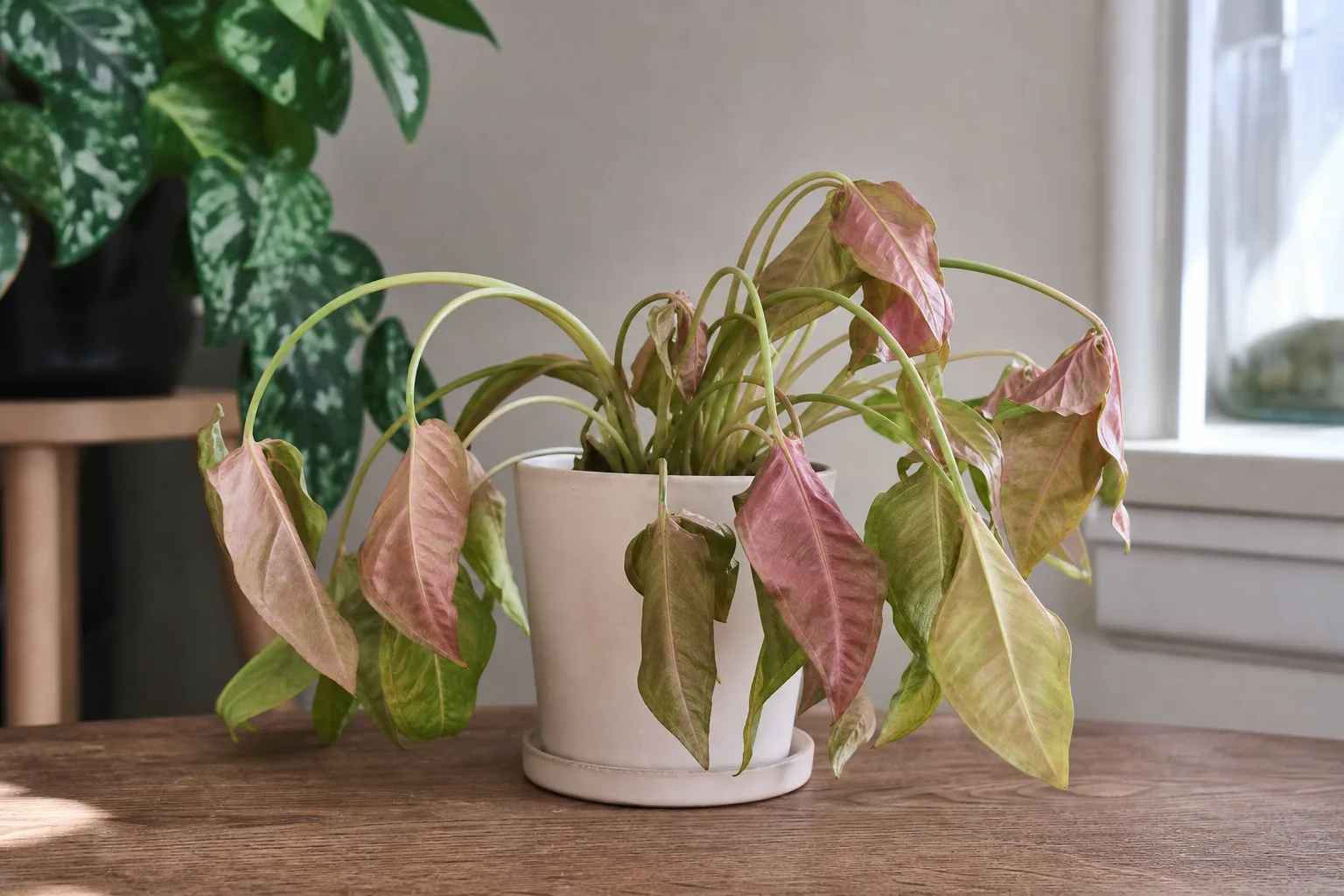
Drooping Leaves on Syngonium Neon Robusta: Causes, Checks & Fixes
This guide covers drooping leaves on Syngonium Neon Robusta. See also the general Drooping Leaves guide, watering, and light pages for this plant.
Drooping Leaves on Syngonium Neon Robusta: Causes, Checks & Fixes
Quick answer
Your pink arrowhead slumped over the pot rim overnight-that visual is alarming on a compact tabletop Syngonium Neon Robusta (Syngonium podophyllum ‘Neon Robusta’), but droop is a water-balance and posture signal, not a diagnosis on its own. Soft rosy-green juvenile leaves lose turgor when roots cannot move enough moisture upward, when long unsupported stems cannot hold pastel foliage weight, or when a sudden environment change outpaces root uptake.
First step: lift the pot and check the top inch of soil before you water or repot. Dry and light means drink; wet and heavy means stop and inspect roots. Getting that split wrong is the fastest way to turn recoverable droop into root rot.
| Pattern | Pot weight | Top inch | Stem base | Likely cause | Next guide |
|---|---|---|---|---|---|
| Whole plant limp, green leaves | Light | Dry, dusty | Firm | Underwatering | Underwatering |
| Whole plant heavy hang | Heavy | Wet days later | May soften | Overwatering / root stress | Overwatering |
| One long vine flops | Normal | Normal | Firm | Leggy structural droop | Leggy growth |
| Slump after bright move | Variable | May be moist | Firm | Transpiration / acclimation shock | Light guide |
| Outer leaves droop, draft side | Normal | Normal | Firm | Cold or heat stress | Wilting |
Early signal before full collapse: newest leaves may lose their pink blush and open dull green while petioles still hold angle-that color fade often precedes slump on Neon Robusta and overlaps with not enough light or a slow-drying wet pot.
Drooping vs. wilting on Neon Robusta
Both terms describe lost turgor on arrowhead foliage. Use this page when you are troubleshooting posture-petioles hanging below their usual angle, a tabletop bush slumping over the rim, or one vine flopping while soil checks still look ambiguous.
Use the dedicated wilting guide when collapse is sudden and whole-plant, when stems soften rapidly at the base, or when you need the acute wet-vs-dry rescue sequence without structural-drooping branches. For confirmed mushy roots and sour mix, escalate to root rot regardless of which symptom word you started with.
What drooping leaves look like on Syngonium Neon Robusta
On this PP18013 cultivar, droop usually shows on soft pink-green juvenile leaves first-not the solid chartreuse tone of pothos ‘Neon’. Petioles hang downward instead of holding leaves at their usual angle, and the whole plant can look tired even though leaf color has not yellowed yet. Because Neon Robusta is often kept as a compact tabletop syngonium, droop is easy to notice-the plant goes from upright and bushy to slumped over the pot rim within a day or two.
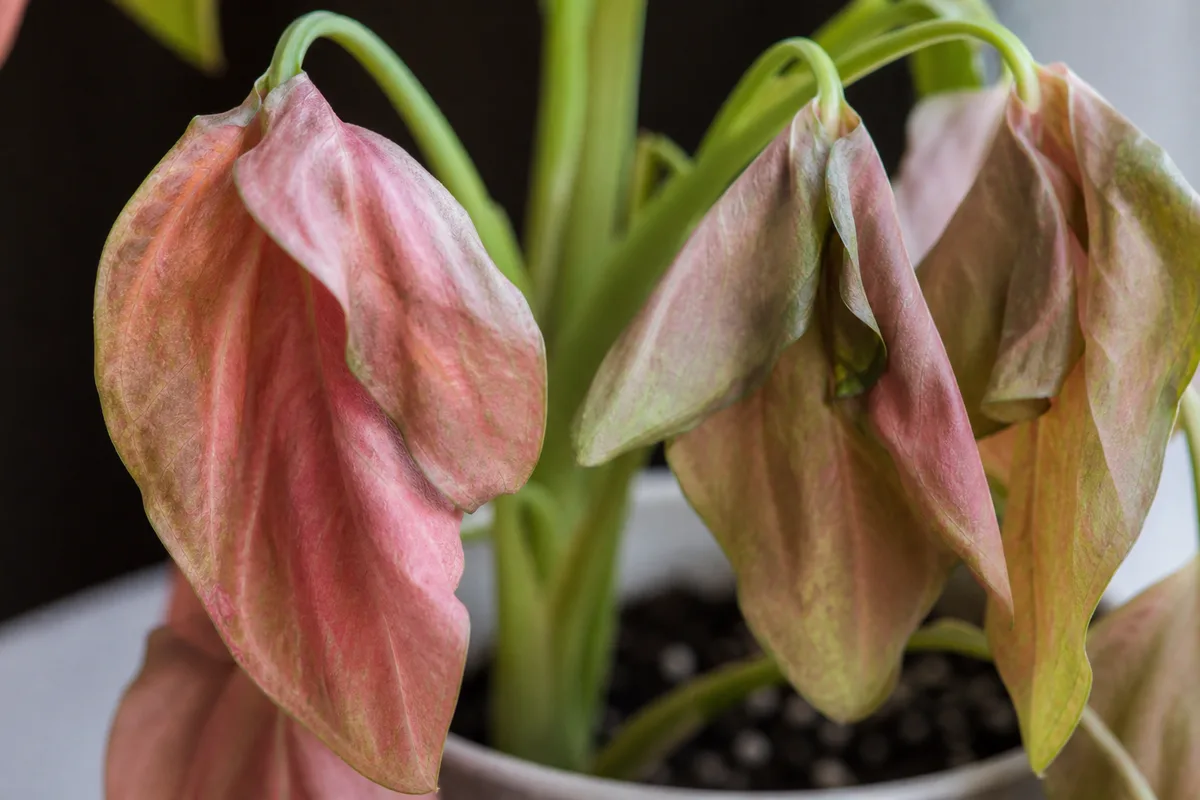
Drooping Leaves symptoms on Syngonium Neon Robusta - compare with healthy tissue on the same plant.
The pattern matters:
- Whole-plant droop with dry soil - leaves feel thin and limp; stems stay firm at the base; pot feels noticeably light.
- Whole-plant droop with wet soil - leaves may still look green but hang heavily; pot stays heavy for days; lower stems may soften.
- One-sided or tip-heavy droop - often the longest vine or the side facing away from light; soil moisture may be normal.
- Droop after a recent move or repot - temporary collapse while roots re-establish; stems usually stay firm if rot is not involved.
- Pink blush fades on newest leaves - dull green new growth with still-upright older foliage; early stress before full slump.
Neon Robusta leaves do not recover their original posture once severely collapsed and dried at the edges. Focus on whether new leaves firm up and open with a visible pink-tinged wash-that is the real recovery sign, not whether yesterday’s limp leaf magically stands straight again.
Field example: dry tabletop slump
A 6-inch (15 cm) Neon Robusta on a north windowsill had not been watered for five days in warm spring growth. The pot felt light, the top inch was dusty dry, stems were firm, and soft pink-green leaves hung below the rim. One deep soak until runoff, saucer emptied within 30 minutes, and pink-tinged new growth firmed within about six hours; one edge-crisp lower leaf did not re-straighten. That outcome is typical when roots are healthy and drought was the only trigger.
Why Syngonium Neon Robusta gets drooping leaves
Syngonium podophyllum is a tropical aroid vine from rainforest understories. In pots, it wants evenly moist but well-drained soil-not constant saturation and not long drought. Neon Robusta’s thinner, softer leaves show water stress faster than thick-leaved houseplants, which is why droop appears before yellowing in many homes.
Underwatering during active growth
In bright indirect light, Neon Robusta transpires steadily through its rosy-green foliage. If you wait until leaves look visibly wilted before checking soil, the top inch may have been dry for days. Summer growth and small tabletop pots dry faster than owners expect, especially near windows or heat vents. See underwatering on Neon Robusta when a light dry pot accompanies limp leaves.
Overwatering and root stress
Watering on a calendar without checking dryness is the other common path. Wilted or drooping leaves with wet soil often mean damaged roots cannot take up water-the same visual symptom as thirst, opposite cause. Dim corners slow water use, so a mix that worked in summer stays wet too long in winter and suffocates roots. Follow the overwatering guide when the pot stays heavy and new leaves lose pink blush before stems soften.
Leggy stems without support
Neon Robusta is valued for a soft pink blush on compact juvenile leaves. In low light, stems stretch long and thin-see leggy growth and not enough light. Unsupported vines become top-heavy; the plant droops even when watering is correct. This is structural droop, not root failure-important because adding water will not fix it.
Environmental shocks
Sudden moves to stronger sun, cold AC drafts, or Syngonium Neon Robusta repotting guide disturbance can cause temporary droop while the plant adjusts. Heat increases water loss faster than roots replace it. Cold below about 55°F (13°C) can cause chilling injury that slows root function and mimics underwatering on outer leaves facing the draft. Fresh repotting breaks fine root hairs, so uptake drops for several days even in moist soil.
Dry air and hydrophobic mix
Moderate humidity suits this syngonium better than desert-dry winter heating, though droop from humidity alone is less common than watering errors. Old peat-heavy mix that repels water can leave the surface dry while the root ball stays oddly dry inside-leaves droop despite recent watering attempts.
Pests draining sap
Spider mites, mealybugs, and aphids can cause limp foliage while soil moisture looks normal. Inspect leaf undersides for stippling, webbing, or cottony deposits before assuming thirst.
How to confirm the cause
Work through these checks in order. Stop when one pattern clearly fits.
- Top-inch moisture - Push a finger into the top inch. Bone dry and dusty points to underwatering. Wet or cool and clinging points to overwatering stress.
- Pot weight - Lift the pot. Light and dry confirms thirst. Heavy days after watering confirms slow dry-down or excess water.
- Stem firmness at soil level - Firm stems with dry soil mean underwatering. Softening at the base with wet soil means inspect roots soon.
- Drainage and saucer - Water sitting in the saucer or a sealed decorative cachepot keeps roots anaerobic. UF/IFAS notes that syngonium media should stay moist but not wet.
- Light context - Leggy pale-green growth with long gaps between leaves suggests low light plus possible overwatering in a slow-drying corner.
- Recent changes - Repot, move, or heat-wave timing explains temporary droop if moisture and stems are otherwise normal.
- Recovery test (dry soil only) - Water thoroughly once. If stems firm and leaves lift within several hours to a day, underwatering was likely. If soil was already wet and nothing improves, do not water again-inspect roots per the root rot guide.
The first fix to try
Lift the pot, check the top inch of soil, and act on what you find-do not water automatically.
- If the top inch is dry and the pot is light: water thoroughly until runoff drains from the bottom, empty the saucer within 30 minutes, and recheck in a few hours.
- If the top inch is wet and the pot is heavy: stop watering, move the plant to brighter indirect light with airflow, and let the mix dry properly before the next drink-see overwatering recovery.
- If moisture is normal but one long vine droops: stake or prune the leggy stem rather than watering.
This single diagnostic step prevents the classic mistake of drowning an already wet syngonium because the leaves look thirsty.
Step-by-step recovery
For underwatering
- Water deeply at the soil surface until water runs from drainage holes.
- If soil is extremely dry and water runs off the surface, bottom-soak the pot in a tray of room-temperature water for 20–30 minutes, then drain fully.
- Wait several hours. Most healthy roots restore turgor within a day in normal room temperatures.
- Resume the rhythm of watering when the top inch dries-not on a fixed weekly schedule.
For overwatering without stem rot
- Stop watering immediately.
- Move to brighter indirect light so the plant uses moisture faster.
- Confirm the pot has drainage and no standing water in the saucer.
- Let the top half of the mix dry before watering again.
- Watch new leaf openings. If they stay small and dull green, light may also need correction per the light guide.
For root rot suspicion
- Unpot and inspect roots. Healthy syngonium roots are firm and pale; mushy brown roots confirm damage.
- Trim soft roots back to firm tissue with clean scissors.
- Allow the root ball to air-dry for several hours.
- Repot into fresh well-draining mix in a pot only slightly larger, with drainage holes.
- Wait until the top inch dries before the first post-repot watering. Do not fertilize until new growth returns. Full protocol: root rot on Neon Robusta.
For leggy structural droop
- Move to brighter indirect light so future growth stays compact.
- Pinch or cut back the longest drooping stems above a node.
- Add a small stake or moss pole if you want climbing form instead of a tabletop bush.
- Rotate the pot weekly so one side does not stretch toward the window.
For cold or heat shock
- Move the pot off winter window glass, AC vents, or radiators.
- Keep soil moisture steady-do not soak a cold-shocked plant or let a heat-stressed one go bone dry.
- Expect gradual firming over 3–10 days if stems stayed firm through the event.
Recovery timeline
| Cause | What improvement looks like | Typical timeframe |
|---|---|---|
| Mild underwatering | Leaves lift; petioles stiffen; new pink-tinged growth opens normally | Several hours to 1 day |
| Severe underwatering | Gradual firming after deep soak; some edge-crisp leaves may not recover | 1–3 days |
| Overwatering (roots intact) | Pot weight drops; droop stops spreading; new leaves stay firm | 3–7 days after dry-down |
| Root rot (partial) | No further stem softening; first firm new leaf after repot | 1–3 weeks |
| Repot or move shock | Stems stay firm; slow return to normal posture | 3–10 days |
| Leggy prune | New shoots from nodes; less top-heavy silhouette | 1–2 weeks |
Damaged leaf tissue does not un-droope permanently. Judge success by firm stems and healthy new rosy-green or pink-tinged leaves, not by old collapsed foliage.
Lookalike symptoms
Wilting vs drooping - On Neon Robusta the terms overlap in practice. Both mean lost turgor. Use soil moisture to split thirst from root failure rather than debating vocabulary; see wilting for acute collapse.
Yellow leaves - Yellowing often follows chronic overwatering or nutrient issues. Drooping alone with green leaves more often means acute water imbalance or structural flop. See yellow leaves when color change is the main symptom.
Brown tips - Usually humidity, salts, or inconsistent watering over weeks. Drooping is a faster whole-plant signal.
Not enough light - Leggy pale growth and droopy long stems without wet-soil symptoms. Fixing light and pruning beats extra water.
Mistakes to avoid
- Watering without checking the top inch because the soft leaves look sad.
- Assuming droop always means underwatering when the pot is heavy and wet.
- Repotting on day one for every droop-only necessary when roots are mushy or mix never dries.
- Fertilizing a drooping plant to “perk it up.” Stressed roots need stable water and light first.
- Misting leaves instead of correcting root-zone moisture. Surface mist does not fix turgor loss.
- Keeping a dim, wet Neon Robusta in hope the pink color returns-slow water use plus frequent watering is a common droop-and-rot cycle.
- Increasing watering when leggy structural droop is the cause-fix light and prune first.
When unpotting or discarding collapsed leaves, keep debris away from pets-Syngonium is toxic to cats and dogs because of calcium oxalate crystals. Contact your veterinarian or the ASPCA Animal Poison Control Center at (888) 426-4435 if ingestion is suspected.
Syngonium Neon Robusta care cross-check
Drooping often means one pillar of normal care slipped:
- Light - Bright indirect light keeps color strong and water use predictable. Dim rooms extend dry-down time and encourage leggy droop-see the light guide.
- Water - Water when the top inch dries in well-draining mix. Saucers must be emptied after each watering per the watering guide.
- Humidity - Moderate humidity (around 50–60%) supports steady transpiration without soggy foliage.
- Temperature - Avoid cold drafts below roughly 16°C (60°F); chill slows root uptake and mimics underwatering.
- Form - Pinch or support before vines run long on a small tabletop pot.
How to prevent drooping leaves next time
Check soil every few days instead of watering on autopilot. Match pot size to the plant-oversized pots stay wet too long around sparse roots. Give enough light that the mix dries within a reasonable window after each watering. Prune or rotate before one side becomes a long floppy vine.
After repotting or moving, expect a few days of limp leaves and avoid stacking extra stress from fertilizer or heavy pruning in the same week. When in doubt, pot weight and the top-inch test beat guessing from leaf softness alone.
When to worry
Escalate quickly if drooping persists more than 48 hours after correct watering for dry soil, or if wet-soil droop comes with sour smell, blackening stem bases, or stems that feel hollow when pinched. Those signs mean root or crown failure-not a wait-and-see situation. Open the root rot guide immediately.
If only one old leaf droops while new growth stays firm and pink-tinged, you are likely seeing natural ageing or a single thirsty spell-not an emergency.
Related Neon Robusta problems
- Syngonium Neon Robusta overview - general care hub
- Wilting - acute collapse with wet or dry soil
- Overwatering - heavy wet pot, pink blush fade
- Root rot - mushy roots, sour mix
- Underwatering - light dry pot, crisp edges
- Not enough light - pink fade, leggy growth
- Leggy growth - structural droop cause
- Yellow leaves - chronic stress follow-on
- Watering - prevention rhythm
- Light - maintaining pink blush
When to use this page vs other Syngonium Neon Robusta guides
- Syngonium Neon Robusta watering guide - Use for routine moisture checks before assuming drooping leaves is the main issue.
- Syngonium Neon Robusta problems hub - Browse all 1 common issues on this species.