6 Best Tomato Fertilizers for Pots and Garden Beds
Find the best tomato fertilizer for containers or beds, with six label-based picks, NPK guidance, feeding timing, application steps, and mistakes to avoid.
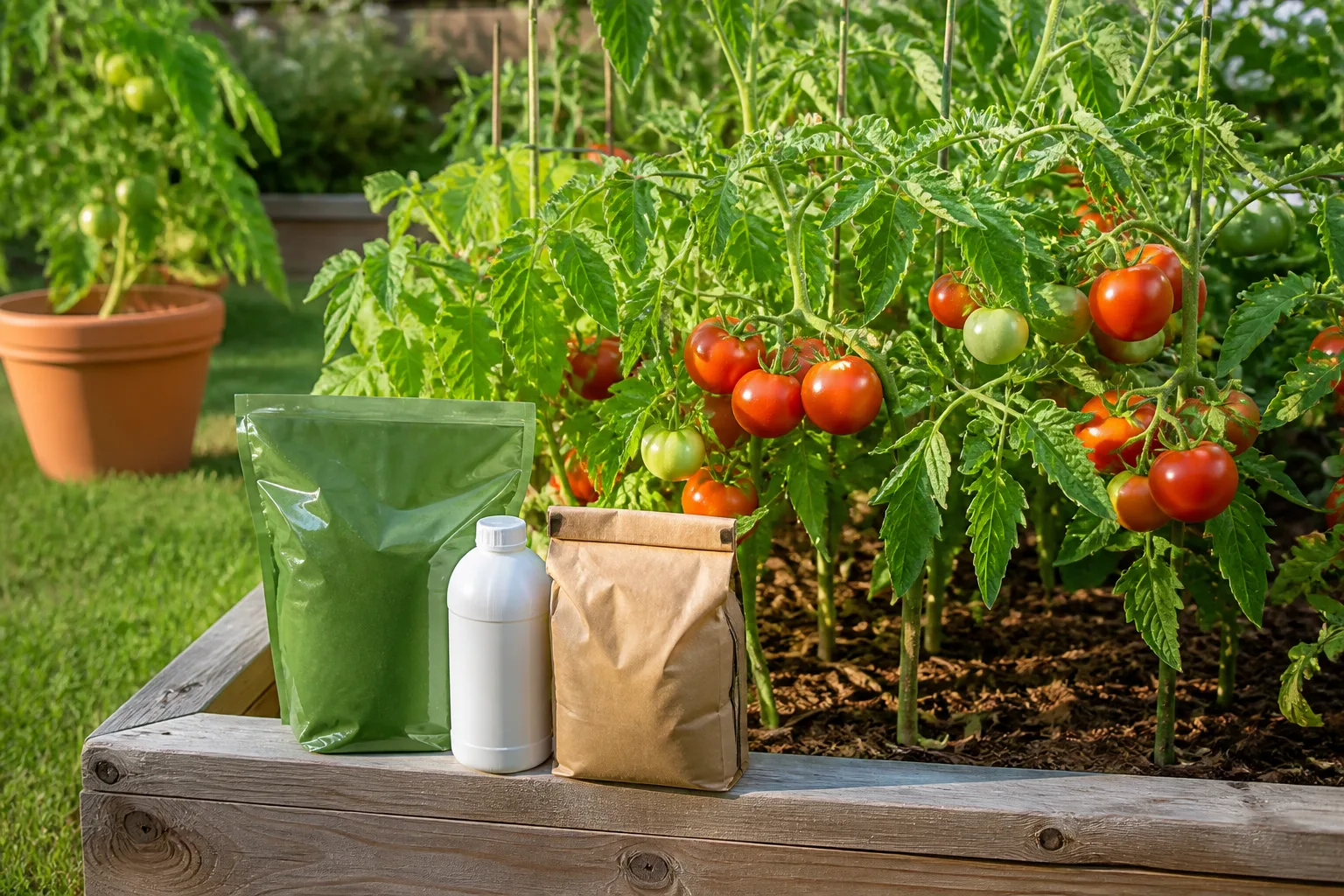
The best tomato fertilizer is not automatically the one with the biggest numbers or the most tomato imagery on its bag. It is the product whose nutrient blend, delivery method, and application schedule fit your soil, container, climate, and willingness to measure.
That distinction matters because tomatoes can be heavy feeders, but fertilizer cannot compensate for compacted soil, poor drainage, drought, root damage, or a disease. Penn State Extension recommends fertile, loamy, well-drained soil and cautions that excess or high-nitrogen fertilizer can produce luxuriant foliage while delaying flowers and fruit. Penn State Extension’s tomato guide is a useful baseline for home growers.
This is a label-and-use-case buying guide, not a new controlled trial. The six products below preserve the shortlist and label snapshots from the supplied product review, while the recommendations are framed around how each form works. Product formulations, package sizes, certifications, and directions can change, so check the current label before you buy or apply anything.
Quick Picks: Match the Fertilizer to Your Garden
| Pick | Form and label snapshot* | Best fit | Main trade-off |
|---|---|---|---|
| Jack’s Classic Tomato Feed | Water-soluble powder, 12-15-30 | Gardeners who want to adjust each feeding | You must mix and measure regularly |
| Gardener’s Supply Company Organic Tomato Fertilizer | Granular, 5-6-5, organic | Raised beds with tomatoes, peppers, and eggplants | Less convenient once plants are established |
| Burpee Organic Tomato & Vegetable Plant Food | Granular, 3-6-4, organic | Low-fuss feeding across growth stages | Granules are less immediately adjustable than liquid |
| Dr. Earth Home Grown Organic Fertilizer | Granular, 4-6-3, organic | Gardeners prioritizing organic inputs | Lower analysis can mean more product by volume |
| FoxFarm Grow Big Liquid Plant Food | Liquid, 6-4-4 | Fast, adjustable liquid applications | Measuring and dilution are non-negotiable |
| Jobe’s Organics Tomato Fertilizer Spikes | Spikes, 6-18-6, organic | Small pots where convenience matters | Point-source feeding can be uneven |
*Ratios and product categories are a snapshot from the supplied shortlist, not a substitute for the current package label. N-P-K numbers describe the labeled percentages of nitrogen, available phosphate, and soluble potash by weight.
Use the table as a starting point, not as a promise of better yields. A container gardener who forgets liquid feedings may do better with a correctly placed granular product. A gardener with a recent soil test and a mixed vegetable bed may prefer a moderate formula that does not add nutrients the soil already has in excess.
What Makes a Tomato Fertilizer a Good Fit?
Start with the garden rather than the product. A soil test can tell you whether nitrogen, phosphorus, potassium, calcium, pH, or organic matter is actually limiting. Penn State describes soil testing as a way to measure plant-available nutrients and determine fertilizer or lime recommendations; its sampling guidance for gardens calls for combining soil from several random locations rather than testing one unusually rich or poor spot. Read Penn State’s soil-testing guidance before making a major amendment.
The second question is where the plant grows. In-ground tomatoes have access to a much larger root zone and usually need fewer interventions than tomatoes in pots. Containers lose water and dissolved nutrients through drainage, so they need closer observation, but that does not mean you should automatically feed at every watering. A pot that is root-bound, waterlogged, or sitting in hot reflected light may need a root-zone correction before it needs fertilizer.
Then choose the delivery form. Liquid and water-soluble products give you the most control over strength and timing. Granules reduce the number of mixing sessions, but their release speed varies: some dissolve quickly, while coated products release over a longer period. Spikes are the most convenient to place, but a concentrated point near one part of the root ball is not the same as an evenly distributed application.
Finally, consider the cost of mistakes. A product that requires measuring may be safer for someone who wants to pause feeding when plants are stressed. A set-and-forget format can be convenient, but it is harder to turn off when light, temperature, watering, or plant growth changes. USDA nutrient-management guidance summarizes the decision as the right source, method, rate, and timing for the crop and site; that principle works just as well in a backyard pot as it does on a farm. USDA’s nutrient-management guide explains the framework.
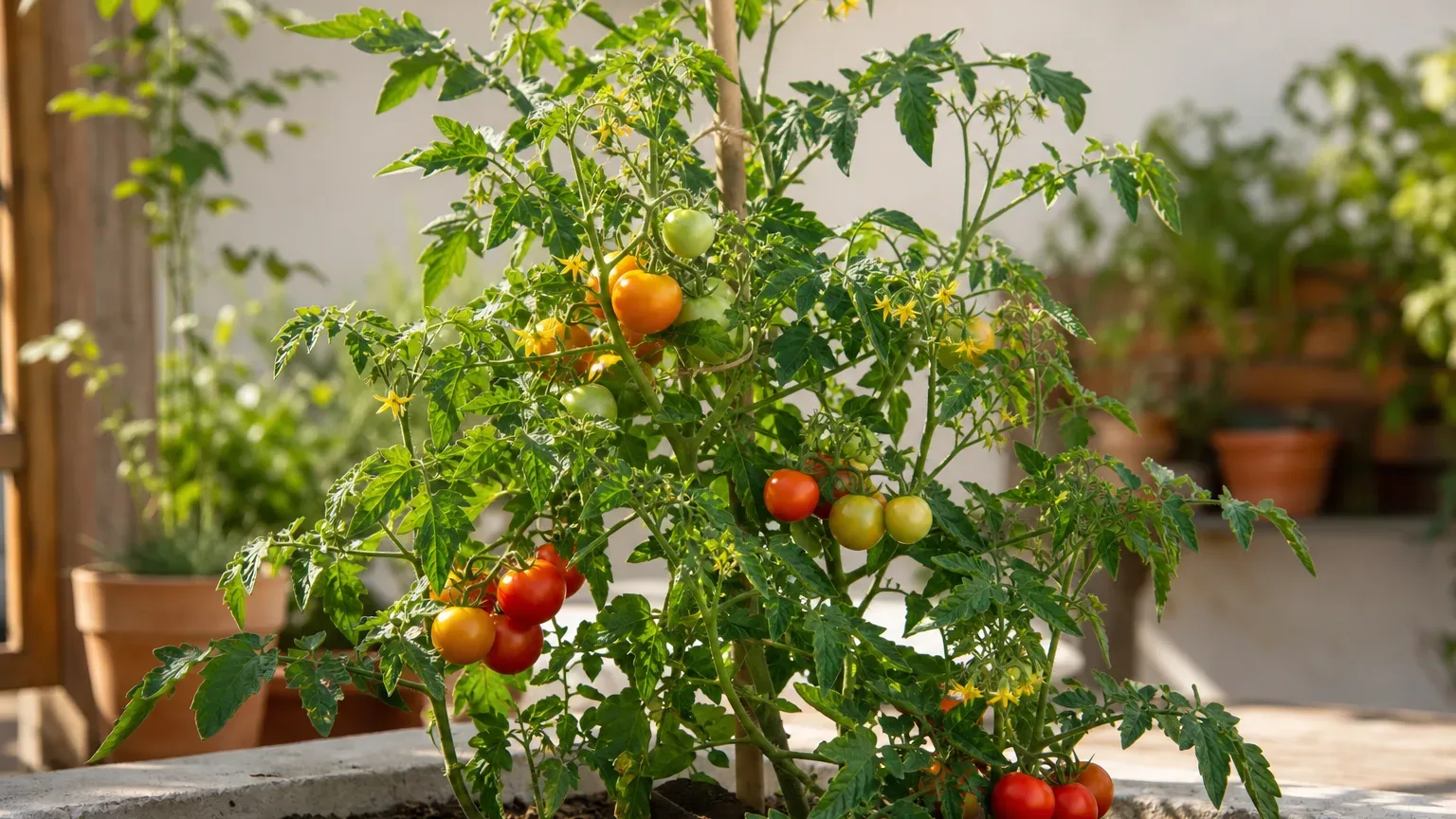
NPK Explained Without the Marketing Fog
N-P-K is a useful shorthand, not a complete feeding prescription. The first number is nitrogen, which supports leafy growth. The second is phosphate, associated with root and reproductive functions. The third is potash, the label term for potassium. The numbers are percentages by weight, so 12-15-30 is more concentrated than 3-6-4, but “higher” does not mean “better” for every garden.
The formula must be read alongside the rate. A low-analysis organic granule can still supply too much if you scatter it repeatedly, while a high-analysis water-soluble powder can be used appropriately when diluted exactly as directed. Never compare products by N-P-K numbers alone without checking how much product the label says to apply and how often.
Nitrogen: Enough for Leaves, Not a Jungle
Tomatoes need nitrogen to build stems and leaves, especially while establishing. But excess nitrogen can create a plant that looks impressive and produces fewer flowers or fruit. The California Department of Food and Agriculture’s tomato nutrient guidance notes that excessive nitrogen results in lush foliage, delayed maturity, greater disease and insect susceptibility, and possible effects on fruit quality. See the CDFA and UC Davis tomato fertilization guidance.
That is why a “tomato” fertilizer with a moderate first number may be a better fit than a lawn-style high-nitrogen product. It is also why a pale plant should not be diagnosed from color alone. Check watering, roots, light, pH, and disease symptoms before adding more nitrogen.
Phosphorus and Potassium: What They Can—and Cannot—Do
A large middle number does not force a tomato to flower, and adding phosphorus to soil that already contains enough can be wasteful or disruptive. CDFA guidance notes that phosphorus availability falls in very acidic or alkaline soil, where correcting pH may be more useful than applying large amounts of phosphorus.
Potassium is important to plant function, but more potassium is not automatically a remedy for weak fruit or blossom-end rot. Nutrients interact in the root zone, and excess applications can make other nutrients harder to take up. Use the soil report and the label rather than chasing a single number printed on the front of a bag.
The Six Fertilizers at a Glance
The six products cover four practical formats. Jack’s Classic Tomato Feed is a water-soluble powder. Gardener’s Supply, Burpee, and Dr. Earth are granular products. FoxFarm Grow Big is a liquid concentrate, while Jobe’s Organics uses spikes. That spread is useful because the real buying decision is often about how you will feed, not just which brand name sounds most specialized.
Jack’s Classic Tomato Feed: Best for Adjustable Feeding
Jack’s Classic Tomato Feed is the most flexible option in this group for a gardener who is comfortable mixing a solution. The supplied label snapshot lists it as a 12-15-30 water-soluble powder, a concentrated format that lets you change the amount delivered by changing dilution or skipping a feeding when the plant is not actively growing.
That control makes sense for mixed containers, changing weather, or a gardener who wants to distinguish a light establishment feed from later maintenance. It also works well when several plants need a measured solution rather than a handful of granules scattered around each stem.
The trade-off is that the product asks you to pay attention every time. Measure the powder and water accurately, use the label’s dilution and frequency, and do not assume a strong-looking formula should be used at full strength. If your routine is already inconsistent, convenience may matter more than concentration.
Gardener’s Supply Company Organic Tomato Fertilizer: Best for Multi-Crop Beds
The Gardener’s Supply Company Organic Tomato Fertilizer is a useful fit for a raised bed that contains tomatoes alongside other fruiting vegetables. The supplied snapshot lists a 5-6-5 granular formula with organic certification, which makes it a moderate, bed-friendly choice for gardeners who want one product for more than a single tomato plant.
Granules are easier to store and apply than a liquid concentrate, and the review snapshot describes a four-to-six-week reapplication window. Treat that interval as a label detail to verify rather than a universal calendar. Soil texture, irrigation, rainfall, crop size, and the nutrients already present in the bed can all change the right schedule.
Its main limitation is placement around established plants. You need to distribute the granules across the root zone without piling them against the stem, and you should water them in according to the label. It is a better fit for beds where you can reach the soil than for a crowded container whose roots already fill the pot.
Burpee Organic Tomato & Vegetable Plant Food: Best for Low-Fuss Granules
Burpee Organic Tomato & Vegetable Plant Food is the low-fuss granular option in this shortlist. The supplied snapshot lists a 3-6-4 organic formula and positions it for tomatoes and other vegetables, so it makes sense for gardeners who prefer to apply a measured dry product and return to watering rather than mix fertilizer each week.
The lower analysis is not a criticism; it simply means the label rate matters. Use the product’s measuring instructions instead of trying to make it “stronger” by adding extra. A longer interval between applications can be convenient, but it can also tempt a gardener to refresh the soil too early when the previous application is still active.
This format is a sensible choice for a vegetable bed or a larger container when you want a routine with fewer steps. It is less useful when a plant needs a very small, quickly adjustable dose or when a soil test says one nutrient should be supplied without adding the others.
Dr. Earth Home Grown Organic Fertilizer: Best for Organic Gardens
Dr. Earth Home Grown Organic Tomato, Vegetable, and Herb Fertilizer is the clearest choice here for a gardener whose priority is an organic-certified input. The supplied snapshot lists a 4-6-3 granular formula and a reapplication interval of about two months, though the current package is the authority for both certification and timing.
Organic does not mean risk-free, instant, or impossible to overapply. Dry meals and other organic materials still contribute nutrients and can still create problems when repeatedly added to already fertile soil. They may also release differently as temperature, moisture, and microbial activity change.
Use this product when you want a granular organic routine and can work it into the soil or spread it across the root zone without disturbing roots. Keep expectations realistic: a fertilizer cannot replace compost used to improve structure, adequate light, even moisture, or a soil test when plants repeatedly struggle.
FoxFarm Grow Big Liquid Plant Food: Best for Liquid Feeding
FoxFarm Grow Big Liquid Plant Food is the liquid-concentrate pick for gardeners who want to adjust feedings as plants move from establishment to active growth. The supplied snapshot lists a 6-4-4 formula and does not list organic certification, so gardeners with organic requirements should verify the current product information before choosing it.
Liquid is useful when you want to dilute carefully, pause after a heat wave, or feed several containers with a consistent solution. It is not automatically more effective than granules. Its practical advantage is control: you decide the dose at the moment of application, provided you measure correctly.
The weakness is also control. A capful is not a universal unit, and “a little extra” can turn into a strong solution quickly. Use a measuring spoon or syringe reserved for garden products, mix only the amount you need, and keep the concentrate out of reach of children and pets. Apply to moist soil as the label directs, not to wilted foliage as a shortcut.
Jobe’s Organics Tomato Fertilizer Spikes: Best for Small Containers
Jobe’s Organics Tomato Fertilizer Spikes are the convenience pick when mixing and sprinkling are the tasks you most want to avoid. The supplied snapshot lists 6-18-6 spikes with organic certification and a single application in the review schedule.
Spikes make the most sense in a small pot where you can follow the label’s number and placement instructions precisely. Pressing one close to the stem or using the same number in every container is not a safe substitute for reading the package. Root balls differ in size, and water may move through one side of a pot more often than the other.
The main trade-off is evenness. A granular product mixed or distributed over the top of the root zone can be more uniform than a point source. Choose spikes for convenience, not because they are automatically gentler. Do not add a full-strength liquid feed on top of fresh spikes unless the labels and plant’s actual growth justify it.
Liquid, Granular, or Spikes: Which Format Fits?
| If you value… | Start with… | Why |
|---|---|---|
| Precise timing and easy pauses | Liquid or water-soluble | You can change dilution or skip a feed |
| Fewer mixing sessions | Granular | One measured application can cover a longer interval |
| A simple pot routine | Spikes | Placement is quick and requires no mixing |
| A mixed bed | Moderate granular fertilizer | One product can be distributed across several crops |
| A nutrient-specific correction | The product named by the soil report | A generic tomato formula may add nutrients you do not need |
Granular does not always mean slow-release, and liquid does not always mean “stronger.” Read the package for release claims, rate, frequency, and whether the product is intended for soil application, foliar application, or both. If two fertilizers have different strengths, compare the amount of actual product and number of applications rather than the price of the container alone.
Avoid stacking forms by default. A pot with active coated granules or spikes can already be receiving a background supply. Adding a full liquid dose because the leaves look a little pale may compound the problem if the real cause is low light, cold roots, overwatering, or a pH issue.
When to Feed Tomatoes Through the Season
Fertilizer timing should follow crop demand, soil information, and the label—not a calendar copied from a different climate. The following sequence is a practical way to think about the season.
- Before planting: Get a soil test when possible, especially for a bed that has received compost or fertilizer repeatedly. Amend pH or nutrients according to the report. If there is no report, avoid reflexively adding several products at once; Penn State specifically cautions against high-nitrogen feeding that creates excess foliage.
- At transplanting: Give the root ball good soil contact and water thoroughly. A starter fertilizer is not mandatory for every garden. Use one only when the label, soil condition, and local guidance support it, and keep concentrated fertilizer from touching tender roots.
- During vegetative growth: Watch for new leaves, branching, and a plant that is actually growing. If growth is pale and slow after water and root problems are ruled out, a measured feed may help. If growth is dark, soft, and excessively leafy, stop adding nitrogen and investigate the soil.
- At flowering and fruit set: Maintain even moisture and avoid feeding harder simply because flowers have appeared. CDFA guidance shows that tomato nutrient demand changes through the crop cycle and that much of the uptake occurs between early fruit set and early red fruit; for home gardens, the useful lesson is to split applications and avoid a large unused reserve.
- Late in the season: Do not keep applying fertilizer after growth has slowed or the plant is declining from heat, disease, or the end of its season. Nutrients that are not taken up can remain in the soil or move with runoff. USDA guidance also recommends considering weather and avoiding applications immediately before heavy rain.
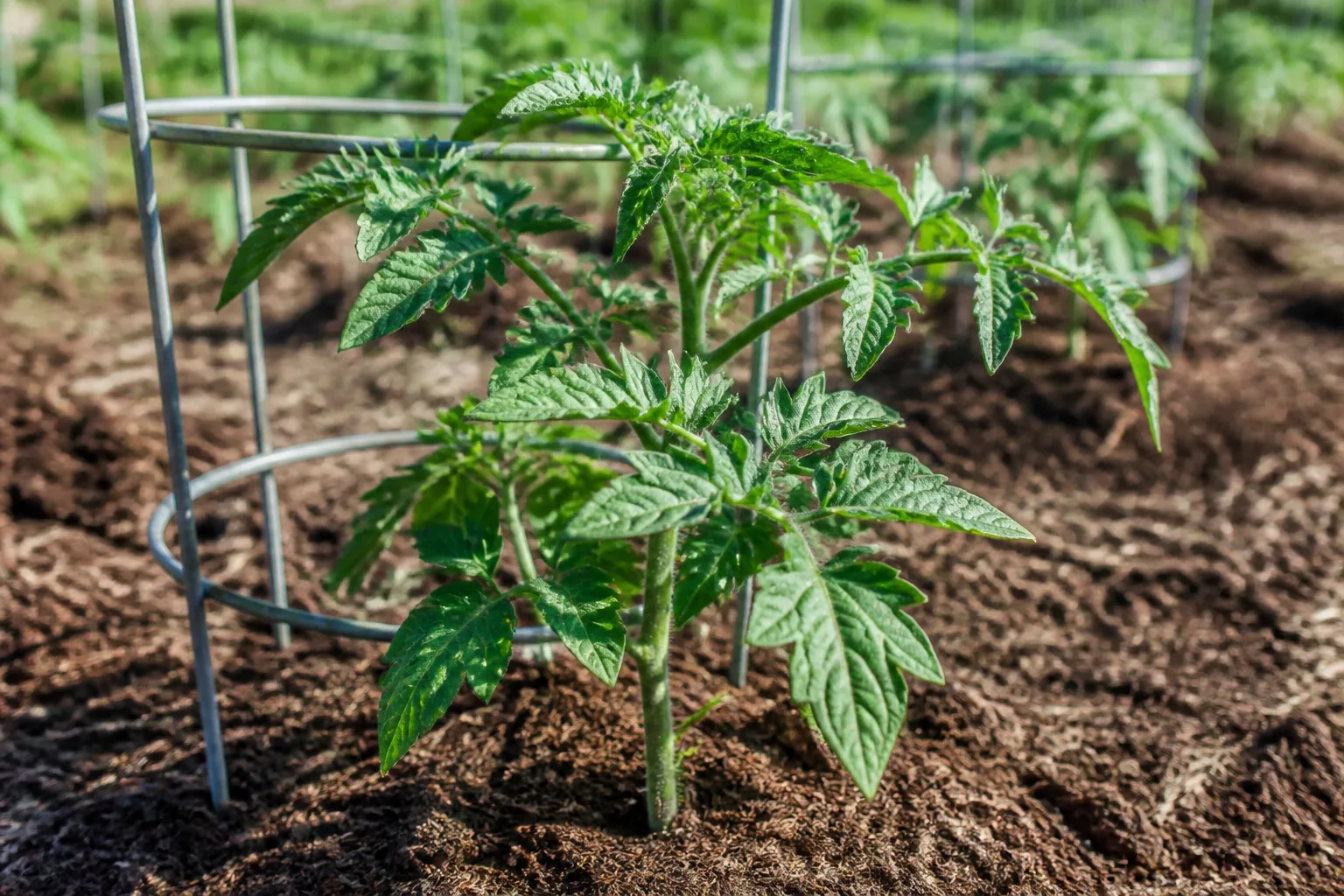
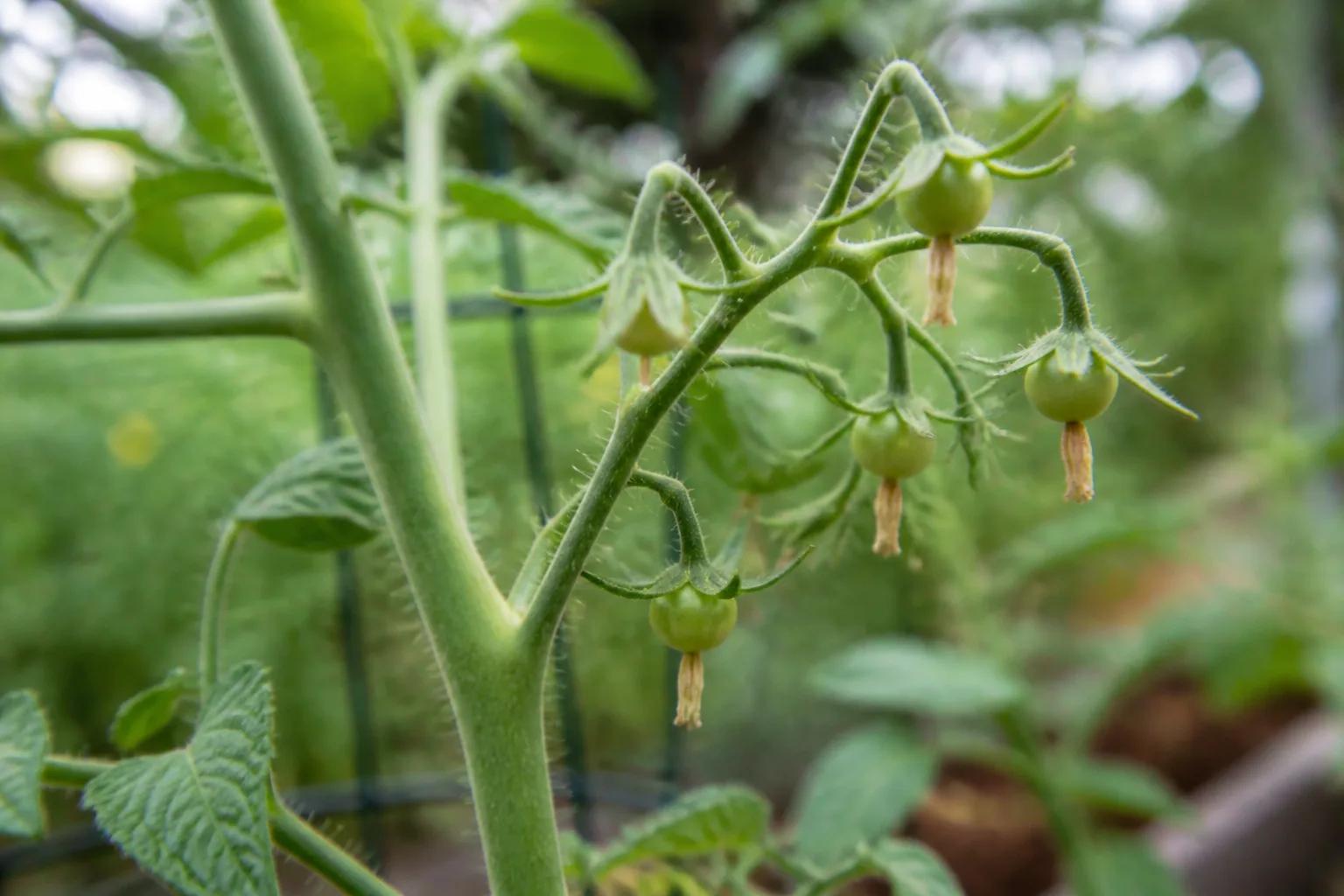
Containers deserve a separate check because frequent watering can carry dissolved nutrients out of the drainage holes. That may call for a consistent, label-based routine during active growth, but it is not a reason to double the dose after a rainy week or a missed feeding. Keep a simple note of the product, amount, date, and plant response so you do not accidentally apply two “first” feedings.
How to Apply Fertilizer Without Burning Roots
Read the label before opening the bag or bottle. Confirm that the product is intended for tomatoes, note whether the rate is given per plant, pot size, area, or volume of water, and check the reapplication window. A fertilizer can be safe at one dilution and damaging at another.
For liquid or water-soluble products, measure the water and fertilizer separately. Mix thoroughly, apply to the soil around the root zone, and do not improvise a foliar spray unless the label explicitly allows it. If the soil is bone dry or the plant is wilted from heat, correct the immediate water stress first rather than pouring a concentrated solution onto dehydrated roots.
For granular products, spread the measured amount in a ring or band away from the stem. Gardening Know How describes side-dressing as placing fertilizer beside a crop rather than against the stem and recommends watering it into the soil after application. Its side-dressing guide is useful for the basic technique, but the product label controls the rate and spacing.
Keep dry granules off wet foliage and stems, especially in bright sun. Water in only as much as the label calls for; do not create runoff that carries fertilizer into a drain, stream, or neighboring bed. If heavy rain is forecast, wait when the label and plant condition allow it.
For spikes, measure the pot and follow the spacing diagram. Push them into the soil at the stated depth, away from the stem and not directly against the root ball if the directions specify otherwise. Remove or replace them only according to the package schedule. Treat a spike as a concentrated source, not as a harmless tablet.
Troubleshooting: More Fertilizer Is Often the Wrong Fix
Pale leaves or slow growth can indicate nitrogen shortage, but they can also follow cool soil, poor drainage, root injury, insufficient light, pests, or disease. Look at the pattern: uniform yellowing of older leaves is different from mottled new growth, and both differ from leaves that are yellow because roots are sitting in saturated soil. Check moisture and roots before feeding.
Dark green leaves with few flowers are a reason to question nitrogen, not to add more. Clemson Extension lists excessive nitrogen as a cause of heavy leaf growth at the expense of blossom and fruit formation. Pause fertilizer, keep moisture steady, and use a soil test before trying to “balance” the plant with a second product. Clemson’s tomato diseases and disorders guide covers this nutrient-and-stress connection along with other common tomato problems.
Brown leaf edges, a white crust, or sudden stalled growth can point to soluble-salt buildup or fertilizer injury. Stop feeding and inspect drainage. In a well-drained container, a thorough watering that exits the drainage holes can reduce soluble salts, but it will not erase remaining slow-release granules or spikes. Remove excess product when the label and pot setup allow it, and repot severely damaged plants only after checking the roots.
Blossom-end rot is not proof that the plant needs a calcium product. Clemson explains that the disorder involves calcium delivery to developing fruit and can be associated with moisture fluctuations, root pruning, and excessive ammoniacal nitrogen, potassium, or magnesium. Keep the root zone evenly moist, mulch an in-ground bed, and use lime or gypsum only when a soil analysis indicates that correction is appropriate. Adding calcium blindly can create a different nutrient imbalance.
A wilted plant should not be fertilized on sight. Feel the soil, inspect drainage, look for stem damage, and check whether roots are healthy. A dry container needs water; a saturated pot needs air around the roots; a diseased plant needs diagnosis. Fertilizer is a tool for supplying nutrients, not a general plant-rescue tonic.
Conclusion
Choose the fertilizer you can apply accurately in the place your tomato actually grows. Jack’s Classic suits adjustable water-soluble feeding; Gardener’s Supply, Burpee, and Dr. Earth suit different granular routines; FoxFarm gives liquid control; and Jobe’s spikes trade even distribution for convenience in small pots.
The more important choice is the routine around the product: test the soil when practical, match the rate to the label, feed during active growth, keep water consistent, and stop when the symptoms point to stress rather than hunger. A moderate, well-timed application is more useful than an impressive N-P-K number applied without a diagnosis.