How Many Cucumbers Per Plant? A Practical Answer
Plan your cucumber harvest with a 10–20-fruit baseline, variety-specific cues, pollination fixes, steady watering, and a picking routine that protects yield.
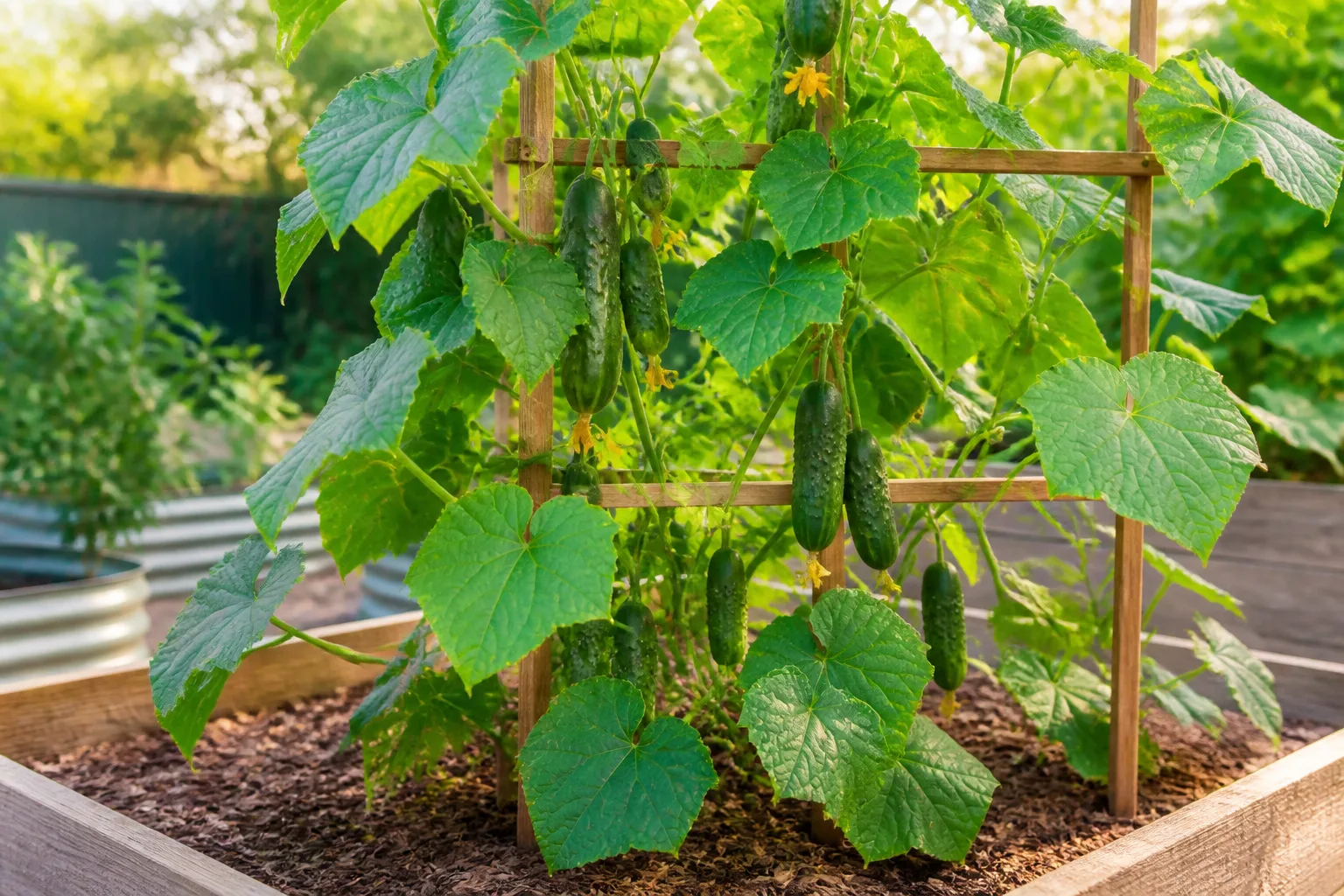
A healthy backyard cucumber plant can produce roughly 10 to 20 medium-size cucumbers over a productive season. A vigorous long-vining plant can go beyond that, while poor pollination, heat, disease, or water stress can reduce the harvest to only a few fruit; Gardenary gives the same 10-to-20 range as a practical home-garden estimate.
That number is a planning range, not a promise printed into the plant. Ten full-size slicers may represent more food than 20 tiny picklers, and a parthenocarpic greenhouse variety follows a different pollination rule from a standard outdoor cucumber. Judge the crop by fruit count, fruit size, quality, and how long the vine keeps setting new fruit.
If you are counting fewer cucumbers than expected, do not start with a stronger fertilizer. First identify the variety, inspect the flowers, check the soil moisture, and look for hidden overripe fruit or early pest damage. Those checks usually reveal the bottleneck faster than adding another product to the bed.
The short answer: plan on 10 to 20 cucumbers per plant
For a home garden, use this as a useful baseline rather than a fixed target:
| Growing situation | Reasonable way to think about the harvest |
|---|---|
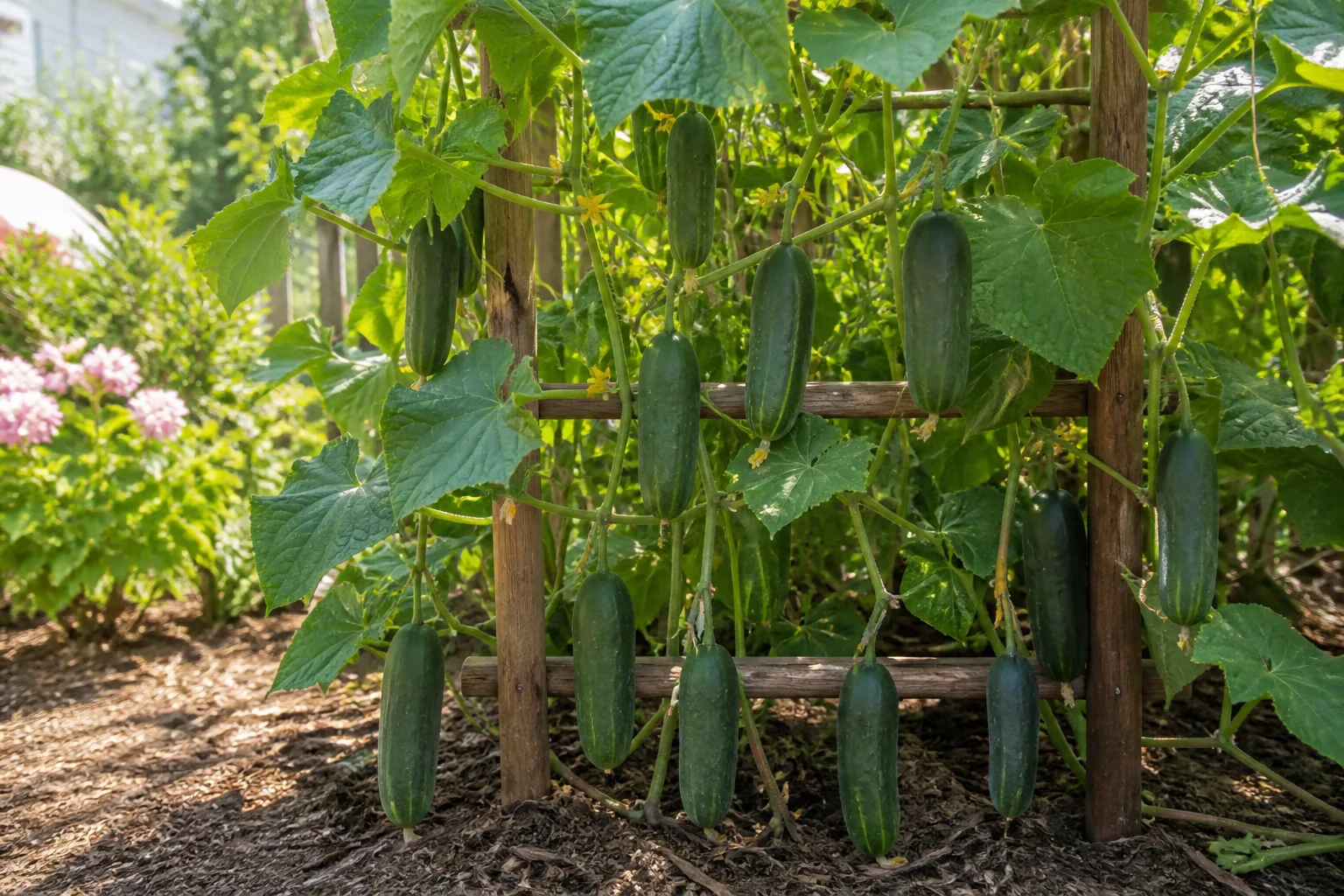
| Healthy outdoor slicer on a trellis | About 10–20 medium fruit is a practical planning range |
| Mini or pickling variety | The plant may produce more individual cucumbers, but each fruit is smaller |
| Parthenocarpic greenhouse variety | Fruit can set without bee pollination; follow the seed packet’s growing instructions |
| Bush or container variety | Often has a shorter or more compact harvest, depending on the cultivar and pot size |
| Heat-, drought-, pest-, or disease-stressed plant | Expect fewer marketable fruit and more dropped or misshapen ovaries |
The most productive plant is not necessarily the one with the largest leaves. It is the one that keeps making healthy female flowers, setting fruit, and having those fruit removed before they become oversized. A plant with 15 crisp pickling cucumbers and a plant with 15 large slicers have the same count but very different yields at the kitchen table.
What changes cucumber yield from one plant?
Cucumber yield is the result of several linked steps: the vine must grow enough healthy leaf area, flowers must appear, female flowers must be pollinated when the variety requires it, tiny fruit must continue growing, and mature fruit must be picked. A failure at any one step can make the final count look like a fertilizer problem when it is actually a flower, water, or harvest problem.
The variety and the environment also interact. A cultivar bred for a short container vine cannot be judged by the same standard as a vigorous field slicer, and a cucumber growing in a hot pot that dries twice a day is not receiving the same conditions as one in deep, mulched soil.
Variety sets the size-and-count trade-off
Start with the seed packet’s description, not a universal number. Slicing cucumbers are grown for fresh eating and may stay on the vine longer to reach their intended length, while pickling and mini types are harvested younger. Bush cultivars save space but usually have a more compact habit; vining cultivars can keep producing as long as they have support, moisture, and healthy foliage.
The flower terminology matters when you are choosing a productive variety. Oklahoma State University Extension describes cucumbers as monoecious when one plant carries separate male and female flowers, gynoecious when it produces mostly female flowers, and parthenocarpic when fruit develops without pollination. A gynoecious packet may call for a compatible pollen-producing variety nearby, while a parthenocarpic packet should be treated according to its own instructions rather than paired automatically with a male-flowering plant.
| Cucumber type | What you will see | Yield decision |
|---|---|---|
| Monoecious | Male and female flowers on the same plant | Protect bee activity and look for successful pollination |
| Gynoecious | Mostly female flowers | Check whether the packet requires a monoecious pollenizer |
| Parthenocarpic | Fruit can form without pollen | Useful where pollination is unreliable; do not assume it needs a pollenizer |
This is why “more cucumbers” is an incomplete goal. If you want fresh salads, choose a slicer and count medium-to-large fruit; if you want pickles, choose a productive pickling type and count smaller fruit at the size the recipe needs. A variety that starts earlier or sets reliably in your climate can beat a theoretically higher-yielding variety that struggles with your summer temperatures.
Pollination determines whether flowers become fruit
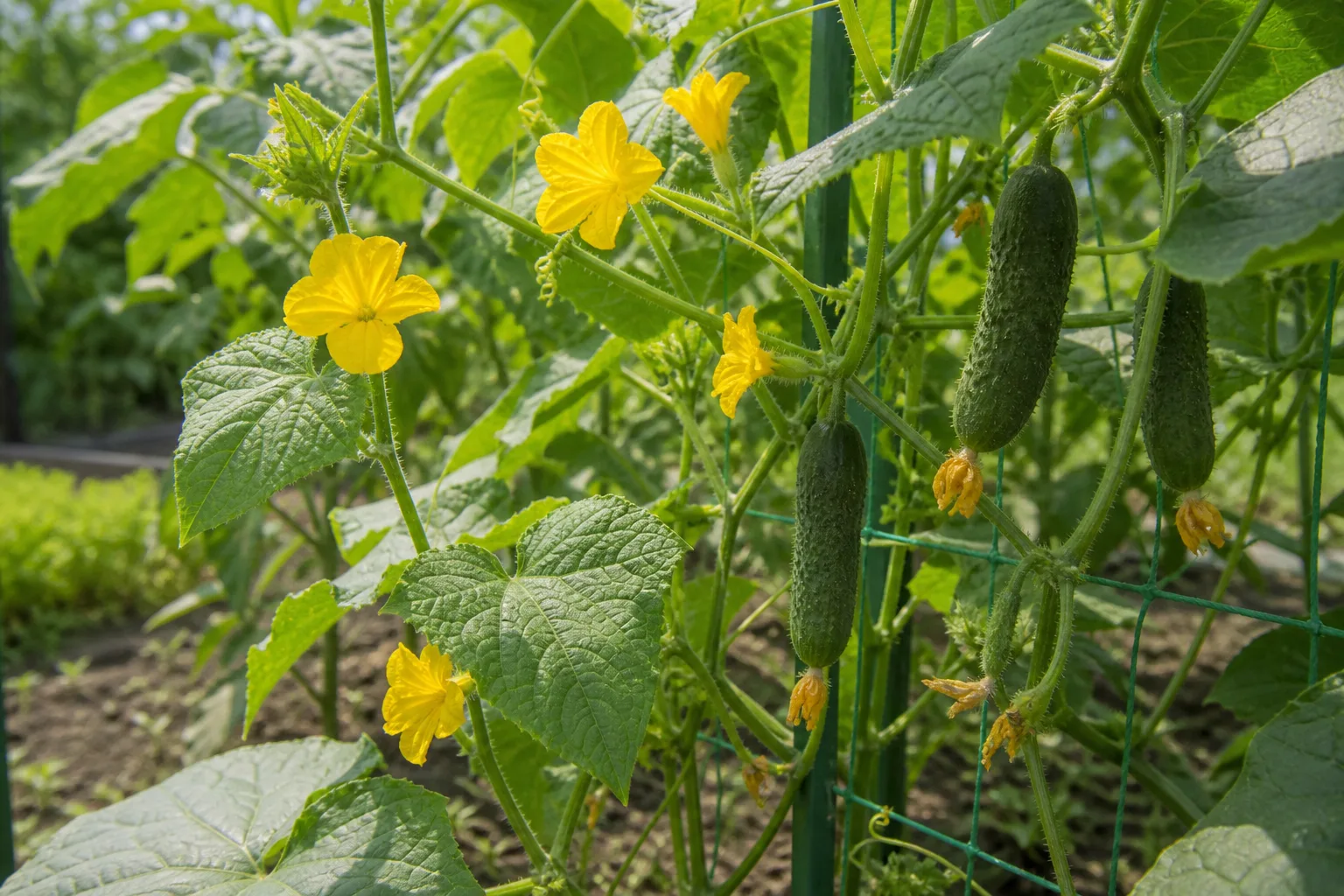
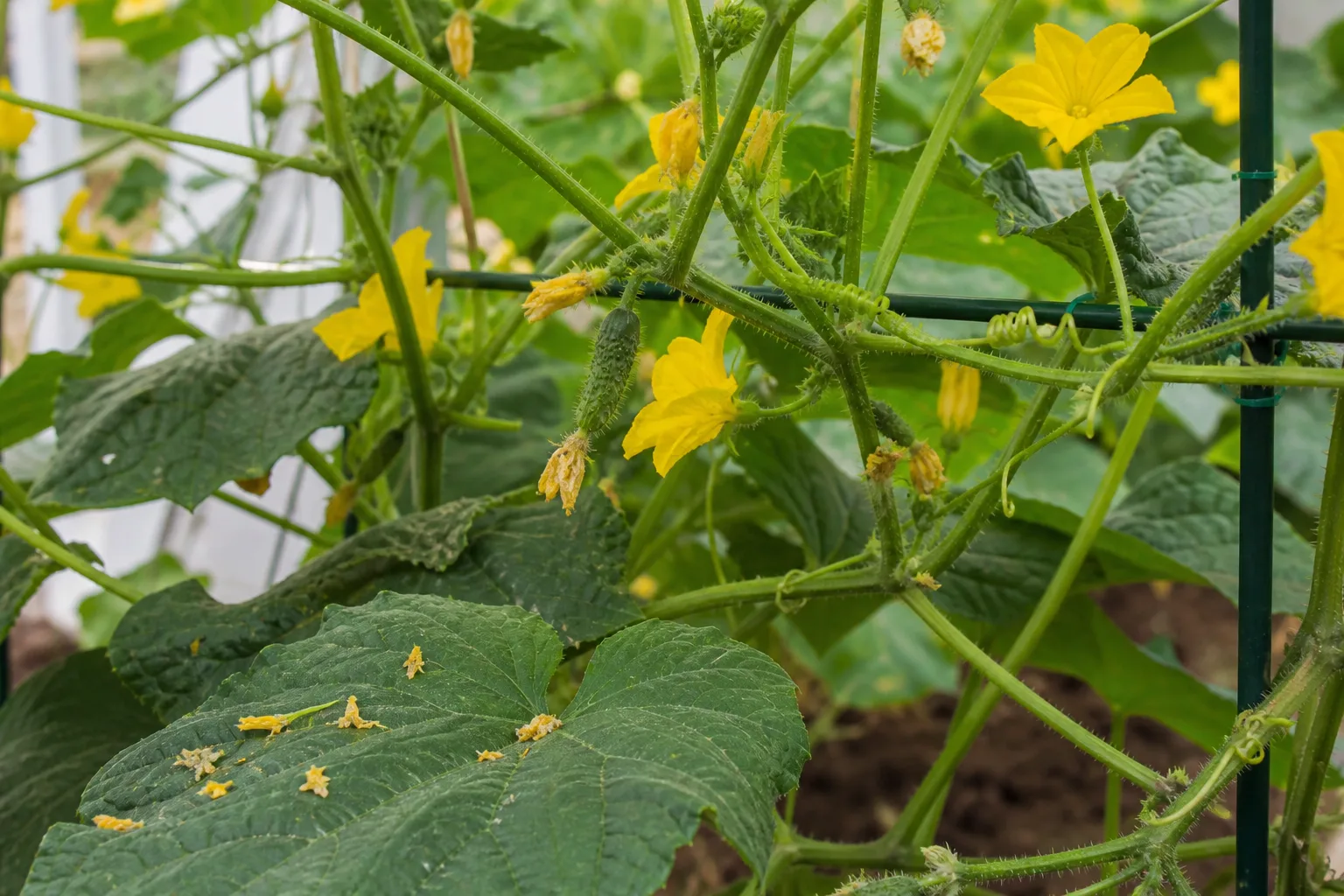
A female cucumber flower has a small cucumber-shaped ovary directly behind the yellow petals. A male flower sits on a plain, slender stem with no swelling behind it. On an outdoor monoecious plant, bees and other pollinators move pollen from the male flower to the female flower; Oklahoma State University Extension notes that cucumber flowers are receptive for only a short period on the day they open.
If the tiny ovary begins swelling and stays green, fruit set is probably progressing. If it remains small, turns yellow, shrivels, and drops, failed pollination is a leading possibility, but extreme heat, drought, waterlogged roots, and disease can produce a similar result. Look at the whole pattern before blaming the bees.
When compatible outdoor flowers are open and insect activity is clearly low, hand-pollinate in the morning. Touch a small brush to the center of a fresh male flower, then transfer that pollen to the center of a fresh female flower; label the flower or make a note so you can watch what happens. Do not use this as a default step for a parthenocarpic or greenhouse all-female cultivar: the Royal Horticultural Society warns that pollinating some greenhouse cucumbers can lead to bitter fruit.
Track the cucumber plant timeline
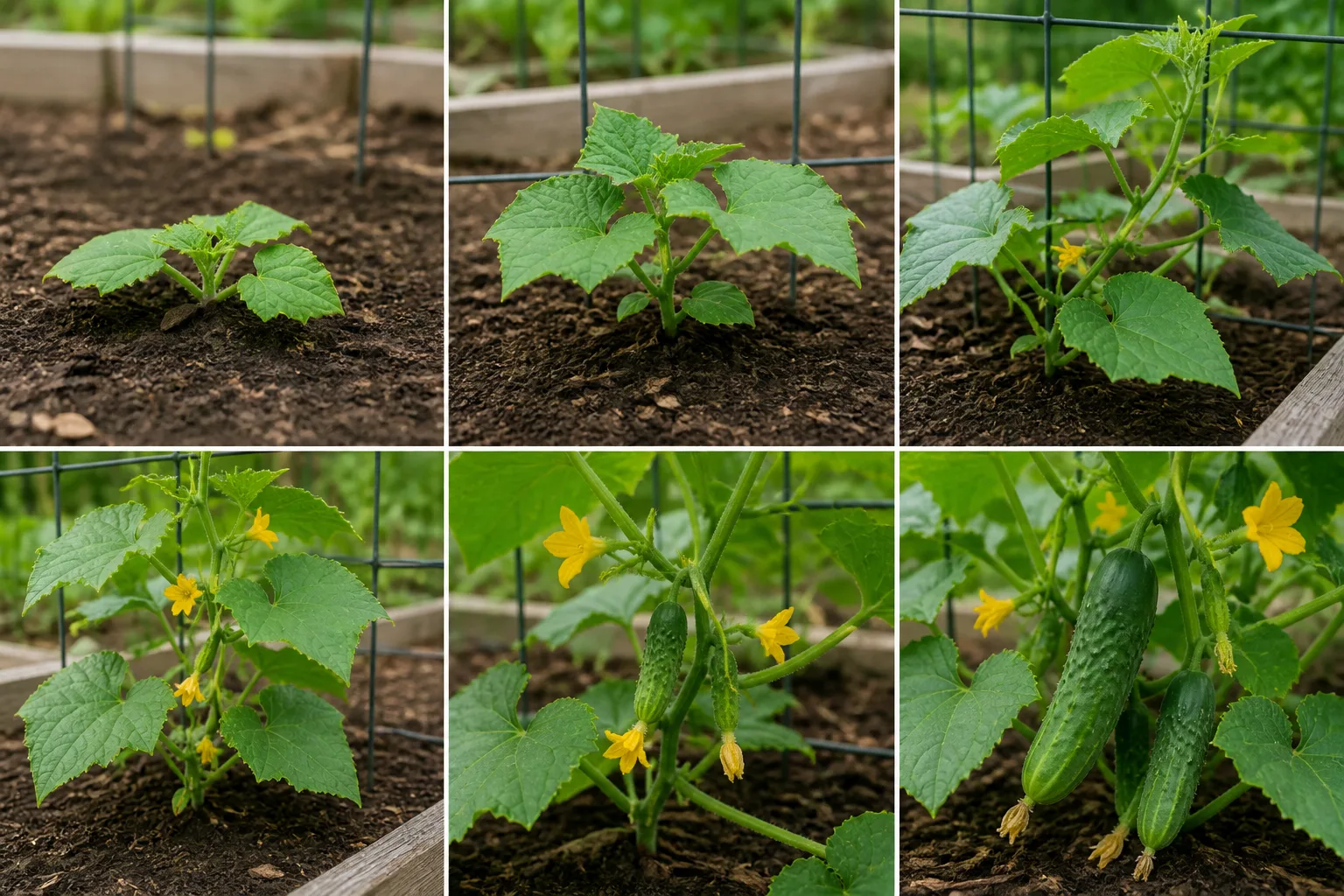
Cucumbers can seem to jump from a small seedling to an unruly vine, but their yield still follows a useful sequence. Track the date of sowing or transplanting, the date of first flower, and the date of the first harvest; those three notes will tell you more about your garden next year than a generic “days to maturity” claim.
Count days from planting, then watch the first flowers
Cucumbers are warm-season plants and should not be rushed into cold soil. Oklahoma State University Extension recommends waiting until soil is at least 60°F, with 75–90°F preferred for germination, while UF/IFAS describes the crop as frost-sensitive and reports harvest roughly 40–65 days after planting under suitable conditions. These figures are useful for planning, but weather, cultivar, and whether you started with a transplant can move the first picking earlier or later.
Direct sowing is often the least stressful method because cucumber roots dislike disturbance. If you use a transplant, handle the root ball gently and expect a pause while it re-establishes. A seed packet’s days-to-maturity count should be treated as the beginning of the inspection window, not a guarantee that every fruit will be ready on that day.
When flowers appear, switch from watching the calendar to watching the plant. A male flower without an ovary is not a harvest promise, and a female flower with a swollen ovary is not a guarantee that it will keep growing. The next few days of moisture, temperature, pollinator access, and fruit inspection determine whether that flower becomes food.
Give each new fruit a fair chance to size up
Once a female flower is successfully set, the little cucumber should steadily enlarge rather than sit unchanged. Fruit that stays tiny and then yellows usually needs a pollination and stress check; fruit that grows quickly but becomes bulbous, soft, or yellow has likely stayed too long on the vine. In both cases, remove the failing fruit so you can inspect new flowers and direct the plant’s resources toward usable harvests.
Do not judge the whole plant by one failed ovary. A vine can lose an occasional fruit during a heat wave and still produce a strong crop after conditions improve. Look for the pattern: many dropped ovaries suggest pollination or stress, while a few hidden oversized cucumbers suggest a harvest problem.
Fix the five yield levers in the right order
The order matters. Sun and support determine whether the canopy can work efficiently, moisture protects flowers and developing fruit, fertility supports growth without forcing leaves, pollinator access protects fruit set, and scouting prevents a small problem from ending the harvest.
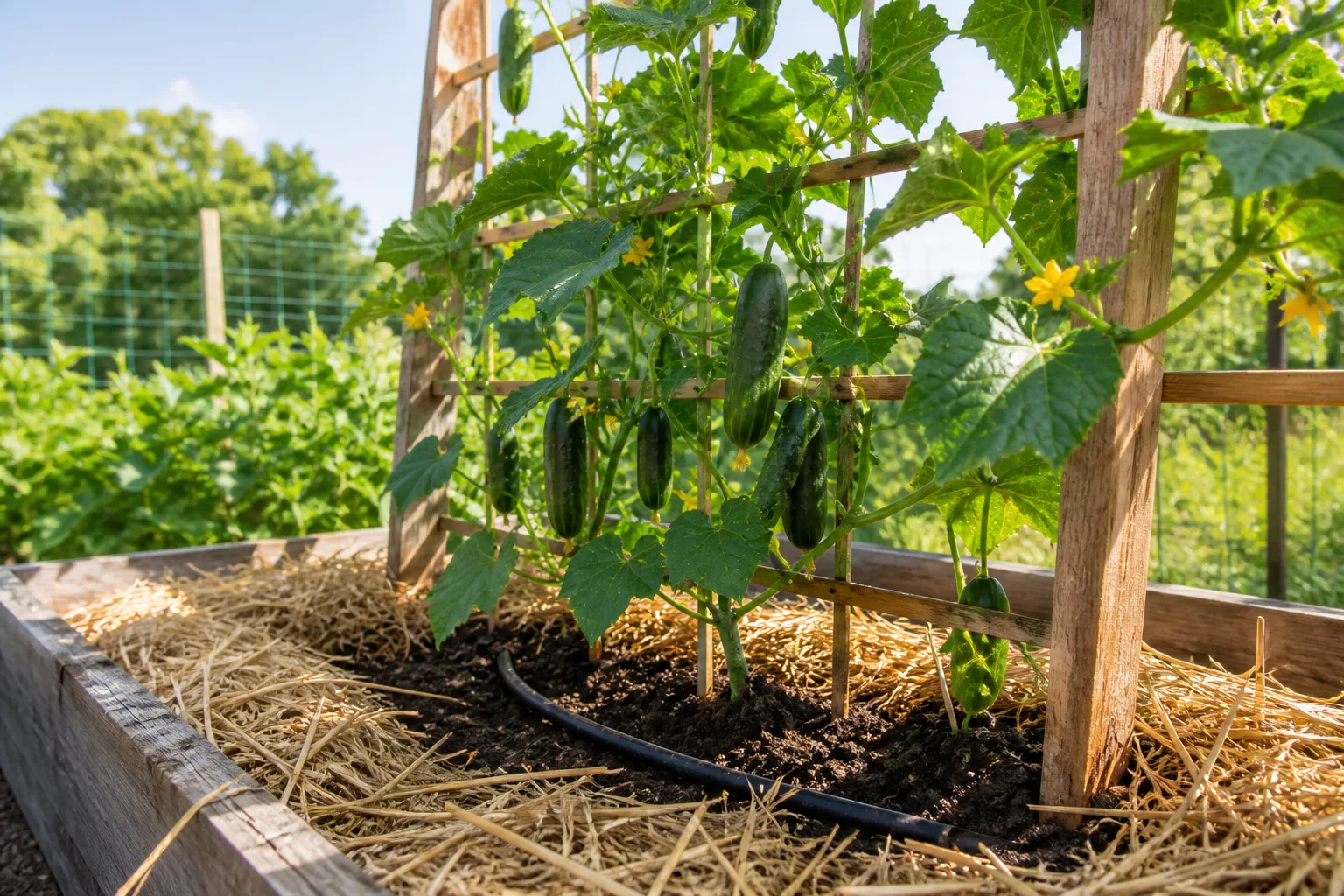
Sun, spacing, and support
Give cucumbers 6–8 hours of direct sun when possible. Gardenary uses that range for good flower and fruit production, and UF/IFAS likewise places cucumbers in a warm, sunny setting. A plant in bright shade may stay alive and leafy but take longer to flower and set fruit.
Give vining types something to climb before the tendrils start searching. Seed Savers Exchange recommends roughly 12–15 inches between trellised plants, while ground-grown vines need much more room to sprawl; the seed packet should win when the cultivar gives a different spacing. A sturdy trellis improves fruit visibility, airflow, and cleanliness, but it does not manufacture flowers, so do not treat support as a guaranteed yield multiplier.
Trellising also changes your harvest behavior. When the vine is lifted, you can see the underside of leaves and find cucumbers before they become yellow and seedy. The trade-off is the cost of a strong support and the need to guide or loosely tie young stems; a flimsy structure that collapses under a wet canopy can damage the plant at its most productive stage.
Moisture at the root zone
Cucumbers have large, thin leaves and a high water demand while they are growing quickly and setting fruit. Keep the root zone evenly moist, then let excess water drain; repeated dry-to-saturated swings can reduce fruit quality, trigger bitterness, and cause tiny fruit to abort. Water the soil rather than spraying the canopy whenever possible.
Oklahoma State University Extension gives about 1.5 inches of supplemental water every 7–10 days as a hot-weather production benchmark when rainfall is inadequate. A home garden should adjust that starting point for rainfall, soil type, mulch, container size, and temperature; use a finger or moisture check in the root zone instead of running a timer blindly.
Mulch can slow evaporation and keep shallow roots from cycling between drought and flood, but keep it a little away from the main stem. Drip or soaker irrigation is particularly useful because it puts water where the roots are and keeps leaves drier. If you must use an overhead sprinkler while flowers are open, avoid the period when bees are working and water early enough for foliage to dry before night.
Fertility without a leaf-only explosion
Work finished compost into poor soil and use a soil test when you suspect a real nutrient deficiency. UF/IFAS cautions that too much nitrogen can create excessive leafy growth while hurting flower and fruit production, and Oklahoma State University Extension similarly links high nitrogen with delayed flowering and fruit set.
That makes a lush vine with no cucumbers a reason to inspect light, variety, and nitrogen—not a reason to keep feeding. Do not automatically apply a phosphorus-heavy “bloom booster”; follow the soil test and the fertilizer label, because extra nutrients cannot repair failed pollination, waterlogged roots, or a diseased canopy.
Container cucumbers need closer attention because a limited volume of potting mix can lose both water and nutrients quickly. Choose a container-friendly variety, use a pot with drainage, and feed only when the plant is actively growing and the product instructions call for it. If the pot is drying by midday, improving the container setup will help more than increasing fertilizer.
Pollinator access and hand-pollination
Keep open flowers accessible to bees by avoiding unnecessary insecticide use during bloom and by not covering flowering outdoor vines for longer than needed. A row cover can protect young plants from cucumber beetles, but it must be removed or managed when pollination is required unless the variety sets fruit without pollen.
If you have many male flowers but few female flowers, give the plant time while checking heat, light, and excess nitrogen. If female flowers appear but repeatedly drop, inspect one flower on the day it opens and hand-pollinate only when the variety needs pollen and natural pollination is not happening. A small paintbrush is enough; the important part is transferring fresh pollen to a fresh stigma, not brushing every flower repeatedly.
Some greenhouse cultivars are all-female or parthenocarpic and are selected precisely because they do not need insect pollination. Read the packet before you bring bees, a male-flowering companion, or a hand-pollination routine into a protected growing space.
Pest and disease prevention
Scout the vine at least weekly, and inspect more often once the canopy becomes dense. Look under leaves for cucumber beetles, aphids, mites, eggs, and early spotting; check stems and fruit for feeding damage; and look at the base of the plant where poor airflow or wet soil can start trouble. UF/IFAS lists cucumber beetles, melonworms, pickleworms, thrips, spider mites, powdery mildew, and downy mildew among cucumber concerns.
Cucumber beetles deserve fast attention because they can spread bacterial wilt. Young plants are especially vulnerable, so row cover, hand removal where practical, crop rotation, and clean garden habits can protect the crop before it flowers. If a plant suddenly wilts and does not recover after watering, do not keep adding water or fertilizer; isolate the diagnosis and remove a plant that is clearly infected rather than allowing a disease to move through the row.
Airflow and dry foliage reduce disease pressure, but do not prune a healthy plant aggressively just to make it look tidy. Use a trellis, keep weeds from closing the canopy, water at the base, and choose disease-resistant varieties when your local history suggests a recurring problem. If you use a pesticide, follow the product label and protect pollinators; a generic spray schedule is not a safe substitute for identifying the pest or disease.
Harvest often to keep the vine productive
Regular picking is one of the simplest ways to protect yield. Oklahoma State University Extension recommends harvesting every two to three days in normal conditions and daily when fruit growth is especially fast, while GrowVeg advises checking and snipping at least every other day. A cucumber hidden under leaves can keep enlarging after it has passed the best eating stage and can make the plant less pleasant to manage.
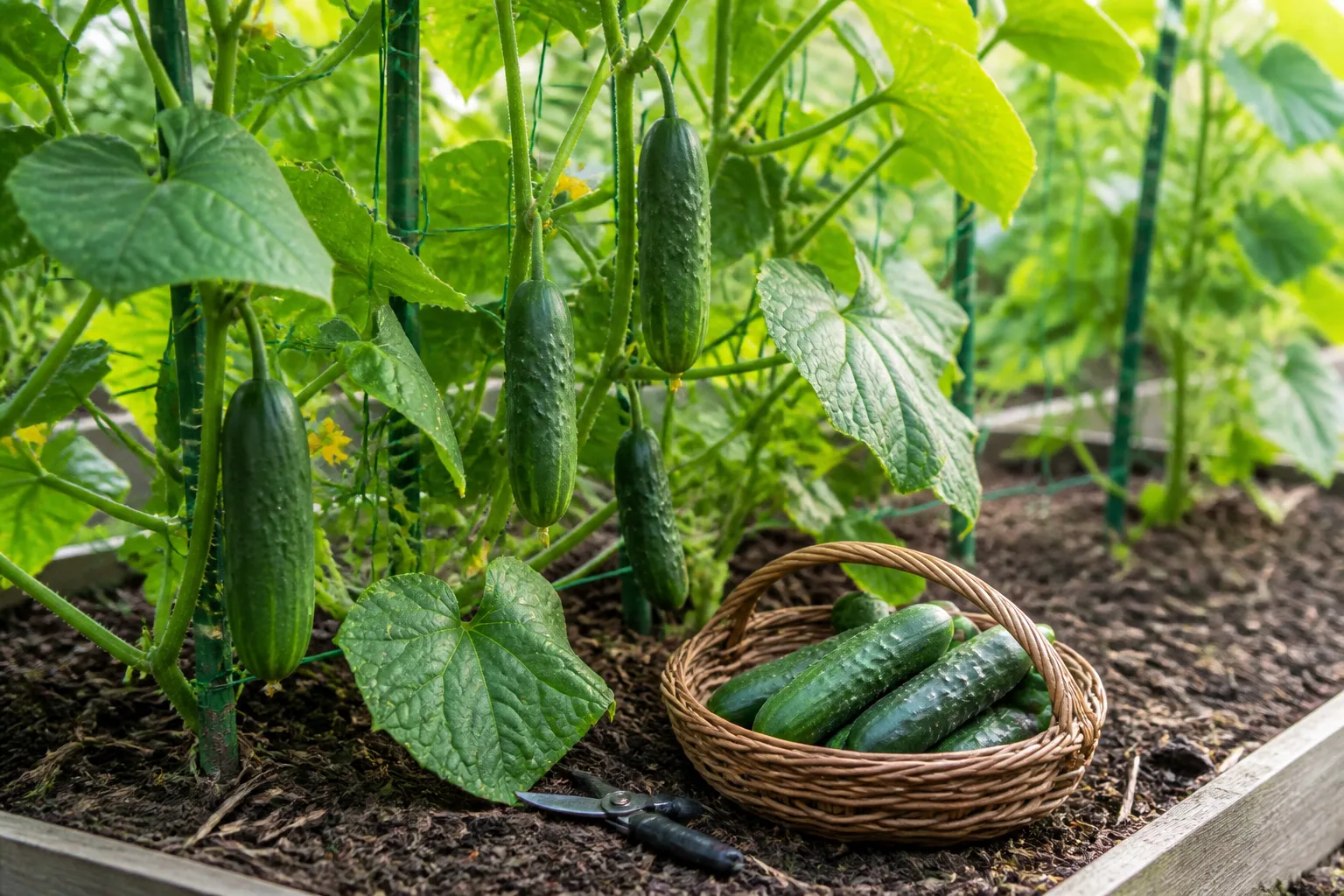
Pick by the variety’s intended size
Use the packet’s mature size as your first cue, then confirm firmness, normal color, and shape. The Royal Horticultural Society gives approximate examples of about 3 inches for mini cucumbers, 6 inches for small-fruited types, and 8–10 inches for full-size varieties, but those measurements are not rules for every cultivar.
Pickling cucumbers are generally best while they are small and firm, before seeds become prominent. Slicing cucumbers can stay longer for a larger fruit, but do not wait until the cucumber turns soft, swollen at both ends, yellow on a normally green variety, or full of hard seeds. Specialty white, striped, or pale cultivars should be judged by their own packet description rather than forced to become dark green.
If you are trying an unfamiliar variety, harvest one fruit at several sizes and cut it open. Note when the seeds are still tender, the flesh is crisp, and the flavor is good; that personal harvest record is more useful than a general length rule when you grow the same variety again.
Cut fruit without damaging the vine
Harvest in the morning when the fruit is cool and firm. Use clean pruners or a small knife to cut the stem, leaving a short piece attached to the cucumber, rather than pulling or twisting the fruit from the vine.
After removing the obvious cucumbers, look behind leaves, along the trellis, and at ground level. Check again the next day during a heavy flush. Frequent, gentle harvest protects the stem, keeps the canopy manageable, and removes the fruit that would otherwise become a drain on the plant.
Diagnose a cucumber plant with flowers but few fruits
Flowers alone do not prove that the plant is underperforming. Use the symptom that appears next to choose the first action:
| What you see | Most likely bottleneck to check | First action |
|---|---|---|
| Male flowers only at the beginning | The plant may not have reached its female-flowering phase | Give it time while checking sun, warmth, and excess nitrogen |
| Female flowers turn yellow and drop while tiny | Failed pollination, heat, drought, or waterlogged roots | Identify the variety, inspect moisture, and hand-pollinate a fresh flower only if needed |
| Many leaves but few flowers | Too much nitrogen, too little direct sun, or heat stress | Stop unnecessary nitrogen, improve light, and stabilize water |
| Fruit grows but becomes yellow, bulbous, or seedy | Harvest is late or the plant is stressed | Remove the overripe fruit and shorten the picking interval |
| Leaves show holes or sudden wilt | Beetle feeding, bacterial wilt, or another disease | Inspect pests and symptoms promptly; do not treat a diagnosis you have not made |
| Lower leaves spot while the canopy stays wet | Foliar disease favored by leaf wetness and poor airflow | Water at the base, open the canopy with support, and follow local extension guidance |
The key distinction is between no female flowers, female flowers that fail to set, and fruit that sets but is harvested too late. Those three problems can look like “low yield,” but the fixes are different. Take a close look at one open flower and one failed fruit before changing the whole bed.
Pruning is not a universal answer. Remove yellow, diseased, or badly damaged leaves with clean tools, and guide a vigorous vine onto its support, but keep enough healthy foliage to power fruit growth. A plant that is already stressed can lose yield if you strip a large share of its leaves in one session.
Extend the harvest without exhausting the plant
Succession sowing spreads risk. Oklahoma State University Extension recommends sequential cucumber plantings at two- to three-week intervals for a steadier supply, which is especially useful when one early planting is damaged by beetles, disease, or a heat wave. Start the next planting early enough to establish before the first vine declines, but use the warm-soil requirement rather than sowing blindly by date.
In a short-season area, the next planting may need a warm, protected start. In a hot climate, a second planting may perform better when the worst heat passes rather than when the first crop is at its peak. Containers can make timing easier because they warm quickly, but they also dry quickly, so a late-season pot needs a reliable watering plan.
Keep harvesting the original plant while it is healthy and setting fruit. Replace it when frost is approaching, disease is spreading, the vine has severe irreversible damage, or the fruit quality has collapsed despite correcting the growing conditions. A temporary pause during extreme weather is not automatically a reason to pull a plant that can recover.
At the end of the season, remove old vines and fallen fruit, clean supports, and rotate the cucurbit family when space allows. Oklahoma State University Extension recommends a multi-year rotation away from cucumber, melon, squash, and pumpkin ground to reduce recurring pest and disease pressure. The next crop’s yield starts with the cleanup of this one.
Conclusion: measure a good harvest by quality, not just count
Plan on 10 to 20 medium cucumbers per healthy backyard plant, with smaller pickling or mini varieties potentially producing more individual fruit and stressed vines producing fewer. The number becomes meaningful only when you also name the variety, expected fruit size, growing method, and length of the harvest season.
To move a low-yield plant in the right direction, check the packet, inspect male and female flowers, stabilize root-zone moisture, provide strong sun and support, avoid excess nitrogen, scout for beetles and disease, and pick every two to three days once fruit begins sizing. That sequence gives you a better harvest than chasing a universal cucumber count—and it tells you exactly what to change before planting another vine.