Phalaenopsis Orchid Care: Light, Water, Bark & Rebloom
Phalaenopsis orchid care after the gift bloom: bright filtered light, soak-and-drain bark watering, aerial-root rules, and cool autumn nights for rebloom.
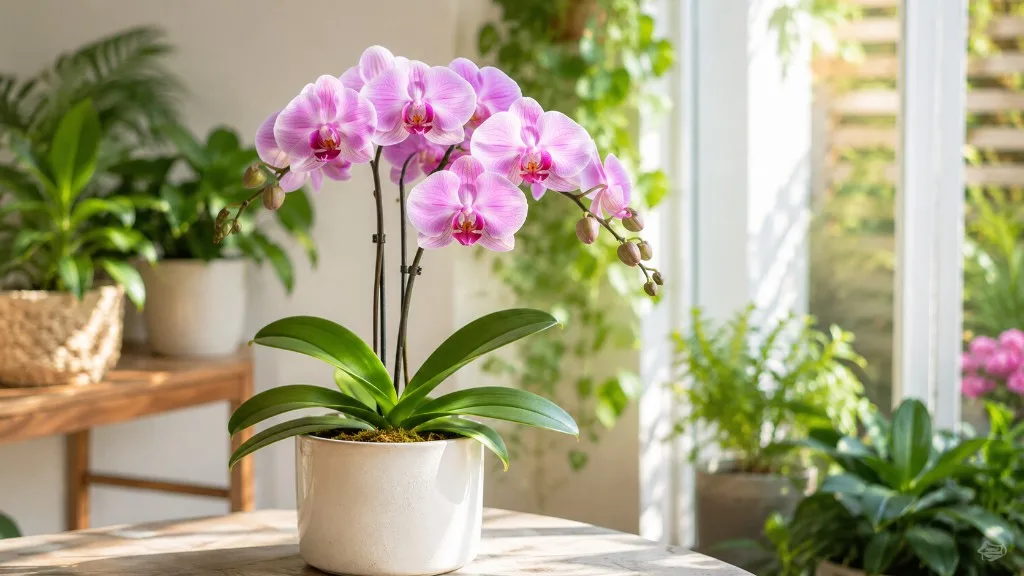
The supermarket moth orchid looked perfect for months—until the last flower dropped, someone started watering on a calendar, and the silvery roots turned brown mush. That pattern is common because moth orchid care is not the same as caring for a foliage plant in potting soil. Treat Phalaenopsis as a tropical epiphyte in bark: bright filtered light, a wet-then-almost-dry watering rhythm, open media that lets roots breathe, and a cool-night cue when you want another spike.
Get those four right and fertilizer, humidity tweaks, and spike trimming become fine-tuning. Get the media or watering wrong and no bloom booster will save collapsing roots. This page is the indoor system for keeping a gift flower alive as a long-term houseplant—light, bark watering, moss-to-bark conversion, aerial roots, rebloom, and the problems that show up first.
Written by Sai Ananth (B.Pharmacy, Andhra University; LeafyPixels lead writer). Reviewed by Dr. Priya Menon (Ph.D. Botany; indoor plant physiology and stress).
Firm leaves, plump roots, and airy bark matter more than a fixed watering day. Healthy moth orchids show medium-green foliage and roots that cycle from green when wet to silvery when nearly dry. Hero asset is a LeafyPixels plant photo for teaching—not a dated grow-log shot.
Who Wrote This Guide and How We Reviewed It
This guide was researched and written by Sai Ananth, whose pharmacy background shapes how LeafyPixels phrases pet-toxicity notes, and whose indoor growing practice focuses on real apartment windowsills rather than greenhouse idealizations. Botanical review by Dr. Priya Menon (Ph.D. Botany; indoor plant physiology and stress), who cross-checks care thresholds against extension and orchid-society sources before publication. Our editorial policy covers sourcing and corrections.
How this guide was built (Phalaenopsis-specific):
- Compared NC State Extension east-window, bark-media, weekly watering, and large-flowered ~55°F chill notes with the dwarf-hybrid exception.
- Mapped RHS moth orchid guidance on bright filtered light, bark compost (not multipurpose soil), tepid watering, and day/night temperature bands.
- Used Missouri Botanical Garden’s visual culture sheet for the olive/dark/red leaf-color meter, no-ice stance, 55°F spike cue, and basal-vs-node spike cuts. (Missouri Botanical Garden)
- Triangulated watering and rebloom physiology with the American Orchid Society culture sheet and rebloom article.
- Held the ice-cube marketing claim against both Mobot’s caution and the Ohio State University greenhouse trial.
- Confirmed pet wording against the ASPCA Phalaenopsis listing and folded LeafyPixels hub notes on watering, light, and root rot into labeled dry-down ranges below.
Experience notes (labeled conditions, not universal guarantees):
- A clear 4–5 inch plastic pot of medium fir bark on an east sill in a heated apartment often reached silvery roots and a light pot every 7–9 days in warm bright weeks and 10–14 days in cooler, dimmer stretches—always confirmed by root color and pot weight, never by a phone reminder alone.
- The same cultivar still in a tight sphagnum nursery liner inside a decorative cachepot often stayed heavy 12–18 days; calendar “weekly” watering there produced mushy roots twice before we converted it to bark.
- After moving a healthy, olive-leaved plant to a cooler bright sill with nights near 55°F (13°C) for about four to five weeks in autumn (days still moderate), a green spike nub appeared between the leaves; a sibling plant left in constant mid-70s°F room warmth with darker foliage did not spike that season.
Diagnostic photos below reuse LeafyPixels plant-problem assets for teaching—not claimed as personal diary shots of those exact pots. Your climate, pot, and hybrid will shift the clock.
What Phalaenopsis Is (Epiphyte Roots, Monopodial Crown)
Phalaenopsis—the moth orchid or moon orchid—is the most widely sold indoor orchid for a reason: long-lasting flowers, compact foliage, and hybrids that tolerate ordinary heated rooms. The RHS Growing Guide for moth orchids describes them as easy houseplants that enjoy year-round warmth and filtered light, with blooms that can last for months in white, pink, purple, yellow, and patterned forms.
Missouri Botanical Garden calls Phalaenopsis one of the easiest orchids for home culture and notes they are tropical epiphytes: in nature they grow on tree branches and trunks without parasitizing the host. They are monopodial—new leaves emerge from a terminal growing point—so the plant adds a leaf or two at the top while older basal leaves eventually senesce. (Missouri Botanical Garden) That growth habit matters when you repot: the crown stays above the mix, and roots radiate outward rather than forming a dense soil ball like a philodendron.
Epiphyte Roots Need Air, Not Garden Soil
The care rule that prevents most failures is biological, not decorative. Epiphytic roots cling to bark, wet when rain passes, then dry in moving air. Packed into standard potting soil they stay wet, lose oxygen, and rot. UF/IFAS notes most orchids are epiphytes and need special media—chopped bark, charcoal, volcanic rock, and similar open ingredients—that create a loose, well-drained root environment. (UF/IFAS Gardening Solutions)
Phalaenopsis also lacks big pseudobulbs for water storage. The American Orchid Society culture sheet stresses that without major storage organs other than leaves, plants must be thoroughly watered and not watered again until nearly dry—never left soggy, never left bone-dry for long. (American Orchid Society) That is why bark timing and root inspection beat any fixed “every Sunday” habit.
Quick Care Snapshot for Indoor Moth Orchids
For a typical home Phalaenopsis in bark, aim for bright indirect light (east sill or shaded south/west), water when bark is nearly dry and roots look silvery, use orchid bark—not potting soil, keep nights warm most of the year with a cooler autumn stretch for spikes, and leave healthy aerial roots in open air. NC State Extension notes moth orchids prefer warm, humid conditions in a bark-based medium with excellent drainage and east-window placement as a strong default. (NC State Extension)
| Care factor | Baseline target | Open this when you need depth |
|---|---|---|
| Light | Bright filtered; east sill ideal | Phalaenopsis light guide |
| Water | Soak when nearly dry; drain fully | Phalaenopsis watering guide |
| Media | Medium orchid bark; never potting soil | Phalaenopsis soil guide |
| Feed | Dilute orchid fertilizer; flush monthly | Phalaenopsis fertilizer guide |
| Rebloom | Cool autumn nights ~55°F for several weeks | No flowers |
A clear plastic pot in bright light will not dry on the same clock as a moss-packed decorative cachepot in a dim hallway. Use root color and pot weight as the schedule.
Light: Windows, Leaf Color, and Grow Lights
Phalaenopsis is often labeled a “low-light orchid,” which is only half true. It needs less intensity than a Cattleya, but it still needs bright, filtered light to stay firm and store energy for spikes. AOS recommends a bright window with little or no direct sun, noting that overcast northern winters may need a full south exposure. (American Orchid Society) RHS similarly wants bright light without harsh summer sun, with east or west sills as practical defaults and brighter winter placement to support flowering. (RHS)
In most homes, place the plant within about half a meter to a meter of an east-facing window, or back from a south or west window behind a sheer curtain. A deep interior shelf that looks “bright” to human eyes is often too dim for reliable rebloom. If the only option is a dark room, use a full-spectrum LED about 30–60 cm (1–2 ft) above the foliage for roughly 12–14 hours; AOS notes artificial light can work when intensity is adequate. Rotate the pot weekly so the spike and leaves do not twist permanently toward one side.
Too Little Light vs Leaf Scorch
Missouri Botanical Garden gives a simple leaf-color meter: olive green suggests appropriate light; dark green suggests too little (and weak blooming); red-tinged foliage suggests too much. (Missouri Botanical Garden) Scorch shows as bleached or brown patches on the sun-facing side after a sudden move to hot glass—pull back and acclimate over one to two weeks. Damaged tissue will not re-green; judge recovery by newest leaves.
If the plant stays healthy but refuses spikes for a year, light is the first lever after root health. The AOS rebloom article is blunt: without enough light, carbohydrates go to maintenance first, and flowering waits. (American Orchid Society) Deepen the diagnosis on not enough light or no flowers when foliage is dark and soft while roots still look sound.
Watering: Soak, Drain, and Read the Roots
Correct watering keeps moth orchids alive more than any bloom product. RHS warns that roots rot if kept too wet and shrivel if kept too dry; water weekly in active growth for many plants, reduce slightly in winter, never leave pots sitting in runoff, and prefer tepid water (rainwater when you can). (RHS) AOS adds morning watering so leaves dry before night and warns not to let water collect in the crown. (American Orchid Society)
Practical method for bark in a clear pot: when roots look silvery-white and the pot feels light, take it to the sink, run room-temperature water through the bark for 30–60 seconds (or dunk and lift), then drain completely before returning it to any decorative cachepot. Green, plump roots usually mean the plant is still wet enough—wait. NC State suggests mature plants about once weekly or more often in heat, with the mix drying some between waterings. (NC State Extension) Moss-heavy nursery pots hold water longer than chunky bark; check the top of moss and the center of the root mass before adding more.
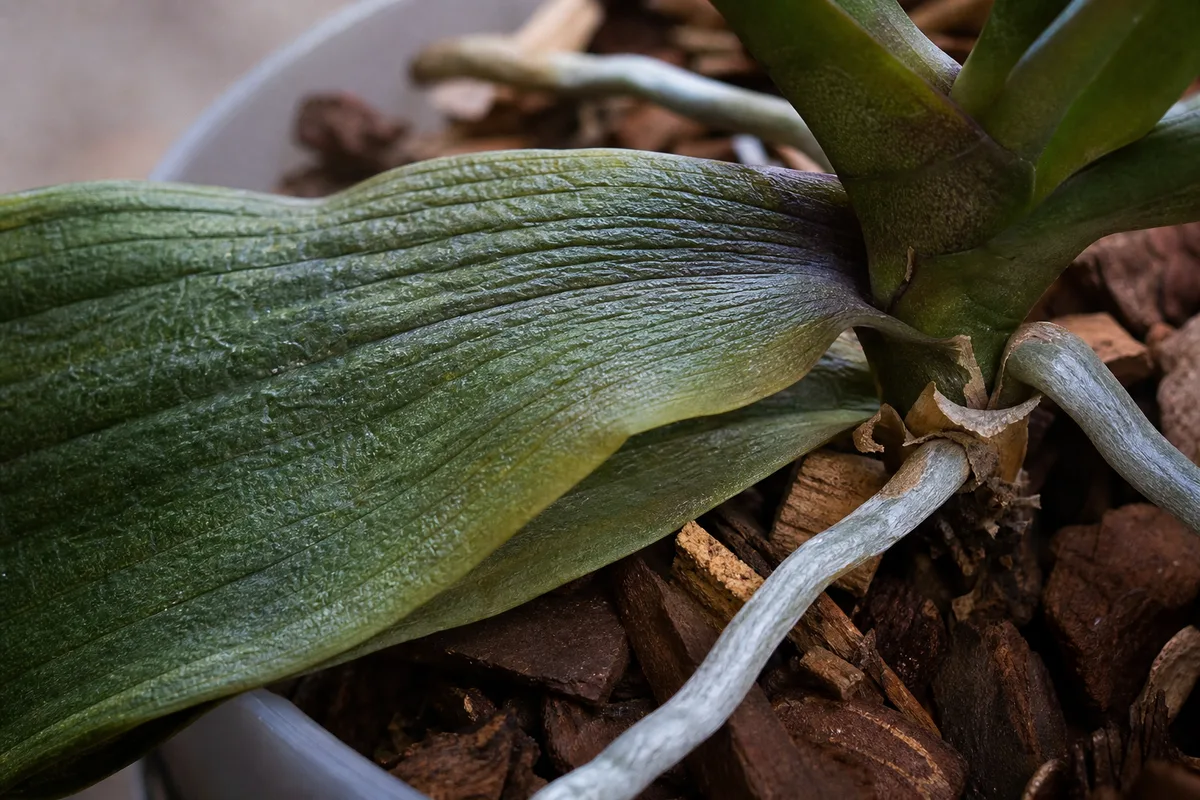
Wrinkled leaves with dry bark and silvery roots in a light clear pot usually mean it is time to soak. Wrinkled leaves on a still-heavy, soggy pot point to damaged roots instead—open root rot before you water again. Teaching image; conditions described are the diagnostic pattern, not a claim that this exact photo is from our east-sill trial.
Ice Cubes vs Room-Temperature Soak
Ice cubes are a marketing habit, not a botanical requirement. Missouri Botanical Garden advises against ice: cold shocks tropical roots and a few cubes often under-water the plant; use lukewarm flood-and-drain in the sink instead. (Missouri Botanical Garden) An Ohio State University greenhouse trial found weekly ice-cube irrigation in bark could support growth comparable to room-temperature watering under their protocol, while noting media, cultivar, and room conditions change water need. (Ohio State University)
For LeafyPixels care, prefer room-temperature soak-and-drain. It saturates bark evenly, avoids cold pockets against roots and crown, and scales when humidity or light shifts. If you insist on ice for portion control, keep cubes on media—not leaves—empty cachepot water, and switch to a full soak whenever roots look chronically silvery or leaves wrinkle. Details live in the watering guide.
Keep Water Out of the Crown
The crown is the soft growing point where new leaves emerge. Standing water there in cool, still air invites crown rot—a plant can look fine at the edges while the center collapses. After watering, tip the pot gently or wick the crown with a paper towel. Mobot and AOS both emphasize morning watering and drying foliage before night. (Missouri Botanical Garden) (American Orchid Society) Mist lightly only if humidity is very low and air moves; wet flowers and stagnant air raise Botrytis risk on blooms.
Bark Media, Moss Conversion, Pots, and Repot Timing
Always use a porous orchid mix, usually medium-grade fir or pine bark with charcoal and perlite as needed. RHS is explicit that bark-based orchid compost is the medium of choice and multipurpose compost will kill moth orchids. (RHS) Mobot says the same: purchase commercial mix labeled for Phalaenopsis; do not use standard potting mix. (Missouri Botanical Garden) Pure sphagnum can work in skilled hands but stays wet and is hard to rewet when hydrophobic—NC State prefers moving such plants into bark-based media. (NC State Extension)
Moss-to-bark conversion (gift orchids): After bloom, if the liner is packed sphagnum that stays cold and wet for weeks, unpot, tease moss off healthy roots, trim only soft/black roots with sterile tools, and settle the plant into medium bark sized to the remaining root mass with the stem–root junction at the surface. Do this after flowers fade—not mid-spike—unless roots are already collapsing. Full technique sits in the repotting guide and soil guide.
Repot about every one to two years, or when bark breaks down into fine particles that stay soggy. Mobot suggests spring or summer after bloom, removing dead brown wiry roots and keeping firm whitish roots. Pot for the root mass—not “for growth”—because oversized pots hold unused wet media. (Missouri Botanical Garden) Clear pots help you read root color; drainage holes are non-negotiable.
Aerial Roots Stay Above the Mix
Healthy Phalaenopsis often send aerial roots up and over the pot rim. Those roots are doing their job: exchanging gas, anchoring, and sometimes greening for photosynthesis. As a culture practice aligned with epiphyte biology—not a chemical law—leave healthy aerial roots above the mix in open air rather than burying them under fresh bark to tidy the pot. Forcing them under media keeps them wetter and darker than they typically need and can start rot at the stem. When you repot, seat the plant so the stem–root junction sits at the top of the mix, spread subterranean roots into bark, and leave firm aerial roots free. Trim only soft, hollow, or blackened roots with sterile tools.
If aerial roots look dry and wrinkled while pot roots are green and the mix is still damp, raise humidity or check whether the room is too hot and dry—do not bury the aerial roots as a “fix.” Persistent shriveling with a light, dry pot means water the bark thoroughly, then reassess light and humidity on the low humidity page if tips keep crisping.
Temperature, Humidity, and Cool Nights That Trigger Spikes
Moth orchids are warm growers. AOS targets nights usually above 60°F and days about 75–85°F, with higher humidity and air movement if temperatures climb. (American Orchid Society) RHS suggests roughly 19–30°C days and 16–19°C nights, away from radiators and draughts. (RHS) Rapid swings and cold window drafts are classic triggers for bud drop.
Humidity of about 50–80% suits them. In dry heated homes, use a pebble tray with water below the pot base, group plants, or run a small humidifier—AOS and Mobot both warn the pot must not sit in the water. (American Orchid Society) (Missouri Botanical Garden) Air movement matters as much as moisture percentage; still, wet air invites fungal spots on flowers. A humid bathroom with weak light is a poor trade—roots need brightness as much as humidity.
Rebloom needs a healthy plant, enough light, and the right cue. AOS explains that many Phalaenopsis set spikes when day–night temperature differences increase in autumn, with nighttime temperatures in the 50s–60s°F (about 10–16°C), and notes they may not flower well if day temperatures stay above about 82°F (28°C). (American Orchid Society) Mobot similarly recommends nights near 55°F for several weeks in autumn to initiate spikes. (Missouri Botanical Garden) NC State adds that some modern dwarf hybrids bred from summer-flowering species are less dependent on a chill. (NC State Extension)
Practical approach: after summer growth, move a healthy plant to a cooler bright sill or a room that drops at night for three to six weeks, keep days moderate, then watch for a green spike nub between the leaves. Stake tender spikes early. Do not chase fertilizer if roots are brown or light is dim—fix health and light first, then the cool cue. Symptom depth: no flowers and slow growth.
No Spike, Bud Drop, or Wrinkled Leaves — Check Order
When the plant disappoints, check variables in this order so you do not fertilize a rotting root system:
- Wrinkled leaves while the pot is heavy or smells sour → inspect roots first (root rot, overwatering). Watering more will not help.
- Buds form then yellow and drop → stabilize temperature, drafts, and humidity; shipping and heater blasts are common (bud drop). Do not move the plant daily.
- Healthy olive or dark leaves, firm roots, no spike for a season → raise light, then try cool autumn nights for large-flowered types; remember dwarf hybrids may need less chill (no flowers).
Only after those three are honest should you change fertilizer strength or spike-cutting strategy.
Fertilizer and Spike Aftercare (Basal Cut vs Node Cut)
Feed lightly and regularly in active growth. Mobot suggests a balanced orchid fertilizer such as 20-20-20 at half strength weekly after watering, or three weeks out of four, with a clear-water flush monthly to limit salt buildup. (Missouri Botanical Garden) AOS notes high-nitrogen formulas can suit bark media, while some growers use quarter-strength with every watering in warm, humid conditions. (American Orchid Society) RHS warns that feeding every watering without a flush can load salts into the compost—skip fertilizer every fourth watering. (RHS)
After the last bloom falls, you have two honest options. Cutting the spike near the base rests the plant and often supports a stronger new spike later. Cutting above a lower node can produce a side spike sooner but stresses the plant more—Mobot prefers a basal cut for yearly rebloom energy. (Missouri Botanical Garden) NC State suggests cutting just above the first node below faded flowers for a possible branch. (NC State Extension) Choose based on plant vigor: soft leaves and few roots → cut hard and recover; robust plant with plump roots → node cut is optional. See pruning and fertilizer.
Common Problems and First Moves
Most indoor failures cluster around wet media, low light, or sudden environment changes. NC State lists scale and mealybugs, bud blast from humidity or location swings, Botrytis on flowers, and wrinkled leaves from drought or damaged roots. (NC State Extension) UF/IFAS recommends isolating sick plants, improving air movement, keeping foliage and flowers dry when possible, and starting pest control with alcohol swabs or orchid-safe soaps before stronger products. (UF/IFAS)
| What you see | Likely cause | First move |
|---|---|---|
| Soft brown roots, sour bark | Root rot / overwatering | Unpot; cut mush; fresh bark; brighter spot |
| Wrinkled leaves, light dry pot | Underwatering | Thorough soak; check media age |
| Buds yellow and drop | Drafts, dry air, move shock | Stabilize temp/humidity; see bud drop |
| Dark green, no spike | Low light | Brighter sill or grow light; not enough light |
| White fluff in leaf axils | Mealybugs | Isolate; alcohol swab; repeat |
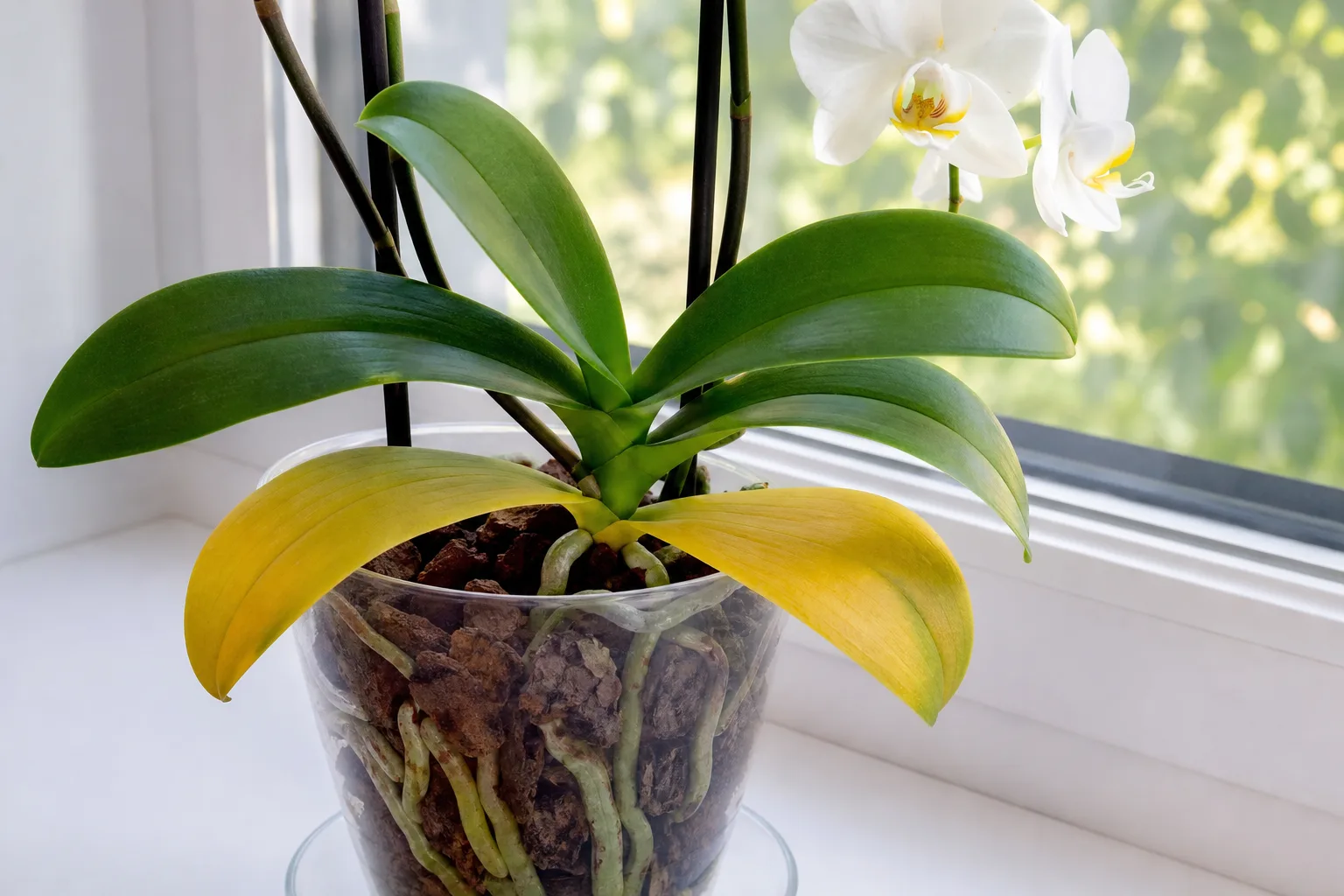
Bottom leaves yellowing with wet bark need a root check before you feed. A single oldest leaf yellowing on an otherwise firm plant with green/silvery cycling roots can be normal aging—judge newest growth and root color. Teaching asset captioned for the wet-bark pattern.
If leaves wrinkle while the pot is still heavy, assume root damage until you prove otherwise. Unpot, rinse, keep firm green or white roots, discard mush, and repot into fresh bark sized to the remaining roots. Do not fertilize for several weeks. Bud drop during opening often tracks shipping stress, heater blasts, or humidity crashes—stabilize the microclimate before adding bloom fertilizer. Yellow leaves with green healthy roots may be natural basal aging; yellow leaves with brown roots are a media and watering problem. Use yellow leaves, wilting, and mealybugs when the pattern matches.
Pet Safety for Phalaenopsis
The ASPCA lists Phalaenopsis orchid (moth orchid, moon orchid) as non-toxic to dogs, cats, and horses. (ASPCA) Non-toxic does not mean snack food—chewing can still upset a stomach or topple a pot—so keep display plants out of digging reach and call a veterinarian if a pet shows unusual symptoms after eating any plant material.
First 30 Days After the Gift Bloom Fades
Use this as a post-bloom action list, not a second care encyclopedia:
- Week 1: Stop calendar watering. Lift the pot; note weight and root color through a clear liner if present. Empty any cachepot reservoir daily.
- Week 1–2: Place in bright filtered light (east sill default). Do not repot while flowers or buds remain unless roots are collapsing.
- After last flower: Choose basal cut (rest) or node cut (possible side spike) based on vigor. Wick the crown dry after any water.
- If moss stays wet >2 weeks: Plan a bark conversion after bloom; size the new pot to roots only.
- Weeks 2–4: Learn one full dry-down cycle. In our clear bark east pots that was often 7–9 days warm / 10–14 cool; moss liners ran longer.
- Ongoing: Leave aerial roots free; flush with clear water monthly once you start dilute feed; wait until autumn cool nights before chasing a new spike on large-flowered types.
Keiki (plantlet) basics and propagation steps live on the propagation page when a baby plant appears on an old spike—success means roots and a leaf before you detach.
When to Open the Phalaenopsis Hub
Once bark watering and light placement are honest, open the Phalaenopsis Orchid care hub for a single-symptom workflow rather than rereading this overview.
Related Guides
- Phalaenopsis Orchid care hub — species overview and cluster entry
- Watering — soak-and-drain timing and ice-cube caveats
- Light — window placement and leaf-color cues
- Soil — bark mixes and media refresh
- Repotting — moss-to-bark conversion and bark breakdown
- Propagation — keiki basics when a plantlet appears
- Root rot — rescue steps for mushy roots
- Bud drop — post-purchase and draft abort triage
- How to water indoor plants the right way — general soak-and-drain habits (media still must be bark)
- Winter houseplant care — dry air and cooler rooms that affect spikes
Conclusion
Your next week with a post-bloom moth orchid should be concrete:
- Confirm bark (or plan moss-to-bark after flowers) and drainage—never potting soil.
- Water only when roots look silvery and the pot is light; soak, drain, wick the crown.
- Place in bright filtered light and score leaf color (olive vs dark vs red-tinged).
- Leave healthy aerial roots in air; pot for the root mass only.
- After the last flower, cut the spike by vigor (basal rest vs optional node branch).
- In autumn, give large-flowered plants several weeks of cooler nights near 55°F once roots and light are sound.
Phalaenopsis orchid care succeeds when you stop treating the plant like a soil houseplant. Give it bright filtered light, water bark only when roots and mix show they are nearly dry, keep the crown dry, leave aerial roots in open air, and refresh decomposing media before roots smother. When you want flowers again, confirm the plant is healthy and well lit, then use a cool autumn night stretch rather than endless bloom fertilizer. Use this page as the system; open the Phalaenopsis hub when one symptom needs a dedicated fix.