6 Signs You Have Lawn Grubs (and How to Fix It)
Brown patches, spongy turf, and wildlife digging can mean lawn grubs. Learn six reliable signs, confirm with a 10-minute soil test, and fix active damage fast.
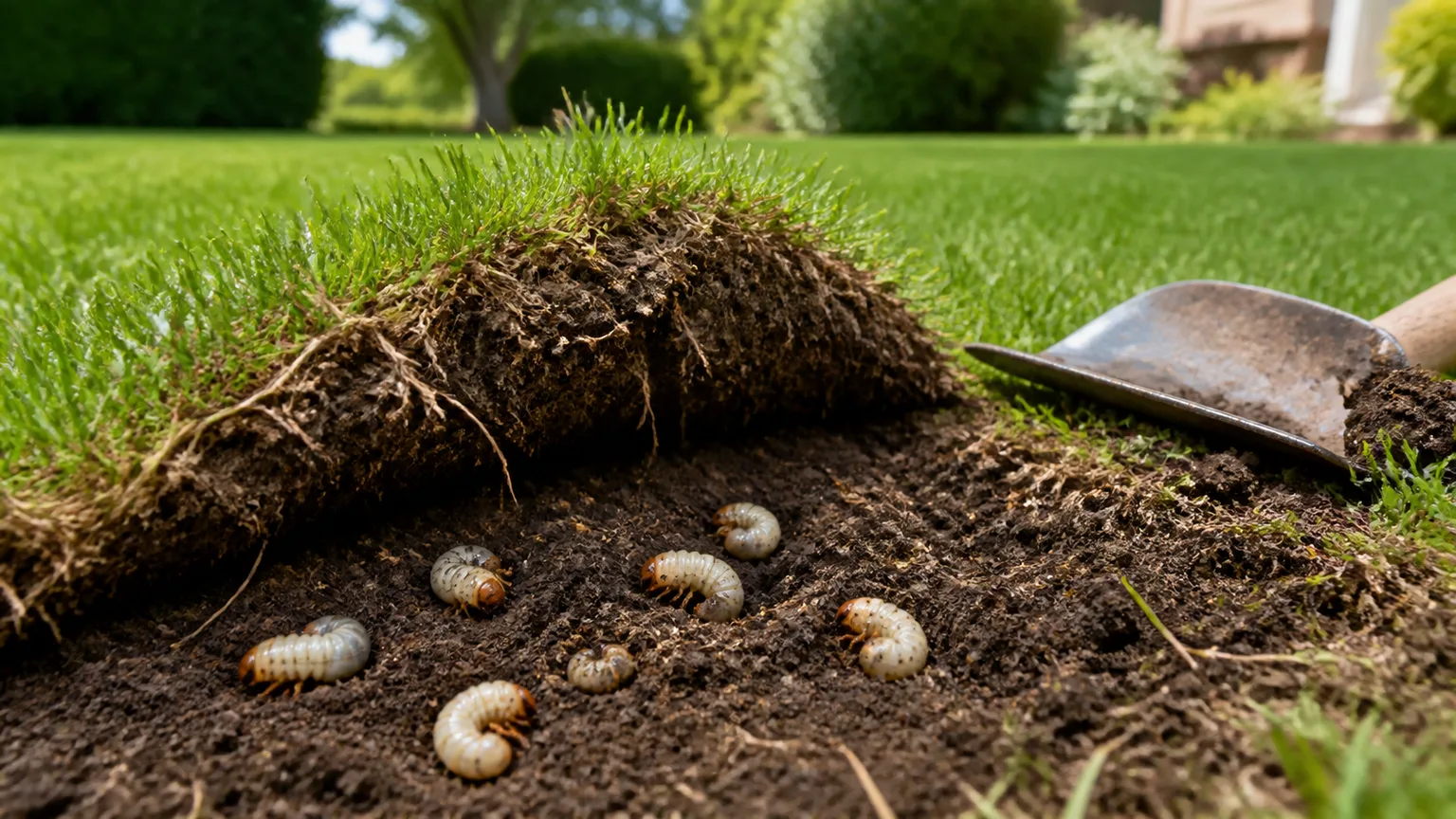
A brown patch in late summer is not automatically a grub problem—but when several clues stack up at once, white grubs are one of the few pests that can peel an entire lawn back from the soil. Lawn grubs are the larval stage of scarab beetles such as Japanese beetles, masked chafers, European chafers, and June beetles. They live in the root zone and feed on grass roots, which is why the damage often looks sudden even though the larvae have been present for weeks.
The six signs below are what turf specialists look for above ground before they ever open the soil. Treat them as a checklist, not a diagnosis. One sign alone—especially animal digging—can mean something else entirely. When two or more line up with what you find in a quick soil sample, you have enough evidence to choose a fast, targeted fix instead of guessing with a lawn-wide insecticide.
What lawn grubs are—and why damage hides underground
White grubs are dirty white, C-shaped larvae with a brown head, three pairs of legs near the front, and a soft body that curls when disturbed. Most species look nearly identical in the field; Japanese beetle grubs average slightly over an inch at maturity, while green June beetle larvae are more robust. Penn State Extension notes that species can be separated by the raster pattern on the underside of the abdomen, but for most homeowners the useful ID is simply scarab grub in the root zone.
The feeding happens out of sight. As roots are severed, grass loses its ability to pull water and nutrients. Heat and drought then turn a moderate root loss into obvious wilting and death. Rutgers NJAES describes the classic progression: gradual thinning and yellowing despite adequate moisture, then scattered dead patches that expand and merge. Because the blades can look fine until the roots fail, grubs are easy to miss until Sign 1 appears.
Sign 1: Brown patches that will not green up with water
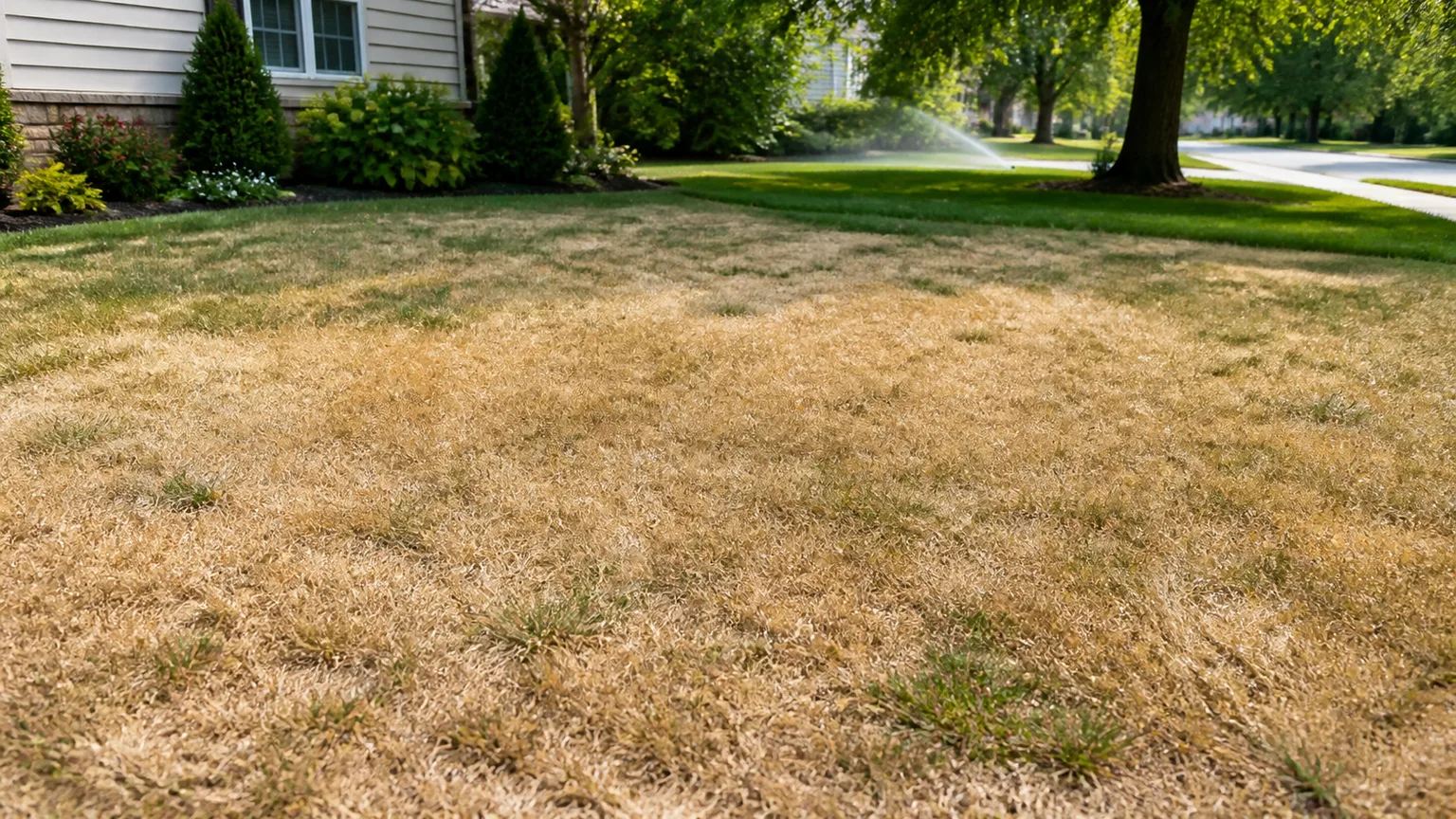
Irregular brown or straw-colored patches are usually the first sign homeowners notice. They often show up in late summer through early fall—August into October in much of the Northeast and Midwest—when third-instar grubs are largest and feeding hardest near the surface. The patches are not neat circles. They are uneven, expanding islands of dead or dying turf, sometimes with a thin green rim where grubs have not reached yet.
Why watering fails when roots are gone
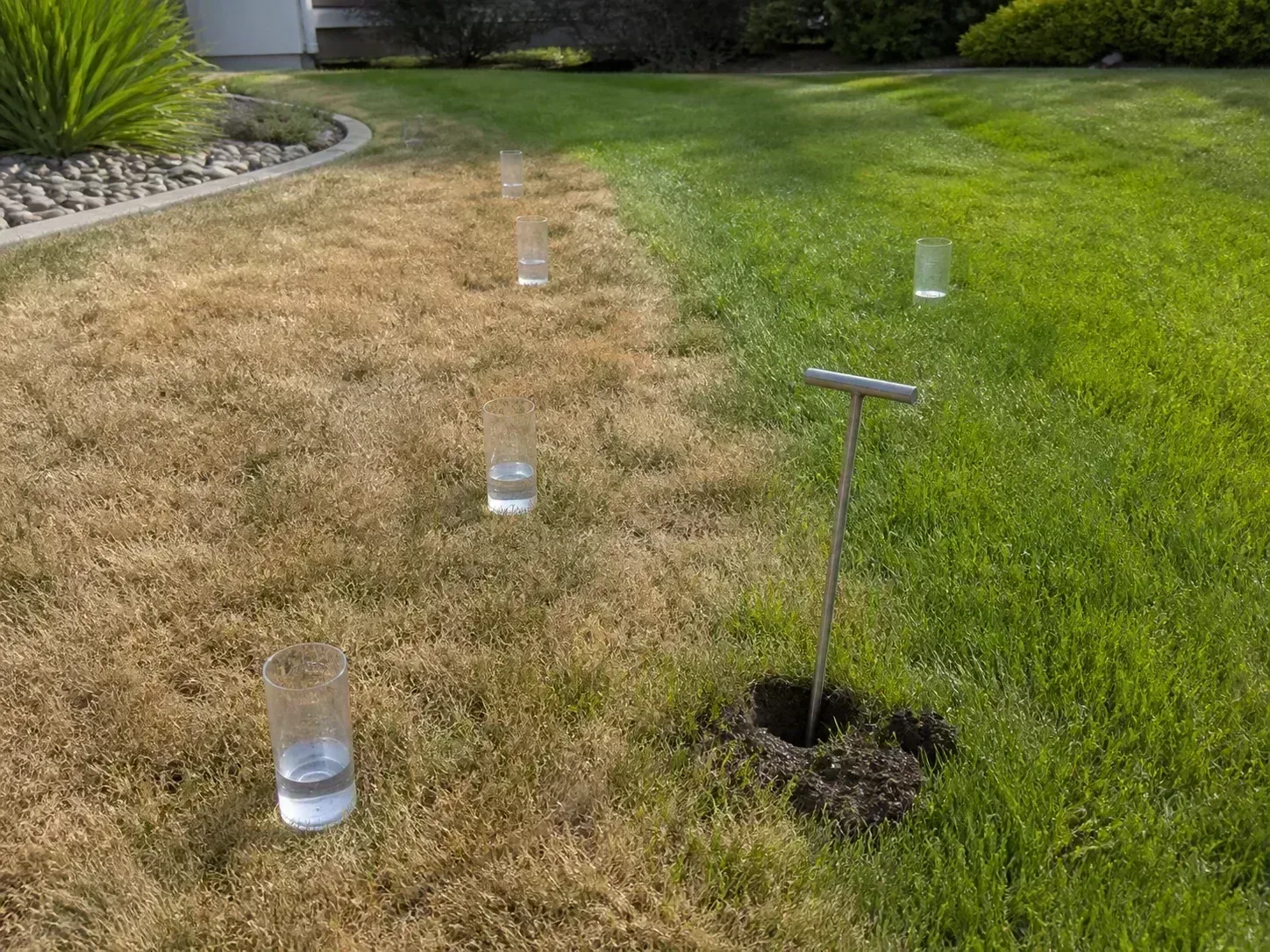
This is the detail that separates grub damage from ordinary drought stress. Run your sprinklers for a few days. If the patch stays brown while nearby grass greens up, the problem is probably not thirst. Grass without roots cannot drink, no matter how much water you apply. For a broader look at brown turf causes, see our guide on reasons grass is turning brown—but if the patch matches the tug-test pattern in Sign 3, stay on the grub track.
Sign 2: Spongy, hollow turf underfoot
Walk across the lawn and notice how the turf feels. Healthy grass feels firm because roots anchor it to the soil. Where grubs have chewed through those roots, the sod can feel spongy, bouncy, or hollow—as if you are walking on a thin mat over empty space. Rutgers NJAES lists spongy turf as an early infestation sign, before large dead areas join together.
Sponginess alone is not proof. Thick thatch, saturated soil, or recent aeration can feel similar. Pair this sign with browning edges or wildlife activity and you have a much stronger case for opening a soil sample.
Sign 3: Grass that lifts like loose carpet
This is the most definitive above-ground clue. Grab a handful of grass at the edge of a damaged area and pull upward with steady pressure. If the turf rolls back like carpet with little resistance, roots are gone or nearly gone. Healthy grass—even drought-stressed grass—stays anchored and tears blade by blade.
That loose-sod feel is what turf managers call a positive tug test. Penn State Extension describes heavy infestations as making sod roll back like a piece of carpet. When you see this, do not wait for more brown patches to appear. Move straight to the confirmation test below and count what is in the soil.
Sign 4: Fresh skunk, raccoon, or crow damage overnight
Skunks, raccoons, crows, and armadillos in southern regions tear into lawns hunting grubs. You may find cone-shaped holes, flipped sod, or shredded turf that was fine yesterday. Penn State Extension notes that vertebrate feeding on turf is a good indication of grubs—but not proof on its own.
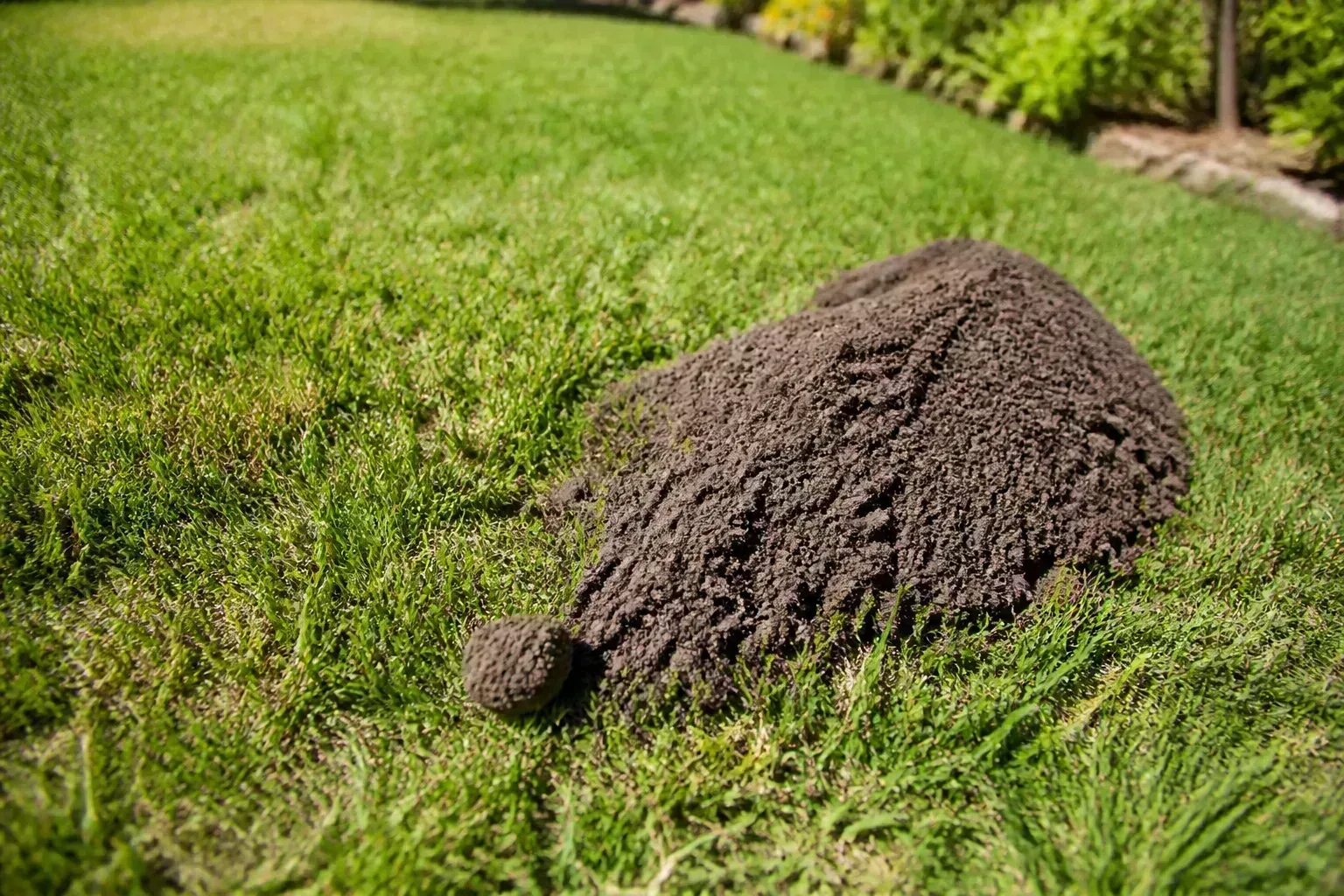
Moles also tunnel through lawns while eating earthworms and other soil life, so mole activity does not confirm grubs. Raccoon and skunk damage tends to be messier and more localized to the grub-rich zone. If predators target one area repeatedly while the tug test fails elsewhere, sample where the digging is worst. Our burrowing pests guide helps separate grub-hunting diggers from gophers, voles, and moles.
Sign 5: Birds pecking and working the lawn in flocks
Starlings, crows, robins, and other ground feeders will congregate on a grub-heavy lawn, stabbing the turf and pulling back small bits of sod. Unlike a few birds hunting worms after rain, persistent flocks working the same zone suggest a concentrated food source below. Bird damage can look like shallow divots or thin, roughed-up turf and often overlaps with Sign 2’s spongy feel.
Bird pressure is a supporting sign, not a standalone diagnosis. Earthworms, crane fly larvae, and other insects also attract birds. Combine flock activity with a positive tug test or visible grubs before you treat.
Sign 6: Cream-colored C-shaped larvae under the sod
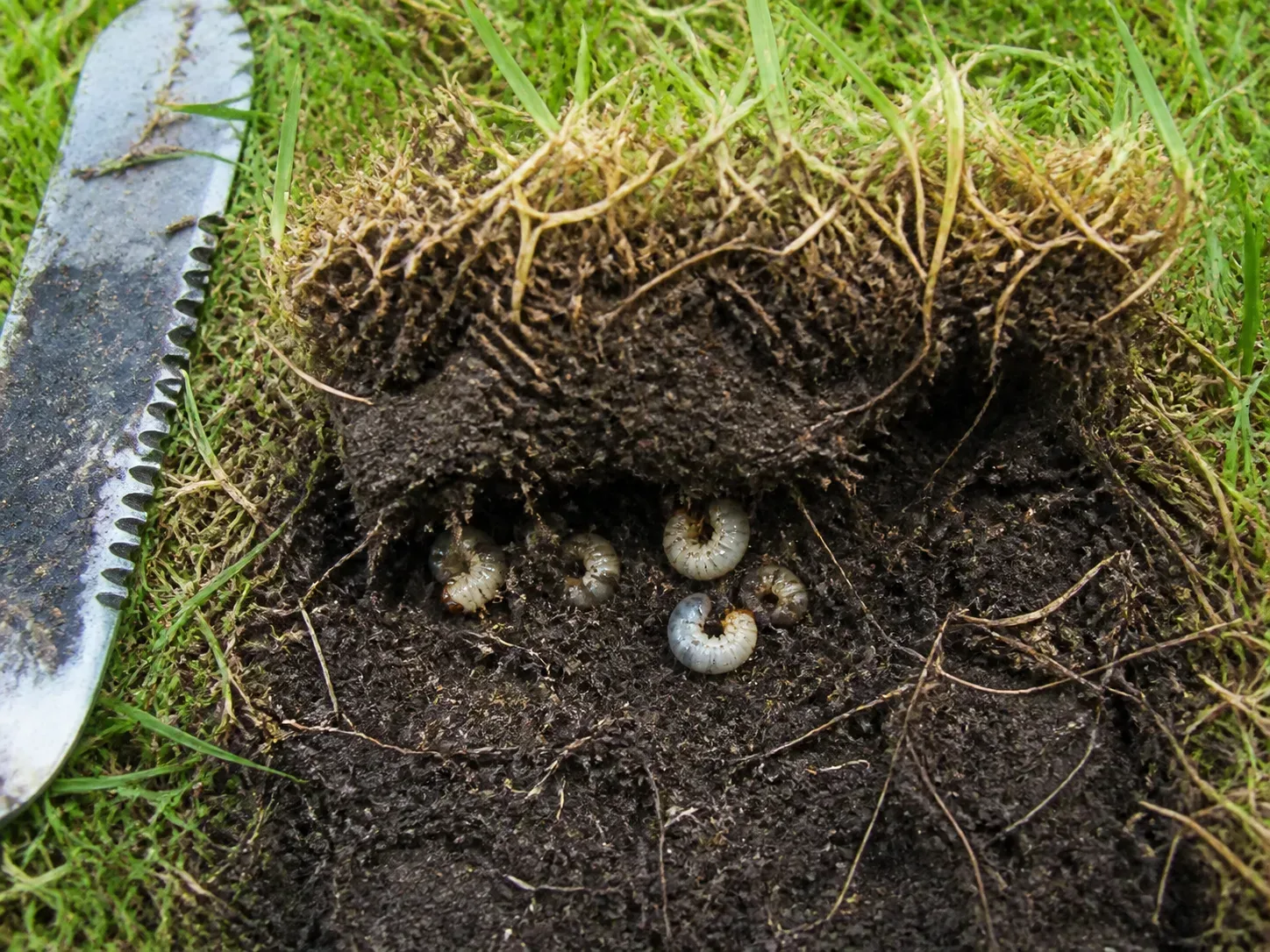
The only sign that actually confirms grubs is finding them. When you peel back loose turf or cut a small sod flap, look in the top 2 to 4 inches of soil and along the underside of the thatch. You are hunting for pale, C-shaped larvae with brown heads. You may see one or two in a healthy lawn; a cluster of larger larvae in damaged turf closes the case.
Visual confirmation also tells you whether treatment is urgent. Tiny newly hatched grubs in July cause little visible injury; fat third-instar grubs in September can destroy roots in days during hot, dry weather. Size and season matter as much as presence.
When the signs point to something else
Grub damage has famous lookalikes, and treating the wrong problem wastes money and can harm beneficial insects. Before you spread insecticide, rule out the common mimics.
Grubs vs drought, disease, and other root problems
Drought stress often browns large sections evenly during heat waves. The turf stays rooted when you tug, and it usually greens within days of deep watering. Brown patch and other fungal diseases may form more circular patterns with lesions on individual blades; roots typically remain attached. Billbugs and sod webworms also attack roots and crowns but produce different soil evidence—billbug larvae are legless and sod webworm damage often includes chewed blades at the surface.
Use this quick contrast: if the grass lifts easily and you find scarab grubs in the soil, grubs are the leading suspect. If the grass stays anchored, look at irrigation coverage, soil moisture, and disease signs first. Our lawn brown after watering guide walks through moisture testing when drought is still on the table.
The 10-minute confirmation test every homeowner should run
Signs get you to the right question; sampling answers it. Penn State Extension recommends removing a one-square-foot section of turf and soil 2 to 4 inches deep at several locations, examining the thatch and soil for grubs, then replacing the sod firmly and watering it in.
Step 1: Choose three to five spots—one in the worst damage, one at the green-brown border, and one in healthy-looking turf. Step 2: Cut three sides of a 12-inch square with a flat spade or sod knife. Step 3: Fold the flap back and count every C-shaped larva in the exposed soil and on the sod underside. Step 4: Lay the flap back, press soil contact, and water if dry. Grubs are patchy; one empty square does not clear the lawn, and one crowded square does not condemn every inch.
How many grubs per square foot is actually too many
Here is where many articles stop too early. Finding a grub is not the same as needing treatment. Healthy, well-fed turf tolerates low populations. Penn State Extension states that five to ten grubs per square foot is often used as a curative threshold depending on species, but each situation must be judged separately. Rutgers NJAES publishes species-specific ranges—roughly 6 to 10 per square foot for Japanese beetle, oriental beetle, and European chafer, and 15 to 20 for Asiatic garden beetle—with higher tolerance in vigorous tall fescue and lower tolerance in stressed or thin lawns.
Treat when counts exceed your local threshold and you see active damage or a documented history of loss. A few larvae in an otherwise solid lawn usually deserve monitoring, not a whole-yard curative application. Record your counts; they tell you whether this year needs rescue treatment or a preventive plan next June.
How to fix lawn grubs fast once you confirm them
The fastest fix is not the harshest product on the shelf. It is the right product at the right life stage, applied with irrigation so it reaches the feeding zone. Spraying neem or running the aerator across the yard without confirming counts or timing is how people spend money and still lose turf.
Curative rescue when damage is already showing
When sampling in late summer or early fall shows above-threshold grubs actively feeding near the surface, use a curative insecticide labeled for lawn grubs on your grass type. Rutgers NJAES notes curative control works best from mid-August into early September while grubs are still smaller; third-instar larvae are harder to kill. Common curative actives include trichlorfon (Dylox and similar) and carbaryl (Sevin). Mow and rake excess thatch first if it exceeds half an inch, then apply and irrigate with about a quarter inch of water immediately so the product reaches the root zone, as Rutgers recommends.
Water the lawn the day before treatment if soil is dry; moist soil brings grubs closer to the surface. Treat the entire lawn, not just brown patches, because grubs migrate. Re-sample two to three weeks later. If populations remain high, a follow-up with a different labeled product may be needed—do not assume one application fixes a heavy infestation in depleted turf.
For product-by-product timing, preventive options, and organic alternatives in full detail, use our how to get rid of lawn grubs guide. That page is the deep treatment reference; this one gets you from signs to the correct first move.
Preventive control for lawns with a grub history
If you confirmed grubs this fall—or you tracked heavy adult beetle flights in June and July—plan preventive control for the next cycle. Preventive products such as chlorantraniliprole, imidacloprid, or clothianidin go down before or around egg hatch, typically late spring into mid-summer depending on region and label. They kill newly hatched grubs as they start feeding, which is far more reliable than trying to rescue mature larvae after the lawn is already peeling up.
Preventive applications are insurance, not a response to every beetle on a rose bush. Rutgers NJAES warns that preventative sprays are often applied over larger areas than necessary, which can reduce natural enemies. Limit preventive treatments to lawns with prior damage, high beetle pressure, or very low tolerance for injury—athletic turf, newly renovated sod, or a yard that failed curative treatment last year.
What does not fix an active infestation by itself: core aeration improves soil health and can expose grubs in removed cores, but it is not an insecticide. Milky spore targets Japanese beetle grubs only and takes years to build. Nematodes can work under precise temperature and moisture conditions but show mixed results in university trials. Neem may disrupt feeding but is not a reliable rescue for established third-instar populations. Use those tools as supplements or long-term strategies, not as a substitute for a timed curative when counts are high and turf is lifting.
Repair the turf after the grubs are gone
Killing grubs does not resurrect dead grass. If roots are completely gone and the sod rolls back, that tissue will not green up again. Rake out dead material, loosen the top quarter inch of soil, and overseed cool-season lawns in early fall or resod large bare areas before winter erosion sets in. Keep seed moist until establishment. Warm-season lawns such as bermuda and zoysia may recover from crowns if enough stolons survive—water and fertilize lightly and watch for regrowth before you reseed.
Address secondary damage too. Skunk and raccoon torn turf needs the same soil contact and watering as your sample flaps. A thick, deep-rooted lawn tolerates higher grub counts next year, so after repair, follow sound mowing, fertilization, and irrigation practices. Aeration belongs in that long-term health plan—see signs you need to aerate your lawn—but schedule it as cultural care, not as grub control.
For step-by-step patch recovery, our repair bare patch on lawn guide covers seed versus sod decisions once the insects are handled.
Conclusion
Lawn grubs announce themselves in layers: brown patches that ignore water, spongy turf, sod that lifts like carpet, wildlife and bird feeding, and finally white C-shaped larvae in the soil. No single sign is enough. The fast fix starts with a 10-minute square-foot sample, a honest grub count against extension thresholds, and a curative application timed while larvae are still near the surface—followed by turf repair where roots are already lost.
Skip the blanket insecticide if counts are low and grass is anchored. Plan prevention if your lawn has a grub history or you watched heavy beetle flights in early summer. Get the diagnosis right once, and you solve this season’s damage and next season’s repeat in the same afternoon.