How to Use a Light Meter for Houseplants
A handheld light meter turns vague “bright indirect” labels into numbers. Measure at plant height, map your windows, and choose plants that fit your real indoor light.
You stood in the nursery aisle holding a tag that promised “bright indirect light” and felt certain your living room qualified. The room has a big south window, white walls, and you keep the blinds open all day. It looks bright. Three months later the new fiddle leaf fig is leaning like it is searching for a sunbeam, new leaves are smaller than the old ones, and you are wondering whether the plant is dramatic or you misread the room entirely.
Your eyes are almost certainly the problem — not your care routine. Human vision adapts so aggressively that a desk ten feet from a window can feel “a little dimmer” when it may be receiving ten times less light than the sill. UF/IFAS Gardening Solutions puts it plainly: our eyes are extraordinary adapters, which makes us poor judges of light intensity indoors, where differences are subtler than outdoors (UF/IFAS Gardening Solutions). A light meter for houseplants — or a disciplined phone-app workflow — turns guesswork into numbers you can shop against, move plants with, and re-check when seasons shift.
This guide walks through what meters measure, which type to buy, how to read a room in five minutes, and when to trust the plant more than the display. For stretch, pale growth, and the fix order once you confirm low light, see signs your houseplants need more light. For supplementing dim windows, pair readings with our grow lights complete guide.
Why Human Eyes Fail at Judging Indoor Light
Walk from a south-facing sill to the sofa across the room and your pupils adjust before you finish the trip. Both spots may register as “well lit” within a minute. UF/IFAS notes that outdoor noon light can exceed 4,000 foot-candles, while a north window may never reach 400 ftc even in winter, and a fluorescent-only office often sits below 40 ftc — yet we navigate all three comfortably (UF/IFAS Gardening Solutions). That adaptability is why phrases like low light and bright indirect feel interchangeable until a plant starts etiolating.
University of Georgia Extension lists inadequate light as the most common indoor environmental problem: thin pale stems, small leaves, loss of lower foliage, and failure to flower (UGA Extension B1318). Those symptoms show up weeks after you placed the plant in what looked like a fine spot. Measuring first prevents buying a high-light species for a medium-light shelf.
How quickly brightness drops as you move from the glass
Light intensity indoors does not fade gently. It falls sharply with distance from the window and with every obstacle — sheer curtain, tinted glass, outdoor tree canopy, a neighbor’s wall. Houseplants Wiki’s practical guidance matches what most room maps show: doubling distance from the window can quarter the reading at plant height. A sill at 800 ftc might read 200 ftc on a bookshelf six feet away on the same wall.
That is why nursery tags frustrate people. “Bright indirect” on a tag does not mean “anywhere in a bright room.” It means a specific illuminance band at the leaves, not at your eye level across the room. A meter held at leaf height exposes the gap instantly.
What Light Meters Actually Measure
Most household light meters report illuminance — how bright a surface looks to a sensor calibrated for human vision. Plants care about a overlapping but not identical slice of the spectrum used for photosynthesis. For window-grown foliage, illuminance in foot-candles (ftc) or lux is still the most practical shopping and placement language.
Foot-candles and lux for everyday houseplant placement
A foot-candle is roughly the brightness of one candle one foot away — the unit UF/IFAS uses for indoor bands. Lux is lumens per square meter; one foot-candle is about 10 lux (UF/IFAS rounds this as “about a factor of ten”) (UF/IFAS Gardening Solutions). Handheld meters usually toggle between both. Pick one unit, stick with it, and convert only when a care sheet uses the other.
Illuminance meters do not tell you the full photosynthetic story for every cultivar, but they beat eyeballing. Hardy Houseplants — an editorial houseplant care site — describes lux and foot-candles as a human-centric ballpark that works especially well for separating survival light from growth light on common foliage (Hardy Houseplants). That is exactly the decision you are making when you choose plants for a north bedroom versus a west sill.
PAR and PPFD when grow lights enter the picture
Once you add grow lights, illuminance alone gets muddy. PAR (photosynthetically active radiation) describes the 400–700 nm band plants use. PPFD (photosynthetic photon flux density) counts how many of those photons hit a leaf per second — the number serious indoor growers tune.
A lux meter can read high under a purple LED bar while PPFD at the leaf is weak, because human-weighted sensors overweight green light plants reflect. Hardy Houseplants explains that lux measures appearance while PAR/PPFD measure usable growth energy (Hardy Houseplants). For a windowsill pothos, skip PAR gear. For a shelf of succulents under a DIY LED panel, a quantum PAR meter or a trusted app’s PPFD mode becomes worthwhile. Our grow lights guide covers distance and timer setup once you know your target PPFD band.
Indoor Foot-Candle Bands That Match Real Plant Needs
UF/IFAS publishes midday foot-candle bands that translate vague labels into ranges you can meter against (UF/IFAS Gardening Solutions):
| Midday foot-candles | Label | What it usually looks like indoors |
|---|---|---|
| 25–100 ftc | Low | Far from windows, heavy shade outdoors, overhead room lights only |
| 100–500 ftc | Medium | Near windows without direct sun; typical north glass or shaded east/west |
| 500–1,000 ftc | High / bright indirect | Close to east or west glass, or filtered south light through sheer curtain |
| Over 1,000 ftc | Direct sun | Clear glass, unshaded south or southwest exposure for several hours |
Treat these as midday generalizations, not precision targets. Missouri Botanical Garden emphasizes that too little light produces weak, spindly growth leaning toward the brightest source (Missouri Botanical Garden environmental problems). The RHS notes insufficient light as a top cause of weak pale houseplants and poor flowering (RHS poorly houseplant help).
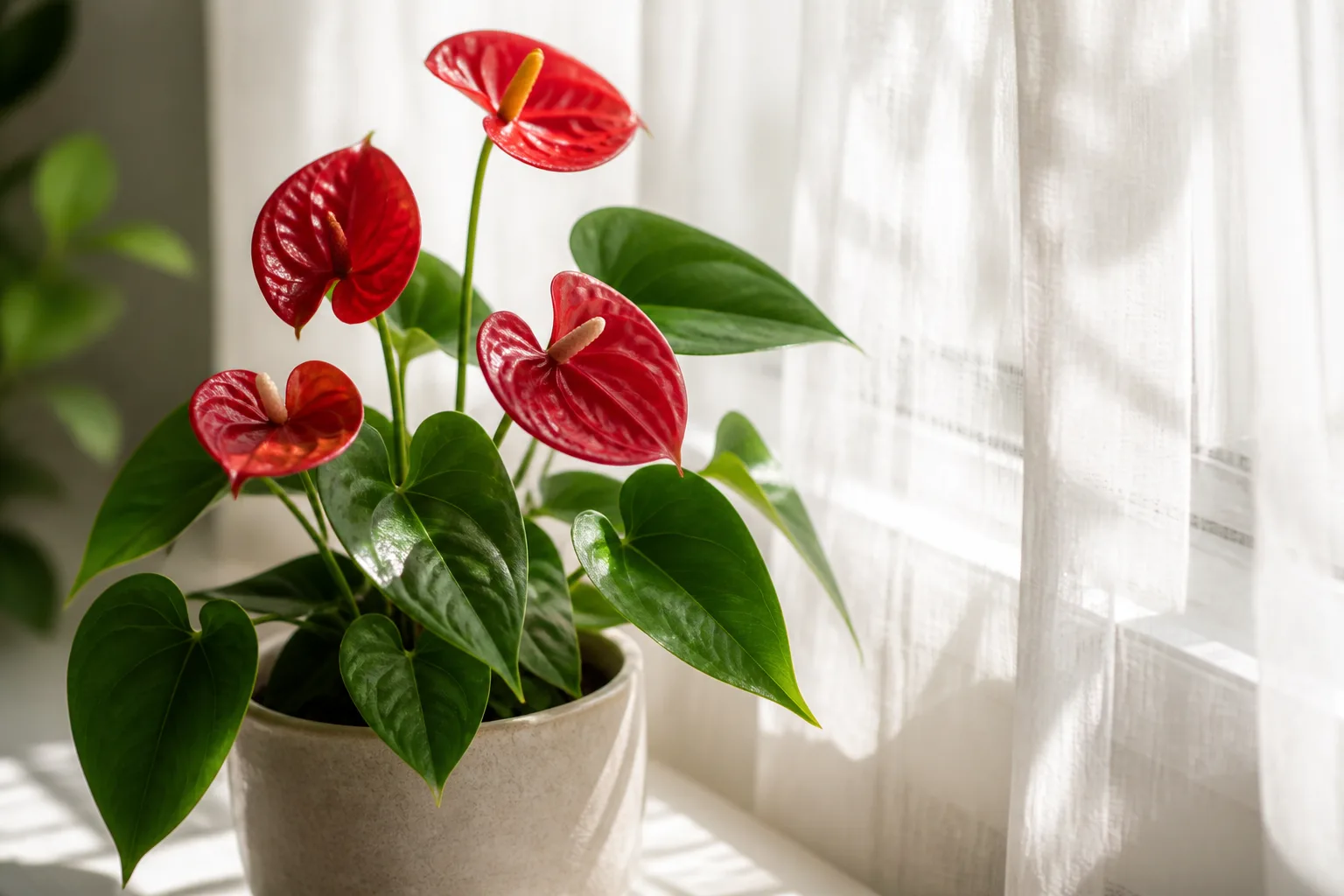
Survival vs growth matters when you shop. UF/IFAS EP151 data cited in our pothos guide shows pothos can survive near 50 ftc, but variegation fades and leaves shrink without brighter bands. A snake plant or ZZ plant may live in low bands; a fiddle leaf fig or flowering anthurium will not thrive there without supplemental light.
Choosing the Right Light Meter for Houseplants
You do not need photographer-grade gear or a lab spectrometer. You need consistent numbers at leaf height. Three tiers cover most homes.
Free phone apps — good for comparison, weak for absolutes
UF/IFAS allows that phone applications can approximate changes between spots, but accuracy varies by device and algorithm — use them for relative ranking, not gospel absolutes (UF/IFAS Gardening Solutions). Apps like Photone or generic lux meters are excellent for answering: “Is the east breakfast table brighter than the north desk?” Hold the phone at leaf height, use the same device every time, and block your hand from casting shadow on the sensor.
Do not trust phone PPFD modes for colored grow LEDs until you verify against a known fixture. Camera sensors differ wildly between iPhone and Android models.
Handheld lux and foot-candle meters — the sweet spot for most homes
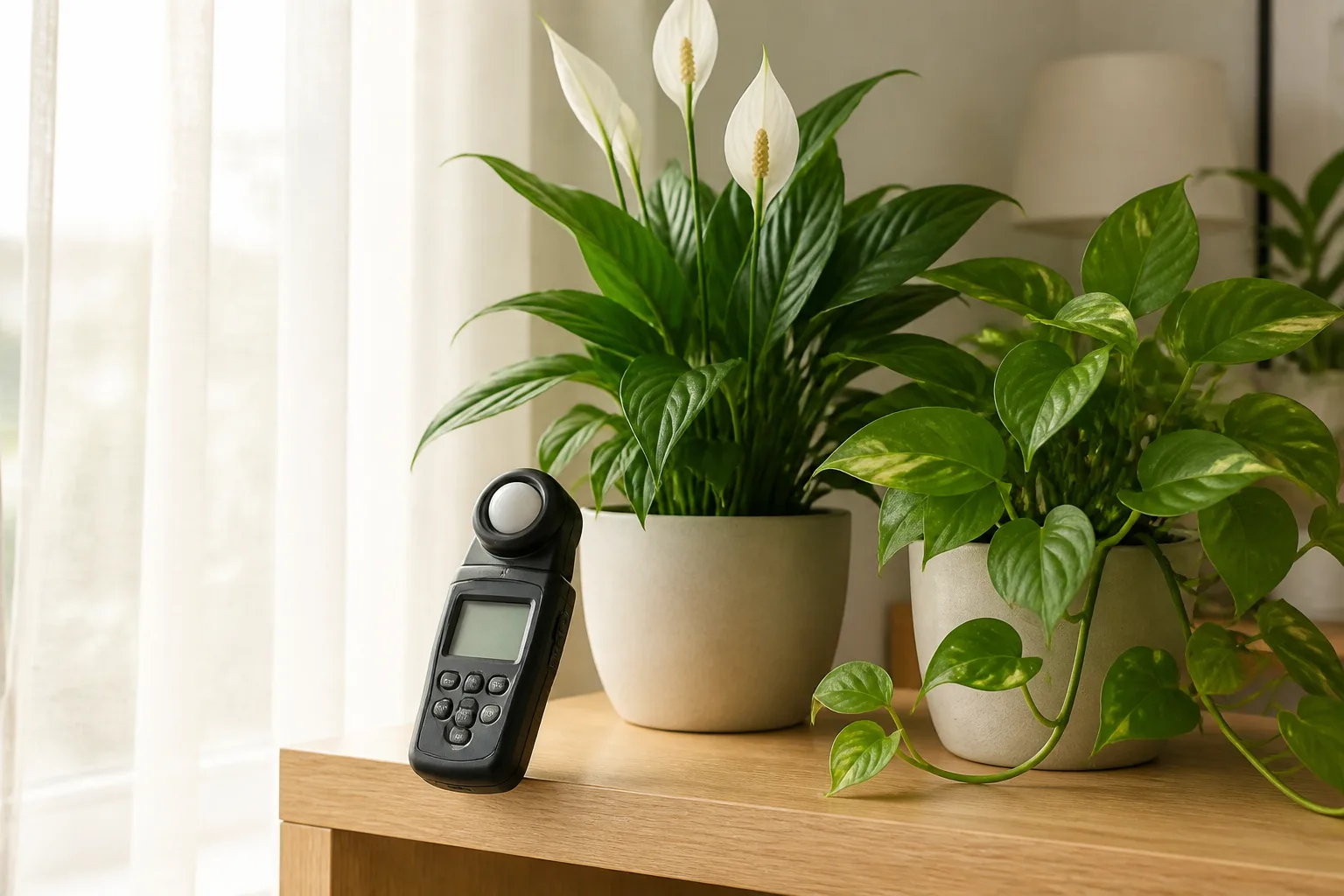
A basic digital illuminance meter in the $25–$120 range — measuring 0.1–20,000 ftc or equivalent lux — is what UF/IFAS recommends for homeowners: accurate to about one foot-candle, switching between lux and ftc (UF/IFAS Gardening Solutions). Look for a sensor you can point toward the window while the display faces you, backlight for dim corners, and stable readings when you hold still for two seconds.
This is the tool that turns a Sunday afternoon into a light map you can tape inside a cabinet or note in a plant journal. It is also the tier most “pro says use a meter” advice actually means — reliable enough to choose between a peace lily and a citrus tree.
PAR meters — worth it only for serious grow-light setups
Quantum PAR meters start around hobbyist prices but justify themselves when you run multiple grow lights, propagate under shelves, or chase bloom on light-hungry succulents indoors. If every plant in your collection still lives on window light, a PAR meter is optional luxury. If you already own a light bar and stretched seedlings, PPFD at the canopy tells you whether to raise the fixture or extend the photoperiod — not whether lux “looks bright.”
How to Measure Light at Plant Height
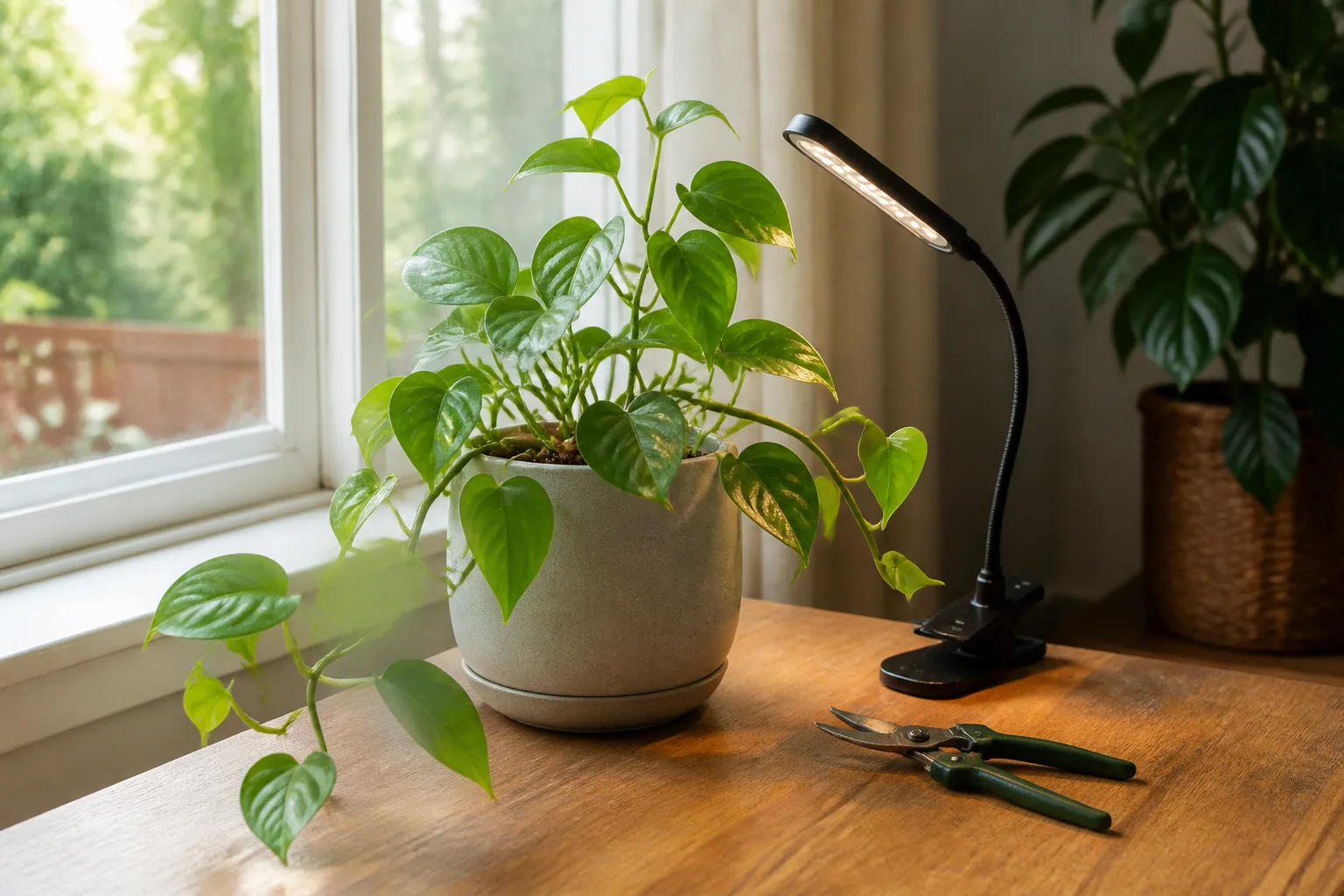
The measurement protocol matters more than the brand on the meter.
1. Set the spot. Place an empty pot or mark the shelf where the plant will sit. Future leaves will live there, not at your eye level.
2. Aim the sensor. Point the cell toward the light source — usually the window — without your body blocking the beam. For grow lights, point straight up toward the fixture.
3. Hold at leaf height. UF/IFAS and every serious indoor guide agree: measure where foliage will be, not at the ceiling or floor (UF/IFAS Gardening Solutions).
4. Record the number and time. Write ftc or lux + clock time + date. A north sill at 9 a.m. tells you little without a midday reading.
5. Repeat across the day before you commit. Check morning, midday, and late afternoon on a clear day. West windows spike late; east windows peak early. UGA Extension’s window-aspect notes help you predict which wall will carry the load (UGA Extension B1318).
6. Use broad bands, not decimal obsession. Anna Ohler’s practical nursery advice — echoed across extension sheets — applies: categorize into low, medium, high, and direct bands instead of chasing 387 ftc vs 412 ftc. You will never hit a single perfect integer; you are buying a range.
Why morning, midday, and afternoon readings differ
Indoor light is dynamic. A spot that averages 350 ftc at noon may sit at 80 ftc by 4 p.m. on a winter day when the sun angle drops. Seasonal shifts can cut the same reading by 50–70% from summer to winter in northern latitudes — the reason winter houseplant mistakes often trace back to light and watering together, not temperature alone.
Midday on a clear day is your baseline for mapping. Morning and afternoon readings tell you whether a “bright indirect” plant will receive a long enough bright window or only a short spike.
Build a Light Map Before You Buy Another Plant
Grab a notebook or a notes app and walk each room once on a sunny day.
Step 1 — Sketch the room. Mark windows, doors, and furniture that block light paths.
Step 2 — Grid the spots. Every sill, shelf, floor corner, and desk where you might place a pot gets a label: N-sill, sofa-east, hall-bath.
Step 3 — Midday numbers at leaf height. One row per spot: ftc/lux at 12 p.m.
Step 4 — Color the bands. Shade low (25–100), medium (100–500), high (500–1,000), direct (1,000+) using UF/IFAS breakpoints.
Step 5 — Shop from the map, not the mood. Low-band corners are snake plant and ZZ territory. Medium bands fit many philodendrons, ferns, and peace lilies. High bands welcome fiddle leaf figs, hoyas, and most succulents near glass. Direct bands are for cacti and herbs that tolerate sun through clear south glass.
Step 6 — Photograph the meter. A phone photo of the display on the sill saves arguments three months later when you wonder whether the tree outside grew denser.
Office workers should map the desk separately. Our best office plants guide notes many workplaces sit around 20–50 ftc at desk height under ceiling panels — fine for human tasks, dim for growth. A meter proves whether a USB grow lamp is necessary or whether a tolerant species is the realistic choice.
Match Plants to Your Numbers — Not to the Tag Alone
Plant tags and online listings compress complex biology into four words. Your map compresses your home into four bands. The job is overlap.
Low band (25–100 ftc): Snake plant, ZZ plant, cast iron plant, some pothos cultivars surviving but not thriving. Expect slow growth and wet soil that lingers — low light and low transpiration go together.
Medium band (100–500 ftc): Pothos, heart-leaf philodendron, many ferns, parlor palm, aglaonema, peace lily. Good default for unshaded north glass and shaded east/west.
High band (500–1,000 ftc): Fiddle leaf fig, rubber plant, monstera, hoya, many flowering houseplants when you want blooms. Often the true meaning of “bright indirect.”
Direct band (1,000+ ftc): Succulents, cacti, citrus, herbs on a south sill with several hours of sun. Watch for glass-intensified scorch when moving plants from dim shops straight to unfiltered south glass — acclimate over a week.
When a tag says “low to bright indirect,” assume it wants the upper half of medium or high for normal leaf size, not the literal darkest corner. If your map shows 120 ftc at the only open shelf, choose a plant whose minimum growth band fits 120, or add a grow light — do not buy a plant that needs 600 ftc and hope fertilizer fixes the stretch.
Window Direction Is a Clue, Not a Guarantee
Orientation sets expectations before you meter, but trees, awnings, and neighboring buildings rewrite the script.
North glass: Often medium-low without direct sun; can still exceed 100 ftc near the pane. UF/IFAS places many north exposures in the medium band at midday (UF/IFAS Gardening Solutions).
East glass: Gentle morning direct, softer afternoons — excellent for many tropical foliage if you meter the sill.
West glass: Stronger afternoon punch; can jump into high or direct bands quickly. Watch summer heat on dark leaves.
South glass: Highest potential; sheer curtains or outdoor shade drop readings from direct to high. Never assume south equals direct sun at the leaves.
UGA Extension’s window-aspect discussion is a starting checklist; the meter is the referee (UGA Extension B1318). For rooms with only north or obstructed glass, browse indoor plants without direct sunlight after you know your numbers.
Re-Measure When Seasons and Furnishings Change
A light map is not permanent. Re-run midday readings when:
- Day length shifts in fall and late winter
- Deciduous trees outside leaf out or drop leaves
- You add or remove sheer curtains, blinds, or solar film
- You move furniture or install a bookshelf between plant and window
- You swap warm vs cool LED bulbs in ceiling cans near plants
RHS winter advice for struggling houseplants includes moving specimens to brighter south or west glass and wiping dust from leaves so available light actually reaches chlorophyll (RHS poorly houseplant help). Dust and grime on glass measurably cut readings — Hardy Houseplants reports noticeable lux gains after washing windows (Hardy Houseplants). A five-minute re-map each equinox prevents spring fertilizer on a plant that still lives in winter light.
Pair Meter Readings With Grow Lights When Windows Fall Short
Sometimes the map proves your favorite reading nook is 90 ftc and your dream plant needs 400+ ftc for compact growth. You have three honest choices: pick a different species, move the plant to a brighter mapped spot, or supplement with a grow light.
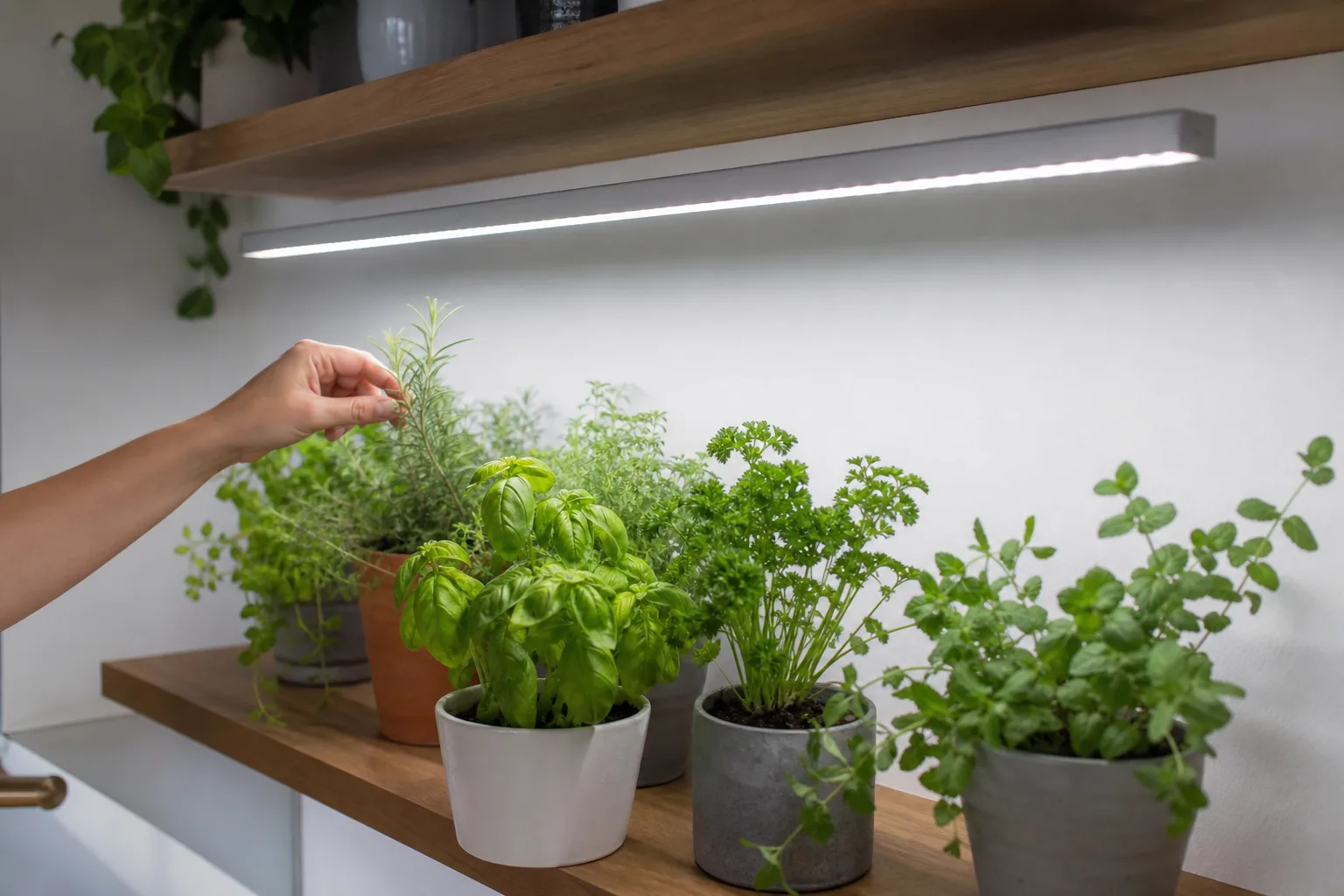
Match the supplement to the gap. A small full-spectrum LED bar or panel 12–18 inches above the canopy, on a 12–14 hour timer, can lift a medium spot into high-band growth for foliage plants. UF/IFAS confirms many plants grow fine under appropriate artificial light when intensity and duration match their needs (UF/IFAS Gardening Solutions). Fluorescent and LED sources beat old incandescent bulbs for efficiency and heat (Clemson HGIC light requirements).
Use the lux meter to compare before/after positions, then fine-tune height using PPFD guidance in our grow lights complete guide. A meter reading after install tells you whether the lamp is decoration or actually closes the gap.
Common Light-Meter Mistakes That Waste Your Time
Measuring at eye level. Ceiling height readings lie. Always leaf height.
One snapshot on a cloudy week. Overcast days depress numbers. Baseline on clear sky when possible; note weather on the log.
Ignoring duration. A west sill that spikes to 900 ftc for two hours may still under-serve a plant that wants 500 ftc for six hours. Combine peak readings with how long the spot stays in each band.
Chasing false precision. Broad categories beat decimal hunting. Plants are biological systems, not lux spreadsheets.
Trusting phone PPFD under colored LEDs without verification. Use PAR tools or manufacturer distance charts for grow lights.
Forgetting pot rotation. A meter reading on the window-facing side can be double the back side on a wide floor pot. Rotate weekly or accept uneven growth.
Buying high-light plants for low-light love. A meter protects you at purchase; denial costs more later.
When Plant Behavior Overrides the Meter
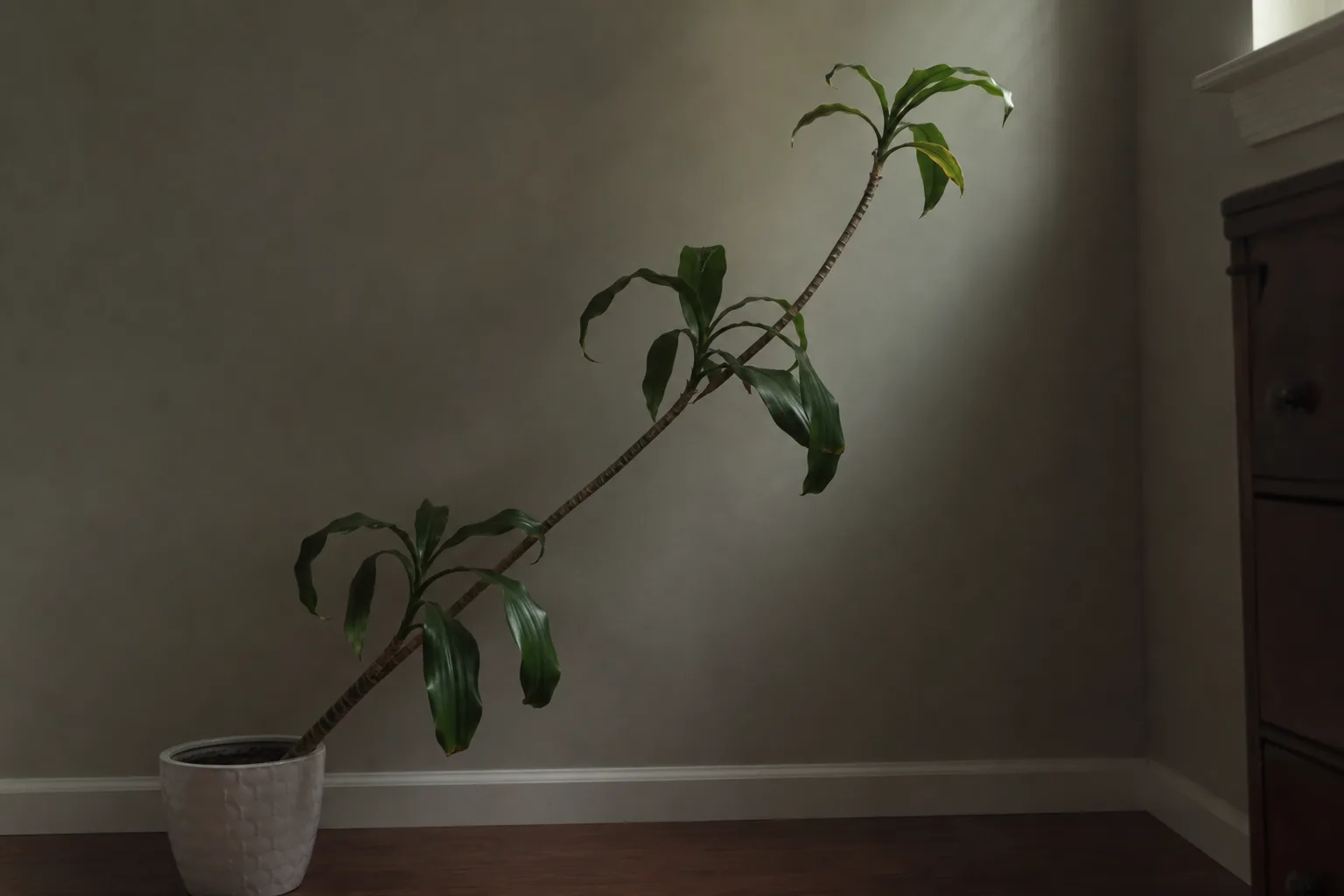
The meter is a scouting tool. The plant is the scoreboard.
Missouri Botanical Garden lists classic too-little-light cues: elongated stems, smaller new leaves, leaning toward windows, and older lower leaves yellowing and dropping as the plant sacrifices shaded tissue (Missouri Botanical Garden). RHS adds spindly pale growth and poor flowering (RHS). If your map says medium but new internodes stretch and variegation reverts, the plant is telling you the spot reads medium for the sensor but low for that species’ growth appetite.
The opposite also happens. A meter may show high band while leaf edges bleach — especially after moving a shade-grown nursery plant to unfiltered south glass. Scorched or crispy patches mean too much direct intensity even when numbers look acceptable; filter light or pull back from the pane.
When numbers and behavior conflict, trust behavior first, then re-measure with finer grids — slightly left vs right of the pane, higher vs lower shelf — before you repot, fertilize, or panic about pests. Full symptom triage lives in not enough light houseplants and our houseplant symptom checker.
Conclusion
Choosing houseplants should not be a lottery based on how bright a room feels at dinner time. A light meter for houseplants — even a phone app used with discipline — exposes the gap between human vision and plant reality. Hold it at leaf height, log midday foot-candles or lux, map each room once, and shop from UF/IFAS-style low, medium, high, and direct bands instead of poetic tag language.
Buy the simple handheld tier if you are serious about placement; reserve PAR gear for grow-light rigs. Re-measure when seasons turn and when trees or curtains change. Then let the plant confirm the decision: compact new growth means the map worked; stretch and pale leaves mean move closer, filter harder, or add light — regardless of what the number said last month.
The guesswork was never about whether you care enough. It was about measuring the wrong thing with the wrong organ. Swap your eyes for a sensor once per room and the right plant for each spot becomes obvious before you reach for the watering can.