Low Humidity on Alocasia Cuprea: Causes, Checks & Fixes
Quick answer
Low humidity on Alocasia Cuprea shows as crispy rippled margins, limp mirror petioles, or stuck red spears in rooms below 65% RH—usually beside a winter heater or AC vent. First step: place a hygrometer at leaf height for 24 hours before you change watering or repot.
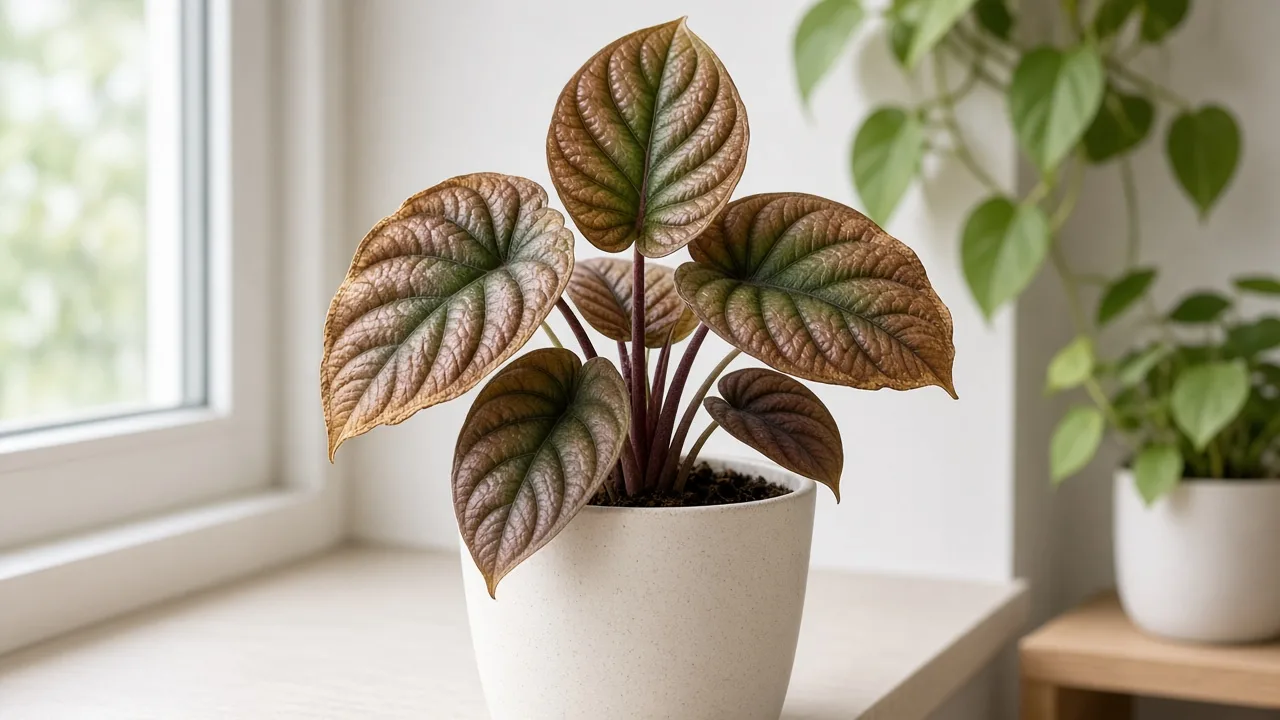
Low Humidity on Alocasia Cuprea: Causes, Checks & Fixes
This guide covers low humidity on Alocasia Cuprea. See also the general Low Humidity guide, watering, and light pages for this plant.
Low Humidity on Alocasia Cuprea: Causes, Checks & Fixes
Quick answer
Alocasia Cuprea (Alocasia cuprea, Red Secret / Mirror Plant) evolved in Borneo’s humid forest understory and wants 65–80% relative humidity at leaf level indoors—higher than many common houseplants tolerate. For how dry air damages foliage in general, see our low humidity hub. On Cuprea, the bullate rippled mirror margin is the farthest tissue from the underground corm, so winter heater air, AC drafts, and rooms below 50% RH show up as crispy edges, limp petioles, or stuck red spears before the whole plant collapses.
First step: place a hygrometer beside the foliage—not on the floor—and log readings for 24 hours before you change watering, mist, or repot. If RH stays below 50% near the leaves while the top 2–3 cm of mix is still moist and the corm feels firm, dry air is the confirmed primary stressor.
When to use this page vs other Cuprea guides
| Pattern | Read next |
|---|---|
| Tan crispy margins only, moist soil, firm corm | This page — dry air on hydrated roots |
| Brown spreading across whole mirror blades or soft tissue | Brown leaves |
| Tip-only necrosis without whole-plant limp | Brown tips |
| Limp petioles with heavy wet pot | Overwatering or drooping leaves |
| Light dry pot, dusty mix, cupped blades | Underwatering |
| Fine stippling and webbing on purple undersides | Spider mites |
| Linear splits at center of newly opened red spear | Holes in leaves — often paired with dry air |
This page covers dry indoor air as the primary cause—not wet-corm failure, drought, or pest damage alone.
What low humidity looks like on Alocasia Cuprea
Healthy Cuprea holds one to three oval bullate leaves flushed copper-bronze above with a dark reddish purple underside. Young spears emerge flushed red before the metallic cuticle darkens. Low humidity changes that silhouette in predictable ways.
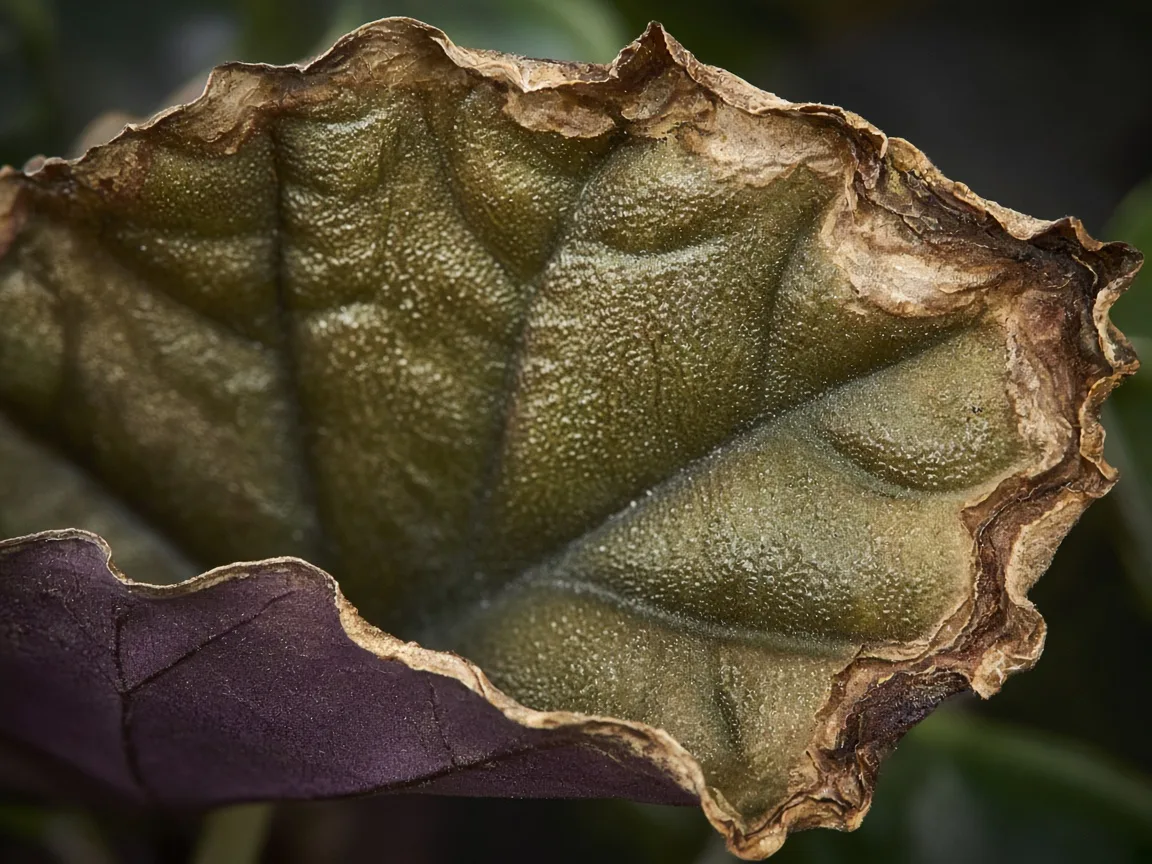
Low humidity on Alocasia Cuprea—dry papery tan margins on rippled copper-bronze edges while the mirror center stays green; dead margin tissue will not re-green.
Typical dry-air patterns:
- Crispy rippled margins on the outer bullate edge while the copper mirror center stays firm and green
- Limp petioles with slightly thin mirror blades before crisp brown edges appear—overlap with drooping leaves
- Upward cupping of blade edges as margins desiccate in heated winter rooms
- Stuck or torn red spears where a folded new leaf sticks together while unfurling in air below 50% RH
- Symmetrical margin burn on both sides of the blade—dry air, not one-sided sun scorch
- Faster symptom onset on leaves closest to a heater vent, open winter window, or bathroom exhaust fan
Usually not low humidity alone:
- Heavy wet pot, yellow lower leaves, sour smell — overwatering or root rot
- Light dry pot with pale crumbly mix — underwatering
- Pale or silvery new spear without crispy margins — overview — normal mirror-leaf colour change
- Fine yellow stippling with webbing — spider mites, which thrive in hot dry indoor air
Mirror-margin anatomy: why Cuprea crispens before it wilts
This section is Cuprea-specific—it does not apply to flat-leaf Alocasia × amazonica hybrids like Polly.
- Bullate ripples concentrate transpiration at the margin. The indented veins create more edge surface area than a smooth arrowhead leaf. When room air drops below Cuprea’s 65–80% comfort zone, those rippled edges desiccate while the corm still sits in moist chunky aroid mix.
- The mirror cuticle hides early stress. Copper-bronze colour can make a margin look healthy from across the room while the outer millimetre is already necrotic. Inspect leaves at arm’s length, not from the doorway.
- Slow corm growth means fewer replacement leaves. Cuprea holds one to three mirror leaves indoors. One badly burned margin is a large share of photosynthetic area—dry air feels alarming even when the corm is firm.
- Alocasias need medium to high humidity and show browning on leaf edges when air is too dry—Cuprea sits at the pickier end of that range.
Always compare the newest fully opened mirror leaf to the lowest oldest leaf. Burn climbing inward on fresh copper growth is more urgent than one fading tip on a leaf the plant is about to shed in dormancy.
Red-spear unfurl tears in dry air
Cuprea’s most distinctive humidity failure happens at the crown, not the oldest leaf margin.
New growth arrives as a tightly folded red spear. In air below about 50% RH, the outer tissue can dry and stick while the inner blade still tries to expand. The result is linear splits, center holes, or ragged unfurl edges on the newest mirror leaf—often within days of a heating season starting. No frass, no insect trails, no yellow halos.
This pattern overlaps with holes in leaves from mechanical damage, but dry-air tears usually appear only on the most recent unfurl and coincide with a hygrometer reading below 50% at leaf height. Fixing humidity protects the next spear; the torn tissue on the current leaf will not repair itself.
The misting trap on mirror leaves
When growers see crisp margins, the instinct is to mist the glossy copper surface. On Cuprea, that is the wrong tool.
Water droplets sit on the bullate cuticle, leave permanent water spots, and do not raise room humidity for more than minutes. Stagnant surface moisture on rippled mirror blades also invites fungal spotting—especially when low humidity and spider mites stack in the same dry winter room.
The fix is a humidifier running near the plant (or grouped tropicals in a bright bathroom with adequate light), not spritzing mirror foliage. Low humidity causes leaves to wilt when water is lost faster than roots can replace it—roots may be fine while air pulls moisture from the farthest rippled margin.
Why Alocasia Cuprea needs more humidity than Polly
Jewel alocasias from Borneo’s understorey evolved with constant ambient moisture. Cuprea’s compact corm and slow leaf turnover mean it cannot outgrow a bad environment the way faster Alocasia × amazonica hybrids sometimes can.
Heating season is the danger window: furnace heat drops indoor RH to 25–40% while Cuprea still wants 65–80%. Symptoms often appear in November through February on plants that looked fine all summer.
AC and exhaust drafts produce the same pattern in summer—crisp margins on the leaf facing the cold vent while mix moisture looks normal.
Bright windows amplify transpiration. A Cuprea in strong east or west light near a dry heater vent loses water from mirror margins faster than roots in a snug pot can replace it—even when you follow the watering guide correctly.
Do not compensate for dry air by watering more often. Overwatering in winter is the most common alocasia killer; wet roots plus dry air still produce crispy edges because the margin is farthest from the corm.
How to confirm low humidity is the cause
Run these checks in order on the same day:
- Hygrometer at leaf height for 24 hours — log minimum and average RH. Below 50% confirms dry air; 50–65% is marginal for Cuprea; 65–80% is the target band.
- Soil moisture at 2–3 cm depth — poke with a finger or chopstick. Moist or damp mix with crispy margins points to humidity, not drought.
- Corm firmness — press gently at the soil line. A firm corm with limp petioles and dry margins fits transpiration stress. A soft corm on wet mix is a different diagnosis.
- Vent and heater map — note whether the plant sits within 1 m of a radiator, forced-air register, or bathroom fan.
- Newest growth check — compare the last unfurled spear to the one before it. Worsening margins on successive leaves confirms ongoing dry air.
If humidity reads above 65% for a full day but new spears keep burning, shift to water quality (brown tips) or pest inspection before buying a second humidifier.
The first fix to try
Run a cool-mist or evaporative humidifier within 1 m of the foliage and aim for 65–80% RH at leaf height.
That single change addresses the root cause without stacking repotting, pruning, and extra watering on the same day. Set the humidifier on a stable surface below leaf level so mist does not collect on mirror blades. Empty and clean the tank weekly to avoid mineral dust on foliage.
Do not mist mirror leaves. Do not move the plant into a dim corner “for humidity” if that sacrifices the bright indirect light Cuprea needs. Do not water more because margins look dry—confirm mix moisture first.
Step-by-step recovery
Once the humidifier is running:
- Log RH every morning and evening for one week at leaf height. Adjust output until readings stabilize in the 65–80% band.
- Move the pot 60–90 cm away from heater vents and cold AC drafts if possible.
- Group with other tropicals or place in a bright bathroom only if light levels stay adequate for at least several hours of indirect sun.
- Maintain the corm-safe watering rhythm — water when the top 2–3 cm of chunky aroid mix dries; reduce sharply in winter dormancy per the watering guide.
- Inspect purple undersides weekly for stippling—dry air and spider mites often arrive together.
- Leave cosmetic crispy margins on old leaves unless they are fully dead and pull away easily. Trimming live tissue stresses a slow-growing corm further.
If petioles stay limp after seven days above 65% RH with correct watering, read drooping leaves for wet-corm or cold-draft causes.
Lookalike symptoms on Cuprea
| What you see | Likely cause | Next step |
|---|---|---|
| Crispy rippled margins, moist soil, firm corm, RH below 50% | Low humidity | Humidifier to 65–80% |
| Crispy margins, heavy wet pot, yellow lowers | Overwatering / root stress | Overwatering |
| Limp blades, light pot, dry top 2–3 cm | Underwatering | Underwatering |
| Tip-only tan necrosis, symmetrical margins | Dry air or tap-water fluoride | Brown tips |
| Fine stippling, webbing on undersides | Spider mites in dry air | Spider mites |
| Center split on newest red spear only | Dry-air unfurl tear | Humidifier; see holes in leaves |
| Upward curl with moist soil | Low humidity or heat stress | Curling leaves |
Recovery timeline
Days 1–3: Humidifier raises RH; limp petioles may firm slightly if transpiration was the main issue. Existing crispy margins stay brown.
Week 1–2: Browning should stop spreading inward on mature mirror leaves. Watch the next red spear—clean rippled edges on unfurl mean the fix is working.
Week 3–6: One or two new copper leaves may open with intact margins. Old damaged tissue remains cosmetic.
Beyond 6 weeks: If every new spear still burns or tears despite sustained 65–80% RH, investigate water chemistry, pests, or root health—not more humidity alone.
Judge recovery by new growth quality, not by re-greening old mirror blades.
Mistakes to avoid
- Misting mirror foliage — water spots and fungal risk without lasting RH gain
- Watering more because leaves look dry — moist well-drained soil does not fix dry air; it risks corm rot
- Humidity tray as the only fix — trays barely raise RH at leaf height on an upright alocasia
- Moving to a dark humid corner — low light weakens petioles and mimics humidity stress
- Repotting and humidifying the same week — let the plant stabilize in corrected air first
- Judging RH at floor level — readings beside the foliage matter; floor humidity misleads
How to prevent low humidity stress next season
- Run a humidifier from October through March in heated homes, or whenever RH at leaf height drops below 55%
- Keep Cuprea away from heater vents and cold windowpanes in winter
- Maintain 65–80% RH as the baseline—not the emergency target after damage appears
- Pair humidity with correct watering and light—environment works as a system
- Expect one cosmetic older leaf to show edge burn in record-dry weeks; watch the newest spear instead
When to escalate
Low humidity alone rarely kills a firm corm, but stacked stress does. Escalate if:
- Every new hardened spear emerges with burned or torn margins within two weeks despite RH above 65%
- Fine webbing and stippling spread on purple undersides — spider mites
- The corm softens, soil smells sour, and lower leaves yellow while mix stays wet — root rot
- No new growth for two months in warm bright conditions after you corrected humidity and watering
A few tan tips on the lowest mirror leaf while new copper growth stays clean is normal maintenance once air is stable.
Conclusion
Low humidity on Alocasia Cuprea is a margin-and-crown problem on slow-growing mirror foliage—not a generic houseplant complaint. Measure RH at leaf height, confirm moist soil and a firm corm, and run a humidifier to 65–80% before you mist, overwater, or repot. Old crispy edges stay brown; success is clean rippled margins on the next red spears Cuprea unfurls.
Related Alocasia Cuprea guides
- Alocasia Cuprea overview — mirror-leaf colour, dormancy, and baseline culture
- Alocasia Cuprea watering — corm-safe dry-down rhythm
- Alocasia Cuprea light — bright indirect placement without scorch
- Brown tips on Alocasia Cuprea — when margin necrosis is the main symptom
- Drooping leaves on Alocasia Cuprea — limp petioles with wet vs dry soil
- Curling leaves on Alocasia Cuprea — upward cup from dry air or heat
- Alocasia Cuprea problems — browse all common issues on this species
Related tool
Use the Humidity Calculator to estimate target humidity and placement for low humidity on this plant before changing multiple variables at once.