Scale Insects on Amla: Woody Branchlet Checks & Fixes
Quick answer
Scale insects on Amla look like flat tan or brown shell-like bumps glued to woody branchlets, the main trunk, and bark—not on feathery leaf blades. First step: isolate if needed, then scrape every visible bump with a cotton swab dipped in 70% isopropyl alcohol before spraying the whole tree.
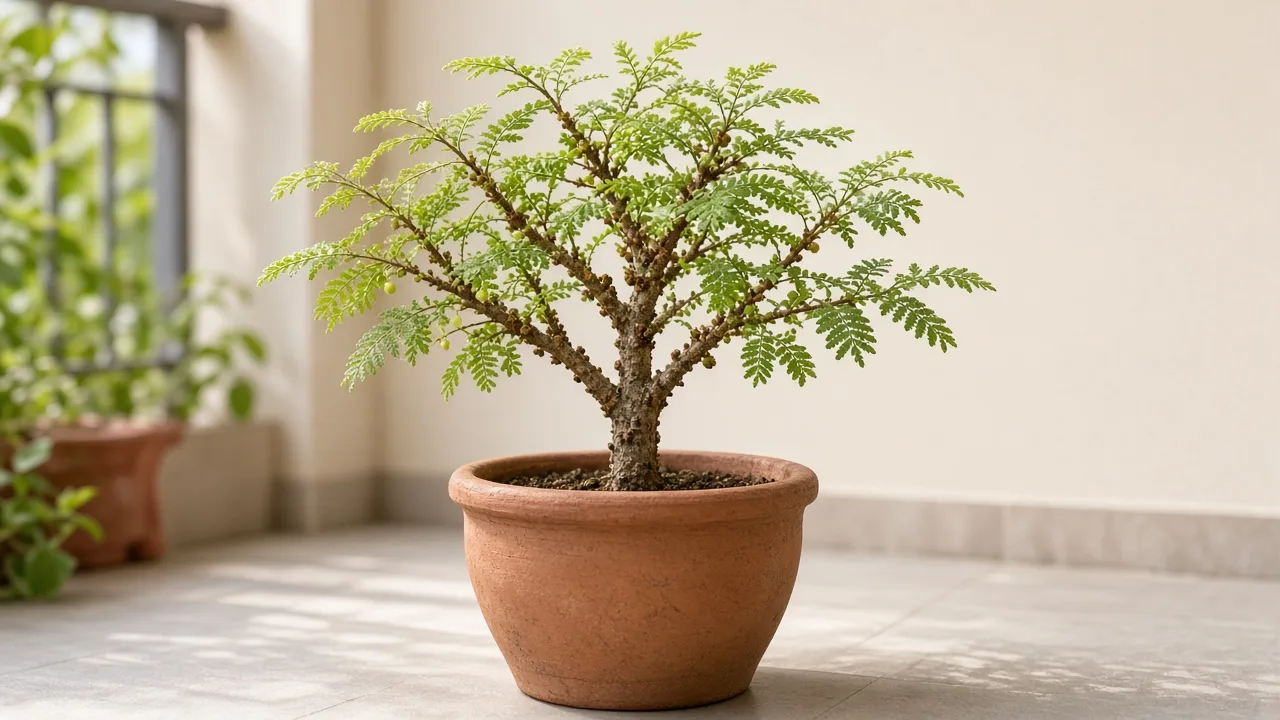
Scale Insects on Amla: Causes, Checks & Fixes
This guide covers scale insects on Amla. See also the general Scale Insects guide, watering, and light pages for this plant.
Scale Insects on Amla: Causes, Checks & Fixes
Quick answer
Scale insects on Phyllanthus emblica (Amla, Indian gooseberry) are small, immobile sap feeders protected by a waxy or shell-like cover that look like flat tan or brown bumps glued to woody branchlets, the main trunk, and bark. They pierce tissue, drain sap, and—on soft scale species—leave sticky honeydew that can feed sooty mold on feathery shoots and terrace tiles below.
For how scale life cycles work in general, see our scale insects guide. On Amla, the practical pattern is firm disks on slender woody branchlets and trunk bark during monsoon flush, sticky shine on young shoots in full sun, and extra concern when flower buds are forming because sap loss can reduce fruit set on container trees. Orchard literature on aonla lists sucking pests including Drosicha sp. alongside spherical mealybug—both can look like waxy bumps on woody stems until you magnify them.
First step: isolate the tree if other fruit plants sit nearby, then scrape every visible bump with a cotton swab dipped in 70% isopropyl alcohol—then re-inspect in three days before spraying anything.
When to use this page vs other Amla guides
This page is the pest-first entry for immobile tan or brown bumps on woody stems.
| Pattern | Read next |
|---|---|
| White cottony clusters in branchlet axils | Mealybugs |
| Soft pear-shaped insects on newest branchlet tips | Aphids |
| Fine webbing and stippling on feathery leaves | Spider mites |
| Tiny white insects that fly up when disturbed | Whiteflies |
| Distorted new leaves without confirmed insects | Distorted leaves |
| Black coating that wipes off with a damp cloth | Black spots (sooty mold from honeydew) |
| Yellow lower leaves, wet mix, soft roots | Overwatering or root rot |
What scale insects look like on Amla
Scale insects are protected by a waxy or shell-like cover that makes adults essentially immobile once they settle. On Amla they are easy to mistake for normal bark texture or dried sap until colonies build:
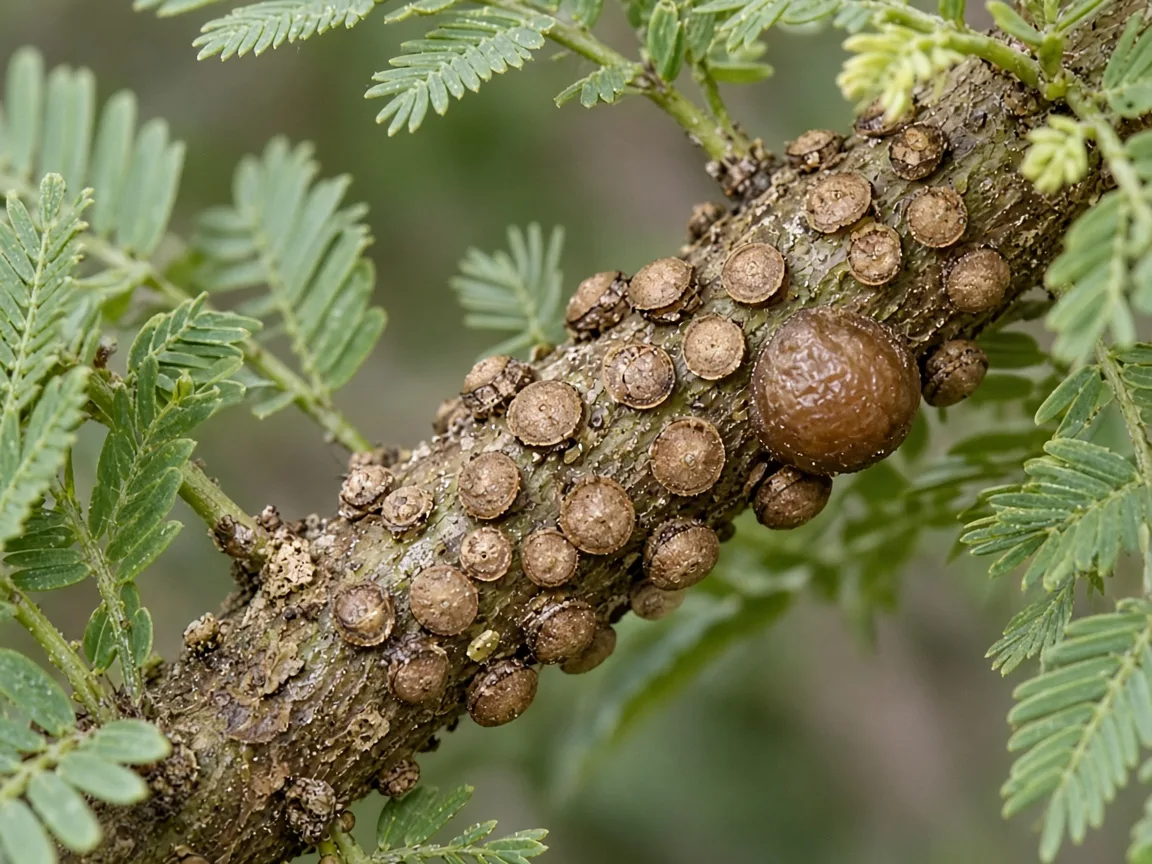
Flat tan scale shells on a woody branchlet—compare with firm feathery leaf clusters above.
- Flat or dome-shaped tan, brown, or bark-colored bumps on woody branchlets, trunk bark, and stem forks
- Disks that do not wipe away with a dry cloth—unlike mineral dust or dried irrigation splash
- Sticky shine on young branchlet tips — Honeydew collects on feathery foliage and terrace tiles below
- Black sooty coating on lower branchlets — Fungus growing on dried honeydew; overlaps with black spots when honeydew is the cause
- Ant trails on the saucer or terrace floor — Ants harvest honeydew and protect scale colonies from lady beetles and parasitic wasps
- Yellowing or dropped emerging branchlets — Heavy feeding on soft flush while woody stems stay firm
- Pale crawlers before shells harden — Newly hatched nymphs are mobile and actively crawl over woody stems until they settle
Healthy Amla branchlets carry fine feathery compound leaves along slender woody stems. Mature lower canopy can look perfect while tan disks hide on upper branchlet forks—do not assume the tree is clean because older branchlets are firm.
Where scale hides on woody branchlets and trunk bark
Amla grows as a deciduous fruit tree with feathery foliage on slender branchlets—not a broad houseplant leaf. Scale follows woody surfaces and protected stem angles, not the fine leaflets themselves.
On Amla, the equivalent hot zones are:
- Main trunk and lower scaffold branches — Bark-colored armored scale blends into rough bark; check from soil line to first major fork
- Branchlet forks — Where feathery leaf clusters meet woody stems; shells tuck into the crotch
- Underside of woody petiole bases — Where each feathery cluster attaches to the stem
- Flower and fruit bud scales — Tender bud tissue on branchlet tips attracts feeding during flowering season
- Graft union on nursery stock — Check the junction where scion meets rootstock on grafted trees
- New nursery stock — Quarantine Amla for two weeks and magnify trunk and branchlet bark before placing it beside other fruit pots
Drosicha sp. is reported among sucking pests of Indian gooseberry in orchard settings. These cottony cushion-type pests can coat trunk and major limbs in heavy infestations—quite different from a few flat armored disks on one upper branchlet.
Once several firm branchlet sections have hardened, scale usually moves up to the next soft flush. Lower mature canopy is a less common feeding site unless the whole tree is stressed and pushing abnormally soft growth in deep shade—cross-check the light guide if every new branchlet is tiny and bumpy.
Why Amla gets scale insects
Amla belongs on a sunny terrace or south-facing balcony with 6+ hours of direct sun, but warm-season flush creates predictable scale habitat even on well-grown trees.
Monsoon and post-monsoon new growth. Container trees on terraces follow the same rhythm as orchard Amla—soft shoots after deep watering in summer heat give scale crawlers fresh tissue to settle on. Sucking pests including [Drosicha sp. and spherical mealybug Nipaecoccus viridis are documented on aonla.
Woody stems that look like bark. Flat armored scale on slender branchlets mimics normal stem texture. A rinse of feathery leaves misses the shells glued to wood below.
Ant protection on terrace setups. Ants feed on honeydew and actively protect scale insects from natural enemies. A balcony tree with ant highways often holds larger branchlet colonies.
Hitchhikers from nursery stock. Scale commonly enters collections on fresh grafted trees or after summer outdoors. They are not a sign you failed at watering—but wet, stagnant crowns plus pests are a worse combination than either alone.
Stress from weak light. Trees kept in deep shade push soft, etiolated branchlets that stay vulnerable longer. Full sun and airy sandy loam mix help stems firm up before scale builds large colonies on bark.
How to confirm the cause
Work through these checks before you treat:
- Location on the plant — Tan disks fixed to woody stems suggest scale. White cottony tufts in branchlet axils suggest mealybugs. Soft pear-shaped clusters on newest tips suggest aphids. Fine webbing and stippling suggest spider mites.
- Lift test — Pry one bump with a fingernail or toothpick. Armored scale covers can be separated from the insect body; mealybugs smear pink beneath cotton.
- Honeydew test — Rub a sticky young shoot. Honeydew feels tacky; sooty mold smears black and wipes off. Armored scale produces little or no honeydew—if stickiness is heavy, suspect soft scale or mealybugs instead.
- Ant activity — Ants near the pot point to honeydew producers on growth above. Ant control alone will not cure scale, but it explains weak biological control.
- Hand-lens inspection — Crawlers are tiny and mobile before shells harden. Whiteflies would fly up in a cloud when disturbed.
- Care cross-check — Confirm the top 3–5 cm of mix dries between soaks per the watering guide. Pest damage on a drowning root zone needs moisture correction, not scrape alone.
If you see only a few isolated disks and lady beetles or lacewing larvae nearby, confirmation may mean monitor rather than spray immediately.
First fix for Amla
Scrape every visible bump with a cotton swab dipped in 70% isopropyl alcohol—then let foliage air-dry in full sun the same day.
Move the pot to a wash area if needed. Support each soft branchlet with your fingers and press the swab directly onto tan disks on woody stems and trunk bark where rinsing cannot reach. Alcohol breaks through the waxy cover on soft scale and kills exposed insects under armored shells when you work the swab into the edge.
This single step preserves predators better than a broad spray on day one. Repeat every two to three days while live bumps remain on inspection.
Do not reach for horticultural oil, insecticidal soap, or neem on day one if colonies are small and beneficial insects are visible nearby.
Edible fruit note: Amla fruit is widely eaten, but rinse treated shoots before harvest season and avoid spraying open flowers or young fruit you plan to eat within two weeks unless the product label allows it.
Step-by-step recovery
After the initial alcohol scrapes:
- Scout every three to four days through warm monsoon and post-monsoon growth. Scale crawlers can resettle within a week in heated terrace conditions.
- Follow branchlet forks with a soft toothbrush when shells hide deep in woody crotches water cannot reach.
- Manage ants when trails are heavy. Sticky barriers on pot rims or ant baits placed away from the tree can let ladybirds, parasitic wasps, and lacewings reach scale. Ant control alone is not a substitute for scraping.
- Apply horticultural oil only if scrapes fail twice and colonies persist. Horticultural oils are most effective against scale insects when crawlers are active or during dormancy on deciduous trees. Test one branchlet first; coat woody stems thoroughly and avoid drought-stressed or heat-shocked trees above 32°C (90°F).
- Wash sooty mold off lower branchlets with plain water once honeydew production stops. Trim shoots that stay heavily coated if they no longer contribute to the canopy.
- Hold extra fertilizer until scale is under control. Resume light feeding per the fertilizer guide after new branchlet flush comes in clean.
Prune only heavily infested, fully distorted branchlet tips that block new growth and fail two treatment cycles. See the pruning guide before removing more than one or two shoots at a time on a young container tree.
Dormant oil on deciduous Amla
Amla is a deciduous fruit tree that drops leaves in cool weather. That leafless window is the safest time for a thorough horticultural oil pass on terrace trees.
Dormant oils are very effective against scale eggs and overwintering stages on fruit and shade trees. On container Amla:
- Apply when the tree is leafless and buds have not yet broken
- Coat trunk, scaffold branches, and every woody branchlet fork
- Avoid application when temperatures are below 4°C (40°F) or above 32°C (90°F)
- Do not mix with sulfur sprays within two weeks—oils and sulfur can burn foliage when new leaves emerge
This plant-only timing step does not apply to evergreen houseplants. A dormant oil pass once per winter often prevents the spring crawler wave that coats upper branchlet forks during monsoon flush.
Recovery timeline
Alcohol scrapes show results within two to three days on moderate colonies. A full follow-up cycle with scouting may take one to two weeks. Sooty-coated feathery tips from heavy feeding often stay dark until replaced—expect clean new branchlets within three to six weeks on slow-growing Amla once insects stay gone.
Improvement signs: Flat feathery leaves on new flush, no new stickiness, firm woody stems, stable leaf color.
Worsening signs: Tan disks spreading to multiple branchlet forks, ants on every new shoot, premature bud drop, or colonies rebounding after two scrape cycles—escalate to targeted horticultural oil or compare with distorted leaves if growth stays warped without insects.
Lookalike symptoms
| What you see | More likely | Quick check |
|---|---|---|
| Flat tan disks on woody stems | Scale insects | Shell lifts; insect underneath |
| White cottony tufts in shoot axils | Mealybugs | Wax smears pink when crushed |
| Dense soft insects on branchlet tips | Aphids | Pear-shaped; not waxy shells |
| Fine webbing + stippling on feathery leaves | Spider mites | Dry heat; shake test on white paper |
| Twisted new branchlets, no insects at 10× | Distorted leaves | Shade etiolation—magnify first |
| Black coating that wipes off | Sooty mold from honeydew | Treat pests above; see black spots |
| Yellow lower leaves, no stickiness | Yellow leaves | Seasonal drop or wet roots—check mix |
Mistakes to avoid
Do not soak the pot repeatedly while treating branchlet stems. Amla hates chronically wet roots—follow water when the top 3–5 cm dries after treatment and empty the saucer within 30 minutes.
Do not spray horticultural oil on a heat-stressed or drought-stressed tree without a test patch. Oils can damage sensitive plants in heat or on drought-stressed tissue.
Do not ignore ants while treating scale only with scrapes. Ant protection keeps colonies rebounding on branchlet flush.
Do not increase fertilizer during an active infestation. Soft lush shoots feed the next generation of crawlers.
Do not strip every distorted lower branchlet at once. Young container trees need mature canopy for photosynthesis—remove only heavily infested tissue.
Do not assume one scrape pass is enough. Warm terrace growth and mobile crawlers that spread the population mean follow-up scouting matters more than the first knockdown.
How to prevent scale insects next time
Scout woody branchlets weekly during monsoon warmth and early autumn—before stickiness reaches terrace tiles below.
Quarantine new Amla trees for two weeks and inspect trunk and branchlet bark before placing them beside other fruit pots.
Preserve beneficial insects when possible. Tolerate small colonies when damage is cosmetic and ladybirds, lacewings, or parasitic wasps are present.
Manage ants on pot rims in terrace and balcony setups.
Apply a dormant horticultural oil during the leafless season on deciduous container trees.
Keep the tree in full sun with airy sandy loam mix so branchlets mature quickly and firm up before scale builds large colonies on bark.
Avoid heavy nitrogen feeds that push soft shoots—follow the seasonal schedule in the fertilizer guide.
When to worry
Small scale disks on one branchlet fork during warm-season flush are common on vigorous terrace Amla and rarely threaten a firm tree if you scrape early. Escalate when tan bumps coat multiple forks, ants protect large colonies on every new flush, or flower buds fail across the canopy.
Act urgently if branchlets wilt, lower leaves yellow in waves, and mix stays wet for weeks—switch to root rot diagnosis rather than assuming insects alone are the problem.
Related Amla guides
- Overview — Indian gooseberry culture and fruiting basics
- Watering — avoid wet roots during treatment
- Light — firm branchlet growth vs soft shaded tips
- Mealybugs — cottony clusters without hard shells
- Aphids — pear-shaped clusters on branchlet flush
- Problems hub — full symptom index
Conclusion
Scale insects on Amla are a woody branchlet and trunk-bark problem on most terraces—not a mysterious whole-tree collapse. Magnify slender stems from the soil line up, scrape tan disks with alcohol, and keep roots draining while you treat. Firm woody stems and clean new branchlets on the next flush are the recovery signal; old sooty leaves can stay imperfect without harming a slow fruit tree.
Related tool
Use the Pest Identifier Tool to narrow causes for scale insects on this plant before changing multiple variables at once.