Distorted Leaves on Amla: Branchlet Flush Checks & Fixes
Quick answer
Distorted leaves on Amla almost always show up on the softest new branchlet flush—feathery leaf clusters twisting, narrowing, or puckering while lower woody stems look fine. First step: inspect those tips with a hand lens for aphids, silvery thrips scarring, or silk-bound leaf rolls before changing water or fertilizer.
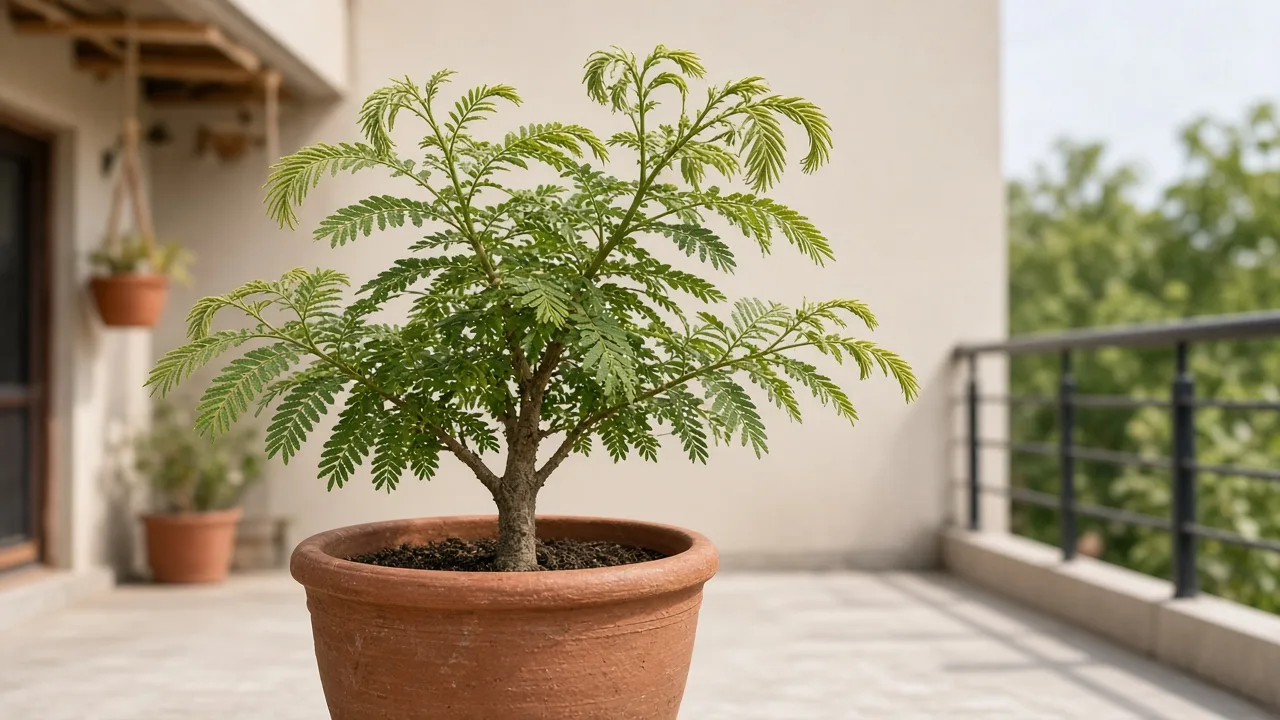
Distorted Leaves on Amla: Causes, Checks & Fixes
This guide covers distorted leaves on Amla. See also the general Distorted Leaves guide, watering, and light pages for this plant.
Distorted Leaves on Amla: Causes, Checks & Fixes
Quick answer
Twisted, puckered, or narrow feathery leaf clusters on Phyllanthus emblica (Amla, Indian gooseberry) almost always mean something interfered while branchlet tips were still expanding—not a problem you can fix on fully hardened foliage. Amla pushes soft new shoots after monsoon rain or deep summer watering on sunny terraces, and that tender flush attracts aphids whose feeding can curl and distort leaves, thrips that rasp young tissue, and leaf roller caterpillars that bind feathery blades with silk.
For how expanding leaves warp in general and when old tissue cannot recover, see our distorted leaves symptom guide. On Amla, the practical pattern is monsoon-season warping on branchlet tips, sticky honeydew on feathery shoots, silk-bound longitudinal rolls, or silvery thrips scars—not uniform cupping of the whole canopy from drought alone.
First step: inspect the softest branchlet tips and leaf undersides with a hand lens—note aphids, honeydew, silvery streaks, or silk threads—before you spray fungicide, add fertilizer, or repot.
When to use this page vs other Amla guides
This page is the shape-first entry for twisted, puckered, or narrow feathery leaflets on expanding branchlet growth.
| Pattern | Read next |
|---|---|
| Soft aphid clusters with sticky honeydew on shoot tips | Aphids |
| Silvery streaks, black specks, scarred buds | Thrips |
| Leaves rolled longitudinally with silk threads and frass inside | Caterpillars or leaf roller section below |
| Serpentine tunnels inside feathery blades | Leaf miners |
| Whole branchlets cup downward in heat without insects | Curling leaves |
| Fine stippling and webbing on hot dry terraces | Spider mites |
| Yellow lower canopy, wet mix, soft roots | Overwatering or root rot |
What distorted leaves look like on Amla
Healthy Amla branchlets carry fine feathery compound leaves along slender woody stems—not broad houseplant blades. Distortion shows on the newest expanding clusters while mature lower canopy often stays flat.
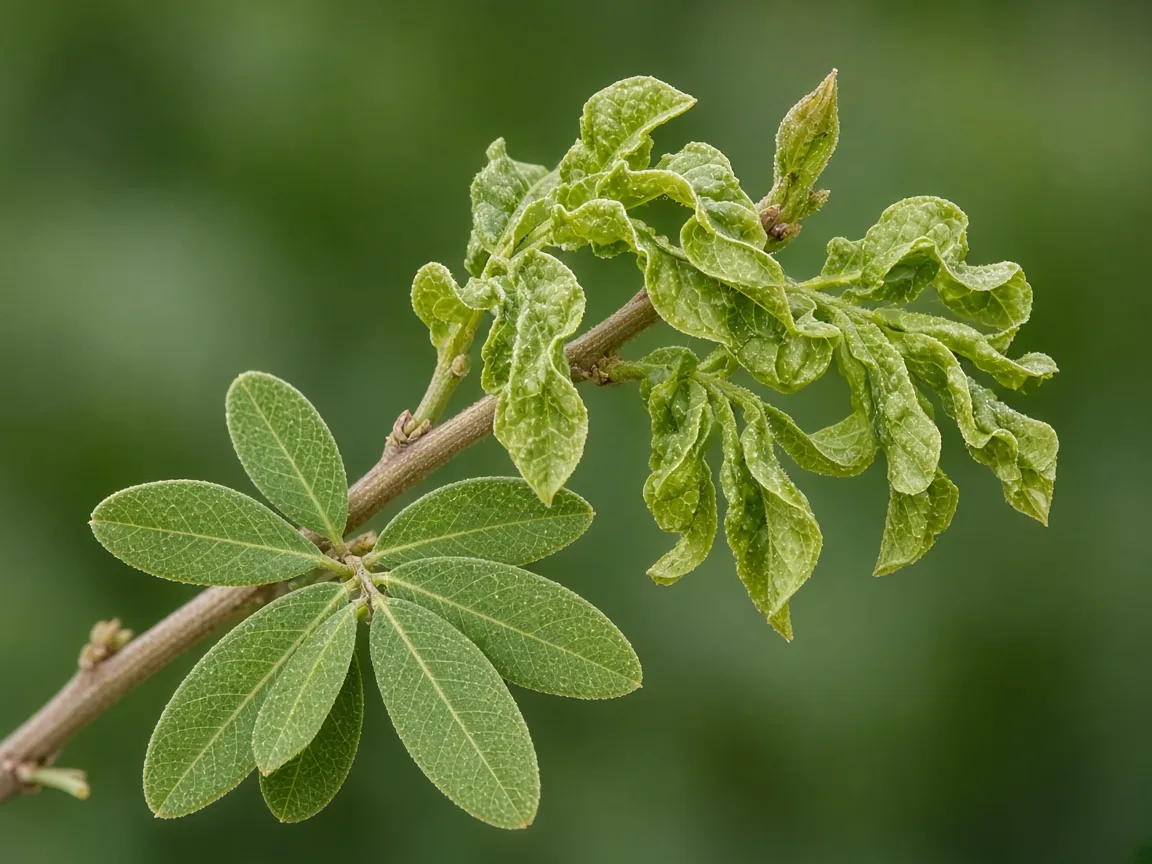
Puckered feathery leaflets on an emerging branchlet tip—compare with firm, flat clusters lower on the same stem.
- Twisted or narrow new feathery leaflets — Individual tiny leaflets pucker, narrow, or fail to open flat while the cluster below looks normal
- Sticky shine on young shoots — Honeydew on feathery foliage points to aphids on branchlet flush before you assume nutrient trouble
- Silvery scars on soft blades — Thrips rasping leaves roughened, discolored tissue that hardens into a warped shape
- Silk-bound longitudinal rolls — Feathery leaves curled like scrolls, edges glued with fine threads—hallmark of aonla leaf rollers
- Serpentine pale trails inside leaflets — Leaf miner tunnels distort blades as tissue collapses along the path
- Patchy tips on one side of the pot — Herbicide drift or terrace overspray can warp only windward branchlets
Fruit tree aphids commonly cause distorted growth and honeydew on spring and summer flush. Amla follows the same logic on monsoon branchlet pushes even though mature trees tolerate drought once established.
Feathery branchlet flush: where distortion starts
Amla is a deciduous fruit tree grown for tart vitamin-C fruit on sunny terraces and home orchards—not a shade houseplant. New growth emerges from woody branchlet tips as clusters of feathery leaflets, often after monsoon rain or a deep soak in summer heat.
Distortion happens while those leaflets are still expanding. Once the branchlet section hardens along the slender stem, warped leaflets stay warped—recovery is judged by the next flush, not by old tissue flattening.
Inspect in this order on a potted terrace tree:
- Innermost soft tips on every active branch—not just the tallest shoot
- Undersides of emerging feathery clusters where aphids hide from overhead view
- Flower and fruit buds on branchlet tips during flowering season—sap loss here can reduce fruit set on container trees
- Axils where branchlets fork — honeydew and thrips scarring collect in tight joints
Lower mature canopy can look perfect while the top flush is twisted—do not declare the tree healthy because older branchlets are firm.
Silk-bound leaf rolls vs sticky aphid puckers
Two common Amla distortions look similar from across the terrace but need different first fixes.
Aphid puckers — Soft feathery clusters twist and narrow with sticky honeydew on shoots and pot rims. Some aphid species inject toxins that curl and further distort growth. On Indian orchards, Schoutedenia emblica targets Amla branchlets, with populations building from July and peaking around September during monsoon flush. Ant trails on saucers often mean protected colonies.
Leaf roller rolls — Caterpillars of Caloptilia acidula and Tonica zizyphi fold or roll feathery leaves longitudinally, binding edges with silken threads. Rolls feel firm, may contain frass, and block sunlight from flattened blades—different from loose aphid curl without silk.
Thrips scarring — Silvery streaks and tiny black specks on young feathery blades harden into uneven shapes; buds may scar before opening. No honeydew, no silk rolls.
If you find aphids, start with the dedicated aphids on Amla rinse protocol. If you find silk rolls, pinching out affected tips before larvae retreat deep inside is often the first mechanical step—details below.
Why Amla gets distorted leaves
Monsoon and post-monsoon flush. Container Amla on Indian terraces pushes soft branchlets after monsoon rain and deep summer watering—the same window when aphid and leaf roller pressure peaks in orchards.
Sap feeders on tender tissue. Aphids, thrips, whiteflies, and mites prefer expanding feathery clusters because cell walls are still forming. Established fruit trees often tolerate low to moderate aphid numbers, but young potted trees with limited canopy lose more growth to shoot stunting.
Leaf rollers in feathery foliage. Rollers are significant in Indian gooseberry orchards because feathery leaves are easy to fold into protective shelters—heavy rolling reduces photosynthetic area on young trees.
Soft shoots after heavy nitrogen. Pushing lush branchlets with extra feed in deep shade creates soft tissue pests prefer. Cross-check the fertilizer guide if distortion followed a big feed.
Shaded, weak flush. Amla needs full sun for firm branchlets. Trees kept in deep shade push tiny soft tips that warp easily and invite pests—often overlapping with leggy growth.
Herbicide drift. Terrace herbicide overspray or lawn weed-and-feed drift can cup or twist new branchlets on one side of the canopy without insects.
How to confirm the cause
Work through these checks before you treat:
- Tip vs whole branchlet — Distortion only on newest feathery clusters suggests sap feeders or rollers. Uniform cupping of entire branchlets in dry heat suggests curling from water stress.
- Hand-lens inspection — Pear-shaped aphids, thrips streaks, silk threads, or miner tunnels each confirm a different page in the table above.
- Honeydew test — Sticky tacky shoots mean aphids or whiteflies; neither matches seasonal yellow leaf drop alone.
- Silk roll test — Gently tease a rolled feathery cluster; caterpillar frass or a small larva inside confirms leaf roller—not aphid curl alone.
- Repeat inspection in seven days — Distortion that returns on every new flush after pests are cleared suggests drift exposure or rare virus—isolate and avoid propagation from that stock.
The first fix to try
Magnify the softest branchlet tips on every active shoot and identify insects or silk before changing water, fertilizer, or pot size.
Once you know what you are facing:
- Aphids confirmed — Rinse colonies off the newest feathery flush with a strong stream of lukewarm water; re-inspect in three days before any spray. Full protocol: aphids on Amla.
- Silk-bound leaf rolls with small larvae — Pinch out and bag the rolled feathery clusters on young trees where you can reach them; one targeted removal beats spraying the whole canopy on day one.
- Thrips scarring on buds — Blue sticky traps and rinsing expanding tips help confirm activity before insecticidal soap—see thrips on Amla for the full sequence.
- No insects, one windward side warped after spraying nearby — Stop chemical exposure, flush foliage with plain water, and protect the tree; do not fertilize stressed tissue.
Do not repot, hard-prune half the canopy, and spray pesticide the same afternoon—you will not know which step helped.
Step-by-step recovery by cause
Aphid-distorted branchlet tips
After the initial rinse, inspect every soft tip weekly through the warm season. Aphids hidden within curled leaves are sheltered from contact sprays—prune out a few heavily distorted tips if colonies persist inside folded feathery clusters. Manage ants on terrace pot rims so natural enemies can work.
Leaf roller rolls on feathery foliage
Hand-remove rolled clusters on young potted trees during early infestation. Integrated pest management for fruit trees combines cultural removal, natural enemies, and targeted sprays only when rollers threaten most of the canopy—contact sprays penetrate poorly once larvae retreat inside silk.
Thrips-scarred new blades
Rinse expanding tips, improve airflow between branchlets, and treat buds before flowering if scarring spreads—details on the thrips page. Distorted petals or scarred buds are a bigger concern on fruiting container trees than on a young ornamental pot.
Shaded soft flush without pests
Move the pot to full sun, adjust watering so the top 3–5 cm dries between soaks, and hold extra nitrogen until new branchlets open firm and flat. Distortion from weak growth alone clears on the next flush if light improves.
Recovery timeline
Judge progress by new branchlet flush, not old warped feathery clusters.
- 1–2 weeks — Active pest treatment should stop honeydew spread and new silk rolls; existing twisted leaflets remain imperfect
- One flush cycle (roughly 3–6 weeks in warm weather) — The next soft tips should open with normal feathery shape if the cause is controlled
- Season-long — Repeated roller or aphid waves during monsoon may need weekly scouting until branchlets harden faster in cooler weather
Badly puckered feathery leaflets do not flatten once woody branchlet tissue sets— that is normal, not treatment failure.
Lookalike symptoms
| What you see | Likely cause | Best page |
|---|---|---|
| Twisted tips with honeydew and aphids | Aphid feeding on flush | Aphids |
| Longitudinal silk-bound rolls with frass | Leaf rollers (Caloptilia, Tonica) | This page / Caterpillars |
| Silvery streaks, scarred buds | Thrips | Thrips |
| Serpentine tunnels inside leaflets | Leaf miners | Leaf miners |
| Downward cup of whole branchlets in heat, no insects | Drought or heat curl | Curling leaves |
| Stippling with fine webbing | Spider mites | Spider mites |
| Chewed holes in mature foliage | Caterpillar feeding | Holes in leaves |
Mistakes to avoid
- Spraying fungicide on insect distortion — Puckered feathery tips without fungal lesions rarely respond to fungicides; confirm pests first.
- Fertilizing warped flush — Extra nitrogen pushes softer branchlets pests prefer; fix light and insects before feeding.
- Judging recovery on old leaves — Wait for two clean new branchlet tips, not perfect lower canopy.
- Ignoring ants on terrace pots — Ants protect aphid colonies that keep new tips twisted.
- Pruning half the tree before identification — Remove only heavily infested rolled tips or aphid-packed folds you cannot rinse clean.
How to prevent distorted leaves next time
Scout new branchlet flush weekly during monsoon and post-monsoon warmth. Quarantine nursery Amla for two weeks on a sunny terrace before placing it beside other fruit pots. Keep trees in full sun with draining loam so branchlets harden quickly. Manage ants, avoid soft nitrogen pushes in shade, and rinse early when sticky tips appear—before aphid toxins curl leaves beyond easy rinse reach.
When to worry
Small distortion on one branchlet during warm-season flush is common on vigorous terrace Amla if you catch pests early. Escalate when silk rolls cover most of a young tree, honeydew coats every new tip during flowering, or distortion returns on every flush after treatment.
Switch diagnosis if branchlets wilt, lower leaves yellow in waves, and mix stays wet for weeks—root rot and overwatering can stunt new growth in ways that mimic pest damage from a distance.
Related Amla guides
- Overview — Indian gooseberry culture and fruiting basics
- Watering — deep soaks without waterlogged roots during pest treatment
- Light — firm branchlet growth vs soft shaded tips
- Aphids — honeydew and rinse protocol on feathery flush
- Thrips — silvery scarring on buds and young blades
- Curling leaves — cupping from drought or heat, not twist on tips
- Problems hub — full symptom index
Conclusion
Distorted leaves on Amla are a branchlet-flush problem on most sunny terraces—not a mysterious whole-tree collapse. Magnify the softest feathery shoot tips, separate aphid puckers from silk-bound leaf rolls, and treat the cause you confirmed before stacking repots, prunes, and sprays. Firm woody stems and clean new branchlet clusters on the next flush are the recovery signal; older twisted leaflets can stay imperfect without harming a slow fruit tree.
Related tool
Use the Plant Problem Diagnosis Tool to narrow causes for distorted leaves on this plant before changing multiple variables at once.