Leggy Growth on Amla: Sun, Branchlets & Fixes
Quick answer
Leggy amla shows long bare branchlets with feathery leaves clustered at tips, a canopy leaning hard toward one sunny side, and weak new shoots in shade—even while the pot stays wet. First step: move the tree to the brightest outdoor spot with gradual acclimation and rotate the container weekly before pruning or feeding.
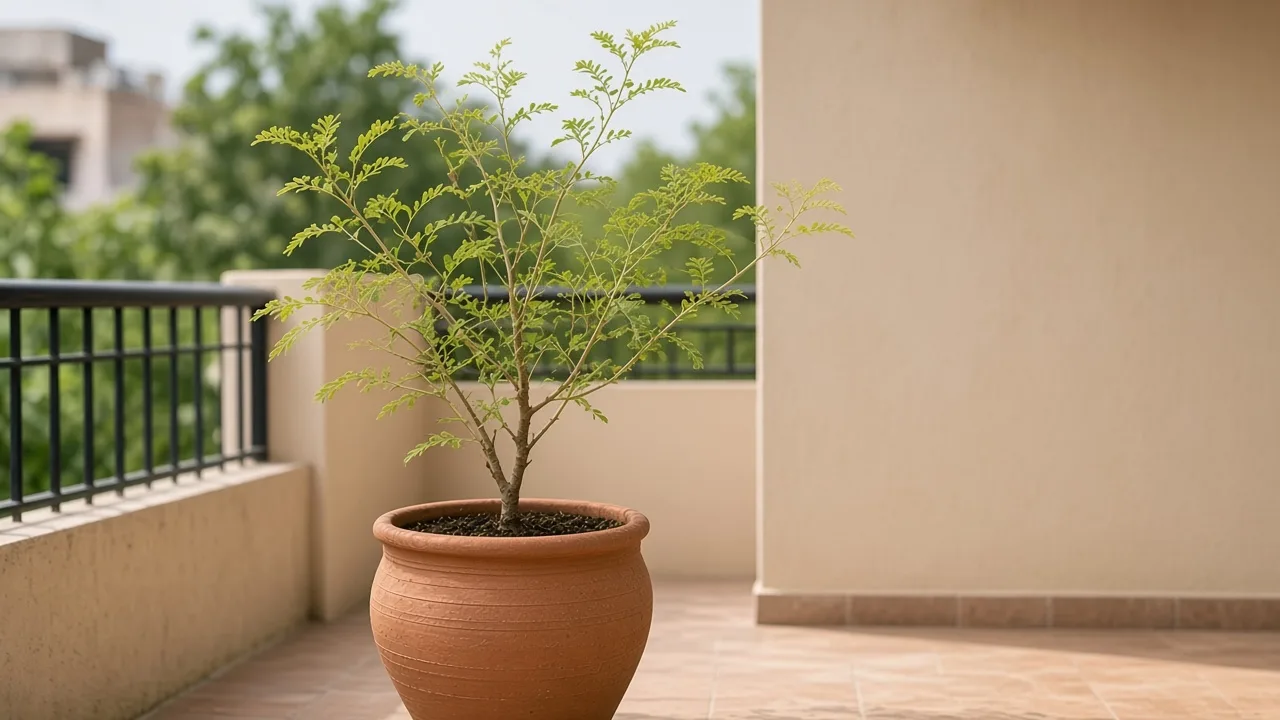
Leggy Growth on Amla: Causes, Checks & Fixes
This guide covers leggy growth on Amla. See also the general Leggy Growth guide, watering, and light pages for this plant.
Leggy Growth on Amla: Causes, Checks & Fixes
Quick answer
Leggy growth on amla (Phyllanthus emblica, Indian gooseberry) is etiolation on a sun-loving deciduous fruit tree, not the same stretch pattern as a pothos vine. The tree lengthens slender branchlets toward light, leaving long bare gaps between clusters of tiny feathery leaves while the whole pot leans toward the brightest terrace wall.
For how low light causes general stretch, see our leggy growth hub. On amla, the telltales are naked branchlet sections climbing the scaffold, pale chartreuse new shoots, a open thin canopy that never closes, and a container that dries slowly because shade reduced water use.
First step: move the tree to the brightest available outdoor location with seven to ten days of gradual acclimation, then rotate the pot a quarter turn every week—before spring pruning, repotting, or fertilizer.
When to use this page vs other Amla guides
This page is the structure-and-stretch entry when branchlets are long and bare—not when leaves alone fade or roots fail.
| Pattern | Read next |
|---|---|
| Dim balcony but stretch not advanced yet | Not enough light |
| Washed-out feathery foliage without long bare branchlets | Pale leaves |
| Firm tree, just slow in cool months | Slow growth |
| Soft trunk base on wet mix | Overwatering or root rot |
| Ready to shorten scaffolds after light is fixed | Pruning guide |
| Window placement and sun hours | Light guide |
What leggy growth looks like on Amla
Healthy amla builds a crooked trunk with spreading scaffold branches carrying closely set feathery leaves along slender branchlets—often mistaken for compound leaflets but actually simple leaves packed tight on each branchlet. Leggy etiolation breaks that silhouette:
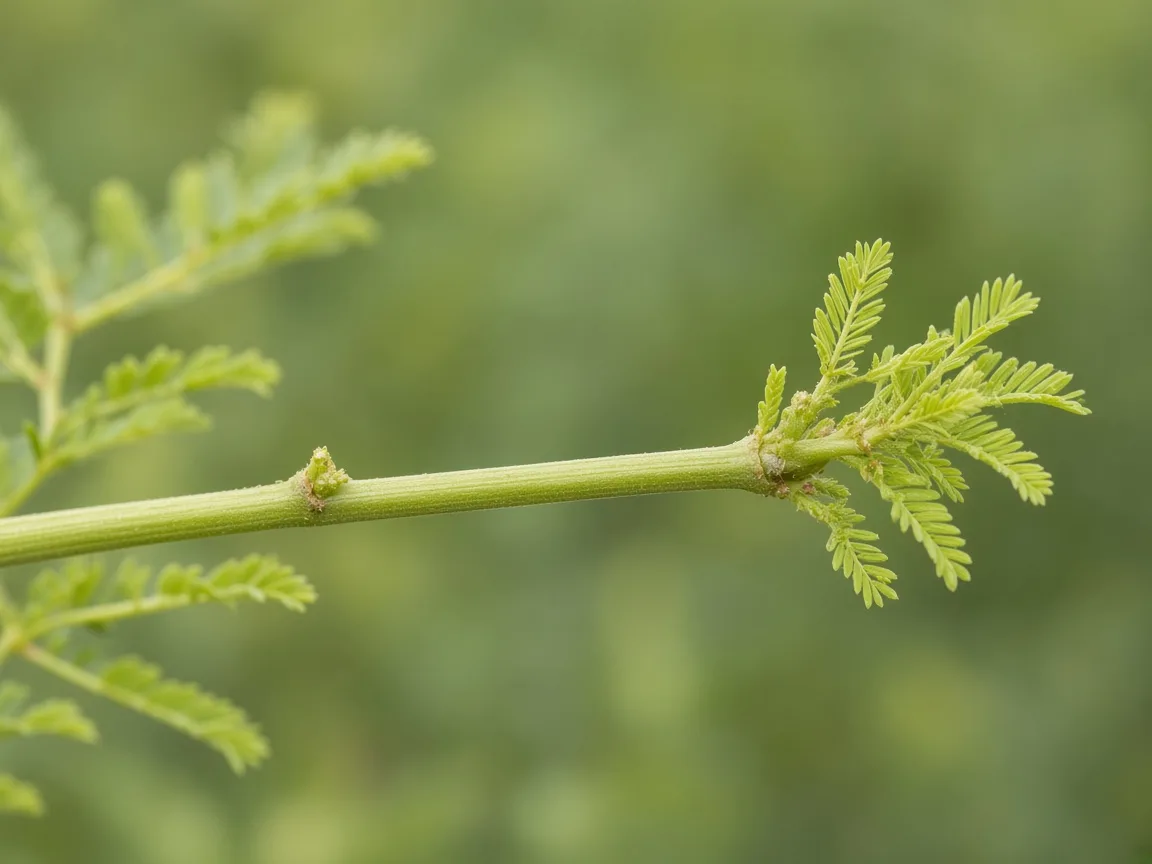
Bare branchlet gap between feathery leaf clusters—compare the wide naked section on stretched growth with tighter leaf spacing on firm lower wood.
- Long naked branchlet sections — Wide gaps where feathery leaves used to sit; newest leaves cluster at tips only
- Thin, pale upper shoots — Chartreuse new wood looks weak compared with older lower branchlets
- Hard lean toward one sunny side — Whole canopy angles toward south terrace rail or west wall gap
- Open, never-closing canopy — Thin crowns are normal enough that plantations need weeding, but chronic shade makes the openness extreme
- Top-heavy container that tips — Fast vertical stretch in dim light outpaces a small root ball
- Wet mix that stays heavy for days — Shade slowed evaporation while the tree still reached for light
Winter leaf drop on this deciduous tree is different: the canopy goes bare seasonally on firm wood, without ongoing window-lean stretch on new branchlets.
Branchlet spacing vs normal leaf drop: a plant-only check
Amla photosynthesizes through dense feathery branchlets on a fruit-tree scaffold, not through a single rosette crown. That changes how you read bare wood:
- Bare lower branchlets, firm trunk, no lean, seasonal timing — Often normal aging before winter rest; upper tips still carry tight new leaves in growing season.
- Bare branchlets climbing the whole scaffold plus terrace lean — Etiolation; full sun is the primary fix.
- Wide gaps only on the shaded side of a branched tree — Directional shade from a wall or taller plant; rotate pot and improve exposure on the weak side.
- Stretch plus heavy wet pot in a north balcony — Dim light slowed water use; check watering before assuming hunger.
This branchlet-internode logic does not apply to snake plants or pothos nodes—it is specific to Phyllanthus emblica architecture.
Why Amla gets leggy growth
Amla is a slow-growing deciduous fruit tree that cannot grow in the shade and wants full sun or at most part-day shade. Orchard and home guides agree on at least six hours of direct sun daily for productive growth; VIRIAR notes six to eight hours for optimal fruiting. When photons are short, the tree lengthens branchlets toward the source—classic etiolation—while keeping feathery leaves small and sparse because energy goes to height, not canopy density.
Plant-specific triggers:
- North-facing or walled-in balcony — Ambient brightness keeps the tree alive briefly but produces open stretchy scaffolds and little fruiting wood.
- Indoor winter shelter too long — Brief frost protection is fine; months in a dim room without supplemental light widens branchlet gaps fast.
- One-sided terrace exposure — Scaffold branches on the shaded side stretch longer; the pot leans as weight shifts.
- Competing shade trees or overhangs — Amla evolved in dry open sparse forests, not under dense canopy.
- Heavy nitrogen feed in low light — Soft elongated shoots on a dim plant; fix light before fertilizer.
- Overwatering in dim corners — Wet mix on a plant using little water stresses roots while branchlets still lean; confirm pot weight and trunk firmness at the soil line.
How to confirm the cause
Work through these checks in order:
- Light audit — At the pot on a clear day, does a hand cast a sharp shadow, or only a faint blur? Amla wants open-sky sun, not room glow.
- Lean direction — Does the canopy point at one terrace opening or grow light? Confirms phototropism, not random weakness.
- Branchlet gap comparison — Measure bare branchlet length on newest upper growth vs mid-scaffold wood from last year. Widening gaps mean ongoing stretch.
- Trunk squeeze at base — Firm and dry supports light-first diagnosis; soft on wet mix needs overwatering steps in parallel.
- Scaffold symmetry — One long bare limb beside a compact limb usually means directional shade, not disease.
- New flush after a week in brighter light — Watch for tighter feathery leaf spacing on top branchlets—not old bare sections filling in.
First fix for Amla
Move the tree to the brightest available outdoor spot and acclimate over seven to ten days—then rotate the pot a quarter turn every week.
That single change addresses most leggy cases on a firm trunk:
- Shift gradually from a shaded corner toward open terrace, roof edge, or south- or west-facing balcony rail where the canopy sees the sun’s disk for most of the day—details in the light guide.
- Add a full-spectrum grow light close enough to reach the whole canopy if the only option is temporary indoor shelter; outdoor sun remains the long-term fix for fruiting.
- Stop fertilizing until new branchlet flush looks normal for two weeks in the brighter spot.
- Do not repot on day one; stretch is rarely a root-volume problem.
If the pot still tips after two weeks of better light, stake the heaviest scaffold temporarily—permanent fix is compact new growth or spring pruning to outward buds, not a larger pot for stability alone.
Scaffold pruning when stretch is already extreme
Existing bare branchlet sections do not shorten when light improves. On severely leggy terrace trees, the rescue path follows Indian orchard training:
- Wait until March–April when NHB schedules formative pinching and thinning and TNAU recommends scaffold work.
- Remove dead, crossing, and weak wood first—cleanup before shortening healthy scaffolds.
- Shorten one overlong scaffold just above an outward-facing bud on live wood, keeping live canopy removal near one-third per session on container trees.
- Train to a modified central leader with wide-angled scaffolds starting about 0.75–1 m above soil—see the full pruning guide.
Pruning without brighter light produces another generation of leggy branchlets. Fix exposure first, then shape.
Recovery timeline and mistakes to avoid
Tighter feathery leaf spacing on new upper branchlets often shows in two to four weeks during warm growing weather with improved sun. Full scaffold balance after hard thinning may take one warm season as multiple buds break. Do not:
- Fertilize a stretched tree still in dim light
- Remove every scaffold at once without confirming firm roots
- Expect lower bare branchlets to regrow dense feathery leaves—they often stay open on mature wood
- Ignore a tipping pot until a scaffold snaps—stake early
Signs you are winning: upright top growth, deeper green on new branchlets, shorter gaps between leaf clusters, and symmetric scaffolds after rotation. Signs to escalate: creased bending limbs, soft base on soggy mix, or collapse despite bright light—root checks before more pruning.
How to prevent leggy growth next time
Match the overview routine: full sun, deep watering when the top 3–5 cm of mix is dry, well-draining loam, and weekly pot rotation on terraces. Scout new branchlet tips monthly in fall when days shorten. Pinch competing upright shoots in the March–April window orchard guides use for formative work. Keep nursery trees out of deep shade before you bring them home—PFAF is explicit that amla cannot grow in shade.
Related Amla guides
Conclusion
Leggy amla is almost always a sun-and-rotation problem expressed as long bare branchlets and a leaning terrace canopy. Move to full outdoor exposure first, rotate weekly, then prune scaffolds in the March–April window if old stretch cannot be reversed. Firm trunks and tighter new feathery flush tell you the tree is recovering; soft wet bases need water correction before any hard thinning plan.