Dracaena Compacta Light Needs: Bright Indirect & Low Light
Dracaena Compacta Light Needs: Bright Indirect & Low Light
Dracaena Compacta Light Needs: Bright Indirect & Low Light
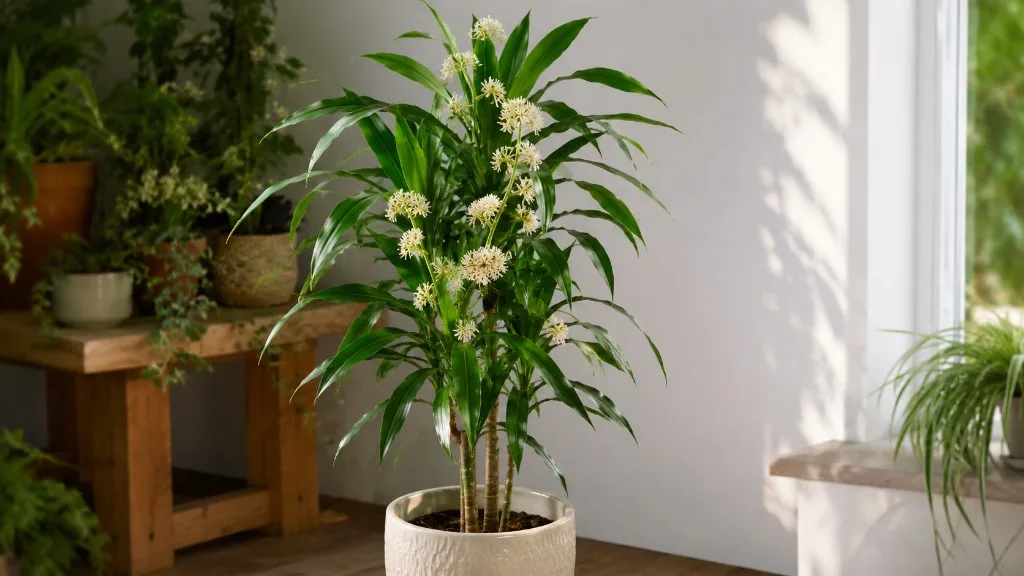
Dracaena fragrans ‘Compacta’ — sold as Dracaena Compacta or Janet Craig Compact — is the short, bushy corn-plant form with tightly stacked dark green leaves on thick canes. It stays much smaller than standard D. fragrans and suits tabletops and floor corners where a 6 ft corn plant would overwhelm the room. Light is the throttle for that compact rosette: enough brightness keeps leaves glossy and canes slowly thickening; too little light thins the bush from the bottom up; too much direct sun scars the wide strap leaves that make this cultivar attractive.
The practical target indoors is medium to bright indirect light — strong ambient brightness on the leaf surfaces without hours of direct sun hitting the foliage. Clemson Cooperative Extension notes that most dracaenas grow best in bright, indirect light, though many tolerate lower light, and that round dry patches and streaks on leaves may be caused by excessive sunlight on the foliage. (Clemson HGIC) Compacta is a solid-green cultivar with leaves clustered along slow-growing stems, which makes it one of the better dracaena choices for moderate and low indoor light — but tolerance is not the same as thriving, and a pot on a dim shelf will still lose lower leaves and stall new growth over time.
This guide covers how much light Janet Craig Compact actually needs, what bright indirect means for a dense tabletop bush, honest low-light limits, direct sun burn signs, window placement by direction, grow-light setups, acclimation steps, and how to read warning signs before stretch or scorch becomes habit. Pair light decisions with the Dracaena Compacta watering guide — dim plants dry slowly, and wet soil in low light is a common path to root stress.
How Much Light Dracaena Compacta Actually Needs
Dracaena fragrans evolved under tropical African forest margins where days are bright but direct sun on any single leaf is filtered and brief. Missouri Botanical Garden guidance for corn plant indoors is bright indirect light locations protected from significant periods of direct sun, with tolerance for some low light. (Missouri Botanical Garden) Compacta shares that biology but expresses it in a short, slow rosette rather than a tall cane — so you judge success on new leaves at the crown, not on how impressive the pot looks from across the room.
For home growers, the usable baseline is bright indirect light for most of the day. Indoors, that usually means within a few feet of an east window, or three to six feet back from a south or west window where the plant sees sky brightness without sustained direct rays on the canopy. NC State Extension advises keeping corn plant in bright to moderate, filtered light, noting that direct sun can burn the foliage and that if light levels are too low, the leaves will narrow. (NC State Extension) On Compacta, narrow new leaves and a thinning lower ring are often the first honest signals that the spot is too dim.
Low light is a fallback Compacta handles better than variegated dracaenas, not the performance target. Clemson HGIC states that if a plant growing in dim light moves to a brighter spot, new leaves will be thicker and stronger and the growth rate will increase — evidence the dim location was limiting even when the plant looked acceptable. (Clemson HGIC) Because Compacta grows slowly, that improvement may take several weeks to show on new tissue; do not declare a placement failed after only three days.
Light also sets the pace for water use. A Compacta in correct bright indirect light dries its pot on a predictable rhythm aligned with the top 2 inches dry rule. A dim plant on the same watering schedule stays wet longer, sheds lower leaves, and invites the kind of root stress that soil drainage alone cannot fix. Treat light as the control for the whole care system.
The Short Answer for Busy Growers
If you only remember four rules, use these. Default placement: bright indirect light — east window or filtered south/west, pot close enough that light lands on the leaf rosette, not just the table around it. Low light is workable for this solid-green cultivar if you accept slower growth, occasional lower-leaf drop, and longer dry-down intervals — it is not a license to park the plant in a windowless room without supplemental light. Avoid prolonged direct sun on the foliage; brief acclimated morning rays through east glass may work, but midday and afternoon direct rays commonly cause burn. Judge by new growth: firm, full-sized, deep green new leaves mean the current light works; pale, narrow, or widely spaced new leaves mean adjust before changing water or fertilizer.
Give any placement change two to three weeks before deciding it failed. Compacta responds more slowly than pothos or spider plants, and old damaged leaves do not recover — only new ones tell the truth.
Bright Indirect Light for a Short, Dense Rosette
Bright indirect light for Compacta means the stacked leaf crown sits in a zone where you could read comfortably without a lamp at midday, but you would not feel sharp heat on your skin from sunbeams tracing across the foliage for hours. The leaf surface should be lit from sky brightness and reflected room light, not from a hard sun disk parked on the strap leaves.
This level supports Compacta’s natural slow to moderate indoor habit — short canes, tightly clustered 5-inch leaves along the stem per Clemson HGIC’s cultivar description — without forcing the plant to reach toward a distant window. (Clemson HGIC) Bright indirect also keeps the glossy dark green color this cultivar is grown for; Missouri Botanical Garden notes that too much sun may prevent best foliage color from developing on corn plant. (Missouri Botanical Garden)
The most common placement failure with Compacta is confusing room brightness with crown brightness. Your eyes adapt to dim offices within minutes; a Janet Craig Compact on a bookshelf three meters from the only window may receive a fraction of what it had at the nursery. Use the new-growth test: after two weeks in a candidate spot, the newest leaf should match the cultivar’s expected width and color. If every new leaf is narrower or paler than the one below it, the spot is likely too dim even if the corner feels fine to you.
Why Crown-Level Brightness Matters on a Tabletop Plant
Standard corn plants fail when light hits the pot rim while the top canopy sits in ceiling shadow. Compacta is shorter — often 2 to 4 ft (60 to 120 cm) indoors — which tempts growers to place it on side tables, credenzas, and low shelves where furniture blocks window light. A bushy rosette can look full while the center of the stack receives little usable light, producing weak new leaves and gradual lower-leaf yellowing.
Place the pot so the top of the leaf cluster, not the base of the cane, sits in the brightest zone you can offer without direct sun. On a low table, that may mean moving the pot forward toward the room rather than tucking it against a wall under the window sill. Rotate a quarter turn every week or two so the rosette does not lean permanently toward the glass.
Low-Light Tolerance: What Janet Craig Compact Really Handles
Compacta earned its office-plant reputation for good reason: as a solid-green D. fragrans cultivar, it photosynthesizes efficiently across the full leaf blade and tolerates low to medium indirect light better than striped types like Warneckii or Lemon Lime. NC State lists ‘Compacta’ or Dracaena Janet Craig among corn plant cultivars and tags the species for low-light interiorscape use. (NC State Extension)
Low-light tolerance means the plant keeps living, not that it keeps looking like the nursery photo. In dim conditions, expect minimal cane extension, smaller or narrower new leaves, wider gaps between leaf nodes, and more frequent lower-leaf yellowing as the plant sheds tissue it cannot support. Watering must slow to match reduced uptake; if soil stays damp for weeks in a dim corner, revisit light before assuming the mix is wrong.
The honest distinction ranking pages blur: Compacta survives dim rooms; it does not prefer them. A Janet Craig Compact in a medium-low office may hold green leaves for years while adding almost no new height — acceptable for a lobby, frustrating if you wanted a slowly filling bush. For display-quality plants in genuinely dim locations, add a local full-spectrum LED rather than expecting ceiling fluorescents to substitute for window brightness.
How Compacta Compares to Tall Corn Plants and Dragon Trees
Versus standard corn plant (D. fragrans ‘Massangeana’ and similar): Light needs are similar — bright indirect is best — but Compacta’s shorter stature means it often sits farther from the glass in practice. A tall corn plant’s upper leaves may still reach bright air while the pot is on the floor; Compacta on a table may not. Give Compacta the closer seat when choosing between two dracaenas in the same room.
Versus dragon tree (D. marginata): Marginata is widely used in commercial interiors because it tolerates low light on thin canes. Compacta matches much of that tolerance but shows stress as rosette thinning rather than dramatic cane stretch. Both need drier soil in dim conditions.
Versus variegated dracaenas: Compacta has no stripe-maintenance problem. You do not need brighter placement to preserve cream or yellow zones — only enough light to keep new leaves full-sized and green. That makes Compacta the right dracaena when your brightest spot is still only moderate indirect.
When Direct Sun Burns Compacta Leaves
Compacta is not a direct-sun houseplant. Prolonged direct rays — especially midday and afternoon through clear south or west glass — damage the wide strap leaves faster than many growers expect because the surface area heats and desiccates quickly.
Clemson HGIC describes sun damage as round dry patches and streaks on the leaves caused by excessive sunlight on the foliage. (Clemson HGIC) RHS guidance for dracaena is to position plants in bright but indirect light and keep out of direct sun in summer, which can scorch leaves. (RHS) The classic failure mode is moving a nursery-shaded Janet Craig Compact to an unfiltered west sill “because dracaena likes bright light.”
Brief, acclimated morning sun through east glass can work for established plants, but it is not required. Bright indirect alone is sufficient for health. If you experiment with direct rays, increase exposure over 7 to 14 days, watch the sun-facing side of the newest leaves each afternoon, and retreat at the first sign of bleaching. Never place Compacta in all-day full sun indoors.
Heat compounds light damage. Dark pots on hot windowsills and reflected heat from patio doors can scorch leaves on moist soil without any change in watering. If burn appears only on the glass-facing half of leaves while the rest of the rosette looks fine, suspect directional sun or heat, not a mysterious disease.
Sun Scorch vs Fluoride Brown Tips
Compacta owners often misread directional sun burn as underwatering or low humidity, when the real issue is placement. Separating sun damage from fluoride brown tips saves weeks of wrong fixes.
Sun scorch shows as bleached or whitened patches on the sun-facing side, round dry tan spots and streaks mid-leaf per Clemson HGIC, and crisp margins appearing within days of a move to a brighter window. Damage is often directional — one side of the rosette worse than the other.
Fluoride brown tips on D. fragrans are usually thin necrosis at tips and margins on many leaves regardless of sun direction, linked to municipal tap water and discussed in depth on the watering guide. They develop gradually over weeks, not overnight after a window move.
Fixing sun burn requires less light intensity and gradual acclimation. Fixing fluoride requires filtered or rainwater. Misdiagnosis leads to moving a scorched plant deeper into shade while still watering with fluoridated tap — or repotting a fluoride-stressed plant that only needed better water.
Best Window Placement for Dracaena Compacta Indoors
Compass direction is a starting guess, not a verdict. A labeled south window blocked by a porch roof may deliver less usable light than an open east pane. Compacta placement succeeds when crown-level brightness matches tolerance for enough hours daily — typically 10 to 12 hours of meaningful indirect brightness during the growing season.
Place the pot within three feet of the glass on the chosen exposure when possible, not on a distant surface where the plant sees sky but receives little flux. For a short bush, ensure the top of the rosette is not below the window sill line on a low table.
East, North, South, and West Windows Compared
An east-facing window is the most versatile default for Compacta. Morning sun is bright but cooler than afternoon sun, giving strong indirect light for the rest of the day after soft direct rays pass. Most Janet Craig Compact plants perform well east without heavy filtering.
A north-facing window delivers consistent but lower-intensity light in the northern hemisphere. Compacta often manages north in summer at mid-latitudes better than variegated dracaenas, but growth stays slow. Expect longer intervals between waterings and accept minimal new leaves in winter unless you supplement.
A south-facing window offers strong winter sun — excellent for Compacta pulled back from direct rays or behind sheer curtain. In summer, south glass can overheat leaves; diffuse peak hours or move the pot four to six feet inward when bleaching appears on the glass-facing side.
A west-facing window delivers harsh afternoon rays — high burn risk for unfiltered Compacta. Use sheer diffusion, situate the plant back from the pane, or treat afternoon filtering as mandatory. West is workable for this cultivar only when peak sun is softened.
Office and Interior Shelf Light
Commercial interiors spread Dracaena because overhead fluorescent and LED lighting plus borrowed window light can sustain solid-green types for years. That setup is extended low to medium light with a ceiling source far above the canopy. Janet Craig Compact copes better than striped cultivars, but a pot more than eight to ten feet from a window relying on ceiling tubes alone should be treated as low-light conditions.
Growth will be minimal, soil will stay wet longer, and the rosette may slowly thin from the bottom. For display-quality plants in those spaces, add a local full-spectrum LED on a timer rather than expecting office lighting to replace window brightness. Do not compensate for dim light with heavy fertilizer — unused salts accumulate and worsen tip burn.
Night and weekend darkness do not harm Compacta, but long dark periods slow growth further. Water less in consistently dim environments. If you must keep the plant on an interior shelf for décor, check new leaf size monthly; narrowing leaves mean the shelf is too far from usable light.
Grow Lights When Natural Light Falls Short
When windows cannot deliver enough brightness — north rooms, winter at high latitudes, interior corners — a full-spectrum LED grow light is the most reliable upgrade. Compacta responds well to supplemental light for preventing rosette thinning; it does not need bloom-stage red spectra or extreme intensity.
Choose a horticultural white LED in the 5000–6500 K range. Position the fixture 12 to 24 inches (30 to 60 cm) above the top of the rosette depending on lamp strength — close enough for impact, far enough to avoid heat spots on slow-growing leaves that sit under the lamp for months.
Fixture Height and Hours for a Slow-Growing Bush
A workable starting setup:
- Run the light 10 to 12 hours daily on a timer to extend effective day length in winter or dim offices.
- Combine overhead LED with the brightest window available when possible so growth is not one-directional.
- Adjust using new-growth signals after two to three weeks. If new leaves still narrow and internodes stretch, lower the fixture 2 inches or add one hour — not both at once.
- If leaf edges bleach only under the lamp, raise the fixture 2 to 3 inches or reduce hours slightly.
Because Compacta stays short, a single modest lamp often covers the entire rosette — unlike tall corn plants that may need multiple fixtures for upper leaves. The goal indoors is steady maintenance, not forced rapid bush expansion in December.
How to Move and Acclimate Dracaena Compacta Safely
Compacta reacts to sudden light jumps more visibly than gradual ones. Moving from a dim office to harsh west glass without transition produces leaf drop, curl, scorch, or stalled new growth even when the destination is correct long term.
Acclimate over 7 to 14 days when increasing light:
- Start at the new bright location for two to three hours of the gentlest part of the day, then return to the previous spot — or keep at the new spot but filter heavily with sheer curtain.
- Increase exposure by 30 to 60 minutes daily or remove one layer of diffusion every few days.
- Watch newest leaves and the sun-facing side each afternoon; halt progression if bleaching appears.
- Increase watering slightly only after confirming soil dry-down speeds up in the brighter spot — not preemptively on day one.
When reducing light, expect slower growth and possible lower-leaf yellowing over weeks. Reduce water before leaves signal distress. Make one change at a time — do not simultaneously repot, fertilize heavily, and move to a new window. Compacta’s slow feedback loop makes stacked interventions impossible to diagnose.
Warning Signs Your Dracaena Compacta Has the Wrong Light
Compacta reports light problems on new tissue first, but symptoms unfold slowly. Old scorched or stretched leaves will not revert; watch the youngest leaf at the crown. Wait two to three weeks after one adjustment before changing water, fertilizer, or pot size.
Too Little Light vs Too Much Direct Sun
Too little light shows as longer gaps between leaves on the cane, smaller or narrower new leaves than older ones per NC State’s low-light description, pale yellow-green new color on a cultivar that should be deep green, strong lean toward the window or lamp, slow recovery after pruning with weak side shoots, and lower-leaf yellowing on moist soil in a dim room. Fix by moving closer to glass, removing obstructions, adding a grow light, and reducing watering to match slower growth.
Too much direct sun shows as bleached or whitened patches on sun-facing zones, round dry tan spots and streaks per Clemson HGIC, crisp margins appearing days after a move, afternoon curling on the glass-facing side only, and sudden leaf drop after relocation without soft stems or foul soil. Fix by pulling back from glass, adding sheer diffusion, and acclimating gradually in the future. Do not trim burned patches expecting recovery on those leaves — wait for clean new growth after light is corrected.
Conclusion
Dracaena Compacta light needs are straightforward but easy to misapply in a real home: bright indirect light is the target, low light is tolerable for this solid-green bush, and direct sun burns the wide strap leaves that define the cultivar. Place Janet Craig Compact where the crown receives consistent brightness — especially on tables and shelves — not where the pot merely decorates a dim corner.
Read new leaves, not nostalgia for old ones. Move exposure in steps over one to two weeks, pair brighter light with adjusted watering, and separate directional sun burn from fluoride tip burn before you change water chemistry. Get the light band right and Compacta becomes one of the most forgiving short dracaenas for offices and living rooms; miss it and even perfect soil and watering produce a pale, thinning rosette that looks nothing like the nursery tag promised.
For whole-plant context, start with the Dracaena Compacta overview. To multiply a healthy bush after light stabilizes, see propagation.
When to use this page vs other Dracaena Compacta guides
- Dracaena Compacta overview — Start here for whole-plant context, toxicity, and a care summary before deep-diving light placement.
- Dracaena Compacta watering — Use when light is adequate but brown tips, yellow leaves, or soggy soil persist; watering and water quality often interact with light level.
- Dracaena Compacta soil — Use when drainage or mix texture is the bottleneck, especially if dim light keeps soil wet too long.
- Dracaena Compacta fertilizer — Use after light and watering are stable; fertilizer cannot fix a etiolated rosette in a dark corner.