Dracaena Compacta Overwatering: Soft Cane & Wet-Pot Fixes
Quick answer
Overwatering on Dracaena Compacta shows as yellow lower leaves on soil that stays damp for days, a heavy small pot, drooping tight rosettes on wet mix, fungus gnats, or a soft mushy cane at the soil line. First step: stop watering, empty saucers and cache pots, and wait until the top 2 inches of mix are dry before the next soak.
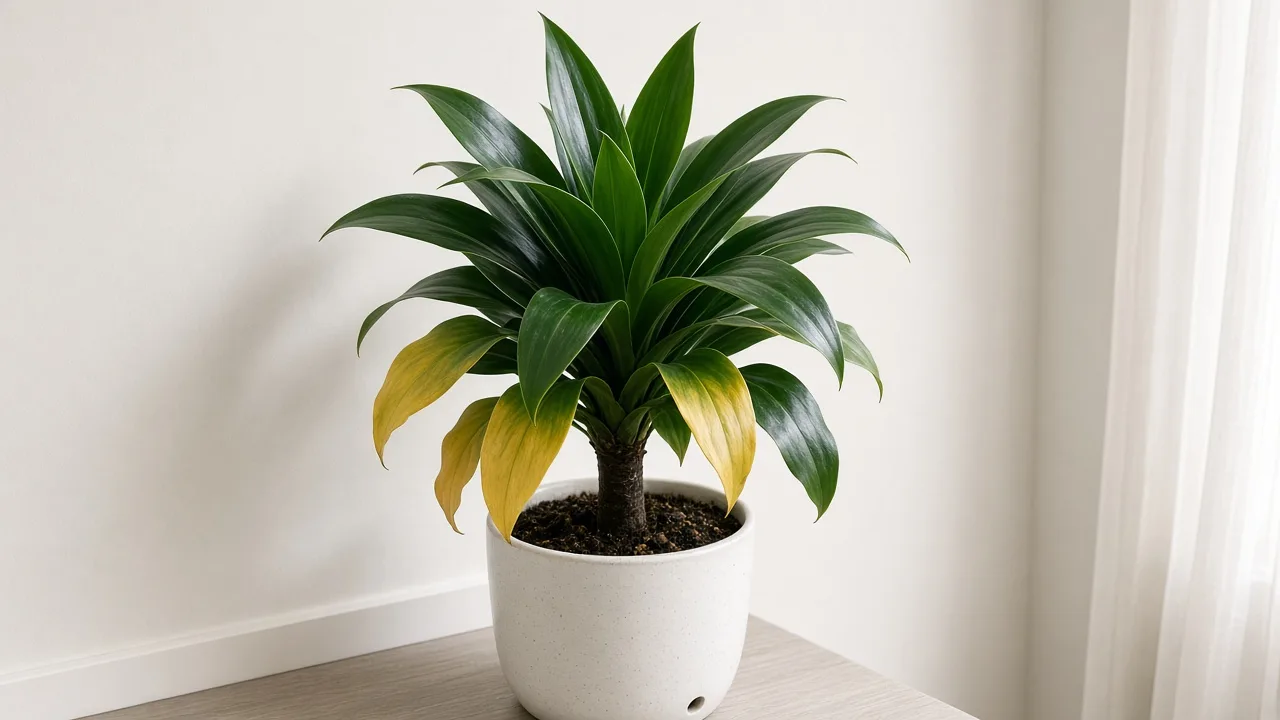
Overwatering on Dracaena Compacta: Causes, Checks & Fixes
This guide covers overwatering on Dracaena Compacta. See also the general Overwatering guide, watering, and light pages for this plant.
Overwatering on Dracaena Compacta: Causes, Checks & Fixes
Quick answer
Dracaena fragrans ‘Compacta’ — Janet Craig Compact — packs corn-plant foliage into a short column of slow canes and tight glossy rosettes. That dwarf habit sits in 6–8 inch pots on desks and side tables, so the same weekly watering instinct that works on a tall floor dracaena can keep Compacta saturated for days.
First step: stop watering and empty every saucer or cache pot. Do not repot, fertilize, or prune until you know whether canes are firm and the top 2 inches of mix are dry. For how chronic wet soil damages roots in general, see our overwatering guide. On Compacta, the pattern usually shows up as yellow lower leaves on heavy wet soil, fungus gnats, or a soft cane base — not always as obvious droop on day one.
What overwatering looks like on Dracaena Compacta
Above the soil line, overwatering on this cultivar is easy to misread because the leaves stay stiff and upright longer than on a limp peace lily. Watch for a cluster of signals together:
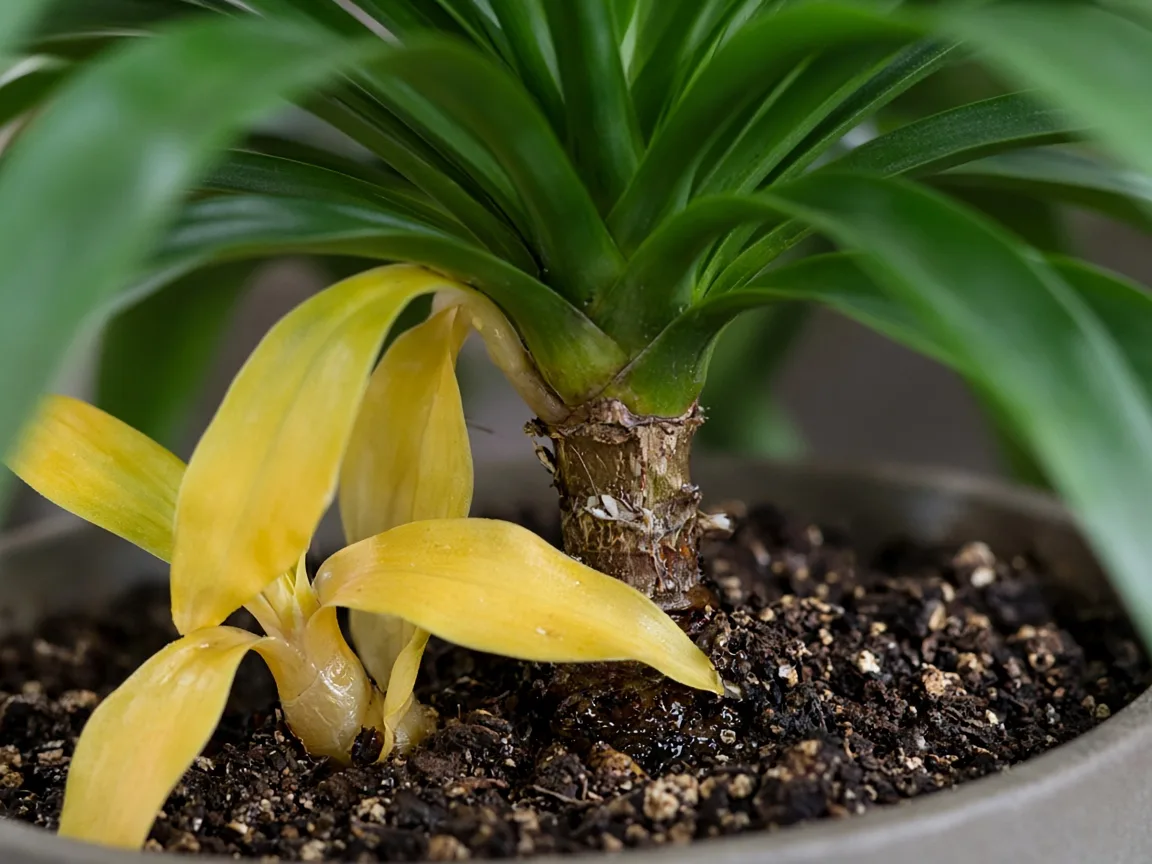
Yellow lower leaves and a damp soil line on Janet Craig Compact — compare with firm upper rosette leaves on the same plant.
- Yellow lower leaves in the tight rosette, often several at once, while the mix still feels cool and damp at a 2-inch depth
- Drooping or dull foliage on wet soil — the whole short rosette may sag slightly even though leaves are thick
- Soil that stays dark and clinging for a week or more after you last watered a small pot
- Fungus gnats on Dracaena Compacta or surface algae on mix that never dries
- A sour or musty smell when you lift the pot or scrape the top layer
- Stalled new leaves at the cane tip while older tiers yellow
The decisive check is at the cane base. Healthy Compacta canes feel hard, like firm green wood. Overwatering and advancing rot show as:
- A squishy or dented cane where it meets the soil
- Brown, black, or translucent roots when you slide the plant out — healthy dracaena roots are pale and firm
- Stem softness spreading upward from the soil line
Missouri Botanical Garden notes that corn plant leaves may brown when soils become too moist or too dry (Missouri Botanical Garden — Dracaena fragrans). On Compacta, uniform yellow lowers on wet mix point to moisture stress at the roots more often than a single dry tip on an otherwise firm plant.
Why the short cane and small pot change the risk
Compacta is still Dracaena fragrans, and Pacific Northwest extension guidance is explicit: allow D. fragrans to dry out; it is easily overwatered (Pacific Northwest Handbooks — Dracaena Tip Burn). The cultivar difference is scale, not tolerance.
Smaller root volume. Most Compacta plants never live in the deep 10–12 inch containers guides assume for corn plants. When 2 inches of dry soil means roughly the upper third of the pot, one extra drink while the middle is still damp keeps the whole root ball anaerobic.
Slow growth uses less water. RHS describes ‘Compacta’ as slow-growing with dense rosettes (RHS — Dracaena fragrans ‘Compacta’). In dim offices or cool winter rooms, transpiration drops, but calendar watering often stays on a summer schedule.
Thick leaves hide early wilt. The tight rosette looks architectural even when roots struggle. Owners wait for obvious collapse — by then the short cane has less healthy tissue between roots and leaves than a tall multi-foot specimen.
Cache pots and saucers. Decorative outer pots without drainage trap runoff. A 6-inch inner pot inside a sealed cache vessel behaves like a standing-water bath after every soak.
Fresh repotting. New peat-heavy mix holds moisture longer than old, root-filled soil. Many owners water on habit right after Dracaena Compacta repotting before learning how the new blend dries on their shelf.
Winter mismatch. RHS advises watering sparingly in winter on dracaenas (RHS — Dracaena fragrans ‘Compacta’). Continuing weekly pours through short days keeps small pots wet while growth stalls.
How to confirm the cause
Work through these checks before repotting or cutting canes:
- Pot weight — A Compacta in plastic should feel noticeably lighter only after the top 2 inches have dried. Heavy and damp days after watering confirms saturation.
- Moisture at 2 inches — Match the Dracaena Compacta watering guide checkpoint. Surface pale crust with wet core still counts as overwatered if you watered recently.
- Cane squeeze — Press the base gently. Firm wood with one yellow lower leaf may be senescence; denting flesh points to rot.
- Smell — Anaerobic mix smells sour at drainage holes.
- Unpot if unsure — Slide the root ball out. Trim only after you see brown mushy roots versus white firm ones.
- Light and season — Weak light on Dracaena Compacta plus unchanged winter watering fits overwatering better than sudden pest attack.
If mix is dry throughout, the pot is light, and canes are firm, yellowing may be underwatering, low humidity, or normal old-leaf drop — not chronic wet feet.
First fix for Dracaena Compacta
Stop watering and remove standing water from saucers, cache pots, and pebble trays.
That pause prevents new damage while you confirm cane firmness. Move the plant to bright indirect light if it sits in deep shade — faster evaporation helps a small pot dry evenly without baking the rosette.
Do not repot on day one unless the cane is already mushy and the mix smells foul. Do not fertilize yellow leaves hoping for green-up — salts on stressed roots worsen tip burn on fluoride-sensitive dracaenas (Pacific Northwest Handbooks — Dracaena Tip Burn).
Step-by-step recovery
Mild case — damp soil, firm canes, early yellow lowers
- Withhold water until the top 2 inches are dry — often 10–21 days indoors depending on season.
- Improve airflow slightly and ensure the pot is not sealed inside a cache vessel.
- Water one thorough soak when the 2-inch test passes; empty the saucer within 15 minutes.
- Remove fully yellow leaves at the base with clean scissors; they will not re-green.
Moderate case — sour smell, soft cane edges, several yellow tiers
- Unpot and knock away wet mix gently.
- Trim mushy roots and soft cane tissue with sterile blades until you reach firm white roots and hard cane.
- Air-dry the root ball on newspaper for 24–48 hours in bright indirect light.
- Repot into dry, well-draining mix per the soil guide — same size or slightly smaller pot, never oversized.
- Wait 7–14 days before the first light watering; use the 2-inch rule thereafter.
- Hold fertilizer until new rosette leaves look glossy for several weeks.
Severe case — mushy base, collapsing rosette
- Salvage firm cane sections above rot. If the entire base is soft, recovery is unlikely — take healthy cane cuttings for propagation before tissue fails.
- Discard soggy mix and wash or replace the container.
- Route advanced rot symptoms to root rot on Dracaena Compacta for salvage detail.
Recovery timeline
Mild overwatering with firm canes often stabilizes in two to four weeks once soil dries and watering resets. Yellow leaves drop and do not revert; judge progress by firm canes and clean new leaves at the rosette tip.
Moderate rot recovery on slow Compacta can take one to three months. A firm cane with no new soft spots is a win even when the plant looks sparse.
Severe base rot rarely rebuilds a bushy silhouette quickly. If softness climbs the cane after trim and dry repot, shift to propagation rather than repeated rescue attempts.
Fluoride brown tips versus true overwatering
Compacta owners often blame brown tips on thirst or humidity when the real issue is fluoride in tap water — dracaenas accumulate fluoride in leaf margins (Pacific Northwest Handbooks — Dracaena Tip Burn). That pattern is marginal necrosis on firm canes with dry-to-normal soil, not yellow clusters on soggy mix.
| Pattern | Likely cause | Next step |
|---|---|---|
| Yellow lowers, wet 2-inch soil, heavy pot | Overwatering / early rot | Pause water; inspect base |
| Brown tips only, firm cane, dry top 2 inches | Fluoride or dry air | See brown tips; try rainwater |
| Drooping rosette, light pot, dusty mix | Underwatering | Deep soak after dry test |
| Yellow leaves, wet soil, gnats | Overwatering | Pause water; dry-down cycle |
Lookalike symptoms to rule out
Underwatering — Light pot, dry mix throughout, thin or wrinkled leaf edges on firm canes. A deep soak perks the rosette within days.
Fluoride / salt tip burn — Brown margins with firm wood and manageable soil moisture. Switch to rainwater or filtered water per watering guidance.
Low light yellowing — Pale, stretched growth in dim rooms without wet soil or soft canes. Improve light before assuming rot.
Normal senescence — One older lower leaf yellows on an otherwise firm plant with appropriate dry-down. Remove the leaf; do not flood the pot.
Wilting on wet soil — Can overlap with wilting and drooping leaves when roots are damaged; confirm smell and cane firmness.
Mistakes to avoid
Do not water because the rosette looks stiff — Compacta leaves stay upright longer than thin-leaved plants even when roots are struggling.
Do not upsize the pot to “fix drainage.” A larger wet zone makes small-rooted Compacta worse.
Do not mist heavily hoping to fix yellow lowers — humidity rarely fixes anaerobic soil; Cafe Planta ties yellow leaves to checking soil moisture, not spraying foliage.
Do not confuse fluoride tip burn with rot and keep pouring water on already wet mix.
Do not fertilize during recovery. Missouri Botanical Garden warns that leaves brown when soils swing too wet or too dry (Missouri Botanical Garden — Dracaena fragrans) — adding salts on damaged roots adds another stressor.
How to prevent overwatering next time
Water on the 2-inch test, not the calendar. RHS general dracaena advice is to water when the top 5 cm feels dry (RHS — How to grow dracaena) — the same depth as Compacta’s top-2-inch rule in inch-based pots.
Use peat-free, well-draining mix with perlite or bark and a pot with open drainage holes.
Right-size the container — modest room around the cane clump, not a large decorative bowl.
Reduce winter frequency when growth slows (RHS — Dracaena fragrans ‘Compacta’).
Empty saucers within 15 minutes of every soak.
Learn post-repot drying — fresh mix in a new soil blend often stays wet longer than expected.
When to worry
Treat as urgent when the cane collapses, softness spreads above the soil line, or most of the rosette yellows on soil that never dries. Compacta has little cane length between roots and leaves — rot reaches the crown faster than on a tall corn plant.
A firm cane, one yellow lower leaf, and drying soil after you pause watering is not an emergency. Mushy base tissue on wet mix is — move to root inspection within days.
Conclusion
Overwatering on Dracaena Compacta is usually a small-pot, calendar-watering mistake on a slow, fluoride-sensitive fragrans cultivar. Pause irrigation first, confirm cane firmness at the soil line, then dry out or trim rot before restarting soaks tied to the top 2 inches — not sympathy for a sculptural rosette. Firm canes and glossy new tip leaves mean you corrected the problem; spreading softness means act fast or salvage cane cuttings.
When to use this page vs other Dracaena Compacta guides
- Dracaena Compacta watering — Routine dry-down checks before assuming overwatering is the main issue.
- Dracaena Compacta problems hub — Browse all common issues on this species.
- Root rot on Dracaena Compacta — When mushy roots and sour smell dominate.
- Yellow leaves on Dracaena Compacta — Broader yellowing causes including light and age.
- Wilting on Dracaena Compacta — When collapse happens on wet or dry soil.
Related Dracaena Compacta guides
- Dracaena Compacta overview
- Dracaena Compacta watering
- Dracaena Compacta light
- Dracaena Compacta soil
- Root rot on Dracaena Compacta
- Yellow leaves on Dracaena Compacta
- Fungus gnats on Dracaena Compacta
- Brown tips on Dracaena Compacta
- Dracaena Compacta problems
Related tool
Use the Root Rot Risk Checker to narrow causes for overwatering on this plant before changing multiple variables at once.