Spider Mites on Dracaena Compacta: Rosette Stippling & Fixes
Quick answer
Spider mites on Dracaena Compacta show pale stippling and fine webbing between tightly stacked glossy leaves—often after hot, dry air near heating vents or dusty desk placement. First step: isolate the plant, separate stacked leaves gently, and rinse every underside with lukewarm water before reaching for sprays.
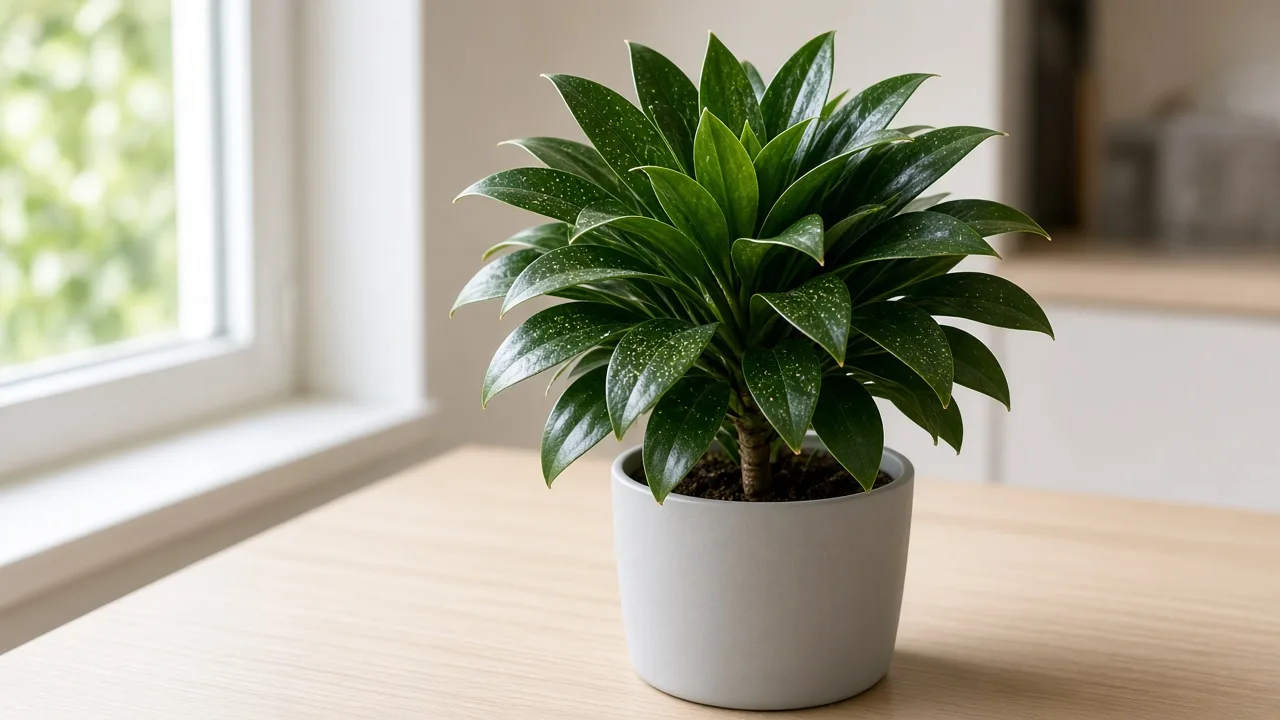
Spider Mites on Dracaena Compacta: Causes, Checks & Fixes
This guide covers spider mites on Dracaena Compacta. See also the general Spider Mites guide, watering, and light pages for this plant.
Spider Mites on Dracaena Compacta: Causes, Checks & Fixes
Quick answer
Spider mites on Dracaena fragrans ‘Compacta’ (Janet Craig Compact) are sap-feeding arachnids that leave pale yellow or bronze stippling on short, glossy, tightly stacked leaves and sometimes spin fine silk between overlapping blades in the rosette crown. Hot, dry indoor air—common beside heating vents and sunny winter windows—speeds their spread.
For mite life cycles, why broad-spectrum insecticides can backfire, and when water sprays work in general, see our spider mites pest guide. On Compacta, the decisive pattern is speckled leaf faces plus webbing or moving specks in the stacked crown—not brown tips alone (brown tips) or yellow lower leaves on wet mix (overwatering). Colorado State Extension notes that dracaenas are common hosts for twospotted spider mite indoors.
First step: isolate the plant if neighbors share a shelf, gently fan apart stacked leaves, and rinse every underside under lukewarm running water—then re-inspect in three to five days before spraying anything.
When to use this page vs other Dracaena Compacta guides
This page is the pest-first entry for stippling and webbing on tight rosette leaves.
| Pattern | Read next |
|---|---|
| White cottony masses in leaf axils or cane bases | Mealybugs |
| Brown margins only, no speckling or webbing | Brown tips or low humidity |
| Yellow lower leaves, soggy soil, no mites | Overwatering or yellow leaves |
| Whole rosette limp, light pot, no specks | Underwatering or wilting |
| Leggy sparse canes, no pest signs | Not enough light or leggy growth |
What spider mites look like on Dracaena Compacta
Early damage is easy to miss because Compacta’s leaves stay upright and glossy while the plant still looks “fine” from across the room. Mites feed on undersides first, so stippling shows on the flat leaf faces you see head-on—tiny pale dots that later merge into a dull, bronzed patch.
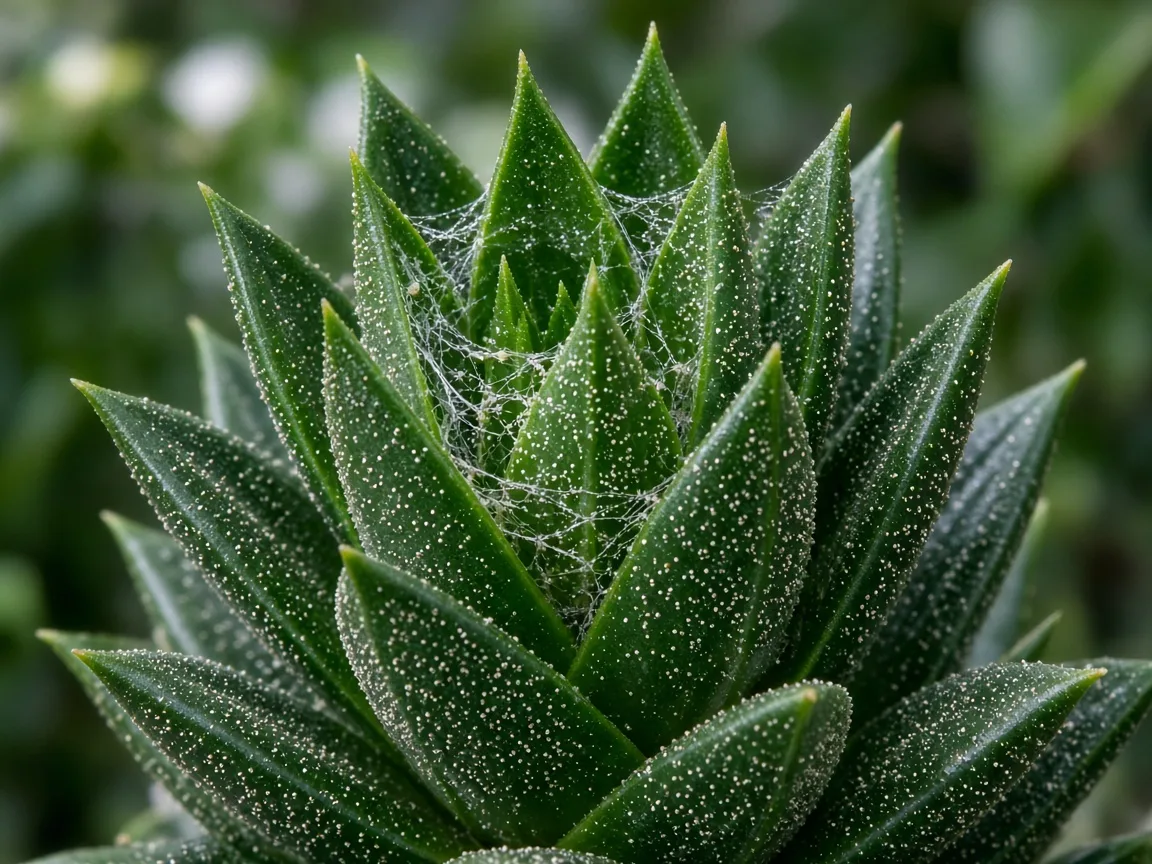
Pale stippling and fine silk between overlapping glossy leaves—compare with a clean blade on the same cane.
- Pinhead yellow or silvery dots on dark green leaves — Feeding wounds appear as white flecks that generalize into graying or bronzing
- Fine webbing between stacked leaves — Silk at the base of the tight rosette or between leaf layers; webbing distinguishes mites from fluoride tip burn
- Dull, dusty-looking rosette — Loss of even gloss while short canes stay firm
- Tiny moving specks on white paper — Adults are roughly 1/50 inch long; a tap test confirms live mites
- Premature leaf drop in heavy cases — Heavily infested leaves may drop early on susceptible houseplants
Where mites hide in stacked Compacta rosettes
Unlike long strap-leaved corn plants, Compacta packs many short blades into a dense column. Spider mites exploit the shingle-like overlap where owners rarely look.
Spider mites live in colonies, mostly on leaf undersides. On Janet Craig Compact, inspect in this order:
- Undersides of the newest tight flush — Where stippling appears first on the visible leaf face
- Gaps between overlapping leaves on the same cane — Fine webbing bridges two blades at once
- The crown where leaves meet the short cane — Dust and silk collect in the narrow pocket
- Lower outer leaves touching the pot rim — Often brushed less often during watering
- Neighboring plants on the same desk or plant stand — Mites crawl short distances or ride air to other plants
Gardening guides for dracaena pests recommend checking under sword-like leaves, along the trunk, and at the base—on Compacta, translate “trunk” to each short cane and the stacked rosette above it.
Fluoride brown tips vs true mite stippling
Dracaena fragrans is sensitive to fluorides and built-up salts, which commonly produce brown leaf margins and tips when tap water or dry winter air stresses the plant. That pattern is different from spider mite damage.
| Clue | More likely fluoride or dry air | More likely spider mites |
|---|---|---|
| Damage location | Tips and margins | Speckles across the leaf blade |
| Webbing | None | Fine silk between leaves |
| Tap test | No moving specks | Moving dots on white paper |
| Soil pattern | May match normal dry-down | Soil moisture does not explain speckling |
| Humidity story | Low humidity browning without dots | Hot dry site plus dusty leaves |
If you only see tip burn on a few older outer leaves and the crown stays glossy with no webbing, start with water quality and humidity before a mite protocol. If stippling spreads on inner leaves with silk, treat as mites.
Why Dracaena Compacta gets spider mites
Spider mites thrive when indoor air runs hot and dry—exactly the microclimate beside radiators, heat registers, and south-facing winter glass. Compacta is often placed on desks and side tables in those spots because it tolerates lower light, but the same placement favors mites.
Contributing factors on this cultivar:
- Dust on glossy leaves — Dusty foliage attracts spider mites and blocks light on slow-growing rosettes you may not wipe often
- Slow growth masking damage — Stippling can sit on a leaf for weeks; see slow growth on Dracaena Compacta for how little new tissue appears each month
- Tight leaf stacks — Mites stay shaded and humid enough between blades while the room air stays dry
- Collection spread — New plants or outdoor summer stays can introduce mites that move across touching leaves on crowded shelves
Compacta is not uniquely weak, but its dense habit rewards weekly underside checks more than occasional top-only glances.
How to confirm the cause
Work through this list before changing watering or fertilizer:
- Isolate the plant from other houseplants on the same furniture.
- Fan apart stacked leaves gently and inspect undersides with bright light.
- Run a white-paper tap test on a stippled leaf.
- Look for webbing between leaf bases—not only on tips.
- Scan neighbors — especially other dracaenas, figs, and ivies listed as common mite hosts.
- Note placement — heating vents, sunny winter window, time since leaves were cleaned.
Confirmed mites need a repeat rinse or spray plan. Tip-only browning without specks or webbing points to culture issues first.
First fix for Dracaena Compacta
Isolate, rinse every underside, and schedule repeats before stacking other fixes.
Move the plant to a separate spot. Support the short cane with one hand and rinse leaf undersides under lukewarm water—sink or shower—using a forceful but controlled stream where possible. Wrap the pot if soil splash is a concern. Let foliage dry fully.
Because contact sprays have no residual activity, plan another rinse or a labeled insecticidal soap or horticultural oil in five to seven days, coating undersides and leaf axils. Make this single correction before repotting, pruning heavily, or fertilizing a stressed rosette.
Step-by-step recovery
- Day 0 — isolate, rinse or wipe all leaf surfaces, especially undersides in the stack.
- Days 5–7 — repeat rinse; add soap or oil if mites persist; inspect with magnification.
- Days 10–14 — third cycle; check plants that sat nearby before isolation.
- Week 3 onward — if stippling has not spread and webbing is gone, move to monthly wipe-downs. If mites remain, continue weekly treatments or discard severely infested plants to protect the collection.
- Trim optional — remove badly bronzed outer leaves for appearance once mites are gone; they will not re-green.
Slightly higher humidity around the plant can discourage new outbreaks, but humidity alone will not clear an active colony without physical removal and repeats.
Recovery timeline
Existing stippled tissue on Compacta’s short leaves rarely returns to deep, even green. Judge success by clean new leaves in the tight crown and no fresh webbing for two to three weeks. Because growth is slow, cosmetic recovery may take a full growing season unless you remove scarred blades.
If three weekly treatment cycles pass and you still see live mites, horticultural oils are among the more effective options for twospotted spider mite on houseplants. Repeat soap applications every four to seven days to catch newly hatched mites.
What not to do
- Do not mist the crown heavily hoping to kill mites—water between stacked leaves without drying can add stress without reaching colonies deep in the stack. Rinse and wipe instead.
- Do not stop after one spray — eggs survive a single pass; plan multiple cycles.
- Do not apply soap or oil in hot direct sun — treat in cooler parts of the day; avoid applications above about 90°F when possible.
- Do not fertilize until feeding damage stops spreading and new growth looks normal.
- Do not return the plant to a crowded shelf until at least three weeks of clean checks.
- Do not assume underwatering because leaves look dull—compare stippling and webbing before changing your watering rhythm.
Lookalike symptoms on Dracaena Compacta
| What you see | More likely cause | How to tell apart |
|---|---|---|
| Brown tips only | Fluoride, low humidity, salts | Margins only; no blade stippling; no webbing |
| Soft cane at soil line | Root rot / overwatering | Wet heavy pot; base yields; sour smell |
| White cottony tufts | Mealybugs | Wax patches, not uniform speckling |
| Uniform pale rosette in dim corner | Low light over months | Gradual; no tap-test specks |
| Speckling + webbing | Spider mites | Moving dots on paper; silk between leaves |
Dracaena Compacta care cross-check
While treating mites, keep culture steady:
- Light — Bright indirect light without baking the rosette against hot glass
- Water — Dry down the top 2 inches before watering; drought stress and pest stress are separate problems
- Soil — Well-draining mix per the soil guide; soggy roots do not explain mite stippling
- Leaf hygiene — Monthly wiping removes dust that attracts mites and blocks light
- Quarantine — Isolate new plants before mixing them with Compacta on a desk display
Pet note: Janet Craig Compact is toxic to cats and dogs. Keep treated plants and rinse water away from pets during treatment; contact your veterinarian if a pet chews leaves.
How to prevent it next time
- Wipe both sides of stacked leaves monthly.
- Keep pots away from heating vents and hot window ledges in winter.
- Quarantine new purchases for two to three weeks.
- Inspect undersides when you water—even if that is only every 7–14 days in summer.
- Check neighboring plants whenever you find mites on one Compacta.
- Avoid letting several plants touch leaf-to-leaf on a crowded tabletop.
A firm cane, glossy tight rosette, and clean newest leaves are the best long-term signs mites are not gaining ground.
When to worry
Escalate quickly if:
- Webbing spans multiple layers in the crown.
- Stippling reaches every new leaf in the rosette.
- Mites appear on other plants in the same room.
- Leaves drop despite treatment.
- Three full treatment cycles still show live mites under magnification.
At that point, heavily infested plants may need to be discarded—bagged before removal—to protect the rest of your collection. Compacta is replaceable; a room-wide mite outbreak is harder to fix.
Practical checks
Urgency check
Treat as urgent when webbing is present, stippling spreads week to week, or more than one plant on the desk shows the same pattern. Stable stippling on one outer leaf with no webbing gives you time to confirm.
Best inspection order
For Compacta, inspect newest stacked undersides, silk between leaf bases, neighboring plants, then placement relative to heat sources. Confirm with a tap test before spraying.
Severity note
This issue is marked medium for Dracaena Compacta—a triage clue, not a guarantee. A small early colony on one cane is manageable; a webbed crown with collection spread is high severity in practice.
Spider mite confirmation rule
Do not treat as spider mites until you have stippling or bronzing plus webbing, moving specks on a tap test, or visible mites on undersides. Tip browning alone points elsewhere.
Escalation point
Move to discard-or-aggressive-treatment if three weekly cycles fail, the crown becomes heavily webbed, or mites reappear on plants that looked clean.
Compacta prevention note
Janet Craig Compact belongs where bright indirect light is realistic and stacked leaves can be wiped without sitting in a hot dry air stream all day. Water when the top 2 inches dry. Dusty rosettes beside a heating vent are a predictable mite setup—a placement and hygiene signal, not a failure of the cultivar.