Aphids on Epipremnum Pinnatum: Causes, Checks & Fixes
Quick answer
Aphids on Epipremnum Pinnatum show up as soft clusters on the newest blue-green juvenile leaves, unfurling moss-pole shoots, and moist leaf axils where aerial roots attach—often with sticky honeydew on leaves below. First step: isolate the vine and shower-rinse leaf undersides and stems with lukewarm water before reaching for sprays.
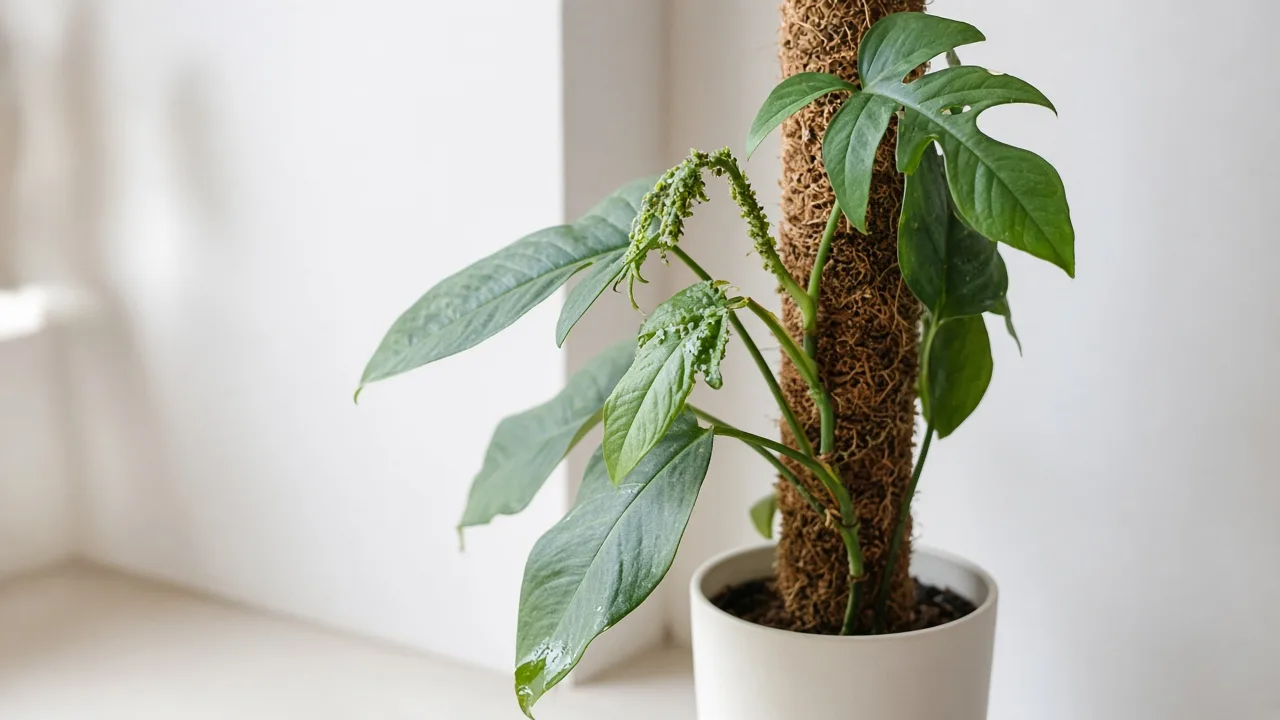
Aphids on Epipremnum Pinnatum: Causes, Checks & Fixes
This guide covers aphids on Epipremnum Pinnatum. See also the general Aphids guide, watering, and light pages for this plant.
Aphids on Epipremnum Pinnatum: Causes, Checks & Fixes
Quick answer
Aphids on Epipremnum pinnatum—the species behind Dragon Tail Plant, Silver Vine, and the popular Cebu Blue cultivar—are small, soft-bodied sap feeders that colonize the tender tissue this fast climbing aroid keeps producing at vine tips, moss-pole axils, and newly unfurling juvenile leaves. In bright indirect light the vine pushes soft shoots through spring and summer, and aphids prefer that lush new growth over older hardened blades.
For how aphids reproduce, why ants defend them, and when water knockdown works in general, see our aphids pest guide. On Epipremnum Pinnatum the practical pattern is colonies on the last few nodes of a trailing basket, sticky honeydew on silvery juvenile leaves below, and hidden clusters where aerial roots meet a damp moss pole—not a mysterious whole-plant collapse.
First step: isolate the vine and shower-rinse leaf undersides and stems with lukewarm water. Move a hanging basket to the shower or use a sink sprayer for smaller pots. Bag the pot to keep mix contained. Confirm live insects before adding soap or oil—many sticky-leaf reports on Cebu Blue turn out to be honeydew from aphids, not a separate disease.
When to use this page vs other Epipremnum Pinnatum guides
This page is the pest-first entry for soft-bodied sap feeders on new vine growth.
- Epipremnum Pinnatum overview — species identity, cultivars, and moss-pole fenestration goals.
- Watering — use when wilt or yellow leaves might be moisture stress instead of insects.
- Yellow leaves — different entry when lower blades yellow without confirmed colonies.
- Mealybugs — cottony masses in axils rather than loose pear-shaped clusters on tips.
- Spider mites — stippling and webbing in hot dry air, not heavy honeydew.
- Problems hub — browse all common issues on this species.
Why Epipremnum Pinnatum gets aphids
Epipremnum Pinnatum is a vigorous hemiepiphyte that keeps extending long vines when light and water support growth. That habit is exactly what aphids exploit. Aphids use slender mouthparts to pierce stems and leaves and suck fluids, concentrating on the softest tissue available—which on this species means pale new petioles, juvenile arrow leaves still gaining size, and the moist junction where a vine wraps a moss or coir pole.
Most indoor infestations start with introduction, not spontaneous generation. Aphids may arrive on new nursery plants or enter through open windows and then crawl or fly short distances to neighbors. Cebu Blue hanging baskets, moss-pole specimens on shelves, and patio summering vines are common entry routes. Honeydew from upper feeding sites drips onto silvery lower leaves and furniture, which is why owners notice tackiness on blades that look clean on top.
Soft juvenile tips and moss-pole axils
Retail E. pinnatum is often sold as Cebu Blue in juvenile form: narrow blue-green arrow leaves on a trailing vine. Each new leaf passes through a vulnerable window while the blade is still thin and the petiole is pale. Aphids thrive on lush new growth, and a well-fed vine in a bright east window can produce successive soft leaves faster than you expect. Colonies tucked against a still-tight juvenile leaf are sheltered from casual inspection until honeydew appears on the leaf below.
When you train the same species up a moss pole, aerial roots attach in humid axils. Those pockets stay slightly moist during regular pole misting and create a second favorite hideout—especially on Baltic Blue or wild-type Dragon Tail plants pushing larger split leaves. Aphids here are easy to miss because owners admire fenestration on the upper blade and never peel back the leaf base where the vine grips coir.
Trailing bare vines vs active nodes
A long bare stem with only the last two nodes carrying leaves is typical on neglected trailing pots. Aphids often concentrate on those active nodes while the rest of the vine looks pest-free. That pattern tricks growers into treating one leaf and missing colonies on a second vine tip in the same basket. Always inspect every growing point, including side shoots you plan to prune later.
Recent fertilizer after a bright spring stretch can push soft shoots that aphids colonize faster than firm mature tissue. This does not mean you should starve a healthy plant, but it explains why a recently fed Cebu Blue in a sunny window can show aphids before a slow-growing corner plant.
What aphids look like on Epipremnum Pinnatum
Typical aphid signs on this species:
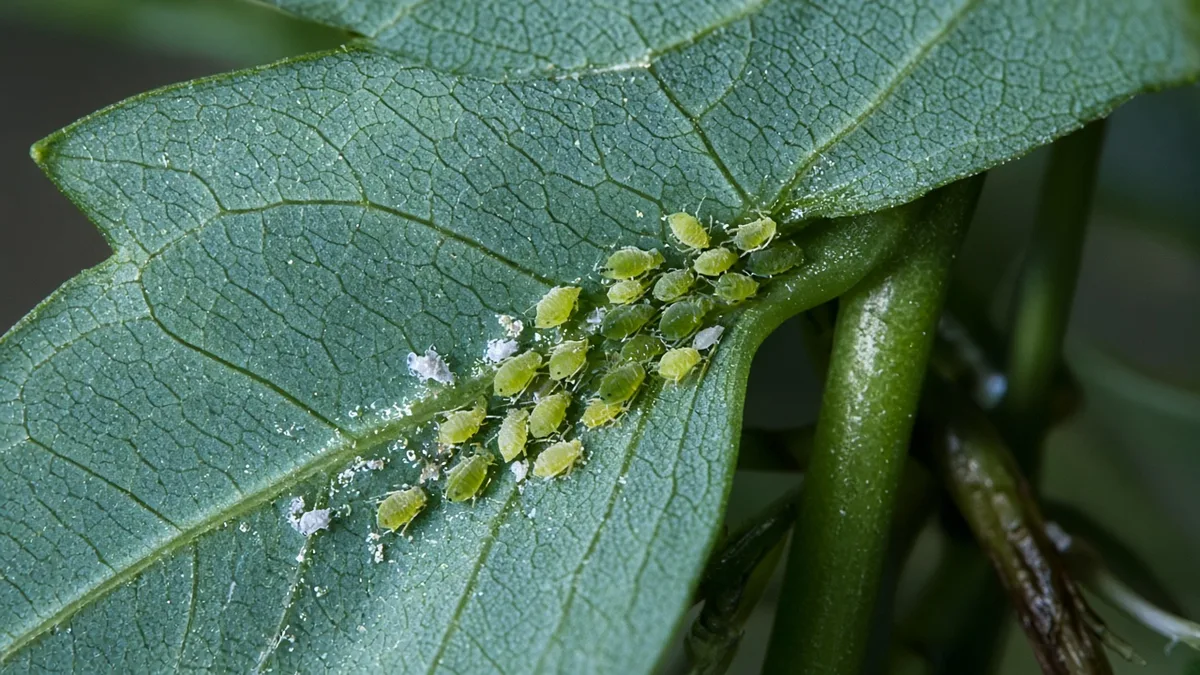
Aphid clusters on Epipremnum Pinnatum - compare with healthy tissue on the same vine.
- Soft pear-shaped insects about 1/16 to 1/8 inch long, usually green but sometimes black, brown, yellow, or white
- Dense clusters on the newest juvenile arrow leaves, pale petioles, and moss-pole axils where aerial roots attach
- Shiny sticky honeydew on silvery blue blades, stems, shelves, or floors below feeding sites
- Black sooty mold that wipes off with a damp cloth—fungus growing on honeydew, not leaf tissue
- New leaves curling, puckering, or staying smaller than neighboring nodes when feeding is heavy
- Yellowing on individual young blades or stalled extension on a formerly fast vine
- Whitish cast skins shed by growing nymphs, often stuck near colonies
- Ants traveling along pot rims, hangers, or moss poles when honeydew farming is involved
On Epipremnum Pinnatum, vine tips and moss-pole axils carry most colonies. A single aphid is easy to miss on a plant with dozens of leaves; look for groups, sticky residue, and the narrow zone of new growth at each vine end rather than scanning every mature split blade on a tall pole.
How to confirm the cause
Work through these checks in order before you treat:
- Vine-tip pass - Follow each active shoot to its end. Gently inspect the newest juvenile leaf still tightening around the shoot and the petiole base with a hand lens. Aphids cluster on soft tissue before older leaves show damage.
- Moss-pole axils - Where the vine wraps the pole, peel back the leaf base slightly and check the damp crease where aerial roots grip coir. Sticky residue or soft bumps here confirms sap feeders even when upper fenestrated blades look clean.
- Underside pass - Lift hanging strands and inspect backs of the upper third of the plant where growth is newest. Many aphid species prefer the underside of leaves.
- Movement test - Touch a suspect cluster with a cotton swab. Aphids move slowly; crushed bodies leave a green or brown smear. Mineral dust and dried water spots do not.
- Honeydew trail - Check silvery leaves and surfaces directly below the pot. Localized tackiness below growing tips points to aphids above, not whole-plant humidity issues.
- Neighbor scan - Inspect other aroids on the same shelf or hanger. Aphids spread by crawling and short flight between pots in tight displays.
If you find insects plus honeydew, aphids are confirmed. If leaves are sticky but no insects appear after two careful searches a few days apart, reconsider mealybugs (cottony masses in axils), scale insects (hard domes on thick petioles), spider mites (fine stippling and webbing in hot dry air), or guttation (clear water beads at leaf margins after watering—not sugary tackiness).
First fix for Epipremnum Pinnatum
Isolate the vine and shower-rinse leaf undersides and stems with lukewarm water.
Move the plant away from other aroids—into a shower for hanging baskets, or a large sink for smaller pots. Bag the pot to keep mix contained. Wash plants with lukewarm water to remove aphids, honeydew, and sooty mold, angling the spray so undersides of arrow-shaped leaves get direct contact. Support thin petioles with one hand while you rinse so soft juvenile blades do not tear.
This one step is the right first response because it knocks off live insects without chemical risk to blue-toned foliage, clears fresh honeydew before ants arrive, and lets you see how large the colony actually is. Aphids drop when disturbed but may climb back, so plan on repeats—not a single splash.
Do not spray insecticidal soap or neem on day one if you have not confirmed insects. Do not fertilize a pest-hit vine hoping to replace damaged leaves; soft nitrogen-driven growth feeds the next generation.
Step-by-step recovery
After the initial rinse:
- Repeat water washes every two to three days until live aphids are gone on inspection. Epipremnum Pinnatum handles repeated rinsing well when foliage dries the same day—avoid leaving wet leaves pressed against a wall overnight.
- Prune isolated hotspots if one vine tip carries dense colonies inside a curled juvenile leaf. Snip back to healthy tissue and dispose of cuttings in sealed trash—not the compost pail indoors.
- Apply insecticidal soap if rinsing alone does not control the population after one week. Insecticidal soaps kill by smothering and require direct contact. Coat undersides, axils, and moss-pole contact points thoroughly; repeat every four to five days through at least three applications.
- Add neem oil only if soap falls short on persistent colonies. UMN Extension lists neem as effective against aphids on indoor plants. Test one newly unfurled leaf first if the plant was recently stressed by sun or drought.
- Wipe sooty mold off lower leaves with a damp cloth once honeydew production stops.
- Re-check neighbors weekly for two weeks after the vine looks clean. Aphids reproduce quickly in warm rooms—each adult can produce many offspring within days.
Reserve systemic insecticides for severe, repeated infestations on high-value specimens, and use them only according to label directions for indoor ornamentals. They are a later escalation, not a first fix.
Recovery timeline
Water rinses show results within two to three days when colonies are small and confined to one or two vine tips. Moderate infestations across several active nodes may need one to two weeks of wash-and-soap cycles before new growth emerges clean. Because Epipremnum Pinnatum grows fast in warm bright conditions, judge success by uninfected leaves at vine ends—not by whether old blemished blades revert.
Sooty mold fades as honeydew dries up; expect cleaner-looking lower leaves within one to three weeks after insects stay gone. Severely distorted juvenile leaves that already hardened may keep their curl; trim them for appearance once the plant is pest-free.
Lookalike symptoms to rule out
Mealybugs form white cottony masses in leaf axils and along stems—not loose pear-shaped clusters on unfurling tips. See the mealybugs guide for alcohol-swab routing.
Scale insects show hard brown or tan domes on thick petioles. They do not cluster as soft groups on the newest arrow leaf.
Spider mites cause fine stippling and webbing in hot dry conditions, not heavy stickiness. Confirm with a white-paper tap test under suspected leaves on the spider mites page.
Fungus gnats point to chronically wet mix, not honeydew on leaf blades. See fungus gnats if tiny flies rise from soil after you water.
Normal guttation can leave tiny clear droplets on leaf margins after thorough watering. Guttation is water, not sticky honeydew, and appears without insects or ants.
Mistakes to avoid
Do not treat only the dramatic upper surfaces of split mature leaves. Epipremnum Pinnatum hides aphids on juvenile tips, moss-pole axils, and the backs of the newest blue-green blades.
Do not return an isolated plant to a mixed collection after a single rinse. Quarantine until pest-free for at least two weeks of monitoring.
Do not use homemade dish soap sprays. Commercial insecticidal soap is formulated for plants; harsh detergents can burn thin juvenile foliage.
Do not soak the moss pole with soap or oil unless you can rinse it the same day—saturated coir that stays wet invites root stress on a plant you are already treating for pests.
Do not over-fertilize during recovery. Lush nitrogen-driven shoots give aphids more feeding sites.
Because Epipremnum Pinnatum has medium-severity poison characteristics if ingested, keep rinsed leaves, pruned cuttings, and treated foliage off floors where pets chew while sprays dry. Pick a higher shelf or pet-safe alternative for trailing vines in cat-heavy homes.
Epipremnum Pinnatum care cross-check during treatment
Aphids are a pest problem first, but weak vines recover more slowly. Confirm the basics while you treat:
- Light - Bright indirect light supports steady growth without the ultra-soft shoots that appear when a plant is pushed with heavy feed in harsh direct sun. See the light guide for placement.
- Water - Water when the top 3–5 cm of mix dries. Chronically wet soil will not cause aphids, but it stresses roots and slows the new growth you are using as a recovery signal. Match rhythm to the watering guide.
- Soil and pole - Use airy, well-drained mix per the soil guide. A waterlogged pole or dense peat mix slows recovery even after insects are gone.
- Fertilizer - Hold feeding until new growth emerges clean. Resume moderate applications only after at least two weeks without live aphids.
How to prevent aphids next time
Quarantine new vines for two to four weeks before mixing them in a shared room. Inspect regularly during isolation and treat hitchhikers before integration.
Scout vine tips weekly during fast growth in spring and summer. A ten-power hand lens makes early colonies visible on pale petioles before honeydew spreads across silvery leaves.
Let foliage dry after rinses so moist axils on moss poles do not stay soggy for days.
Avoid excess nitrogen that produces large soft shoots with tender tissue. Moderate fertilizer reduces lush aphid-friendly growth without starving the plant.
Check patio specimens before indoor return in fall. Outdoor vines often look clean on upper surfaces while aphids hide on undersides and in axils.
When to worry and escalate
Treat as urgent when honeydew and sooty mold spread across most of the canopy within a few days, ants swarm multiple stems, or colonies jump to several plants in one room. Large aphid populations can yellow leaves and stunt shoots; a formerly fast Cebu Blue with stalled tips after heavy feeding may need aggressive pruning plus repeated treatment.
Escalate when three weekly soap cycles fail to reach colonies hidden inside tight juvenile leaves or along a moss pole you cannot rinse thoroughly.
Discard extremely infested small cuttings if every active tip carries colonies and rinsing fails after two weeks. Propagation from a clean node is often faster than fighting entrenched aphids on a dense multi-vine basket.
Epipremnum Pinnatum rarely dies from aphids alone when roots are healthy. Worry when pest pressure combines with root rot, severe leggy growth from low light, or repeated reinfestation because neighbors were never treated.
Conclusion
Aphids on Epipremnum Pinnatum concentrate on the soft new growth this climbing aroid keeps producing—juvenile arrow tips, moss-pole axils, and pale petioles on fast spring vines. Isolate, shower-rinse undersides first, and repeat until every active node stays clean. That path stops honeydew before sooty mold and ants complicate the job, and it keeps chemical treatments as a second step rather than the default.
For the full care picture, see the Epipremnum Pinnatum overview, plus guides on watering, light, soil, and related pest pages for mealybugs and spider mites.
Related Epipremnum Pinnatum guides
- Epipremnum Pinnatum overview
- Epipremnum Pinnatum watering
- Epipremnum Pinnatum light
- Epipremnum Pinnatum soil
- Epipremnum Pinnatum fertilizer
- Mealybugs on Epipremnum Pinnatum
- Spider mites on Epipremnum Pinnatum
- Yellow leaves on Epipremnum Pinnatum
- Epipremnum Pinnatum problems
Related tool
Use the Pest Identifier Tool to narrow causes for aphids on this plant before changing multiple variables at once.