Root Rot on Epipremnum Pinnatum: Causes, Checks & Fixes
Quick answer
Root rot on Epipremnum Pinnatum starts when moist, well-drained mix stays saturated too long—common in dim corners, cachepots, or winter calendar watering. First step: stop watering, lift the pot, and unpot to pinch roots before you add more water to limp blue-green leaves.
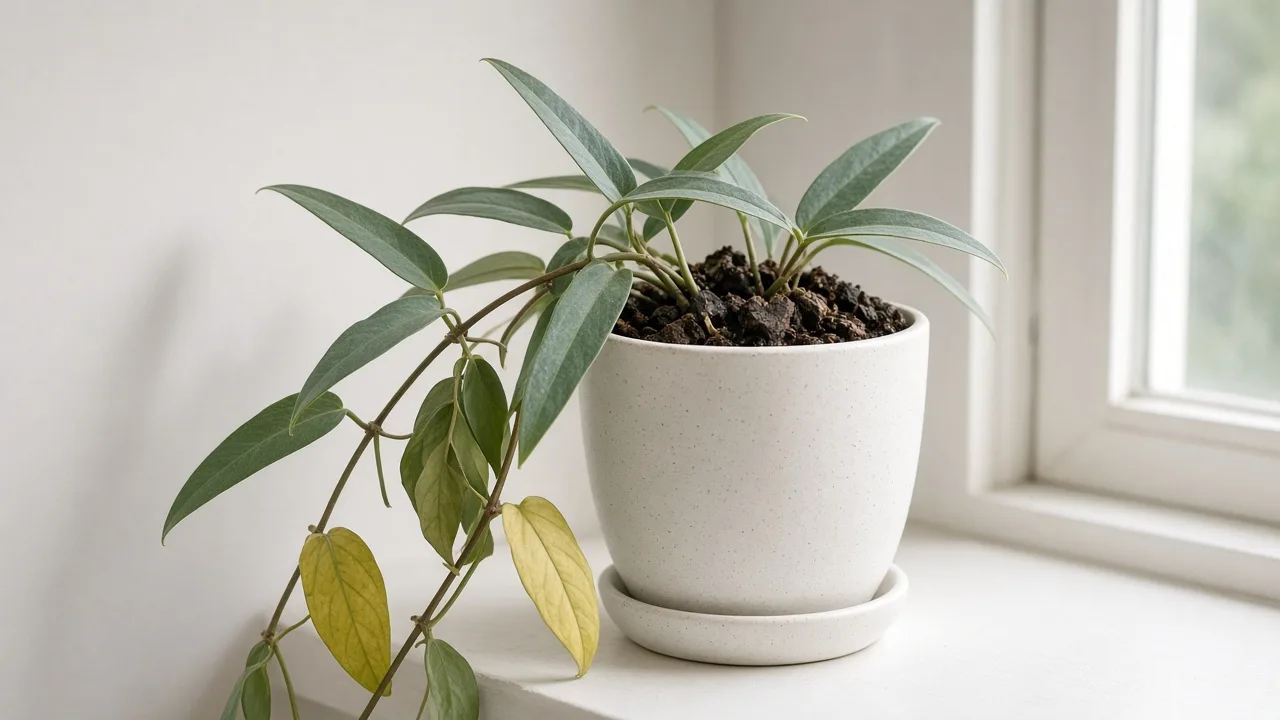
Root Rot on Epipremnum Pinnatum: Causes, Checks & Fixes
This guide covers root rot on Epipremnum Pinnatum. See also the general Root Rot guide, watering, and light pages for this plant.
Root Rot on Epipremnum Pinnatum: Causes, Checks & Fixes
Quick answer
Root rot on Epipremnum Pinnatum (Epipremnum pinnatum—Dragon Tail, Silver Vine, and the popular Cebu Blue cultivar) is active decay of roots and stem nodes after mix stays waterlogged long enough to displace oxygen around roots. Overwatering can cause fungal and bacterial diseases that lead to root rot on this climbing aroid. For how chronic wet mix damages roots in general, see our root rot guide. On Cebu Blue, the warning pattern is limp blue-green juvenile leaves on a heavy wet pot, yellow lowers, and soft nodes at the soil line while the trailing tip still looks okay.
First step: stop watering and unpot to pinch roots—do not pour water because narrow leaves hang limp. Mushy brown roots with a sour smell confirm rot; firm pale roots with only a heavy pot may still be early overwatering on Epipremnum Pinnatum. Trim decay, air-dry cuts, repot into fresh well-draining mix sized to remaining roots, or take node cuttings from firm tissue above the rot line using the propagation guide.
What root rot looks like on Epipremnum Pinnatum
Cebu Blue and other E. pinnatum forms carry narrow, blue-toned juvenile leaves along thin climbing stems. Those leaves can stay colorful while the base fails underground—unlike a bushy peace lily that collapses evenly. Rot often shows on lower leaves and nodes at the soil line first while newer growth at a moss pole or basket rim still looks firm for a while.
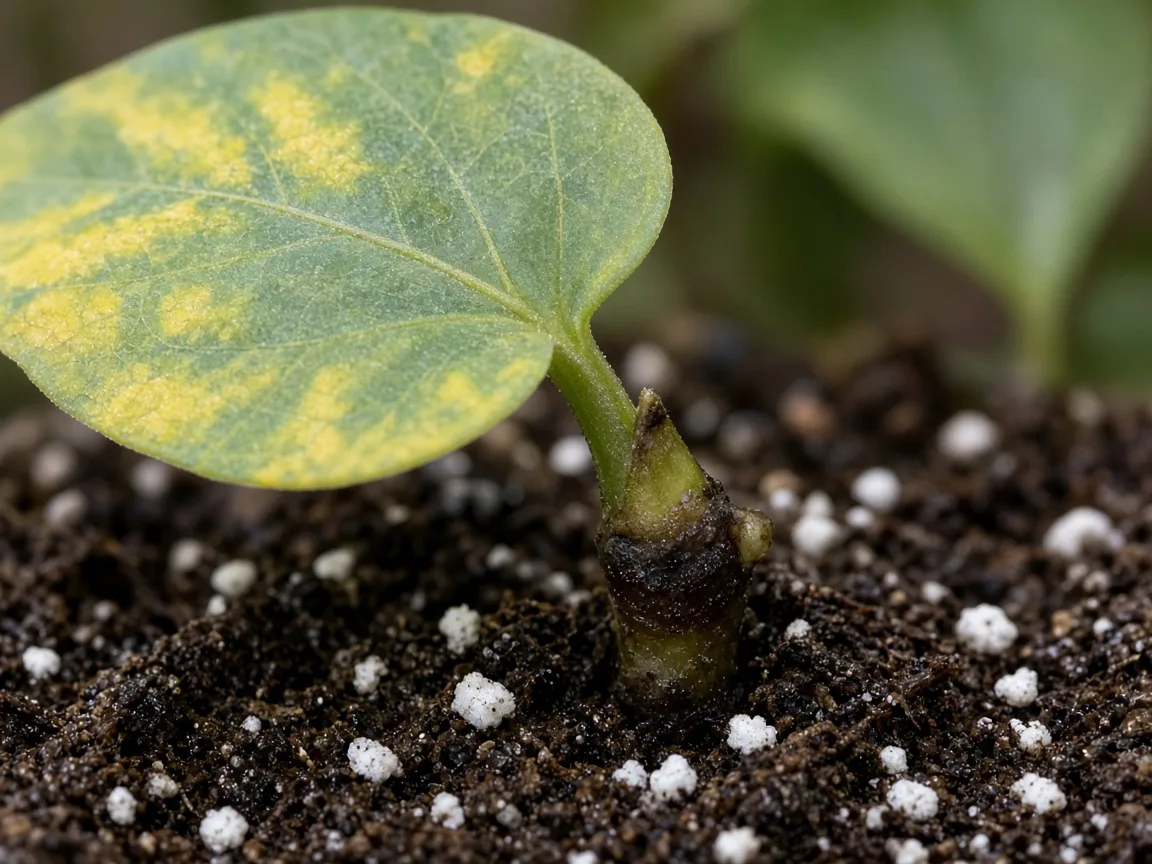
Root rot on Epipremnum Pinnatum—compare yellowing, soft tissue at nodes with firmer blue-green leaves higher on the vine.
Early signs (wet mix, roots partly firm)
- Yellowing lower leaves on persistently dark, cool mix—not a single old leaf aging off a long trail
- Pot stays heavy several days after the last watering while the top 3–5 cm may still feel damp
- Faint sour or musty smell from drain holes
- Fungus gnats at the soil surface when mix never dries
- Slow or pale new juvenile leaves while older foliage yellows from the bottom up
Advanced signs (active decay)
- Limp blue-green leaves on wet soil—the wet-soil wilt pattern when damaged roots cannot move water upward
- Soft, dark, or translucent nodes where stems meet saturated mix
- Brown, slimy, or hollow roots that dissolve when pinched; healthy roots are firm and pale
- Sour smell intensifies when you slide the plant from the pot
- Whole trailing sections collapse while inner mix is still damp
What root rot is not
- Light dry pot with limp leaves that firm within hours after one thorough drink—see underwatering
- Droop on dry mix with crispy tips—moisture mismatch, not decay; see drooping leaves
- Gradual lower-leaf drop on an old bare vine with firm nodes and white roots—may be normal aging on long trails; see pruning
Cebu Blue trails vs moss-pole rot traps
Epipremnum Pinnatum is a climbing aroid, not a standard pothos rosette. NC State notes it needs support for long trailing stems and bright, indirect sunlight. That growth habit changes where rot starts.
Hanging baskets dry fast at the top 3–5 cm in bright light—owners sometimes overcorrect by watering before the core dries, especially in winter. Moss poles add a second moisture zone: aerial roots may stay damp on the fiber while the pot base also stays wet if you water heavily to “feed the pole.” The result is saturated nodes at the soil line even when leaves halfway up the stake look fine—a failure mode that does not fit a short Golden Pothos in one nursery pot.
If you grow for fenestrated adult foliage on a pole, remember juvenile Cebu Blue leaves stay small when trailing; do not mistake a long bare vine for health while the buried nodes rot.
Why Epipremnum Pinnatum gets root rot
This species wants moist, well-drained, slightly acidic mix—not a permanently wet root zone. When saturation persists, fine roots die first and water molds such as Pythium or Phytophthora can invade weakened tissue.
Common Epipremnum Pinnatum triggers include:
Calendar watering in a dim winter room—shorter days slow uptake while the same pot holds moisture for weeks.
Cachepots and saucers holding runoff after every drink, especially on floor baskets under trailing weight.
Oversized decorative pots with wet outer soil beyond a small root ball.
Dense peat-heavy mix without enough perlite; see soil for Epipremnum Pinnatum for drainage ratios.
Low light slowing evaporation so you keep summer frequency in a corner where the silvery blue sheen has already dulled—see not enough light.
Adding water to limp leaves on wet soil—The Spruce notes that soft stems, unpleasant soil odor, and yellow leaves often follow overwatering that leads to root rot; more water deepens anaerobic conditions.
How to confirm the cause
Work through these checks in order:
- Pot weight—Heavy and cool days after watering confirms saturation; light weight with wilt points away from rot.
- Moisture at 3–5 cm—Clinging wet mix with limp leaves suggests root failure, not thirst.
- Smell—Sour or musty drain-hole odor supports decay.
- Unpot and pinch roots—Firm white or cream tissue is healthy; brown, slimy, or hollow roots are rot.
- Node firmness—Press where stems enter mix. Firm nodes above soft tissue mean salvage is likely; mushy nodes spreading up the vine mean trim higher or propagate.
- Wet-vs-dry wilt fork—Use the table below before repotting.
| Signal | Wet-soil wilt (root rot likely) | Dry-soil wilt (underwatering likely) |
|---|---|---|
| Pot weight | Heavy, cool | Light |
| 3–5 cm probe | Damp to wet | Dry |
| Lower leaves | Yellow on wet soil | May curl; often perk after water |
| Nodes at soil line | Soft, darkening | Firm |
| Roots (if inspected) | Brown, mushy | Pale, firm; may be dry |
| After thorough watering | Stays limp | Firms within hours |
Confirmed root rot: mushy roots, sour smell, soft nodes, or wet-soil wilt that does not resolve after you stop watering and improve light/airflow. Early saturation only: heavy wet pot with firm roots and no smell—follow overwatering before full trim-and-repot.
First fix for Epipremnum Pinnatum
Stop all watering the moment you suspect rot. Adding water to damaged roots is the fastest way to lose the base of the vine.
Then choose one path:
- Early wet soil, firm nodes, mostly firm roots—Hold water until the top half of mix dries; confirm drainage; adjust to the watering guide dry-down rhythm.
- Sour smell, soft nodes, or mushy roots on inspection—Unpot within 24 hours and begin the rescue sequence below.
Do not fertilize, heavily mist, or repot on reflex without seeing roots.
Step-by-step rescue
When inspection shows decay, work in this order:
- Unpot gently and rinse away wet mix so every root and node is visible. Epipremnum pinnatum is toxic if ingested; wear gloves if sap irritates skin when handling rotted tissue.
- Trim all mushy roots with clean scissors sterilized in rubbing alcohol. Cut back to firm pale tissue even if you remove much of the root mass.
- Inspect stem nodes. If tissue at the soil line is soft, cut the vine above the damage to firm nodes with intact leaves.
- Air-dry trimmed roots and stem cuts 2–24 hours on a paper towel in bright indirect light—not sealed in a bag.
- Repot into fresh mix with perlite per the soil guide. Use a clean pot with drain holes sized to remaining roots, not the former canopy width. See repotting for timing after trim.
- Hold water briefly—Wait until the top 3–5 cm of new mix is dry before the first light drink unless repotted mix is bone dry and leaves are severely limp.
- Node-cutting salvage—When roots are mostly gone but firm nodes remain higher on the vine, root cuttings in water or moist mix per propagation. Cebu Blue often roots faster than you expect from a single-node section.
Make one major correction, then wait several days before stacking fertilizer, heavy pruning, and pesticide.
Recovery timeline
Mild rot with firm nodes and half or more healthy roots: new upright juvenile leaves often appear within two to four weeks after repot into dry-appropriate mix and cautious watering.
Moderate rot with heavy root loss: allow three to six weeks for white root tips. Old yellow or limp leaves rarely re-arch fully; judge success by firm nodes and tight new blue-green leaves.
Salvage via cuttings: water-rooted nodes may show initials in 7–14 days; potted cuttings can take slightly longer.
Worsening signs: nodes soften above your last trim line, mix stays wet while the vine declines, or no firm new growth after four weeks of corrected care.
Lookalike symptoms
| What you see | Likely cause | Where to go next |
|---|---|---|
| Limp leaves, wet heavy pot, yellow lowers | Root rot / advanced overwatering | This page |
| Limp leaves, dry light pot | Underwatering | Underwatering |
| Sudden collapse, limp stems | Wilting / uptake failure | Wilting |
| Yellow lowers only, firm nodes | Early overwatering or light stress | Yellow leaves |
| White fuzz on soil surface | Mold on wet mix | Mold on soil |
What not to do
Do not keep watering limp Cebu Blue when mix is already wet—that converts reversible stress into node loss. Do not repot into dense peat or a pot without drain holes. Do not fertilize during recovery. Do not discard the plant until you check firm nodes above the rot line for cuttings. Do not stack repotting, pruning, fungicide, and fertilizer on the same day.
How to prevent root rot next time
Water when the top 3–5 cm dries in bright indirect light, then soak until water runs from holes and empty saucers within 30 minutes. Match winter frequency to slower growth. Use well-drained mix with perlite, size pots to the root mass, and keep trailing baskets in enough light that the pot cycles predictably. If you use a moss pole, avoid keeping the base sodden while only misting the top—balance pole and pot moisture. Inspect weekly during routine care so heavy pots and sour smells are caught before the whole trail collapses.
When to escalate from the overwatering page
- Overwatering—mix stays wet too long, but roots are still mostly firm
- This page (root rot)—mushy roots, sour smell, soft nodes, or wet-soil wilt that persists after dry-down
- Propagation—base lost but firm cuttings remain
When to use this page vs other Epipremnum Pinnatum guides
- Watering—Routine dry-down before roots fail.
- Overwatering—Early saturation before mushy roots appear.
- Drooping leaves—Turgor loss before you know if roots are damaged.
- Problems hub—Browse all issues on this species.
Related Epipremnum Pinnatum guides
Related tool
Use the Root Rot Risk Checker to narrow causes for root rot on this plant before changing multiple variables at once.