Spider Mites on Fig: Hot-Dry Stippling & Webbing
Quick answer
Spider mites on common fig (*Ficus carica*) cause pale stippling and fine webbing on the undersides of large lobed leaves—often on older foliage in hot, dusty, drought-stressed terrace pots or wall-trained trees. First step: shake a suspect leaf over white paper to confirm moving specks, then blast or wipe leaf undersides thoroughly while keeping the root ball from staying soggy.
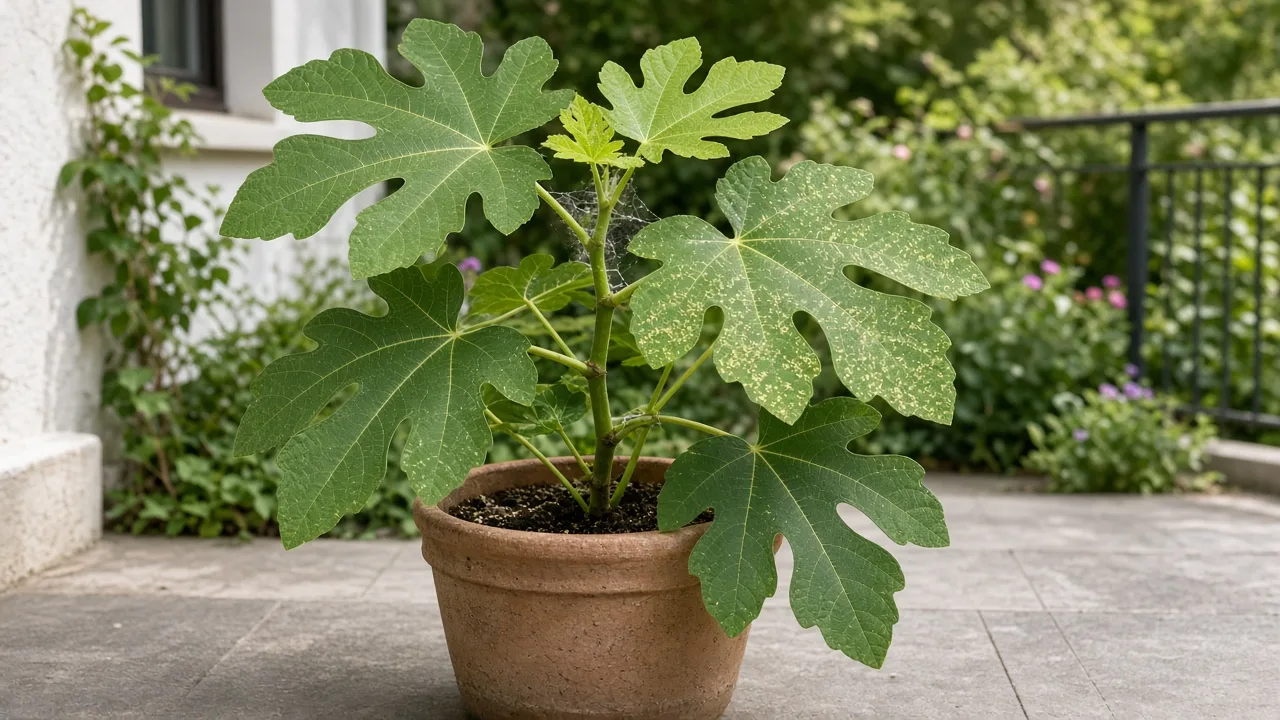
Spider Mites on Fig: Causes, Checks & Fixes
This guide covers spider mites on Fig. See also the general Spider Mites guide, watering, and light pages for this plant.
Spider Mites on Fig: Causes, Checks & Fixes
Quick answer
Spider mites on common fig (Ficus carica) show up as pale yellow or white stippling and fine webbing on the undersides of large, deeply lobed leaves—often on older sun-exposed foliage during hot, dry weather. First step: tap a suspect leaf over white paper to confirm tiny moving specks, then rinse or wipe every lobe underside thoroughly without leaving the root ball waterlogged.
For mite biology, life cycle, and why dry air favors outbreaks in general, see our spider mites pest guide. On fig, the pattern that matters is stippling on mature lobes while spring shoot tips stay clean, outbreaks on drought-stressed terrace pots and dusty wall-trained cordons, and extra care because you are treating a food-bearing tree—not an evergreen indoor Ficus.
Why Fig gets spider mites
Hot, dusty microclimates figs love. Common fig wants full sun and steady moisture while leaves and fruit develop. Terrace pots, south-facing walls, and reflected pavement create exactly the hot, dusty conditions where spider mites surge—especially when a missed deep watering leaves the tree drought-stressed at the same time.
Large lobed leaves hide colonies. Mites feed on undersides along midribs and at petiole joints on lobes that can span a hand’s width. Owners notice bronze dulling on the upper surface long before they spot silk tucked under a lobe point—unlike aphids on Fig, which coat soft spring shoot tips with sticky honeydew.
Deciduous rhythm changes the calendar. On in-ground trees, mites may overwinter under bark scales and return when warm weather resumes—similar to other deciduous fruit hosts. Do not confuse normal autumn leaf drop with mite-driven yellowing in July; mite damage keeps stippling and webbing on leaves that are still firm and green-tipped.
Outdoor predators help—until sprays erase them. Gardens often host predatory mites, six-spotted thrips, and lady beetles that limit spider mite numbers. A lone container on a baking balcony lacks that backup, so colonies climb faster. Broad-spectrum insecticides for other pests can kill predators and spike mite populations.
NC State lists spider mites among common fig insect problems alongside aphids, scale, and mealybugs—confirm specks and silk, not cottony wax or soft pear-shaped clusters.
What spider mite damage looks like on lobed fig leaves
- Fine yellow or white stippling scattered across lobes, often starting on older sun-facing leaves
- Bronze or gray dulling of otherwise deep green blades while stems stay firm
- Tiny moving dots on undersides—yellow-green Pacific or twospotted mites with dark spots when magnified
- Fine silk webbing at petiole joints, between overlapping lobes, or along wall-side cordons
- Premature yellowing and drop of heavily fed leaves in summer—not the orderly fall shed of a dormant tree
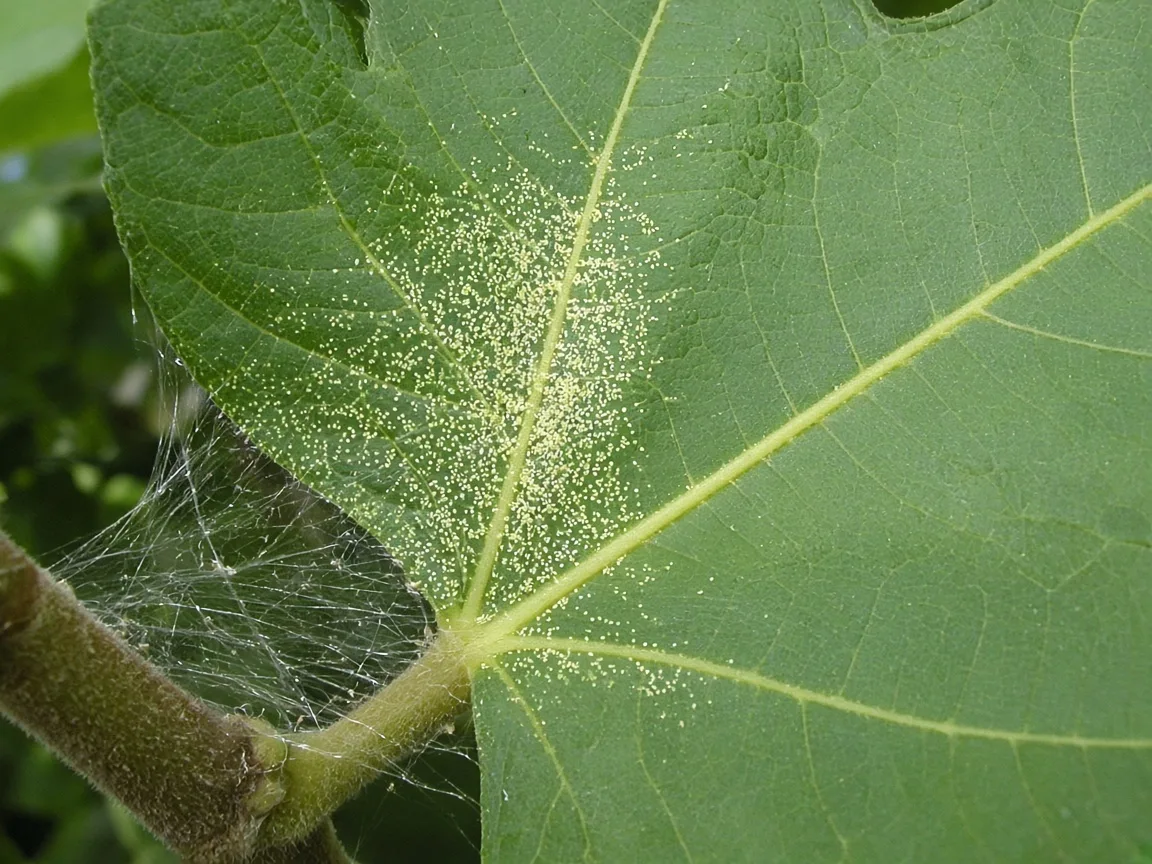
Spider mites on fig—compare pale stippling and silk at a petiole joint with healthy green tissue on the same lobe.
Unlike brown tips on Fig, mite damage is speckled and patchy with healthy green between dots—not uniform dry margins from missed watering alone. Unlike scale, mites crawl when disturbed and do not form hard immobile bumps on bark.
Where spider mites hide on a fruiting fig (plant-only check)
Work from older sun-exposed wood inward—mites rarely start on the softest spring flush aphids prefer:
- Sun-facing lobes on wall-trained cordons — The wall side stays dusty and warm; check undersides along horizontal arms.
- Upper third of container trees — Terrace heat rises; stippling often appears here before lower leaves.
- Petiole joints on large lobes — Webbing anchors where the stalk meets the branch—easy to miss on three-lobed leaves.
- Dusty road- or patio-adjacent specimens — Dusty margins favor mites on fruit trees the same way they do on orchard rows.
- Suckers at the base — Soft leaves near soil level on in-ground figs can host colonies while the canopy looks clean.
Spider mites vs drought, aphids, scale, and normal leaf drop
| What you see | Likely cause | How to tell apart |
|---|---|---|
| Stippling + webbing on undersides | Spider mites | Paper-tap test shows moving specks |
| Crisp margins, light pot, dry mix at 1–2 inches | Drought / underwatering | No webbing; no crawling dots |
| Soft insects + honeydew on shoot tips | Aphids | Clusters on new growth, not old lobes |
| Cottony white in axils | Mealybugs | See mealybugs on Fig |
| Whole-tree yellow on wet sour mix | Root stress | Overwatering / root rot pattern |
| All leaves drop in autumn, bare wood | Dormancy | No summer stippling progression |
On fig specifically, drought and mites share hot terrace conditions. If edges are crisp and stippling spreads with webbing, treat confirmed mites while you fix the watering dry-down rhythm—do not flood the pot daily to “help” the tree.
How to confirm the cause
- Paper tap test — Shake a lobe over white paper; mites move rapidly when disturbed.
- Underside scan with a hand lens — Look for colonies, cast skins, and silk along midribs.
- Stippling pattern — Patchy dots with green between; sun scorch hits exposed faces uniformly without underside mites.
- Watering cross-check — Test mix depth; drought-stressed figs are highly susceptible to mite damage.
- Predator scan — Six-spotted thrips, predatory mites, or lacewing larvae mean you may only need rinsing and patience outdoors.
- Season check — Summer/July–September flare-ups differ from normal fall leaf fall on this deciduous species.
Confirmed: moving specks plus stippling and/or webbing on undersides.
Suspected: dull lobes with a clean tap test—recheck in three days and deep-soak once if mix is dry.
Monitor vs treat vs escalate
| What you find | Urgency | Next move |
|---|---|---|
| A few pale dots on one lobe; clean paper test | Monitor | Recheck; improve watering; wipe that underside |
| Moving specks + stippling on several lobes | Treat now | Rinse/wipe undersides; repeat on schedule |
| Webbing on multiple branches; yellow drop in summer | Treat urgently | Full rinse cycle + labeled soap/oil; check all patio plants |
| Small container fig wilting on dry mix plus mites | Escalate | Deep-soak once, drain, then pest cycle—fix both stresses |
First fix for Fig
Blast or wipe every lobe underside with plain water on in-ground, wall-trained, or large patio figs where drainage is good. UC IPM recommends water sprays to the undersides of leaves as a first-line mite control when populations are found—common fig’s woody stems and thick lobes tolerate this when you are not soaking the root ball repeatedly.
For container figs, move the pot to a driveway or tub, rinse undersides top-down, and tilt so water drains fast. Your fig still needs the top 1–2 inches to dry between deep waterings; do not leave saucers full after each rinse.
Wear gloves. Broken fig tissue releases irritating latex; wash skin promptly and keep prunings away from pets.
Do not apply horticultural oil in blazing midday sun on drought-wilted leaves. Do not reach for miticides with long pre-harvest intervals if syconia are ripening—Gardening Know How notes bifenazate-treated figs should not be eaten for a year; prefer repeated water removal and horticultural oil on labeled intervals when fruit is present, and always read the product label.
Step-by-step recovery
- Confirm mites with the paper-tap test—not dust, sun scorch, or drought alone.
- Rinse or wipe undersides every three to five days for two weeks; mite eggs survive a single pass.
- Deep-soak once if mix is dry at 1–2 inches—water-stressed figs stay vulnerable.
- Apply insecticidal soap or horticultural oil only if live mites remain after several rinses; cover undersides completely and avoid heat-stressed midday sprays.
- Repeat labeled sprays every five to seven days for at least three cycles in warm weather when generations can complete in about a week.
- Prune only hopeless lobes that are mostly bronze—bag cuttings; wear gloves for latex.
- Hold fertilizer until new spring flush leaves open clean for two weeks—soft nitrogen-rich shoots invite other pests.
- Inspect neighbor plants on the same patio or wall; mites drift on silk threads between pots.
Recovery timeline
Live mite counts should drop within one to two weeks of consistent underside rinsing if coverage reaches every lobe. A full cycle—rinse plus three soap or oil applications—often runs three to four weeks in warm weather.
Stippled lobes will not re-green; judge success by clean new leaves on the next flush and firm fruiting wood—not by polishing old bronze tissue. Heavy feeding can yellow and drop leaves; on mature in-ground trees, single-season leaf loss may not ruin the current crop unless defoliation happens very early in summer.
What not to do
- Do not rinse container figs daily while leaving mix soggy—roots need oxygen between the deep soaks this species prefers.
- Do not spray only the glossy upper lobe surface; mites live on undersides.
- Do not use homemade dish soap on food-bound trees; use products labeled for ornamentals or edible crops per label directions.
- Do not apply broad pyrethroid sprays for beetles or borers without expecting a mite rebound.
- Do not ignore drought while treating pests—water-stressed plants suffer worse mite damage.
- Do not touch pruning wounds bare-handed—latex sap is a real skin hazard on Ficus carica.
How to prevent spider mites next time
Keep figs evenly moist while leaves and fruit develop—check the root ball, not a calendar, as in the watering guide. Reduce dust on patio specimens with occasional gentle rinses of leaf surfaces in dry summers.
Scout two or three undersides weekly from midsummer through early fall on container trees. Quarantine new nursery figs for two weeks before placing them on a warm light-exposed wall.
Tolerate low mite levels outdoors when predators are visible—they often crash populations by late season without chemicals. Avoid unnecessary insecticides that wipe out predatory mites and six-spotted thrips.
When to worry
Escalate when webbing covers most sun-facing branches, summer yellowing mimics a sick tree outside dormancy, or rinsing plus three labeled spray cycles fail over four weeks. A mature in-ground fig with firm wood rarely dies from mites alone, but a small container plant that is also starved for sun or water can stall badly.
Consider removing a severely defoliated container fig that keeps reinfecting patio neighbors rather than fighting endless reinfestation in one hot microclimate.
When to use this page vs other Fig guides
- Fig watering — Use when limp leaves and dry mix suggest drought, not stippling.
- Fig problems hub — Browse all common issues on this species.
- Aphids on Fig — Soft shoot-tip clusters and honeydew on spring flush.
- Brown tips on Fig — Margin necrosis without specks or webbing.
- Yellow leaves on Fig — Whole-tree yellowing with care-stress patterns.
Related Fig guides
Conclusion
Spider mites on fig are a hot, dry-season underside problem on Ficus carica, not a mysterious whole-tree collapse. Confirm moving specks and stippling on lobed leaves; rinse or wipe undersides without waterlogging terrace roots; deep-soak when mix is dry; and choose food-safe controls when syconia are ripening. Judge recovery by clean new flush leaves and firm wood—not by old bronzed lobes. Build weekly underside checks into summer patio care, and read crisp margins alongside pest checks so drought and mites do not blur together.
Related tool
Use the Pest Identifier Tool to narrow causes for spider mites on this plant before changing multiple variables at once.