Underwatering on Fig: Dry Pot, Fruit Drop & Fixes
Quick answer
Underwatering on common fig shows as dry mix 1–2 inches down, a feather-light container, limp lobed leaves, and sometimes green synconia dropping while the root ball stays dry—not soggy soil with soft stems. First step: one deep soak until water drains freely, then resume watering when the top 1–2 inches feel dry per the fig watering guide.
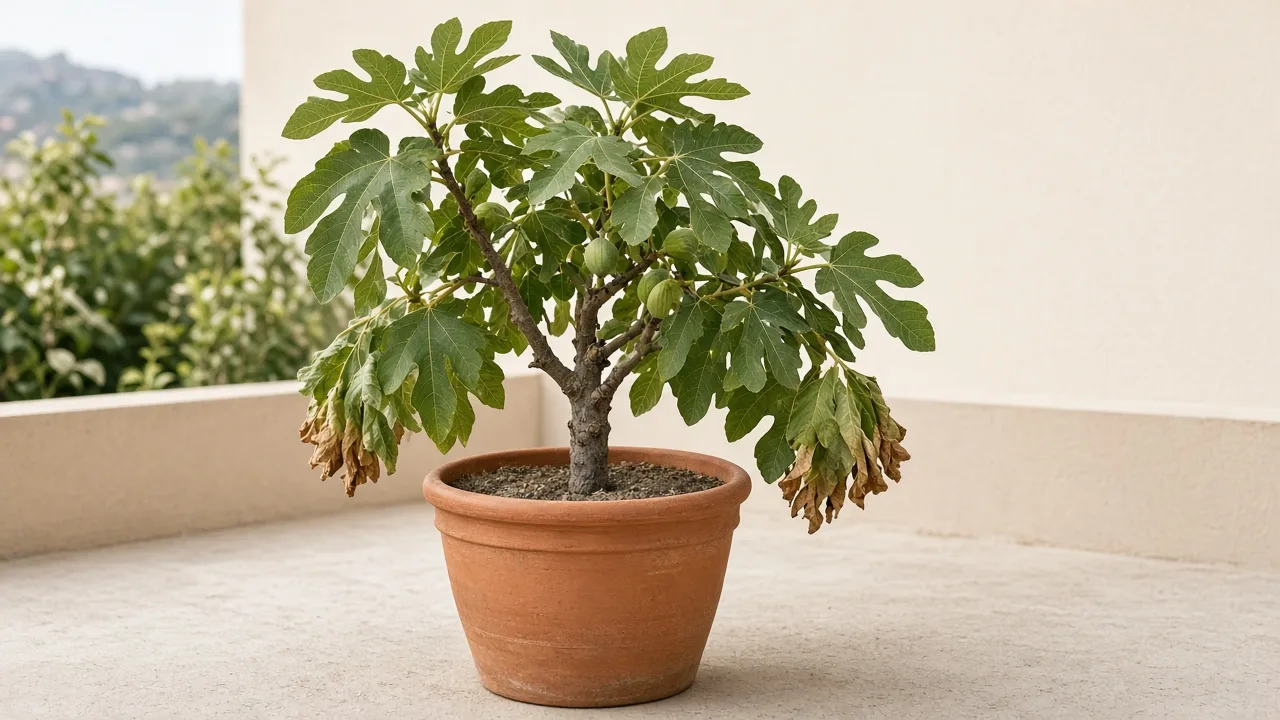
Underwatering on Fig: Causes, Checks & Fixes
This guide covers underwatering on Fig. See also the general Underwatering guide, watering, and light pages for this plant.
Underwatering on Fig: Causes, Checks & Fixes
Quick answer
Underwatering on fig (Ficus carica, common fig) means the root ball stayed dry too long while the tree was still losing water through large lobed leaves and, often, developing fruit. The mix is dry 1–2 inches (2.5–5 cm) down, the container feels light, leaves hang soft, and you may see green synconia drop while soil—not saucer water—stays thirsty.
For how chronic dry soil limits uptake in general, see our underwatering guide. On fig, the pattern usually shows up as a light terrace pot, limp palmate foliage, mix pulling from pot walls, and premature fruit drop during swell—not yellow lowers on heavy wet mix.
First step: give one deep soak until water runs freely from drainage holes, then empty standing water from saucers. After that, resume the top 1–2 inch dry check from the fig watering guide—not a fixed calendar from your rubber plant or fiddle-leaf fig.
When to use this page vs other Fig guides
- Fig watering guide — Routine 1–2 inch dryness checks, dormancy reductions, and deep-soak method before symptoms stack.
- Overwatering on fig — Opposite branch when soil stays wet, mix smells sour, or stems soften while leaves still droop.
- Wilting on fig — Sort wet vs dry wilt when the pot weight is ambiguous.
- Drooping leaves on fig — Limp canopy when you are not sure whether roots or moisture failed first.
- Fig problems hub — Browse all issue pages on this crop.
Wet soil vs dry soil — is it really underwatering?
Fig wilts from both drought and drowning, and fruit drop appears with too little and too much irrigation (UC IPM — fig drop or no fruit). Weight and depth beat guesswork.
| Pattern | Pot / soil weight | Soil at 1–2 inches | Leaf / fruit signs | Likely cause |
|---|---|---|---|---|
| Underwatering | Light | Dry, crumbly | Limp lobed leaves, crisp edges, green fruit drop on dry ball | Drought |
| Overwatering | Heavy | Wet, cool | Limp leaves on damp mix, yellowing lowers | Root stress |
| Heat + wind | Normal to light | Drying fast | Midday flagging that recovers overnight | Evaporation spike |
| Dormancy mismatch | Varies | Too dry while leaves still on | Early leaf drop before fall color | Seasonal schedule error |
| Root-bound pot | Light between soaks | Dust-dry in days | Wilts between short wet cycles | Volume too small |
If the pot is heavy and mix stays damp, stop adding water and read overwatering on fig and root rot on fig. If it is light with dry depth, proceed with rehydration.
What underwatering looks like on Fig
Common fig is a deciduous fruit tree, not an evergreen indoor Ficus. Its large, deeply lobed leaves transpire heavily in full sun, and swelling synconia pull water during the fruiting season (UF/IFAS Gardening Solutions — figs). When the root zone cannot keep up, the whole plant reads as thirsty outdoor crop stress, not a single pale houseplant leaf.
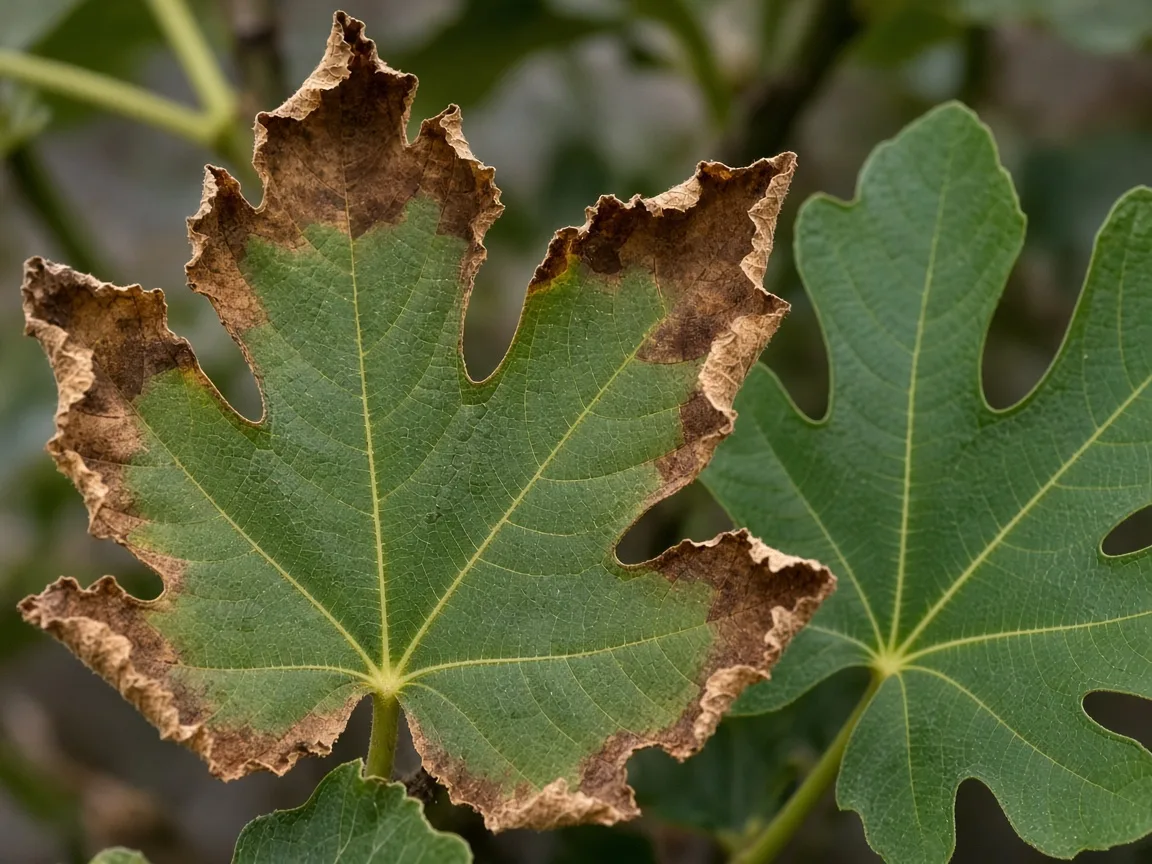
Underwatering on fig — compare limp, dry-edged lobes with firm new growth on the same branch.
Typical above-soil signs include:
- Limp or drooping lobed leaves that feel dry or papery at the margins—not soft and darkening like overwatered tissue
- Brown, crispy leaf edges on older sun-exposed leaves, sometimes with cupped or curled blades
- Mix shrunken away from container walls, especially on peat-heavy potting soil after a hot week
- A very lightweight pot when you tilt it on casters or lift by the rim
- Green fruit dropping before ripeness while the root ball is dry (UC IPM — fig drop)
- Slowed new shoot extension even though light and season say the tree should be pushing growth
Below soil, healthy fig roots stay firm and pale tan to white. Underwatering rarely turns roots mushy—that pattern belongs to rot. Repeated drought may kill fine root tips, so the tree wilts sooner on the next dry cycle even when you “watered on schedule.”
Fig-specific clue: Gardening Know How warns that container figs dry faster than in-ground trees and that excessive dry spells can drop leaves or reduce fruit. If margins are crisp but mix at depth is cool and clingy, suspect a partially rewetted root ball or wind desiccation on Penn State’s drought-sensitive container figs—not automatic thirst.
Why Fig gets underwatered
Fig tolerates some dry-down between soaks, but fruit and nut trees need consistent, uniform soil moisture, and stress during early growth or fruit production cuts yield and quality (UC IPM — watering fruit and nut trees). Moisture should be replaced before the tree shows stress—not after fruit is already on the ground.
Treating fig like a drought-tolerant houseplant Ficus
Growers familiar with rubber plants or fiddle-leaf figs sometimes stretch intervals too far on a sun-baked terrace fig. NC State lists organically rich, well-drained, moist soil for Ficus carica (NC State — common fig). “Moist” here means replenished after the upper layer dries, not saturated every day and not bone dry for weeks while leaves and fruit are active.
Container volume, wind, and terrace heat
Penn State Extension notes container figs are sensitive to drought stress and wind and should be watered regularly as weather indicates. A large leaf surface in a 15–20 inch pot on a windy balcony can go from “fine yesterday” to limp and light in a few hot days—faster than an in-ground tree on a 2–3 week deep irrigation rhythm (UC IPM cultural tips).
Fruit swell without extra water
UF/IFAS states figs need plenty of water during the fruiting season but will not tolerate excessively wet soil (UF/IFAS — figs). Many owners keep spring watering discipline while July and August fruit demand more frequent checks. Green drop on otherwise healthy branches is often the first crop signal—not a mystery disease.
Hydrophobic mix after travel or neglect
When mix stays dry for long stretches, water runs down the wall gap and exits the bottom without rewetting the center. The surface looks damp; the middle stays dust-dry. That mimics “I watered” while the tree still thirsts—common after vacations on container figs.
Wrong season on a deciduous tree
Missouri Botanical Garden recommends regular watering during the growing season but reduced watering in fall on container plants (MBG — Ficus carica). Two failure modes look like underwatering: continuing summer soaks on leafless dormant roots (rarely the fix you need) versus still-active late-summer growth on a “I already cut back for fall” schedule. Match drinks to leaf presence and fruit load, not the calendar alone.
Fear of overwatering after past root stress
After sour mix or yellow leaves on wet soil, owners sometimes under-water chronically. UF/IFAS and UC IPM both tie improper moisture to drop and poor production—the fix is even replenishment, not alternating floods and droughts.
How to confirm the cause
Work through these checks before repotting or feeding:
- Pot weight — Lift or roll the container. A light pot with limp leaves strongly suggests drought; a heavy pot with drooping leaves suggests overwatering or root damage instead.
- Depth moisture — Test 1–2 inches down, not only the rim. Gardening Know How uses dry to an inch below the surface as the water trigger for potted figs.
- Skewer test — Insert dry wood toward the bottom on large pots. Clean, dry wood at mid-depth confirms it is time to soak.
- Fruit stage — Note whether green synconia are dropping on dry soil versus wet, heavy mix.
- Stem feel — Stems should stay firm and green-brown. Soft, darkening bases point away from drought-only treatment.
- Season — Leaves still expanding or fruit swelling? You are in high-demand irrigation. Leafless in a cool garage? You need light moisture, not summer volume—see fig watering winter notes.
- Drainage — Water should exit holes within minutes of a full soak. If it never does, fix soil and drainage before blaming underwatering.
The first fix to try
One deep soak until water runs freely from drainage holes, then drain saucers completely.
Use a hose or watering can at the soil surface—not a brief mist on leaves. For pulled-away mix, slow the first pass, pause until the surface darkens, then continue until runoff is steady. Wear gloves if you break stems; fig latex can irritate skin (NC State — toxicity notes).
Do not follow immediately with fertilizer, heavy pruning, or repotting on the same day. Let the tree drink once, drain, and show you whether turgor returns.
If the container is extremely dry and water channels out instantly, set the nursery pot in a basin and let it draw water from the bottom until the surface moistens, then lift and drain fully—same rescue logic as large indoor trees, adapted to outdoor fig pots.
Step-by-step recovery
After the first soak:
- Wait 24 hours, then recheck leaf turgor and 1–2 inch dryness—not “water again because leaves still look tired.”
- Resume the fig rhythm: soak when the top 1–2 inches dry, then let excess drain (fig watering guide).
- Mulch the surface (not against the trunk) to buffer evaporation—NC State recommends mulching roots to maintain moisture (NC State — common fig).
- Stake or move wind-exposed pots if Penn State’s wind sensitivity matches your site.
- Track fruit — stable swelling without new green drop is a good sign; continued drop on wet soil means pivot to overwatering diagnosis.
- Repot only if the pot dries in one day every cycle because roots fill the volume—see fig repotting—not as day-one drought treatment.
Recovery timeline
- 12–48 hours: Leaf turgor often improves after one correct soak if roots are intact.
- 1–2 weeks: New shoot tips should look firm; older crispy margins stay damaged.
- One fruiting cycle: Judge crop recovery by fewer premature drops and steady swell, not instant ripening.
- If still limp on moist mix 48 hours after a proper soak: Inspect roots and compare with root rot before repeating drought treatment.
Lookalike symptoms
- Overwatering — Heavy pot, sour smell, yellow lowers on wet mix.
- Wilting and drooping leaves — Same limp canopy; use weight and depth to split wet vs dry.
- Not enough light — Weak lanky growth without a chronically light dry pot.
- Spider mites — Stippling and webbing with otherwise odd moisture history.
- Normal fall leaf drop — Deciduous senescence on schedule, not mid-summer crisping on a baked pot.
What not to do
- Do not flood daily after one drought scare—fig roots still need oxygen between soaks (UF/IFAS — figs).
- Do not use shallow sips that never rewet the center; UC IPM warns frequent light watering builds shallow roots (UC IPM — watering fruit trees).
- Do not fertilize a drought-stressed tree before moisture stabilizes.
- Do not prune heavily while the canopy is collapsed from thirst—wait until turgor returns, then follow fig pruning rules for timing.
- Do not touch milky sap without gloves when handling broken twigs during rescue soaks.
How to prevent underwatering next time
- Check 1–2 inch dryness every few days on active container figs in sun; in-ground mature trees may use deep, less frequent irrigation (UC IPM cultural tips).
- Increase checks during fruit swell when UF/IFAS’s fruiting-season water demand applies.
- Use large enough pots and free-draining but moisture-retentive mix from the soil guide.
- Mulch surface roots; roll pots to sheltered walls before windy heat spells.
- Reduce volume only after leaf fall, per MBG and the watering guide dormancy section—not mid-crop.
- Learn your pot’s dry weight by lifting before each soak on terrace plants.
When to worry
Escalate when:
- Leaves stay limp 48 hours after a complete rewet on firm stems
- Stems soften or darken at the soil line
- Pot stays heavy and sour while you assumed drought
- New growth stalls for weeks with yellowing on wet soil
Then inspect roots, review fig overview grower notes, and route to root rot or overwatering before another drought soak.
Related Fig guides
- Fig overview
- Fig watering
- Fig light
- Fig soil
- Fig fertilizer
- Slow growth on fig
- Brown tips on fig
- Fig problems hub
Conclusion
Underwatering on fig is dry mix 1–2 inches down, a light container, limp lobed leaves, and sometimes green fruit drop on a dry root ball—not mystery wilt on soggy soil. One deep, drained soak is the first fix; then return to the dryness-guided rhythm in the watering guide. Firm new shoot tips and stable fruit swell mean you are back on track; limp tops on wet sour mix mean escalate to root care, not another drought treatment.
Related tool
Use the Plant Watering Calculator to narrow causes for underwatering on this plant before changing multiple variables at once.