Aphids on Insulin Plant: How to Identify and Treat Them
Quick answer
If you see aphids on Insulin Plant, first isolate the pot from other plants. Confirm the insects on a fresh leaf spiral or its underside, then rinse the foliage while keeping water from pooling around the rhizomes. Aphids are a possible pest, but the sources reviewed do not establish that they are common on Costus igneus.
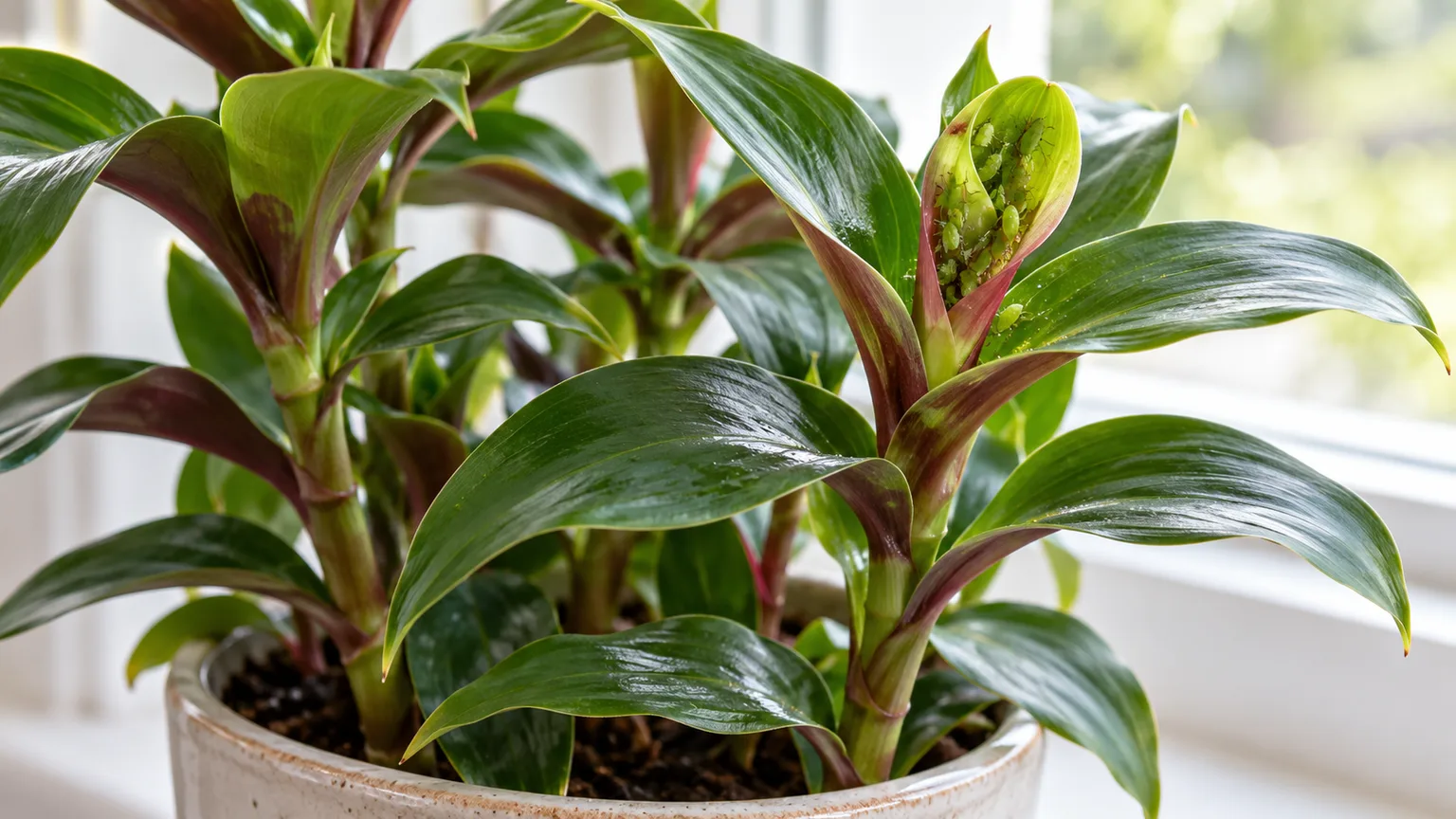
Aphids on Insulin Plant: Identification, Treatment & Recovery
This guide covers aphids on Insulin Plant. See also the general Aphids guide, watering, and light pages for this plant.
Aphids on Insulin Plant: Identification, Treatment & Recovery
Quick answer
If aphids are visible on your Insulin Plant, first move the pot away from other plants. Then confirm that the insects are clustered on the tender, unfolding leaves or shoot tips rather than treating sticky residue by itself. Once confirmed, rinse the foliage gently but thoroughly, including the undersides and folded leaf surfaces. Keep the pot upright and avoid leaving the rhizome mix soaked. Aphids are a possible pest on Costus igneus, but I did not find a species-specific study establishing how often they attack it; the diagnosis and treatment below apply general aphid biology to the plant’s spiral growth.
For the broader aphid lifecycle and management options, see our aphids guide. This page focuses on where to look on Insulin Plant and how to remove aphids without turning a foliar pest into a wet-root problem.
What aphids look like on Insulin Plant
Aphids are small, soft-bodied, sap-feeding insects. They can be green, yellow, pink, gray, or dark, and many have a pear-like outline with a pair of short projections near the rear of the abdomen called cornicles. Winged and wingless forms occur. Their size and color make one insect easy to miss; a group of them is much easier to recognize. The University of Nevada, Reno Extension describes aphids as soft-bodied and often teardrop-shaped, with colonies on new shoots and leaf undersides; it also notes that feeding can curl or distort leaves and leave sticky honeydew (UNR Extension).
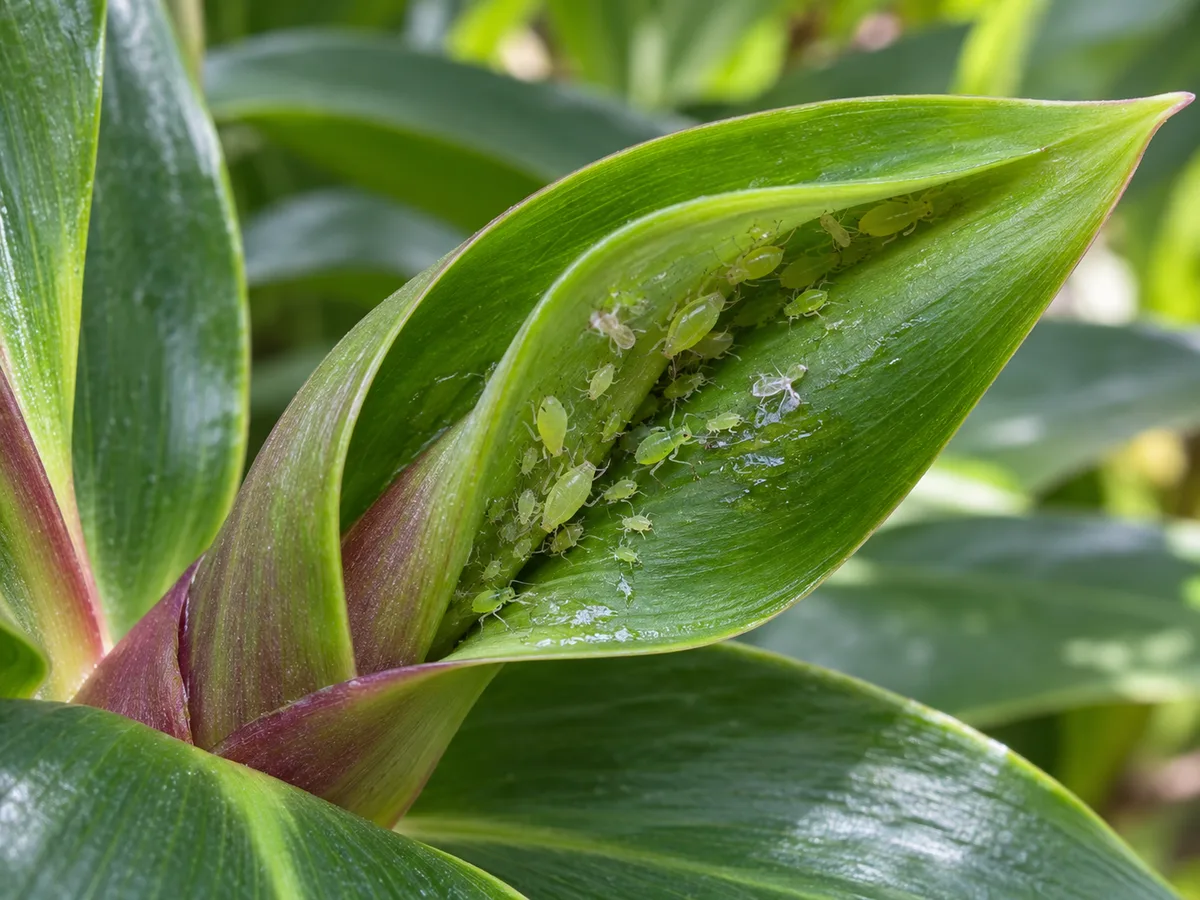
Aphids can be hard to see inside a folded Insulin Plant leaf; check the newest spiral and its underside before treating.
On an Insulin Plant, pay particular attention to the leaf that is still opening, the narrow fold along its length, the point where a young leaf emerges, and the tips of actively growing stems. This plant’s leaves are arranged in a spiral along the stems, a feature recorded by the Missouri Botanical Garden Plant Finder. That arrangement gives you a useful inspection path: follow each stem upward and inspect each fresh leaf where it meets the shoot. The spiral itself is not evidence of infestation; it simply tells you where young tissue and sheltered folds are likely to be found.
If aphids are present, you may also see curled or misshapen new leaves, tiny pale cast skins, or clear sticky droplets on the leaf or a surface below it. Aphids excrete honeydew as they feed, and ants may visit it. Sticky residue can be an early clue, but it is not a stand-alone diagnosis: check for the insects themselves before choosing a treatment. A few blemishes on older leaves, without live insects or new distortion, do not prove that aphids are still active.
Why aphids may settle on Insulin Plant
The most plausible place to find aphids is soft new growth. Extension guidance describes aphids as favoring fresh shoots, leaf undersides, and swelling leaf or flower buds. The Insulin Plant’s unfolding spiral leaves and fresh stem tips provide the same kind of tender tissue, so they are where I would inspect first. This is a practical inference from the plant’s morphology and general aphid behavior, not evidence that aphids are a common or characteristic pest of this species.
Indoor outbreaks can begin when a plant is brought in from outdoors, when an infested new plant joins a collection, or when aphids enter on fresh flowers or other material. A houseplant-specific guide from Get Busy Gardening recommends isolating an affected plant and checking nearby plants when aphids are found indoors. That is a useful containment step even if you never identify how the insects arrived. Winged adults can move between plants, and small colonies can be overlooked until tender growth starts to distort.
Rapidly increasing aphid numbers are possible, although the rate depends on species and conditions. The University of Maine Cooperative Extension notes that aphids vary in color and that their numbers may rise quickly, with winged forms appearing as crowding increases. Do not infer the exact aphid species from color alone, and do not assume an indoor Insulin Plant has aphids just because it has a curled leaf. Confirm the insects on the plant.
Excessive nitrogen feeding can encourage soft, succulent growth that aphids prefer, according to UNR Extension. That does not mean you should starve an Insulin Plant or stop normal feeding indefinitely. It means an aphid outbreak is a poor reason to apply extra fertilizer in an attempt to force damaged leaves to recover. Return to the plant’s normal feeding plan only after active aphids are controlled; use the Insulin Plant fertilizer guide to check timing and avoid overfeeding.
Confirm the insects before you spray
Take the plant to a bright spot and inspect it before rinsing. A hand lens helps, but a phone camera with close focus can also make a tiny colony easier to see. Look at both surfaces of the newest leaves, the base of each fresh leaf, stem tips, and any flower bud. Check the next older leaves too, because a colony may have moved from a newly opened leaf while leaving that leaf curled.
Use this short check:
- Look for several small, soft-bodied insects grouped together, not just one speck.
- Check whether the insects are concentrated on tender growth or the underside of a leaf.
- Look for pale shed skins, fresh leaf distortion, or sticky honeydew nearby.
- If the insects are difficult to see, tap a shoot over a clean sheet of white paper and watch for small insects that move.
- Recheck a neighboring leaf and the next stem before deciding the whole plant is infested.
The aphid combination is more persuasive than any one sign: a visible colony plus new distortion or honeydew. Aphids are generally soft and pear-shaped; the Gardening Know How guide to indoor aphids also describes colonies around new stems and leaf undersides, with curled foliage and sticky honeydew as supporting signs. If you cannot find insects, do not spray based on sticky residue or old leaf damage alone. Clean a small patch with water, mark or photograph it, and inspect again in a few days.
Read the spiral before removing leaves
An Insulin Plant’s newer leaves can be folded tightly around their own center as they emerge. Open the leaf only as far as it moves easily. Pulling or prying apart a tight spiral can tear the blade and make a healthy leaf look pest-damaged. Instead, view the outer fold from several angles and use a fine stream of water after confirmation to dislodge insects from sheltered surfaces.
If the plant has many upright stems, assess each one separately. A colony at one tip does not automatically mean the lower leaves or the entire clump need pruning. Mark the affected stem with a loose tag or note its position, then inspect that spot first during follow-up checks. This keeps your observations consistent and avoids cutting healthy spiral growth merely because the plant is dense.
First action: isolate the Insulin Plant
Move the pot to a separate, well-lit area before handling other plants. Keep leaves from touching neighboring foliage, and do not set the plant next to a shared propagation tray or a cluster of fresh cut flowers. If it cannot be moved to another room, create as much space as the room allows and inspect plants that were touching it. Isolation is the first action because it limits contact while you confirm whether the insects are aphids; it does not replace treatment of a confirmed colony.
Keep the plant in bright filtered light while it is separated. Do not put it in harsh afternoon sun simply because you have moved it. Insulin Plant is grown in part shade or bright filtered light, and sudden strong sun can scorch foliage; the Insulin Plant light guide explains how to keep its light steady during recovery. Avoid moving it into a dark corner too, since prolonged dim conditions slow growth and can leave the potting mix wet for longer.
Rinse the foliage without flooding the rhizomes
After you confirm live aphids, use water as the first treatment. Take the plant to a sink, shower, or sheltered outdoor area and direct a gentle but firm stream at the infested shoot, leaf undersides, and folds. Support a leaf with your free hand so water reaches the surface without bending the soft tip sharply. Rinse each affected stem and nearby leaf, then let the foliage drain before returning the plant to its separate spot. UNR Extension identifies washing aphids from plants with a stream of water as an effective management step that may need repeating (aphid management guidance); on Insulin Plant, adapt the rinse so it reaches the spiral leaves without saturating the root zone.
This plant-specific boundary matters because Insulin Plant is grown in an evenly moist but well-draining mix, while its rhizomes are vulnerable to staying wet in poorly draining conditions. The Insulin Plant soil guide covers drainage and mix structure; its watering guide explains how to keep moisture even rather than leaving the pot waterlogged. During a pest rinse, do not turn the pot sideways, leave it sitting in a bowl of runoff, or let water collect in a cachepot. Keep the pot upright and empty any standing water after the foliage has drained.
Do not spray pesticide during the rinse. First see whether the visible colony has been removed, then dry the foliage and inspect it again in good light. If one or two leaves remain crowded with aphids and are already badly distorted, you can remove only those leaves with clean scissors and discard them in a closed bag, a limited cleanup approach consistent with UNR Extension’s aphid guidance. Avoid cutting the central growing tip or stripping multiple healthy leaves; this plant needs its active foliage to rebuild a balanced clump.
If aphids return after rinsing
Inspect the same stems again after the leaves dry, then check them again over the following days. A water rinse can miss insects tucked into a fold, and a new nymph may be too small to notice immediately. If live aphids remain or return, repeat a careful foliage rinse. Focus on the affected shoots rather than repeatedly wetting the whole pot. Continue to keep the plant apart from the rest of the collection until you no longer see live aphids on new growth.
For an infestation that persists despite repeated rinsing, choose a commercially prepared insecticidal soap or other product only if its label lists aphids and indoor ornamental plants. Read the whole label, follow its directions for coverage and repeat use, and avoid using an improvised household cleaner on the leaves. A contact product must reach the insects to work, so inspect the inner side of the spiral as carefully as the exposed leaf surface. UNR Extension notes that contact treatments such as insecticidal soap and horticultural oil need to touch aphids and advises using pesticide labels as written (extension guidance). If the product is not labeled for this plant setting, do not assume it is safe because it is marketed as natural.
Test a labeled product on a small area first if the label permits, then check that area for damage before treating the rest of the foliage. Do not apply sprays to a plant in hot direct sun or combine multiple products in the same session. Do not repeat an application more often than its label directs. These limits matter on an Insulin Plant because its leaves are broad enough to hold spray droplets in their spiral arrangement, and young unfurling leaves are easy to damage with rough handling.
If the insects do not look like aphids, pause rather than escalating the spray. White waxy clumps, fixed hard bumps, fine stippling, or webbing can point to a different pest. Aphid color alone is not enough to identify a species, and a photo from a phone may not resolve every detail. Take a sharp close-up of the insects and leaf surface, then ask a local extension office or qualified plant clinic for identification before applying a stronger treatment.
Lookalikes and damage that can remain
An older leaf with a crease or split may have been damaged while it unfurled, and a yellowing lower leaf can have more than one cause. Those signs by themselves do not establish aphids. Look for the insects, their clustering pattern, and fresh distortion on growth that is currently expanding. If the plant shows no live insects and no new sticky residue, keep monitoring rather than treating the whole clump.
Mealybugs and scale are also listed among common Insulin Plant pest concerns in the plant’s care profile, but their appearance differs from an aphid colony. Mealybugs usually have conspicuous white wax, while scale appears as fixed bumps on a stem or leaf. Spider mites are more likely to be associated with fine stippling and delicate webbing than with the soft, pear-shaped insects described above; Colorado State University Extension’s houseplant pest guide describes those distinguishing signs. These are sorting clues, not a substitute for identification; a mixed infestation is also possible. Use the plant’s problems hub to compare plant-specific issues, and return to the aphid diagnosis only when you can see aphid-like insects.
Sticky honeydew can also be mistaken for water spots or residue from another source. Wipe a small section of leaf with a damp cloth and check whether a clear, tacky film returns near active insects. If no insects are visible, inspect again before treating. Aphid feeding can distort leaves, but a damaged leaf does not flatten out after the pests are removed. It is usually more useful to watch the next leaf than to wait for a curled one to become pristine.
Recovery: follow the next spiral leaf
The first sign of improvement is not an old leaf returning to its original shape. It is the absence of live aphids after successive checks, followed by clean new growth. A leaf that was already curled, scarred, or sticky may keep those marks. Remove sticky residue with plain water when practical, but do not scrub a tender blade until it tears. New growth may take longer to appear if the plant is growing slowly or light and temperature are not favorable; keep its normal filtered light and moisture stable while you monitor.
For the first week after treatment, examine the affected spiral and the two nearest stems every few days. After that, check at least weekly for several weeks, especially before returning the pot beside a dense group of houseplants. Record whether you see live insects, new honeydew, or additional leaf distortion. If the count is dropping and new leaves are opening without a colony, keep the treatment gentle. If new colonies keep appearing, inspect nearby plants again and reassess the insect identification before switching products.
Watch the base of the stems as well as the leaves. Aphids feed above the soil line, but an Insulin Plant that has been repeatedly drenched can face a separate root-zone problem. If the pot remains unusually heavy, mix smells sour, or stems soften at the base, stop rinsing the whole plant and review the watering guide and repotting guide. Do not unpot merely because aphids were present; investigate the mix only if those separate signs point to a drainage or rhizome issue.
Prevent a repeat without stressing the plant
Inspect new purchases before placing them beside the Insulin Plant. Check the undersides of leaves, fresh shoot tips, and any buds; repeat the inspection after a plant returns from a summer outdoors. Houseplant aphids can arrive with infested plants or material and spread through contact or movement, so a short separation period for new additions is a practical precaution. Get Busy Gardening’s indoor aphid guidance also recommends checking nearby plants when an outbreak is found.
During active growth, include the newest spiral leaf in your regular plant check. Do not use a fixed calendar as proof that pests are absent: aphids may be small, partly concealed, and easier to spot after leaf distortion or honeydew appears. Keep the plant in its normal bright, filtered location and water according to how the potting mix is drying, not in response to pests. Healthy care does not make a plant immune to aphids, but it avoids adding stress while you look for the cause.
Avoid overfeeding with nitrogen in an attempt to make the plant replace leaves faster. UNR Extension connects excessive nitrogen and especially soft growth with greater aphid attraction (nitrogen and aphids). For Insulin Plant, use measured routine feeding only when it is actively growing and not under immediate pest stress. Do not add humidity, prune the whole clump, repot, and apply multiple sprays at once; making one change at a time helps you see whether the aphids are actually declining and protects the rhizomatous root system from unnecessary disturbance.
When to seek another identification
Ask a local extension service, botanical garden, or plant clinic for help if you cannot see the insects clearly, the affected growth keeps deforming after repeated checks, or a labeled product appears to injure the leaves. Seek help sooner if the colony is spreading quickly across several plants or you cannot isolate the Insulin Plant. Provide close photos of both leaf surfaces, the shoot tip, the whole plant, and any insects on white paper. Include what treatments were used and when; that gives the reviewer more useful evidence than a description such as “tiny green bugs.”
Related Insulin Plant guides
- Use the Insulin Plant overview for a full species-care baseline and general problem triage.
- Use the light guide if the plant was moved into direct sun or has slowed while isolated.
- Use the soil guide if the mix drains poorly or stays saturated after a rinse.
- Use the fertilizer guide to review feeding after aphids are controlled.
- Use the repotting guide only if separate drainage or root-zone signs point to a mix failure.
- Use the Insulin Plant problems hub when the symptoms do not match an aphid colony.
Related tool
Use the Pest Identifier Tool to compare aphids with another suspected pest before choosing a treatment.