Fungus Gnats on Insulin Plant: Safe Soil and Larva Control
Quick answer
If small dark flies are circling your Insulin Plant, first check the top 2–3 cm of mix and let that layer dry before watering again. Do not let the whole root ball dry out: this plant needs even moisture, while its rhizomes are vulnerable in waterlogged soil. Confirm larvae in the mix before escalating beyond that watering adjustment.
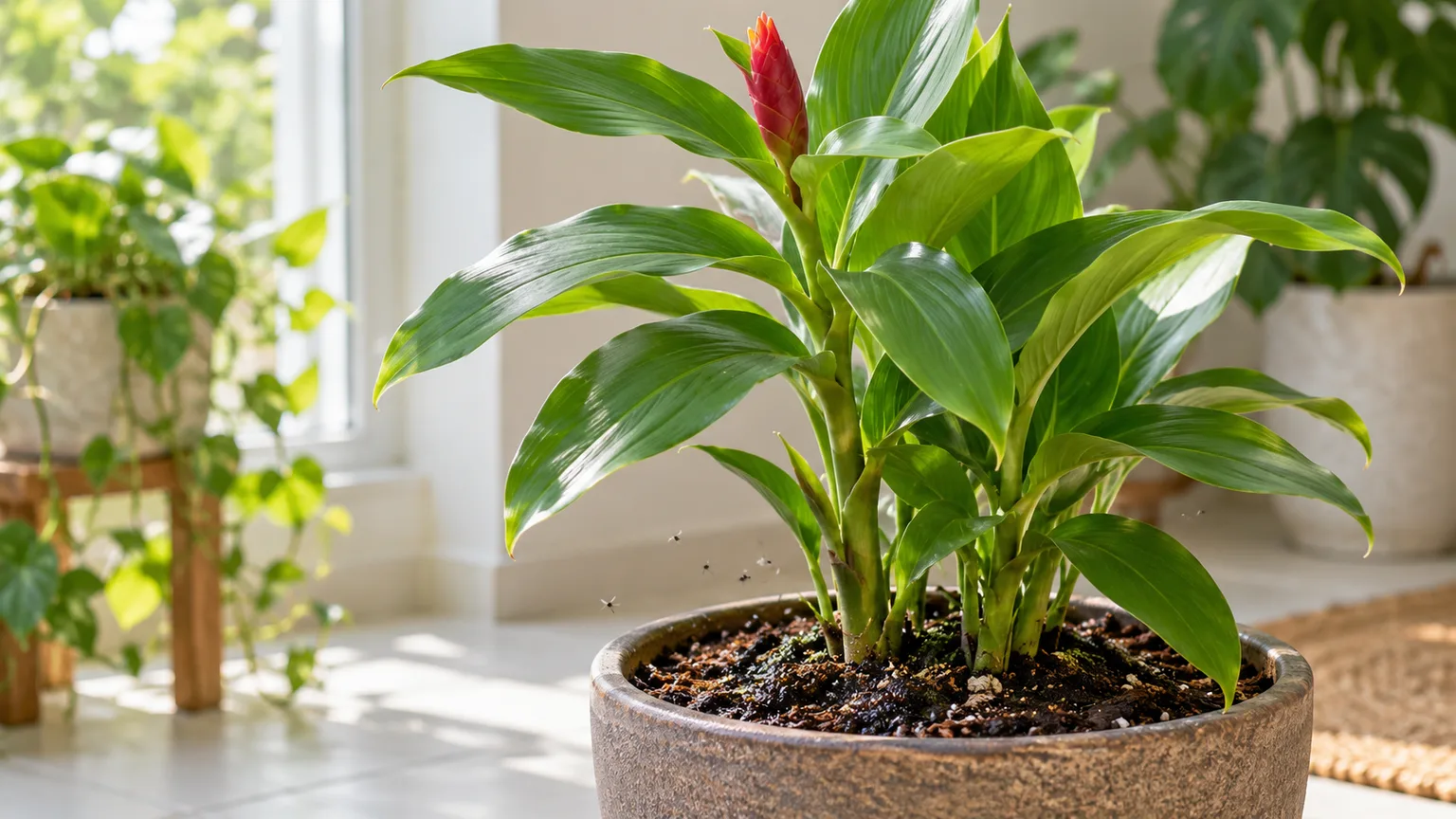
Fungus Gnats on Insulin Plant: Identification, Treatment & Prevention
This guide covers fungus gnats on Insulin Plant. See also the general Fungus Gnats guide, watering, and light pages for this plant.
Fungus Gnats on Insulin Plant: Identification, Treatment & Prevention
Quick answer
If small, dark flies are hovering around your Insulin Plant, first check the top 2–3 cm of potting mix. Let only that surface layer dry before watering again; do not leave the entire root ball dry. Costus igneus needs an evenly moist, well-draining mix, and its rhizomes can rot when the pot stays wet in low light. If you still see adults after the surface dry-down, look for larvae in the upper mix before applying a larval treatment. For the general pest lifecycle and other control options, see our fungus gnats guide; this page explains how to reduce the breeding conditions without sacrificing the moisture this plant needs.
What fungus gnats look like around Insulin Plant
Adult fungus gnats are tiny, dark, mosquito-like flies that drift weakly around a pot, run across the mix, or collect near a bright window. They often stay close to the plant they emerged from. The larvae are harder to spot: they are slender, translucent or whitish worms with a dark head capsule and live in the damp surface layers of potting mix. Colorado State University Extension describes this adult-and-larva pattern and notes that larvae feed on fungi and decaying matter as well as plant roots when populations are high (Colorado State Extension).
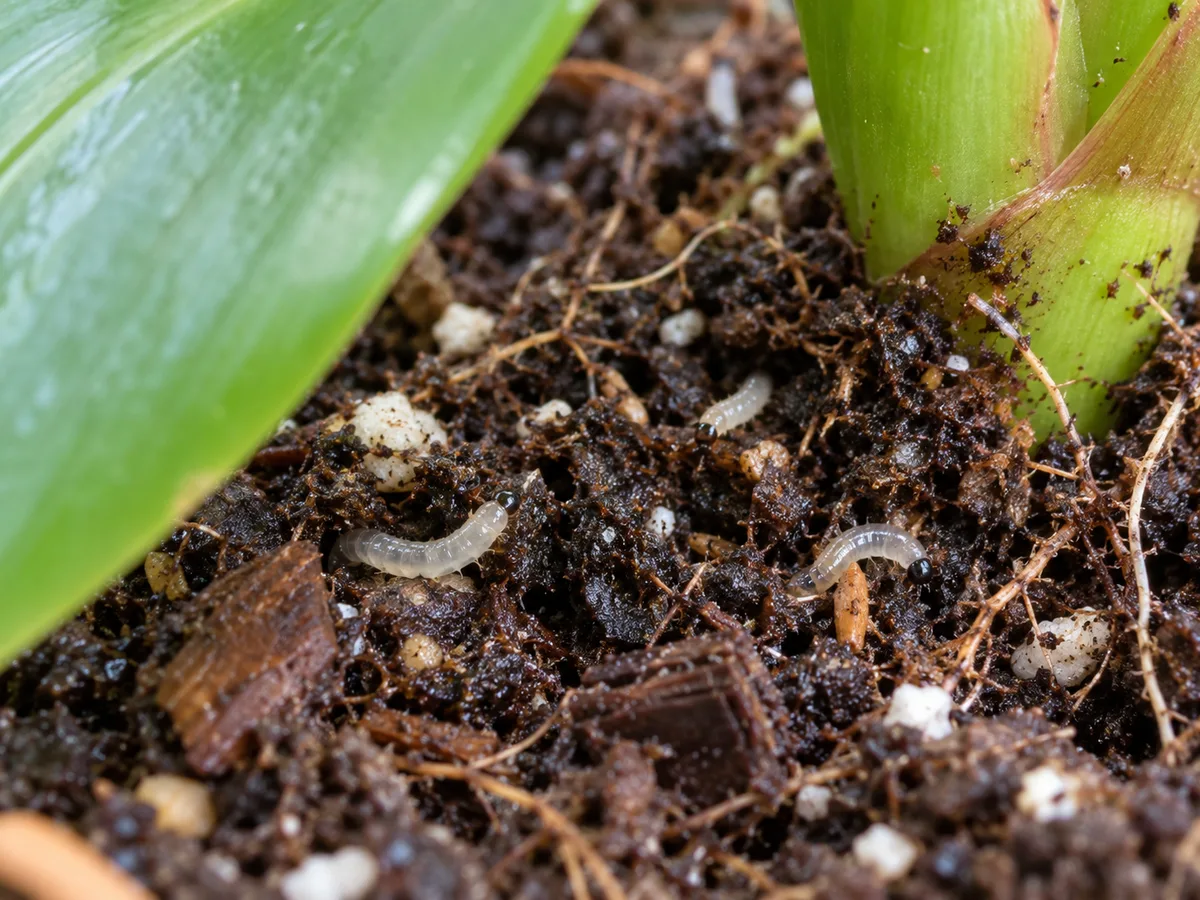
A larva in the mix is stronger evidence than a single flying adult; inspect the upper soil layer and remove any test material after checking.
The adult flies are a nuisance, but they do not chew the plant. Larvae normally consume fungi, algae, and decaying organic matter. In large numbers they can also feed on fine roots and root hairs, which can slow growth or injure a vulnerable plant. UC Integrated Pest Management notes that meaningful root injury is more likely in moist, organically rich media and in seedlings or young plants than in established houseplants; adult flies alone do not prove that roots have been damaged (UC IPM). The Royal Horticultural Society likewise says established plants are unlikely to be damaged, while seedlings and cuttings are more susceptible (RHS).
On Insulin Plant, separate the fly problem from any leaf problem. A few adults near the pot usually call for soil checks, not pruning. If the plant is wilting, yellowing at the base, or losing firmness, also inspect drainage and rhizome condition: fungus gnat larvae are only one possible cause, and excess water or a failing mix can harm this plant independently.
Why fungus gnats may appear on this plant
Fungus gnats breed where the surface of potting media remains moist and contains fungi, algae, or decaying plant debris. Insulin Plant is not a “dry soil” plant: its care profile calls for watering once the top 2–3 cm dries while keeping the rest evenly moist. The target is a shallow dry-down, not a full-pot drought. Missouri Botanical Garden describes the related Chamaecostus cuspidatus as growing in part shade in evenly moist, well-drained loam, with leaves arranged in a spiral along the stems (Missouri Botanical Garden Plant Finder).
That combination explains the practical challenge. A pot kept continuously wet can give larvae a favorable surface layer, but a pot left dry for too long can stress the plant and damage its growth. The correct adjustment is not to abandon even moisture; it is to let the top layer dry between waterings, drain the pot completely, and remove rotting material that collects at the surface. Use the Insulin Plant watering guide to check its 2–3 cm test and seasonal cadence, and the soil guide if the mix stays soggy despite a reasonable watering interval.
Light and season affect how quickly the surface dries. In cooler or dimmer months, Insulin Plant grows more slowly and uses water at a slower pace, so a summer schedule may keep the pot wet too long. Move it toward bright filtered light if it is sitting in deep shade, but do not put it into hot afternoon sun just to dry the soil. The Insulin Plant light guide explains the plant’s filtered-light range; keeping light appropriate helps the mix dry at a pace the rhizomes can tolerate.
Confirm larvae before choosing a treatment
Start with the pot, not with the leaves. Adults flying around a window may have come from another container, and several small flies can look similar at a glance. Check the Insulin Plant’s mix for a persistently damp surface, algae, dead leaf fragments, or a sour smell. Then examine the flies: fungus gnat adults are delicate, dark, and weak-flying, while shore flies have a sturdier body and shorter, bristle-like antennae. UC IPM uses the long segmented antennae and delicate appearance to distinguish fungus gnats from shore flies; both may occur near moist media, so location alone is not a complete identification.
If you can see adults but not larvae, use a simple monitor. Place one small piece of raw potato, cut side down, on the mix near—but not pressed against—the stem. Check the underside after about two days, then remove and discard the potato. Fungus gnat larvae may gather under it, giving you a more direct sign of activity than adult flies alone. UConn IPM describes both potato pieces for larval monitoring and yellow cards for adult monitoring (UConn IPM). Keep the test brief: a piece left to decay on the soil becomes another organic food source.
Yellow sticky cards help track adults. Place a small card near the soil surface or pot rim, secured so it does not touch the Insulin Plant’s leaves. Count what it catches over time rather than treating one trapped fly as proof of a severe infestation. A yellow card will not kill larvae in the mix, so fewer adults on the card is a monitoring result, not the full treatment plan. The houseplant guide from Gardening Know How also distinguishes adult sticky-trap capture from soil-based larval control.
First fix: let the top 2–3 cm dry before watering again
If the surface is still damp, delay the next watering until the top 2–3 cm feels dry to the touch. Then water the plant thoroughly enough to moisten the root ball, let excess water drain, and empty the saucer or cachepot. This is one targeted change: stop keeping the surface continuously wet, while preserving moisture deeper in the pot for the Insulin Plant’s rhizomes.
Colorado State Extension recommends allowing the surface layer of growing medium to dry between waterings because dry surface media is less suitable for fungus gnat eggs and young larvae (Colorado State Extension). For this plant, follow the shallower 2–3 cm check in its care profile rather than the broader dry-out advice sometimes given for succulents or drought-tolerant houseplants. The mix should not become bone-dry down to the rhizomes. If it dries unevenly or the surface stays wet for many days, investigate pot drainage and the mix structure in the soil guide before making a larger watering change.
Remove fallen leaves and any visibly decaying material from the top of the mix. Do not scrape deeply or disturb the rhizomes while doing this. If a leaf has naturally detached, discard it rather than leaving it to break down on damp soil. Keep the pot in bright filtered light with gentle airflow, but do not aim a fan directly at the plant or place it in severe heat to force the surface dry.
Reduce adults and larvae without stressing the rhizome zone
Once you have corrected the surface moisture, keep using a sticky card as a monitor and replace it when it is dusty or full. It can reduce some adults, but the larvae and pupae remain in the potting mix. If adults continue to emerge after you have allowed the upper layer to dry appropriately and removed debris, check again for larvae with a potato piece or by inspecting the surface with a hand lens.
For a persistent larval population, consider a soil treatment only if the product is labeled for fungus gnat larvae and indoor ornamental plants. UC IPM lists Bacillus thuringiensis subspecies israelensis (Bti) and certain beneficial nematodes among biological controls for fungus gnat larvae in container media (UC IPM); Bti acts as a temporary control and may require repeat applications according to product directions. Use the label for the specific formulation and setting, because products and legal directions differ. Do not guess a concentration, mix several products, or apply a product intended for mosquito water to a houseplant pot unless its label explicitly includes that use.
Adults and larvae need different control methods. A spray aimed at flying adults does not reach larvae beneath the surface. UC IPM advises focusing on the immature stages, reducing excess moisture and organic debris, and avoiding indiscriminate indoor spraying. If you use a biological larval treatment, apply it evenly to the mix as directed, then continue the plant’s shallow dry-down routine. Do not add extra water between scheduled applications unless the product label requires it and the plant’s mix needs it.
Repotting is not the first response to a few flies. Consider a fresh, airy mix only when the current media has broken down, drains poorly, stays wet far too long, or smells sour. Insulin Plant can lose roots in a persistently wet rhizome zone; unnecessary unpotting adds stress and may damage those rhizomes. If the pot genuinely needs a refresh, use the Insulin Plant repotting guide and preserve firm healthy rhizomes while discarding failed media.
How to tell whether the plant is recovering
Adult flies may remain visible while eggs, larvae, and pupae already in the media finish developing. At ordinary indoor temperatures, Colorado State Extension reports that a fungus gnat generation may complete in roughly three to four weeks (Colorado State Extension). Do not judge the result after one day. Instead, keep a simple log of adult captures, surface moisture, and whether larval checks still find live larvae.
Early improvement looks like fewer adults on the card and no live larvae under a fresh potato monitor after the treatment interval. For the plant itself, look for stable stems, firm rhizomes, and continued leaf production. An established Insulin Plant may tolerate a small gnat population without visible root damage; if the leaves remain firm and growth continues, focus on reducing the nuisance rather than escalating to harsh measures.
If the plant wilts while the mix is wet, or the lower stems soften, stop treating the problem as “just gnats.” Check whether the pot drains freely, whether it sits in water, and whether the rhizomes are firm. The Insulin Plant problems hub can help route symptoms that do not fit the gnat pattern. Heavy larval feeding can injure roots, but overwatering, poor drainage, or light stress may explain decline more directly.
Prevent a repeat while keeping normal care
Use soil moisture rather than a fixed date to decide when to water. During warm, bright growth, the top layer may dry quickly; in cool or low-light conditions, the same pot may need longer between waterings. The Insulin Plant’s care guidance gives seasonal intervals as starting points, but pot size, media, light, and room conditions still determine when the surface is ready. If it remains wet beyond its usual rhythm, inspect drainage before adding more water.
Keep the top of the pot free of dead leaves, old flower debris, and spilled organic fertilizer. Do not add a thick compost layer, fish emulsion, or fresh organic mulch as a fungus-gnat remedy; decaying organic matter can feed the fungi and algae on which larvae rely. Keep routine feeding limited to active growth and use the Insulin Plant fertilizer guide for timing instead of increasing feed to “push through” pest stress.
When bringing an Insulin Plant indoors after a warm season outside, inspect the soil surface and leaf bases before placing it beside other plants. A small sticky card near the pot can help detect adult activity early, but treat it as a warning signal, not a larval diagnosis. If you see flies on several pots, check every container that stays moist, since the adults can emerge from more than one breeding site.
When to get another diagnosis
Ask a local extension office or plant clinic to identify the insect if the flies do not match the delicate, weak-flying gnat pattern, if adults appear while the mix is consistently dry, or if potato checks find no larvae. Shore flies, fruit flies, and other small insects need different responses. A clear photo beside a ruler, a photo of the soil surface, and a note about watering will help distinguish them.
Seek plant-specific help if roots or rhizomes are soft, foul-smelling, or collapsing, or if the plant keeps declining after you have corrected surface wetness. Those symptoms call for a root-zone diagnosis rather than more sticky cards or repeated insecticide. Avoid unpotting a healthy clump simply because adult gnats are annoying.
Related Insulin Plant guides
- Use the Insulin Plant overview for a full care baseline and seasonal adjustments.
- Use the watering guide for the 2–3 cm dry-down check and seasonal cadence.
- Use the soil guide if the mix retains water or drains slowly.
- Use the light guide if a dark position is slowing dry-down.
- Use the fertilizer guide to review feeding while the plant recovers.
- Use the repotting guide only when the mix has failed or rhizomes need more room.
- Use the Insulin Plant problems hub if symptoms do not match fungus gnats.
Related tool
Use the Pest Identifier Tool if the insects near your Insulin Plant do not match fungus gnats.