Jackfruit Fertilizer Guide for Trees & Pots
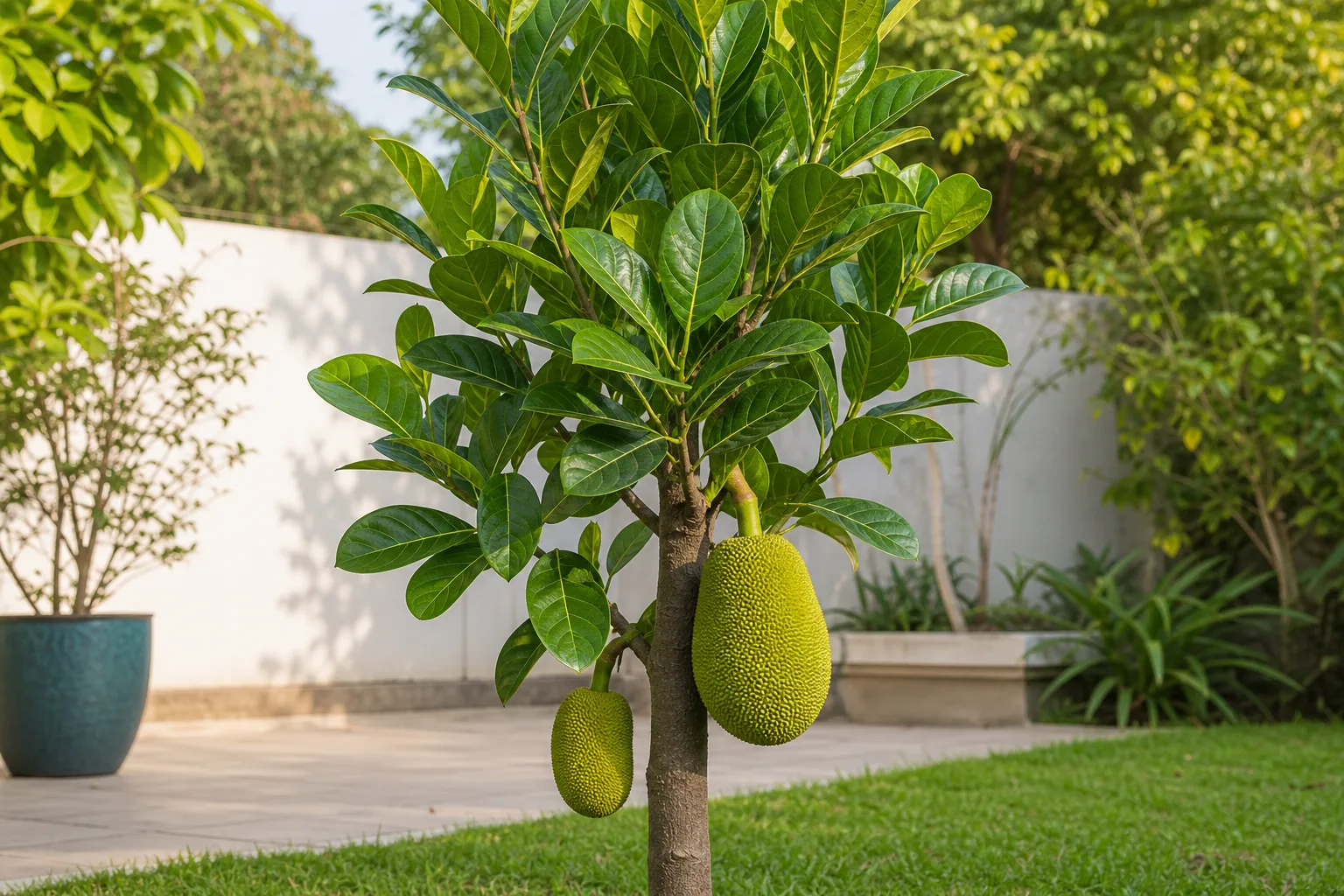
Jackfruit Fertilizer Guide for Trees & Pots
Jackfruit Fertilizer Guide for Trees & Pots
A pale or stalled jackfruit is not always hungry. Artocarpus heterophyllus may be limited by shade, flooded roots, a cramped pot, cool weather, or recent transplant stress before it is short of nutrients. Feed only after Jackfruit light, Jackfruit watering, and drainage are sound, because extra fertilizer cannot fix those problems and can reduce fruiting quality.
That distinction matters most on Indian courtyards and large terrace tubs, where orchard kilogram rates are easy to find and dangerous to copy into a pot. A landscape tree explores a large soil volume; a container jackfruit holds every added salt in a confined root zone. The same species benefits from measured, age-aware feeding in both settings, but the safe dose changes with root volume, tree age, and whether the tree is still vegetative or already bearing.
The quick answer: what to feed jackfruit
Use a complete fertilizer that supplies nitrogen, phosphorus, potassium, and ideally magnesium, plus minor elements, then scale the amount to tree age. UF/IFAS recommends starting young landscape trees with about ¼ lb (113 g) of a mix such as 6-6-6 with minor elements (and roughly 30% of the nitrogen from organic sources) once new growth appears after planting, repeating about every eight weeks in the first year, then gradually increasing as the canopy expands in its jackfruit fertilizer guidance.
For mature bearing trees, the same UF/IFAS guide advises two to three dry applications from bloom through right after harvest and pruning, using materials such as 6-6-6-3, 8-3-9-3, 4-2-12-2, or similar complete blends with magnesium. In Indian orchard practice, Tamil Nadu Agricultural University schedules manures and fertilizers in two splits (May–June and September–October), rising from modest first-year NPK plus FYM to higher totals by year six and beyond.
For a container on a terrace, prefer a complete liquid fruit-tree or general-purpose fertilizer labeled for pots. Start at one-quarter to one-half of the label’s container rate on already-moist mix, and never pour an orchard kilogram rate into a tub.
Why jackfruit fertilizer needs change with age and crop stage
Young jackfruit trees are building framework wood and leaf area, so they use a steadier supply of nitrogen along with phosphorus, potassium, and magnesium. UF/IFAS tables increase both application frequency and amount through the early years, then shift mature trees to fewer, larger applications timed around bloom and harvest.
Once the tree is bearing, nutrition supports fruit fill as well as flushes. Jackfruit flowers and fruits on the trunk and large branches, and heavy crops already stress limbs—overloading nitrogen while starving potassium or micronutrients does not help fruit quality. Treat fertilizer as support for the growth stage you actually have. A newly grafted container tree and a mature garden specimen are not on the same nutrient program, even when both are Artocarpus heterophyllus.
Best fertilizer type for Artocarpus heterophyllus
Choose a product with a full guaranteed analysis rather than a single-nutrient “bloom booster.” Equal N-P-K numbers are not a biological requirement. Extension schedules for jackfruit favor complete blends that include magnesium and room for micronutrients, not a weekly high-middle-number flower product.
Clemson Extension’s 4R nutrient guidance stresses the right nutrient, right rate, right time, and right place—apply when the tree can use the feed, keep granules in the root zone (not on hardscape), and skip applications before heavy monsoon downpours that wash nutrients away.
How to read the NPK and magnesium label
The three large numbers are percentages by weight of nitrogen, phosphate (P₂O₅), and potash (K₂O)—not a feeding schedule. Clemson’s fertilizer-label explanation notes that soilless container mixes benefit from all three major nutrients, though not necessarily in equal proportions. Check whether the product lists magnesium and micronutrients such as iron, zinc, manganese, and boron, then follow the container directions if the tree is potted.
UF/IFAS examples for jackfruit include 6-6-6 or 8-3-9 (and magnesium-bearing variants). A generic 10-10-10 can supply the three majors for a young tree when used carefully, but it is not magically better than a fruit-tree blend that lists magnesium and minors. Micronutrients still matter on sandy or high-pH soils; excess boron or other minors can damage plants, so follow soil tests or labeled rates rather than improvising “cocktails.”
FYM, compost, and neem cake in the ground
Finished compost or well-rotted farmyard manure can improve structure and supply background nutrition, but release rates are hard to calculate in a pot. Keep organic matter as a modest part of an airy Jackfruit soil mix rather than packing a thick, water-holding collar against the trunk. Never use fresh manure in a container; it can be salty, chemically hot, and physically dense.
TNAU planting guidance mixes 10 kg FYM and 1 kg neem cake into the pit fill for field planting, then continues FYM with mineral N, P, and K in two seasonal splits. Those kilogram-per-tree rates assume open soil and orchard spacing. They confirm that organic matter and mineral nutrition can work together; they should not be scaled by guesswork into a terrace pot.
A warm-climate jackfruit fertilizer schedule
In frost-free tropical and subtropical climates, follow visible flushes and fruiting stage more than a temperate four-season calendar. Feed when the tree is producing healthy new leaves or supporting fruit and the root zone is using water normally. Pause when growth stalls, the mix stays saturated, or the tree is recovering from root disturbance.
UF/IFAS Florida calendars for mature trees cluster dry fertilizer from roughly bloom through summer, and they caution against nitrogen applications late enough to push soft winter growth that can reduce spring flowering in that climate. In monsoon India, translate that principle: do not force nitrogen during cool stalled periods or while the root zone is waterlogged, and prefer the TNAU May–June and September–October split windows when soils are workable.
Young and newly planted trees
Do not fertilize into the planting hole as a concentrated band under the root ball. UF/IFAS advises that it is not necessary to apply fertilizer, topsoil, or compost into the hole first—and that planting on a compost layer under the root ball is undesirable. Mix modest amendments into excavated soil if you amend at all, establish the tree, then begin light complete feeds after new growth starts.
UF/IFAS’s first-year pattern is roughly ¼–½ lb per application, about six times per year, then larger amounts as the tree ages. TNAU’s first-year mineral rates are on the order of 0.15 kg N, 0.08 kg P, and 0.10 kg K plus 10 kg FYM, increasing annually until mature rates near 0.75 / 0.40 / 0.50 kg N-P-K with 50 kg FYM from year six onward. Use whichever regional schedule matches your soil and water regime, but keep doses proportional to canopy size and never stack both full schedules on top of each other.
If the plant wilted after transplant, the stem base darkened, or the mix stayed wet, troubleshoot establishment through the Jackfruit repotting guide before feeding.
Bearing and mature trees
Shift toward fewer applications timed around bloom, fruit development, and post-harvest pruning. UF/IFAS recommends two to three dry feeds for mature trees from bloom to right after harvesting and pruning, with materials that still include magnesium. Foliar nutritional sprays containing magnesium, manganese, zinc, molybdenum, and boron are most useful in the warm months, and iron soil applications are most effective in warm weather as well.
Thin heavy fruit loads on young bearing trees so limbs are not asked to carry a full crop while the canopy is still establishing. Fertilizer cannot compensate for overloaded wood or shade from nearby buildings—use selective Jackfruit pruning after harvest to open the canopy and keep height manageable.
Container jackfruit vs landscape rates
Landscape rates assume roots can explore beyond the drip line. Container trees recycle every salt you add. Prefer liquid or controlled-release products labeled for containers, water thoroughly so excess drains away, and discard runoff rather than letting it sit in a saucer.
A practical terrace rhythm is a dilute complete feed every four to six weeks during strong warm-season flushes, then pause during monsoon saturation, cool stalled periods, drought wilt, or transplant stress. If the pot dries in a day and growth stalls despite full sun, check root restriction before raising fertilizer strength—jackfruit is strongly affected by pot-bound taproots.
UF/IFAS also notes that heavy fertilization of lawn adjacent to jackfruit can reduce fruiting or fruit quality because roots extend beyond the canopy drip line. Keep a grass-free mulch ring and do not treat the tree as a lawn-fertilizer bonus plant.
Micronutrients, iron, and pale leaves
Pale new leaves on jackfruit are not automatically a call for more nitrogen. High-pH calcareous soils and poorly aerated pots both limit iron and other micronutrient uptake. UF/IFAS recommends four to six foliar nutritional sprays in the warm season and soil iron applications (iron sulfate on acid soils; chelated iron such as EDDHA on high-pH rockland soils, EDTHA-type chelates on neutral to acid soils), noting that foliar iron sprays are generally less effective than soil drenches for correcting iron deficiency.
Fix Jackfruit soil drainage and watering first. If leaves yellow while the mix stays wet, or the tree declined after days of flooded soil, you are looking at aeration and root health—not a missed fertilizer day. Jackfruit may decline after only two to three days of continuously wet conditions according to the same extension research.
Warning signs of underfeeding and overfeeding
Underfeeding on an otherwise well-sited tree often shows as slow flushes, uniformly pale older leaves, and weak fruit set when light and water are already adequate. Confirm sun and root health before increasing dose.
Overfeeding more often shows as tip burn, leaf-edge scorch, white crust on the pot rim or soil surface, sudden soft wilt after a strong feed, or lush soft shoots with poor fruit quality. Stop feeding, remove visible granules, and flush with plain water only if the container drains freely—discard all runoff. If the mix is waterlogged, the trunk base is soft, or roots smell sour, inspect the root zone instead of repeatedly adding water.
What not to do when fertilizing jackfruit
Do not band strong fertilizer under a newly planted root ball. Do not copy orchard kilogram rates into a 40–60 cm pot. Do not fertilize into dry mix or during drought wilt—plants need water to take up nutrients safely. Do not fertilize into a flooded monsoon pot or a sour, anaerobic root zone. Do not stack lawn high-nitrogen programs against the drip line of a fruiting tree. Do not treat micronutrient deficiencies with random high rates of boron or other minors without a clear need.
When to use this page vs other Jackfruit guides
Use this page for what to feed, when to feed, and how to dose jackfruit in ground and containers. Use the Jackfruit watering guide when leaves yellow in wet soil, wilt in dry weather, or the tree sits flooded. Use the Jackfruit soil guide when drainage, mix texture, or pH is the real limit. Use the Jackfruit light guide when growth is weak in shade. Use the Jackfruit repotting guide when the taproot is circling or the pot dries too fast. Use the Jackfruit overview for size, latex handling, and whole-tree placement decisions.
Related Jackfruit guides
- Jackfruit care overview — species habits, size control, and latex safety
- Jackfruit watering — dry-spell irrigation and flood risk
- Jackfruit soil — free-draining mixes and landscape soils
- Jackfruit light — full-sun requirements for growth and fruit
- Jackfruit repotting — deep pots and root restriction
- Jackfruit pruning — height control and post-harvest thinning
- Jackfruit hub — profile and care cluster entry point
Conclusion
Feed jackfruit with a complete, age-aware program—light frequent doses while the tree is young, fewer applications timed around bloom and harvest once it bears, and much smaller rates in containers than in the ground. Pair fertilizer with full sun and free drainage, use FYM and mineral NPK as open-soil tools rather than pot recipes, and pause whenever roots are wet, cool, or recovering. When growth stalls, diagnose light, water, and roots before reaching for a stronger bag.