Jackfruit Light Needs: Full Sun, Shade Limits & Placement
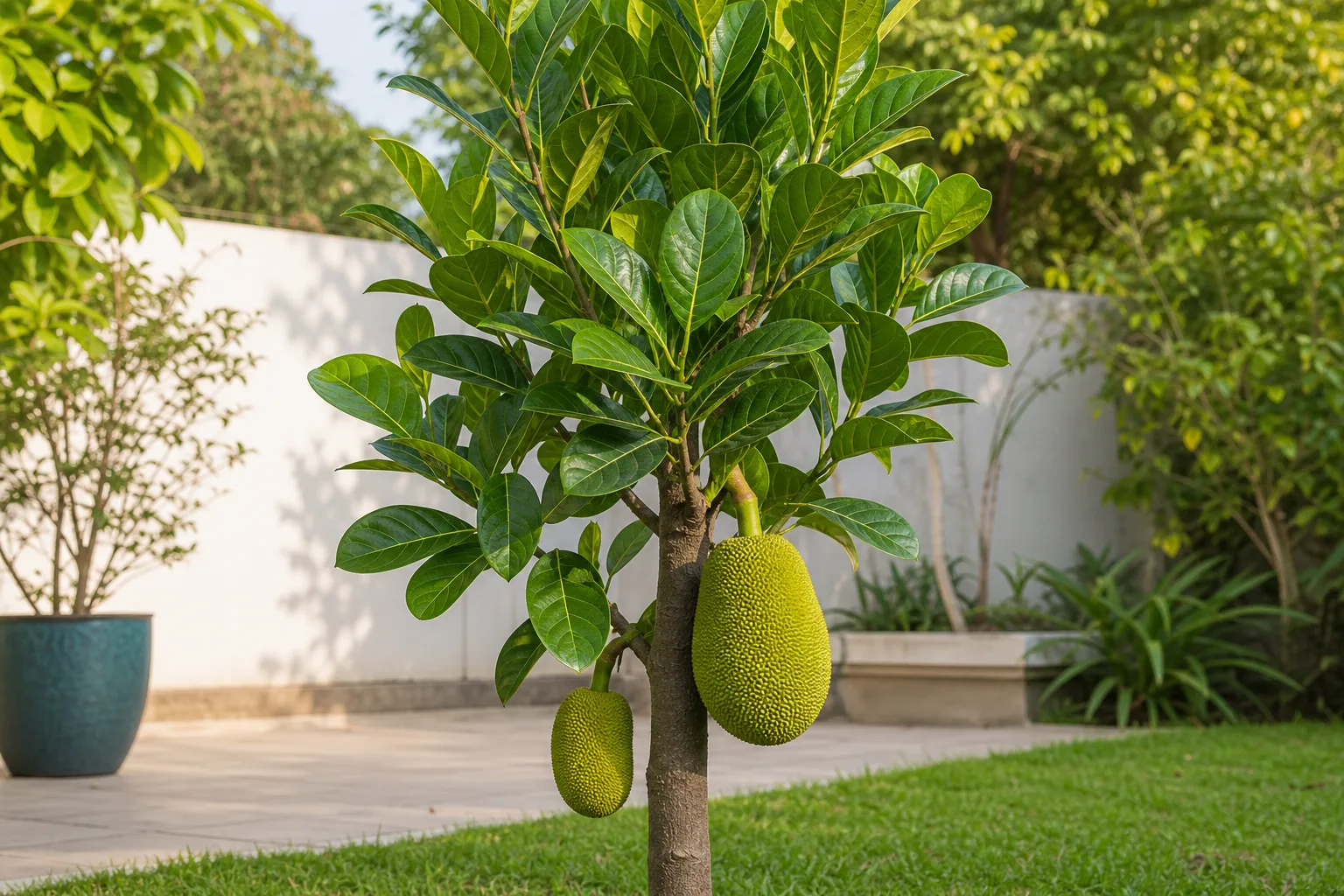
Jackfruit Light Needs: Full Sun, Shade Limits & Placement
Jackfruit Light Needs: Full Sun, Shade Limits & Placement
A young jackfruit can stay green in a bright corner, but that does not make Artocarpus heterophyllus a low-light houseplant. Jackfruit is a large evergreen tropical fruit tree. Compact wood, steady flushes, flowering, and usable fruit all depend on long hours of open sun, not the soft ambient light that keeps a snake plant alive.
In most Indian homes and similar warm climates, the useful question is not “Does this room look bright?” It is “Can the canopy see open sky for most of the day?” Plant in the sunniest workable site from the start. Use large containers only where the foliage still receives direct sun, and treat indoor glass as temporary protection for seedlings or frost nights — not the long-term fruiting plan.
Jackfruit light needs at a glance
Give jackfruit full sun — ideally at least 6–8 hours of direct sun on most clear days, with all-day open exposure preferred for trees you expect to fruit well. UF/IFAS recommends planting jackfruit in full sun for best growth and fruit production. A few hours of morning sun plus afternoon shade may keep a young plant alive, but growth usually stays thinner and fruiting weaker than on an open site.
Count sun that actually hits the leaves. A high wall, deep balcony slab, neighbouring tree, or shade cloth can cut usable light even when the courtyard feels hot. Walk the site at mid-morning, noon, and mid-afternoon before you dig a permanent hole.
For placement priority, use this order: open garden or farm sun; a sunny courtyard or terrace with a wide sky view; a large sun-facing balcony with the canopy close to the rail; temporary window or grow-light holding for a young plant. A normal ceiling bulb cannot substitute for outdoor sun on a jackfruit.
Why Artocarpus heterophyllus wants open sky
Jackfruit is adapted to humid tropical and near-tropical climates, with origin commonly linked to the rainforests of the Western Ghats and long cultivation across South and Southeast Asia. UF/IFAS describes the species as well adapted to the hot humid tropics, with best growth and production in continuously warm areas. That biology points to strong sky light and heat, not understory dimness.
The tree also builds a large canopy. Unpruned landscape trees commonly reach about 9–12 m (30–40 ft) in Florida conditions, and Morton notes even taller tropical specimens. Dense planting next to buildings or taller trees does more than look crowded — UF/IFAS notes trees planted too close may not grow normally or produce much fruit due to shading.
Light must reach more than the outer leaves. Jackfruit flowers and fruit on the trunk and large branches (cauliflory). After harvest, growers thin upright wood and open the inner canopy to increase light penetration toward those fruiting sites. Shade that starts as a “cool spot” often becomes permanent weak wood and sparse bearing.
Tamil Nadu Agricultural University notes jackfruit comes up well in the plains and up to about 1,200 m elevation when drainage is good. Elevation does not replace sunlight. A cloudy hill slope still needs the clearest available exposure you can give the canopy.
Best outdoor placement in India and similar climates
In India and comparable tropical or subtropical zones, choose the warmest, brightest, free-draining position that will not flood after monsoon rain. UF/IFAS pairs full sun with selecting a warm landscape area that does not remain wet after heavy rain. Light and drainage fail together on many home plots: a shady low corner often stays wetter, which jackfruit roots handle poorly after only 2 to 3 days of wet soil.
Gardens, courtyards, and farm plots
Plant where neighbouring houses, coconut palms, or mango canopies do not steal the middle of the day. South, southeast, and southwest exposures are often useful in the Northern Hemisphere, but compass labels matter less than uninterrupted sky hours. Leave generous clearance if you will prune little — UF/IFAS suggests roughly 7.6–9.1 m (25–30 ft) from other trees and structures without regular size control, or closer spacing only when you prune annually.
If the only ground bed sits between a compound wall and a mature shade tree, a large container on a sunnier paved court may outperform that permanent pocket. Visit the Jackfruit overview before you commit to an in-ground site that cannot be moved later.
Terraces, rooftops, and large containers
Containers let you chase sun, but they create heat. On a west-facing rooftop in Chennai, Hyderabad, or Ahmedabad, leaves may love the exposure while a black plastic pot and concrete slab cook the roots. Shade the pot wall, raise the container for drainage, use a light-coloured sleeve, and water more carefully — do not solve root heat by parking the canopy under a permanent awning.
Choose a grafted cultivar when you need manageable size and earlier bearing, and plan annual pruning so the tree does not outgrow the terrace. Seedlings are genetically variable and often become large before they fruit well. Keep deep pots; jackfruit resent tight, circling taproots when you later plant them out.
Can jackfruit grow in partial shade?
Partial shade is a survival compromise, not a fruiting strategy. Young plants can hold leaves with morning sun and bright open shade, especially during nursery hardening. Long-term shade — under a dense tree, deep north court, or covered balcony — usually produces longer internodes, thinner wood, slower canopy fill, and weak or absent crops.
UF/IFAS is direct: plant in full sun for best growth and fruit, and avoid close plantings that shade the tree. Morton also notes that young plantings may need protection from sunscald — temporary shade for newly set trees — which is different from growing a bearing tree in permanent half-day shade.
If your only option is 3–4 hours of direct sun, expect decorative foliage more than reliable fruit. Improve the site (raise the pot higher on the rail, prune a competing branch on a neighbouring tree, or move the container) before you blame watering or fertilizer for weak growth. Check Jackfruit watering and Jackfruit fertilizer only after light is honestly assessed.
Indoor windows and honest limits
A jackfruit seedling can produce foliage indoors for a while beside a large, unobstructed sun-facing window. A normal room rarely supplies enough intensity or canopy space for a productive adult tree. Glass cuts and redirects outdoor light, and intensity falls quickly as the pot moves even a metre back from the pane.
University of Georgia Extension notes that an open sunny outdoor site can reach around 10,000 foot-candles, while many indoor “bright” spots are only a fraction of that. Treat indoor culture as nursery holding, quarantine, or cold protection — not the default fruiting setup.
Jackfruit is also frost-sensitive. UF/IFAS reports leaves may damage near 0°C (32°F), with colder freezes injuring branches or killing trees. Moving a potted young tree indoors on rare frost nights can save tissue, but parking it permanently in a dim living room undoes the sun advantage you need for growth. Return the plant outdoors as soon as nights are safely warm.
Grow lights for young or overwintered plants
Use a grow light when cold weather forces a young jackfruit indoors and the window cannot deliver several hours of strong direct sun. Oklahoma State Extension notes that when rooms lack natural light, artificial lights should be used, and that special plant lamps or fluorescent fixtures can support growth better than random ceiling lighting.
For a seedling or recently grafted plant, a full-spectrum LED panel on a timer for roughly 12–14 hours daily, with the fixture close enough that new leaves stay compact, is more realistic than a decorative bulb across the room. Grow lights help you hold a juvenile tree through a dull winter. They do not turn a bedroom into a jackfruit orchard. Move the plant outdoors gradually when heat and sun return.
Acclimating nursery jackfruit to full sun
Nursery and polyhouse jackfruit are often grown under filtered light. Moving that foliage straight onto a July terrace can bleach or scorch leaves within days. Morton’s culture notes include protecting young plantings from sunscald, which matches what growers see after abrupt exposure.
Harden off over 7–14 days. Start with morning sun and bright open shade, add an hour or two of stronger midday or afternoon sun every few days, and pause the increase if the newest leaves turn pale, papery, or crisp on the sun-facing side. Keep the root zone watered during heat spikes so drought stress does not compound light stress. Do not combine a hard root prune, heavy fertilizer dose, and full west-sun transplant in the same week.
Warning signs of too little or too much light
Too little light usually shows as stretched shoots with long gaps between leaves, thin soft wood, slow canopy fill, and little or no flowering even on trees old enough to bear. Inner wood stays dark and leafy density drops. Soil in containers may stay wet longer because the plant uses less water — which then invites root problems that look like a watering issue.
Too much light after shade culture shows as bleached patches, brown crisp margins on the sun-facing side, or sudden leaf scorch right after a move. Established outdoor trees in true full sun rarely “burn” from sun alone when roots are cool and moist; heat plus drought is the usual partner. Distinguish scorch from latex-stained cuts or pest damage before you relocate a healthy open-grown tree into shade.
Judge by new growth after any placement change. Old scars tell you about last month’s mistake. Fresh flushes tell you whether today’s light works.
When to use this page vs other Jackfruit guides
Use this page to choose sun hours, site direction, terrace vs garden placement, indoor limits, grow lights, and acclimation. Switch to Jackfruit watering when leaves wilt, yellow in wet mix, or dry at the margins during heat. Use Jackfruit soil when drainage, pot mix, or flooded monsoon beds are the constraint. Use Jackfruit fertilizer when light is already strong but flushes stay pale or weak. Use Jackfruit pruning to open the canopy and hold height once the tree is in real sun. Use Jackfruit repotting when a circling taproot or undersized pot is limiting growth despite good light.
Related Jackfruit guides
- Jackfruit overview — size, climate fit, latex handling, and whether this tree belongs in your space
- Jackfruit watering — dry-spell irrigation, bloom-to-fruit moisture, and flood risk
- Jackfruit soil — free-draining mixes and landscape drainage
- Jackfruit fertilizer — feeding once light and drainage are in place
- Jackfruit pruning — opening the canopy for light penetration and size control
- Jackfruit propagation — seedlings vs grafts and early nursery light
- Jackfruit repotting — deep pots and avoiding pot-bound taproots
Conclusion
Jackfruit light needs are simple and strict: give Artocarpus heterophyllus full sun, warm air, and a root zone that never stays flooded. Aim for long daily direct exposure outdoors, protect young nursery foliage with a short acclimation period, and open mature canopies so light reaches trunk and scaffold wood where fruit forms. Use windows and grow lights only as holding tools. If growth stays thin, fix the sky view before you rewrite the watering schedule.