Jackfruit Care Guide for Warm Climates
Artocarpus heterophyllus
Grow Jackfruit in full sun, warm humid conditions, and freely draining soil. Learn watering, potting, size control, and latex-handling tips for Artocarpus heterophyllus.
Jackfruit Care Guide for Warm Climates
Start with wateringThe most common care mistake for JackfruitWatering guide →Jackfruit care essentials
Light
Water
Water young and container-grown Jackfruit regularly during dry periods so the root ball never stays bone-dry for long. Mature landscape trees are moderately drought tolerant, but irrigation is critical from bloom through fruit development. Do not leave the root zone wet for days — UF/IFAS notes trees may decline or die after 2–3 days of flooded soil.
Soil
Use a deep, freely draining mix rather than heavy, water-holding compost. A practical container blend is 50% quality potting mix, 25% coarse perlite or grit, and 25% fine pine bark or finished compost. Landscape trees grow best in well-drained sand, sandy loam, or rocky soils that never stay flooded.
Humidity
Temperature
Fertilizer
About Jackfruit
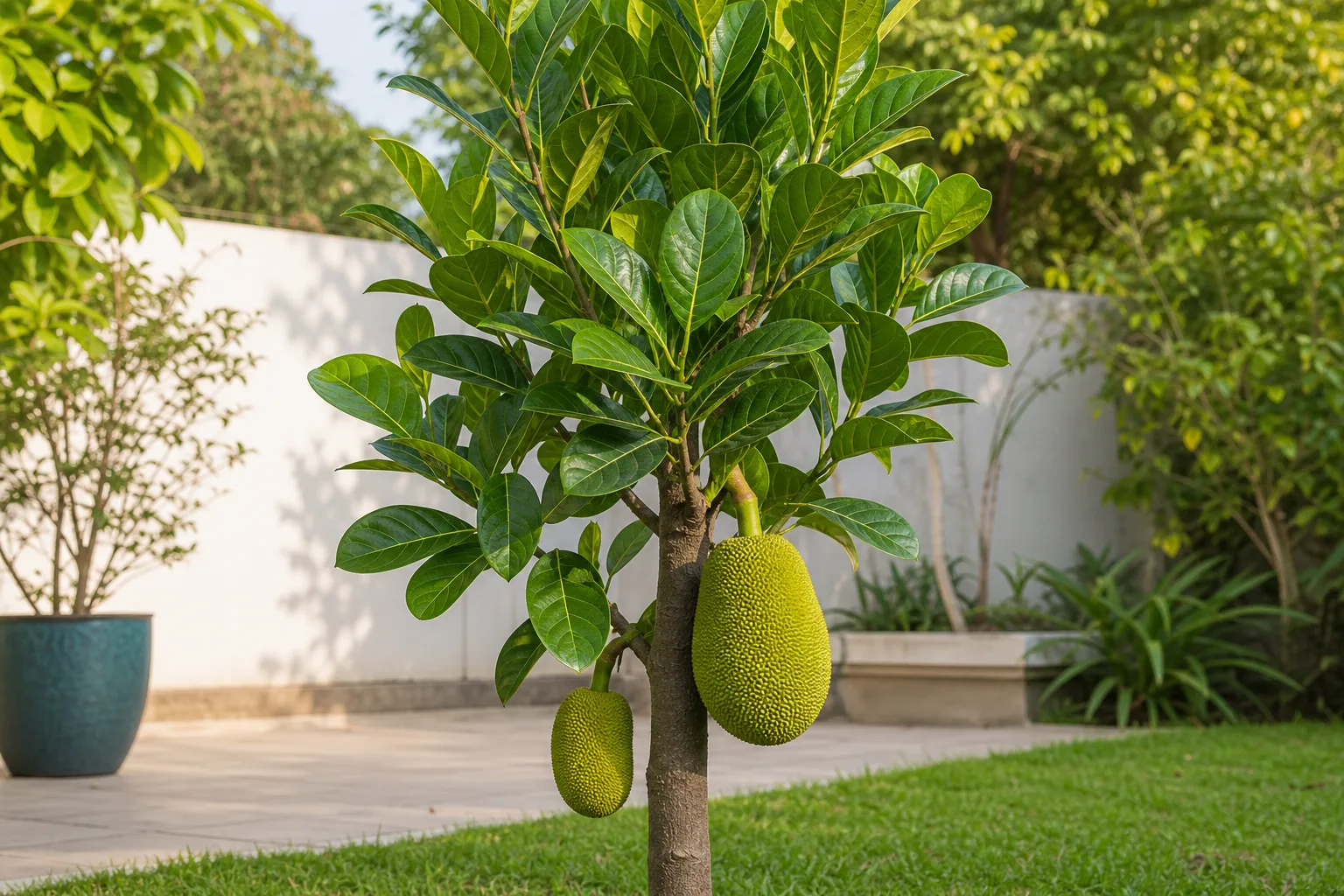
Jackfruit is native to Tropical India — believed indigenous to Western Ghats rainforests; widely cultivated across South and Southeast Asia, typically reaches 9–12 m (30–40 ft) tall in warm subtropical landscapes if lightly pruned; unpruned tropical trees can reach 9–21 m (30–70 ft); home trees can be held near 2.4–4.3 m (8–14 ft) with selective annual pruning indoors, with moderate to fast in hot, humid tropical or frost-free subtropical climates with full sun growth. Jackfruit has a tree like growth habit and part of the Moraceae family. It is also known as Kathal, Jakfruit, Jak, Panasa, and Nangka.
| Detail | Information |
|---|---|
| Also known as | Kathal, Jakfruit, Jak, Panasa, Nangka |
| Native region | Tropical India — believed indigenous to Western Ghats rainforests; widely cultivated across South and Southeast Asia |
| Mature size | 9–12 m (30–40 ft) tall in warm subtropical landscapes if lightly pruned; unpruned tropical trees can reach 9–21 m (30–70 ft); home trees can be held near 2.4–4.3 m (8–14 ft) with selective annual pruning |
| Growth rate | Moderate to fast in hot, humid tropical or frost-free subtropical climates with full sun |
| Growth habit | Tree Like |
| Scientific name | Artocarpus heterophyllus |
| Family | Moraceae |
Jackfruit Care Guide for Warm Climates
Jackfruit is a large evergreen tropical fruit tree, not a compact indoor foliage plant. Give Artocarpus heterophyllus full sun, sustained heat and humidity, and a root zone that drains quickly, then manage water and canopy size according to whether it grows in the ground or a deep pot. That distinction matters: a landscape tree and a terrace tree share the same biology but not the same drying rate, nutrient reserve, or space budget.
For most home growers in India and similarly warm regions, the practical challenge is rarely keeping jackfruit alive in the right climate. It is choosing a site that never floods, planning for a tree that can reach building height if left alone, and handling sticky white latex during pruning and harvest without staining everything in reach.
Quick jackfruit care at a glance
- Light: Full outdoor sun for strong growth and fruiting; shade makes weak, poorly fruiting canopies.
- Temperature: Hot humid tropics and frost-free subtropics. Protect young plants near freezing; leaves may damage around 0°C.
- Water: Keep young and container trees evenly moist in dry weather; irrigate bearing trees from bloom through fruit fill; never leave soil flooded for days.
- Soil: Deep, freely draining sand, sandy loam, or rocky soils; avoid heavy water-holding compost and ponding monsoon basins.
- Pot: Deep containers (about 45–61 cm) while young; avoid circling taproots that establish poorly after planting out.
- Feeding: Light, regular feeding while young during warm growth; mature trees need fewer, carefully timed applications from bloom through post-harvest pruning.
- Pruning: Annual selective pruning after harvest can hold height near 2.4–4.3 m; thin heavy crops on young trees to protect limbs.
If the tree is declining, check the root zone before buying a tonic. Wet, sour mix or standing water demands a drainage correction; bone-dry mix and a very light pot call for a thorough soak. The Jackfruit watering guide and Jackfruit soil guide separate those two problems.
What kind of plant is a jackfruit tree?
Artocarpus heterophyllus belongs to the fig family, Moraceae, alongside breadfruit, fig, and mulberry. UF/IFAS describes jackfruit as an erect evergreen tree, probably originating in India, and now cultivated across South and Southeast Asia and other tropical regions. Purdue’s Morton summary places its likely wild home in Western Ghats rain forests and notes long cultivation at low elevations across India.
Male and female flowers form on the same tree on short shoots from the trunk and large branches — a habit called cauliflory. The fruit is a multiple syncarp: many flowers fuse into one large structure. UF/IFAS reports typical fruit weights of about 4.5–27 kg, with some compact cultivars much smaller, and roughly 150–180 days from flowering to maturity. All leaf parts contain sticky white latex, and cut fruit stems gush latex that permanently stains clothing.
Growth habit and realistic mature size
An unpruned jackfruit is not a patio herb. In warm subtropical landscapes, UF/IFAS lists typical heights of 9–12 m (30–40 ft), while Morton notes trees can reach 9–21 m in humid tropical settings. Plant 6–9 m from buildings and power lines if you will prune little. With annual selective pruning after harvest, UF/IFAS reports home trees can be held near 2.4–4.3 m (8–14 ft) with a more open inner canopy.
Container culture does not genetically dwarf a vigorous seedling. The pot limits roots while pruning limits the canopy; both also limit how much stress and crop load the tree can support. A named grafted cultivar, annual size control, and realistic acceptance of fewer fruits make a large outdoor container workable. A tall tree jammed into a tiny pot with a circling taproot is not a compact fruit tree — it is a stressed one.
Choose a grafted cultivar for predictable fruit and size
Choose a healthy grafted nursery tree when fruit quality, bearing age, and manageable vigour matter. UF/IFAS prefers grafted trees of known cultivars when available and notes that seed-grown trees are genetically variable even though seedlings can begin bearing in about three to four years. Grafted trees also let you select pulp texture and fruit size rather than gambling on an unknown seedling.
Inspect the root ball as carefully as the leaves. Reject a tree with a circling taproot packed against a small container, trunk constrictions, sour-smelling mix, or active scale and mealybugs. Jackfruit is strongly affected by root restriction: pot-bound trees establish poorly and grow weakly after planting out. Prefer deep nursery pots and a plant that is not top-heavy for its container.
Best placement in India and other warm climates
Use a warm, open courtyard, farm plot, or large terrace with unobstructed sun and airflow. Jackfruit is adapted to hot humid tropics and frost-free subtropical coasts. UF/IFAS notes leaf damage near 0°C, branch injury near −1°C, and possible tree death near −2°C. In inland or higher-elevation Indian sites with cool winters, treat young trees as frost-sensitive and provide temporary protection during cold snaps.
In monsoon climates, air movement and quick soil drainage matter as much as rainfall volume. Wet weather favours flower and fruit rots, and continuously wet soil invites root pathogens. Choose the warmest non-flooding part of the property. If the water table is high, plant on a broad raised mound rather than in a low basin that holds runoff.
Growing jackfruit in a large container
A container jackfruit belongs outdoors. Start with a deep pot that gives the taproot room — UF/IFAS recommends roughly 45–61 cm deep plastic pots for nursery trees — and enlarge gradually as roots occupy the mix. An oversized wet tub around a small root ball can stay saturated during rain, while a shallow pot on a hot terrace can dry dangerously in a day.
Dwarf or lower-vigour grafted cultivars and annual pruning make terrace culture realistic. Moveable casters help with storms or brief cold, but do not plan to wheel a fruiting jackfruit into a dim living room as its permanent home. For step-by-step pot changes, use the Jackfruit repotting guide.
Light: treat jackfruit as a sun tree
Jackfruit grows and fruits best in full sun. UF/IFAS states that trees should be planted in full sun for best growth and fruit production, and that trees planted too close to buildings or other trees may not grow or fruit normally because of shading. A bright window may keep a seedling alive briefly, but glass and indoor spacing will not deliver the light, heat, or airflow a fruiting canopy needs.
Place a container where walls, awnings, and larger trees do not shade it through the main part of the day. Acclimate nursery foliage over several days before moving it into harsh reflected terrace heat. If growth is long and weak, leaves are widely spaced, and flushes stall despite warmth, light is the first constraint to examine. Use the Jackfruit light guide for placement and acclimation detail.
Watering through heat, monsoon, and cooler months
Young and container-grown jackfruit need more consistent moisture than established landscape trees, but neither benefits from permanently saturated roots. Water a pot thoroughly when the upper 3–5 cm feels dry, then let all excess drain away. Check with a finger and learn the pot’s dry weight instead of obeying a fixed weekday.
UF/IFAS describes jackfruit as moderately drought tolerant once established, yet recommends regular watering of young trees in dry periods and irrigation of mature trees from bloom through fruit development. Morton’s older horticultural account is stricter about drought on young plantings and emphasises irrigation when rainfall is deficient. Treat those views as complementary: do not leave young pots bone-dry for long, and do not skip water when flowers and fruit are filling.
Flooding is the clearer hard limit. Trees may decline or die after 2–3 days of continuously wet soil. During dependable monsoon rain, empty saucers, keep drainage holes clear, and pause irrigation. Lawn timers that keep the root zone wet are a common cause of decline around landscape trees.
Soil and drainage: protect the root zone
Jackfruit tolerates several mineral textures when drainage is excellent. UF/IFAS notes good performance in sand, sandy loam, and even high-pH rocky calcareous soils of southern Florida when water does not linger. Morton adds that the tree flourishes in deep, medium-textured soils and cannot tolerate “wet feet” — roots in standing water may stop fruiting or kill the tree.
For containers, use a deep, freely draining mix rather than heavy garden clay or fine compost alone. A practical starting blend is about half quality potting mix, one quarter coarse perlite or grit, and one quarter fine pine bark or finished compost. Adjust for climate: humid monsoon locations need faster air return, while very hot dry terraces may need slightly more moisture retention. Do not bury the trunk flare under mulch, and keep mulch several centimetres away from the bark. The Jackfruit soil guide covers mix structure in more depth.
Feeding without forcing weak growth
Feed a young container tree lightly after new growth begins, following product labels and watering the root ball before applying soluble fertiliser. UF/IFAS suggests frequent light applications in year one (for example, a 6-6-6-type material with micronutrients every several weeks), then gradually larger amounts as the canopy expands. Mature trees need fewer applications, typically two to three from bloom through harvest and pruning, rather than constant high-nitrogen pushes.
Excess nitrogen late in the season can keep a tree growing when it should be settling toward flowering cycles in some climates. Micronutrient needs vary with soil pH — calcareous sites often need chelated iron strategies different from acidic sands — so use local soil testing or horticulture-department advice before stacking foliar sprays. See the Jackfruit fertilizer guide for age- and container-specific schedules.
Pruning, flowering, and fruit expectations
Train young trees for a manageable framework. UF/IFAS advises little pruning in year one, then tip pruning and later leader management to encourage spreading laterals rather than a single skyward stem. On bearing trees, remove selected upright vigorous shoots and thin the inner canopy after harvest so light reaches fruiting wood on the trunk and large branches.
Limit crop load on young trees. Heavy fruit sets have been observed to cause limb decline, death of branches, or stunting; UF/IFAS recommends limiting young trees to about one fruit per major limb until the framework is strong. Mature trees may produce tens to over a hundred kilograms of fruit under good conditions, but quality often improves when overloaded limbs are thinned. For a focused size-control sequence, open the Jackfruit pruning guide.
Sticky latex and safe handling
Sticky white latex is normal biology, not a disease. It is present in leaf tissue and pours from cut fruit stems. Wear gloves and long sleeves for pruning and harvest, wrap the cut stem or set the fruit on its side until the flow slows, and coat knife blades and work surfaces with a little cooking oil before separating edible pulp from the inedible rag. UF/IFAS and harvest-focused extension notes both emphasise that latex permanently stains clothing.
Do not confuse latex mess with toxicity panic. Ripe pulp is a familiar human food, but latex on skin or clothing is still a practical hazard during every cut. Clean tools after work, and keep pruned stems and unripe fruit out of play areas where children or pets might chew them.
Pet cautions around jackfruit trees
Ripe jackfruit flesh being eaten by people does not establish that leaves, latex, bark, unripe fruit, or treated potting mix are safe for every pet species. No species-specific ASPCA toxic/non-toxic listing was identified for Artocarpus heterophyllus in the sources used for this hub, so the conservative choice is caution rather than a “pet-safe tree” label.
Keep animals away from sticky latex, foliage, unripe fruit, pesticide- or fertiliser-treated soil, and large numbers of seeds, which can pose choking or obstruction risks. After significant chewing or signs such as repeated vomiting, oral irritation, swelling, breathing difficulty, or marked distress, contact a veterinarian rather than trying a home remedy.
Common mistakes and the first corrective action
Keeping jackfruit indoors permanently: Move it outdoors to full sun once nights are warm, acclimating leaves gradually. Leaving the root zone flooded after monsoon rain: improve drainage, raise the planting, and stop irrigation until the soil can breathe. Buying a tall pot-bound seedling for a small terrace: reset expectations — up-pot into a deep container, prune for structure, or choose a grafted cultivar selected for manageable size.
Watering on a fixed calendar through cool or rainy weeks: check the upper mix and pot weight instead. Stacking fertiliser on a yellow tree in wet soil: correct aeration and watering first. Ignoring latex at harvest: oil tools and wear gloves before the first cut. Letting young trees carry a heavy crop: thin fruit so limbs and the framework can mature.
When to use this page vs other Jackfruit guides
Use this overview to decide whether your climate and space suit jackfruit and to identify the first care constraint. For exact moisture checks and seasonal adjustments, open Jackfruit watering; for sun placement and acclimation, use Jackfruit light. The Jackfruit soil guide covers mixes and drainage, while Jackfruit propagation explains seed, grafting, and why nursery method changes fruit timing.
Use Jackfruit repotting when roots circle, the tree dries too quickly, or old mix collapses. Use Jackfruit fertilizer when nutrition is the main question, and Jackfruit pruning when canopy height, inner light, or crop thinning — not basic health — is the decision.
Related Jackfruit guides
- Jackfruit light requirements — outdoor sun and acclimation
- How to water Jackfruit — pot checks, bloom-to-fruit irrigation, and flood risk
- Best soil for Jackfruit — drainage and container mix structure
- Jackfruit fertilizer schedule — feeding by age and setting
- Repotting Jackfruit — deep pots and root care
- Propagating Jackfruit — seed, grafting, and nursery choices
- Pruning Jackfruit — size control and post-harvest thinning
Conclusion
Successful jackfruit care starts with accepting the plant’s scale and tropical biology. Artocarpus heterophyllus wants outdoor sun, hot humid conditions, a root zone that drains, and either long-term clearance in the ground or disciplined pruning in a deep container. In a garden, give it a non-flooding site; in a pot, begin with a healthy grafted plant, avoid circling taproots, and prune every year rather than waiting for an oversized rescue cut.
In India and other warm climates, let weather drive care: check pots frequently in hot dry periods, irrigate from bloom through fruit fill when rain fails, and stop automatic watering when monsoon soil stays wet. Handle latex with gloves and oiled tools, and keep pets away from foliage, latex, unripe fruit, and seeds rather than assuming edible pulp makes every part safe. Get light, drainage, and realistic size control right first; the detailed care guides can refine the rest.
How to care for Jackfruit?
When should you water Jackfruit?
Water young and container-grown Jackfruit regularly during dry periods so the root ball never stays bone-dry for long. Mature landscape trees are moderately drought tolerant, but irrigation is critical from bloom through fruit development. Do not leave the root zone wet for days — UF/IFAS notes trees may decline or die after 2–3 days of flooded soil.
- Test the top 3–5 cm and the pot's weight - Water young and container-grown Jackfruit regularly during dry periods so the root ball never stays bone-dry for long.
- water thoroughly only when that layer is dry - Water young and container-grown Jackfruit regularly during dry periods so the root ball never stays bone-dry for long.
- then let all excess drain away - Water young and container-grown Jackfruit regularly during dry periods so the root ball never stays bone-dry for long.
- Drain excess water - Water young and container-grown Jackfruit regularly during dry periods so the root ball never stays bone-dry for long.
What soil works best for Jackfruit?
Use a deep, freely draining mix rather than heavy, water-holding compost. A practical container blend is 50% quality potting mix, 25% coarse perlite or grit, and 25% fine pine bark or finished compost. Landscape trees grow best in well-drained sand, sandy loam, or rocky soils that never stay flooded.
- 50% quality potting mix - A practical container blend is 50% quality potting mix, 25% coarse perlite or grit, and 25% fine pine bark or finished compost.
- 25% coarse perlite or horticultural grit - A practical container blend is 50% quality potting mix, 25% coarse perlite or grit, and 25% fine pine bark or finished compost.
- 25% fine pine bark or finished compost - A practical container blend is 50% quality potting mix, 25% coarse perlite or grit, and 25% fine pine bark or finished compost.
Grower notes for Jackfruit
What matters most with Jackfruit
Jackfruit is a large evergreen tropical fruit tree in the fig family (Moraceae), not a compact indoor herb. Give Artocarpus heterophyllus full sun, sustained heat and humidity, and a root zone that drains quickly. Water young trees through dry spells, keep bearing trees supplied from bloom through fruit fill, and never leave roots flooded — UF/IFAS reports decline after only 2–3 days of wet soil.
Best placement in a real home
Use a warm, open courtyard, farm plot, or large terrace with unobstructed sun and airflow. An unpruned tree can reach 9–12 m or more, so plant 6–9 m from buildings and power lines, or prune annually to hold height near 2.4–4.3 m. Protect young plants from frost; leaves may damage near 0°C, branches near −1°C, and colder freezes can kill limbs or whole trees.
Before you buy this tree
Choose a healthy grafted cultivar when fruit quality, bearing age, and manageable size matter. Avoid a tall tree jammed in a small pot with a circling taproot — pot-bound Jackfruit establishes poorly. Seed-grown trees are genetically variable; UF/IFAS prefers grafted trees of known cultivars when available.
First month after bringing it home
Acclimate nursery foliage to intense sun over several days, quarantine the plant, and learn how quickly its deep pot dries before up-potting. Water the whole root ball, then wait for the upper 3–5 cm to dry. Do not combine a drastic root disturbance, hard pruning, strong fertiliser, and a sudden move into harsh sun.
Expect sticky latex when pruning or harvesting
All leaf parts contain sticky white latex, and cut fruit stems exude latex that permanently stains clothing. Wear gloves and long sleeves for pruning or harvest, wrap the cut stem, and coat knives and work surfaces with a little cooking oil before cleaning ripe pulp. Keep latex and unripe plant parts away from pets and children.
How Jackfruit flowers and fruits
Male and female flowers form on the same tree on short shoots from the trunk and large branches (cauliflory). Fruit is a multiple syncarp — often 4.5–27 kg, sometimes smaller on compact cultivars — and takes about 150–180 days from flowering to maturity. Thin heavy crops on young trees to protect limbs; prune after harvest to open the canopy and control height.
Is Jackfruit safe for pets?
Ripe Jackfruit flesh is a human food, but that does not make the whole tree pet-safe. Keep pets away from sticky latex, leaves, unripe fruit, treated potting mix, and seeds, which can be a choking hazard in quantity.
Artocarpus heterophyllus does not have a species-specific ASPCA toxic/non-toxic plant listing cited for this hub. Do not classify the whole tree from the edibility of ripe pulp. Leaves and cut stems exude sticky white latex that stains and can irritate skin or mouths; seeds are numerous and can pose a choking or obstruction risk. Seek veterinary advice after significant plant-part ingestion or any swelling, repeated vomiting, breathing difficulty, or distress.
Watering Jackfruit
For Jackfruit, test the top 3–5 cm and the pot's weight; water thoroughly only when that layer is dry, then let all excess drain away and water check containers every 2–4 days in hot dry weather and weekly when cooler or rainy; water newly planted trees often in dry spells, and water bearing trees steadily from bloom to harvest. Keep young trees evenly moist in warm dry growth; increase watering from bloom through fruit set; rely more on monsoon rain when drainage is good, and reduce irrigation in cool months when growth slows.
| Detail | Information |
|---|---|
| How often | Check containers every 2–4 days in hot dry weather and weekly when cooler or rainy; water newly planted trees often in dry spells, and water bearing trees steadily from bloom to harvest |
| How to check | Test the top 3–5 cm and the pot's weight; water thoroughly only when that layer is dry, then let all excess drain away |
| Seasonal changes | Keep young trees evenly moist in warm dry growth; increase watering from bloom through fruit set; rely more on monsoon rain when drainage is good, and reduce irrigation in cool months when growth slows |
Signs of overwatering
- yellowing leaves while the mix remains wet
- soft dark roots or a sour smell
- stalled flushes and branch dieback
- decline after 2–3 days of waterlogged soil
Signs of underwatering
- limp or dull leaves during hot dry weather
- dry brown leaf margins
- aborted new flushes
- poor fruit set when drought hits bloom or fruit fill
Soil & potting for Jackfruit
Use a mix of 50% quality potting mix, 25% coarse perlite or horticultural grit, 25% fine pine bark or finished compost for Jackfruit. Free drainage is essential; Jackfruit tolerates several soil textures but declines quickly in continuously wet or flooded ground. Target soil pH around 5.5–7.5 (tolerates high-pH calcareous soils when drainage is excellent). Repot every 1–2 years while young; use deep pots and avoid long-term pot-bound roots — UF/IFAS notes root-restricted trees establish and grow poorly after planting out, ideally in late spring or early summer at the start of warm active growth (or the rainy season where outdoor planting is possible).
| Detail | Information |
|---|---|
| Recommended mix | 50% quality potting mix, 25% coarse perlite or horticultural grit, 25% fine pine bark or finished compost |
| Drainage | Free drainage is essential; Jackfruit tolerates several soil textures but declines quickly in continuously wet or flooded ground |
| Soil pH | 5.5–7.5 (tolerates high-pH calcareous soils when drainage is excellent) |
| Repotting frequency | Every 1–2 years while young; use deep pots and avoid long-term pot-bound roots — UF/IFAS notes root-restricted trees establish and grow poorly after planting out |
| Best season to repot | Late spring or early summer at the start of warm active growth (or the rainy season where outdoor planting is possible) |
Signs it needs repotting
- taproot circling the pot wall or roots emerging from drainage holes
- pot drying within a day during warm weather
- tree becoming unstable or top-heavy
- growth stalling despite full sun and appropriate feeding
Humidity & temperature for Jackfruit
Fertilizer & pruning for Jackfruit
Common problems on Jackfruit
Yellow Leaves
MediumLikely cause: Common on this plant type; confirm with recent watering, light, and root checks.
Quick fix: Inspect the plant and correct the most likely care stressor before stacking treatments.
Full fix guide →Brown Tips
MediumLikely cause: Common on this plant type; confirm with recent watering, light, and root checks.
Quick fix: Inspect the plant and correct the most likely care stressor before stacking treatments.
Full fix guide →Root Rot
MediumLikely cause: Common on this plant type; confirm with recent watering, light, and root checks.
Quick fix: Inspect the plant and correct the most likely care stressor before stacking treatments.
Full fix guide →Overwatering
MediumLikely cause: Common on this plant type; confirm with recent watering, light, and root checks.
Quick fix: Inspect the plant and correct the most likely care stressor before stacking treatments.
Full fix guide →Underwatering
MediumLikely cause: Common on this plant type; confirm with recent watering, light, and root checks.
Quick fix: Inspect the plant and correct the most likely care stressor before stacking treatments.
Full fix guide →Spider Mites
MediumLikely cause: Common on this plant type; confirm with recent watering, light, and root checks.
Quick fix: Inspect the plant and correct the most likely care stressor before stacking treatments.
Full fix guide →Mealybugs
MediumLikely cause: Common on this plant type; confirm with recent watering, light, and root checks.
Quick fix: Inspect the plant and correct the most likely care stressor before stacking treatments.
Full fix guide →Aphids
MediumLikely cause: Common on this plant type; confirm with recent watering, light, and root checks.
Quick fix: Inspect the plant and correct the most likely care stressor before stacking treatments.
Full fix guide →Leggy Growth
MediumLikely cause: Common on this plant type; confirm with recent watering, light, and root checks.
Quick fix: Inspect the plant and correct the most likely care stressor before stacking treatments.
Full fix guide →Slow Growth
MediumLikely cause: Common on this plant type; confirm with recent watering, light, and root checks.
Quick fix: Inspect the plant and correct the most likely care stressor before stacking treatments.
Full fix guide →Wilting
MediumLikely cause: Common on this plant type; confirm with recent watering, light, and root checks.
Quick fix: Inspect the plant and correct the most likely care stressor before stacking treatments.
Full fix guide →Drooping Leaves
MediumLikely cause: Common on this plant type; confirm with recent watering, light, and root checks.
Quick fix: Inspect the plant and correct the most likely care stressor before stacking treatments.
Full fix guide →Low Humidity
MediumLikely cause: Common on this plant type; confirm with recent watering, light, and root checks.
Quick fix: Inspect the plant and correct the most likely care stressor before stacking treatments.
Full fix guide →Not Enough Light
MediumLikely cause: Common on this plant type; confirm with recent watering, light, and root checks.
Quick fix: Inspect the plant and correct the most likely care stressor before stacking treatments.
Full fix guide →Fungus Gnats
MediumLikely cause: Common on this plant type; confirm with recent watering, light, and root checks.
Quick fix: Inspect the plant and correct the most likely care stressor before stacking treatments.
Full fix guide →Mold on Soil
MediumLikely cause: Common on this plant type; confirm with recent watering, light, and root checks.
Quick fix: Inspect the plant and correct the most likely care stressor before stacking treatments.
Full fix guide →