Fungus Gnats on Jackfruit: Causes, Checks & Fixes
Quick answer
Fungus gnats around Jackfruit usually point to a persistently damp, debris-rich pot surface, not a pest feeding on the leaves. First check that the flies are fungus gnats and whether larvae are present; then remove standing water and let only the upper mix dry while keeping the young tree's deeper root ball evenly moist and freely drained.
Fungus Gnats on Jackfruit: Causes, Checks & Fixes
This guide covers fungus gnats on Jackfruit. See also the general Fungus Gnats guide, watering, and light pages for this plant.
Fungus Gnats on Jackfruit: Causes, Checks & Fixes
Quick answer
If tiny dark flies gather around a Jackfruit pot, check the potting mix before blaming the leaves. Fungus gnats breed in moist growing media; adults are irritating, but larvae are the stage that can nibble fine roots when populations are high, especially around seedlings and young plants. The first correction is simple: remove standing water and damp debris from the pot surface, then let the upper mix dry somewhat while keeping the deeper root ball from going bone-dry.
That balance matters because Artocarpus heterophyllus is a tropical fruit tree, not a drought-adapted indoor foliage plant. A young or container-grown Jackfruit needs regular moisture in dry weather, yet its roots decline quickly in soil that stays flooded. Do not respond to gnats by withholding all water; use a moisture check suited to Jackfruit and correct the pot’s drainage and surface conditions.
What fungus gnats look like on Jackfruit
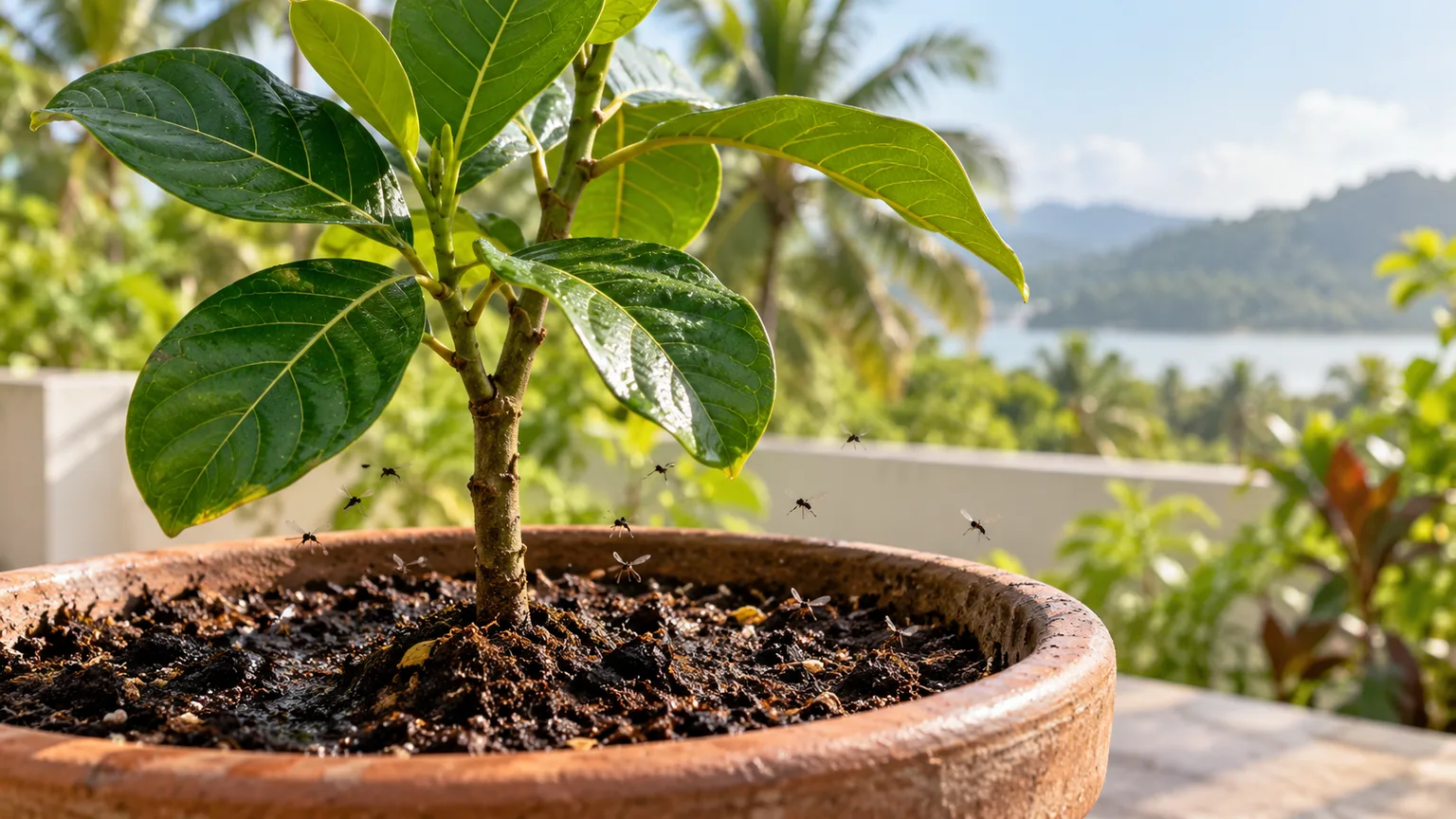
A Jackfruit with fungus gnats usually has small dark flies that lift from the soil when you water, move the pot, or brush the surface. Adults tend to stay close to the container rather than repeatedly attacking the canopy. Their presence can make the tree look infested even when the leaves are clean and the roots are still healthy. The larvae live in the moist mix, where they feed mainly on fungi and decaying organic material; at high densities they may also damage fine roots of young plants. UC IPM describes this soil-based cycle and the greater risk to seedlings than to established plants in ordinary outdoor settings (UC IPM’s fungus-gnat biology).
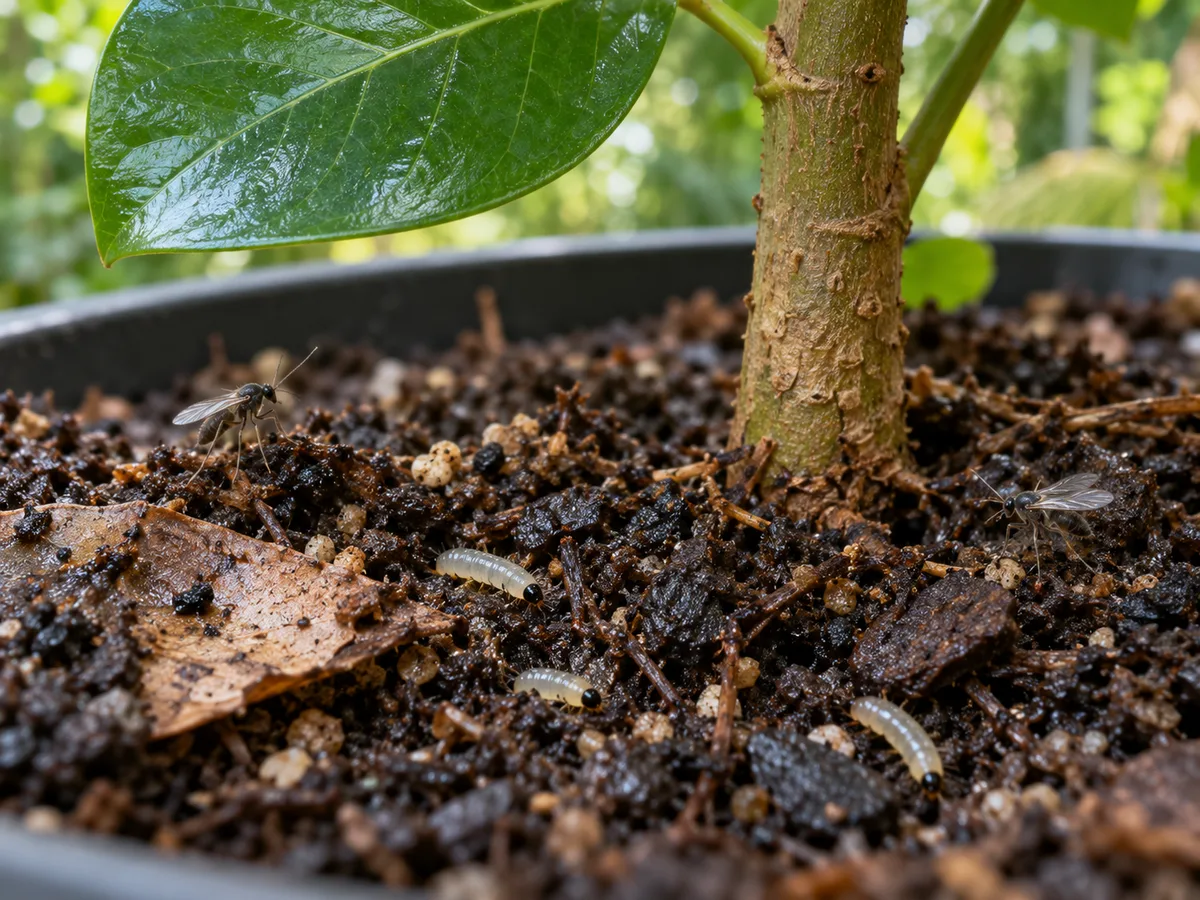
Look at the mix and stem base first: Jackfruit leaf damage is not the usual sign of fungus-gnat activity.
An adult fungus gnat is usually slender and mosquito-like, with long legs and antennae; when you tap the pot, it may rise in a weak, short flight and settle near the soil, a pattern consistent with UC IPM’s identification notes. Larvae are pale, translucent or whitish, and have a shiny dark head; they are easier to see with a hand lens against a light surface than by digging through the Jackfruit’s root ball. Yellow sticky cards placed just above the mix can help confirm flying adults, while a small piece of raw potato set cut-side down on the soil for a day can attract larvae to a visible spot. Use the trap as a diagnostic check, not as proof that the tree itself is being eaten.
Do not assume every small fly around an outdoor Jackfruit is a fungus gnat. Shore flies are often stockier and more associated with algae or very wet surfaces, while fruit flies gather around ripe fruit, kitchen scraps, or fermenting material. The RHS fungus-gnat guidance notes that these flies are linked to damp compost and that many are harmless decomposers. If the flies are everywhere in the garden but do not rise from the container, the Jackfruit pot may not be their source.
Fungus gnats do not chew holes in Jackfruit leaves or make silvery stippling on foliage. If leaf damage is your main symptom, inspect leaf undersides for mites, scale, or other pests rather than treating the soil for gnats. A healthy canopy with a few adults near wet mix points toward a pot-surface issue; yellowing, wilting, a stalled flush, or branch decline calls for a closer root and watering check because several stresses can produce those symptoms.
Why container-grown Jackfruit attracts them
Fungus gnats are attracted to the damp, biologically active top layer of potting media. Jackfruit creates a tricky setting for prevention: the tree needs steady water during hot, dry growth, but its growing mix must still drain freely. A large pot, slow-draining compost, rain-filled saucer, or sheltered terrace corner can leave the surface wet for days even when the tree is not being overwatered by volume. UF/IFAS warns that Jackfruit declines in flooded soil and needs drainage, while also describing the importance of water for young trees and developing fruit (UF/IFAS Jackfruit guidance).
Young Jackfruit needs deeper moisture, not a permanently wet surface
The most common mistake is to treat the whole pot as if it must dry completely before watering. That can stress a small Jackfruit, especially in strong sun or warm wind, because a young tree has a limited root system and can lose water quickly. On the other hand, frequent sips that keep the top few centimeters constantly damp encourage gnat egg-laying and leave the interior poorly aerated. A better rhythm is to water thoroughly, let excess drain, and check the upper 3–5 cm and pot weight before watering again; in hot spells the interval may shorten, while rainy or cool periods call for more frequent checks rather than automatic irrigation.
Jackfruit also has a long, delicate taproot when young, so repeated unpotting to chase a small number of flies is not a good first move; Purdue notes that advanced seedlings are difficult to transplant because of this root in its Jackfruit cultivation summary. Start aboveground: remove any fallen leaves or soft organic debris, empty the saucer, and make sure drain holes are open. If the mix smells earthy and the tree is pushing firm new leaves, a surface-level adjustment is safer than root surgery.
The size and position of a Jackfruit pot changes dry-down
A Jackfruit is often grown in a deep container while young because the tree is destined to become large and benefits from vertical rooting space. That deep volume can hold moisture below the surface after the top looks dry, particularly when a small canopy uses little water or the container is shaded. Conversely, a black pot in direct tropical sun can heat up and dry at the edges much faster than the center. Check more than one clue: pot weight, the upper soil texture, moisture on a wooden skewer inserted partway into the mix, and the tree’s newest growth.
The Jackfruit soil guide explains why a loose, freely draining mix matters for this tree. A mix with too much fine peat or uncomposted organic matter may stay soggy around a seedling; a heavy garden soil can compact in a container and limit oxygen. The goal is not sterile, inert media, which would be a poor substitute for healthy root conditions, but a stable mix that holds enough water for a tropical tree while allowing excess to leave through the drainage holes.
Monsoon and humid weather can hide the real source
A pot left outdoors during monsoon rain can stay wet even if you stop hand-watering. Humid air slows surface evaporation; shade under a roof or dense canopy slows it further. In contrast, a sunny, breezy terrace may dry the upper layer quickly while deeper soil remains moist. The same Jackfruit may therefore need different watering checks by season and placement. Compare the pot’s moisture pattern over several days and note rainfall, not just the date you last watered.
Purdue’s Jackfruit reference also emphasizes the crop’s tropical growing conditions and well-drained soil needs (Purdue’s Jackfruit cultivation summary). For a potted tree, this means dampness at the surface should be judged alongside drainage and root-zone moisture, rather than treated as a simple instruction to dry the entire container.
How to confirm the problem before treating
Use a short observation period to separate adult visitors from a breeding colony. Place a yellow sticky card close to the soil line, not high in the canopy, and count new flies over the next few days. Then inspect the soil surface for tiny larvae and organic debris. If you have a seedling or a very young Jackfruit, a small cut piece of raw potato left on the mix overnight can make larvae easier to spot; remove it promptly so it does not decay and become another food source.
Next, check the root zone without pulling the plant from its container. Press a finger into the upper 3–5 cm, lift the pot to judge its weight, and note whether water drains freely when you irrigate. A sour or swampy odor, a pot that remains heavy long after rain, or water sitting in the saucer indicates a drainage or watering problem that should be corrected regardless of whether the insects are fungus gnats. Healthy roots are generally firm; if a plant is already loose, declining, or has dark mushy roots visible at the drain holes, root damage may be the more urgent issue.
The insect diagnosis is strongest when several clues line up: adults repeatedly rise from the same damp pot; sticky cards collect small slender flies; and the surface remains moist or holds decaying matter. If only one adult appears near an outdoor tree, there may be no breeding population in the Jackfruit container. The RHS notes that established plants are unlikely to suffer meaningful damage from the ordinary fungus-gnat species found around compost, and that outdoor populations are often of little concern. That context is useful for a mature landscape tree: do not treat the whole garden because one or two flies show up near it.
If you are unsure whether the tree’s decline is pest-related or water-related, compare it with the Jackfruit problem guide index and the Jackfruit overview. Those pages help distinguish a single pot pest from broader care stress. A gnat sighting alone is not enough to diagnose root damage.
First fix: remove the wet surface habitat
First, empty any saucer or cachepot and clear fallen leaves or soft debris from the Jackfruit’s soil surface. Do this before changing the watering schedule. It removes standing water and food-rich material where gnats can breed, while avoiding a sudden dry-down of the entire root ball. If the pot has no clear drainage path, uncover the holes or move it into a suitable container with drainage before the next watering.
For the next irrigation, water the root ball evenly rather than dribbling small amounts around the trunk. Let the excess run out, discard the runoff, and wait until the upper layer begins to dry before repeating. Do not let a young Jackfruit wilt repeatedly as a pest-control tactic: the objective is a drier surface, not drought stress. BHG’s practical houseplant guidance likewise emphasizes reducing persistently wet surface conditions and using sticky cards to monitor adults, while taking care not to wilt the plant (BHG’s fungus-gnat advice).
Keep a sticky card near the pot to track whether adult numbers fall over the next week. A card is a monitoring tool, not a complete treatment: it catches some adults but does not remove eggs or larvae already in the mix. If counts stay high after you have fixed drainage and surface debris, consider whether the container is oversized for the young tree, the mix is compacted, or rain is repeatedly rewetting the pot. Make one adjustment at a time so you can see which change helps.
A Jackfruit-safe follow-up plan
Keep water available to the deeper root ball
Once the surface habitat is corrected, continue to check the Jackfruit rather than following a rigid calendar. In hot, windy weather a young container tree can need water more often than in a humid rainy week. Feel the mix at several centimeters deep and compare the pot’s weight after watering with its weight as it dries. If the upper layer is dry but the container remains heavy and cool, wait and check again; if the root ball is drying quickly and the leaves lose firmness, water thoroughly and improve drainage rather than forcing a longer dry interval.
This is where the Jackfruit watering guide is more useful than a generic houseplant rule. UF/IFAS describes Jackfruit as sensitive to flooding, but the tree still needs regular water when young and during dry periods. Do not translate fungus-gnat advice into a full drought cycle that this tropical fruit tree does not need.
Use traps and larval checks as evidence
After the first surface cleanup, keep the yellow card at soil height and check it at the same time every few days. Fewer new adults over successive checks suggests that the breeding habitat is shrinking. If the card keeps catching many flies, use a potato slice or hand lens to see whether larvae remain near the surface. UC IPM’s monitoring tools include yellow sticky traps for adults and potato pieces for larvae; the method is useful for deciding whether the problem is still active, not for measuring every larva in a deep container.
Gardening Know How’s discussion of root feeding by fungus-gnat larvae reinforces why a small Jackfruit seedling deserves closer observation than a mature tree when wet media persists (Gardening Know How). Treat that as practical horticulture context, not proof that every Jackfruit seedling with gnats has root injury.
Repot only when the mix or roots justify it
Repotting a Jackfruit is disruptive, especially when it is small and taprooted. Do not bare-root or wash the roots just because a few adults fly from the soil. Consider a careful move only if the mix stays saturated after watering, drainage holes are blocked, the potting media has collapsed into a dense mass, or roots show clear decline. If a repot is necessary, keep the root ball intact as much as possible, choose a deep container only modestly larger than the existing one, and use a loose, freely draining mix.
The Jackfruit repotting guide covers container depth and root handling. If larvae are concentrated in old, decaying media and the tree is already declining, replacing the mix may reduce the breeding source, but avoid aggressive root pruning unless rotten tissue is actually present. When a tree has a tender root system, a stable medium and careful aftercare matter more than a dramatic one-day treatment.
Use pesticides only when monitoring shows a need
Most home infestations improve when the pot stops acting as a continuously damp breeding site. Do not spray leaves for a soil pest, and do not mix home remedies or apply a pesticide to edible fruit crops without checking the product label and local rules. If an infestation persists despite correcting the growing conditions, choose only a product specifically labeled for fungus-gnat larvae and the intended growing situation, then follow its directions exactly. Keep treatments away from children, pets, pollinators, and harvestable fruit as the label requires.
Biological larval controls such as labeled Bacillus thuringiensis israelensis products or beneficial nematodes are sometimes used in container media, but performance depends on the product, target stage, and correct application. UC IPM’s management guidance discusses such options for persistent populations; for a Jackfruit grown for food, seek local extension or agricultural guidance before using any pesticide or biological product. A low-level nuisance around a healthy mature outdoor tree generally does not justify chemical treatment.
Lookalikes and problems that need a different response
| What you notice | More likely explanation | Better next step |
|---|---|---|
| Tiny dark flies rise from damp potting mix | Fungus gnats breeding in the container | Check the upper soil, drainage, and sticky-card count |
| Sturdier flies gather on algae or wet saucers | Shore flies or another moisture-associated fly | Clean standing water and identify the insect before treatment |
| Flies concentrate around ripe fruit or food scraps | Fruit flies rather than a Jackfruit root pest | Remove fermenting material and check whether flies emerge from the pot |
| Leaves show stippling, webbing, or silvery scars | A foliage-feeding pest, not typical fungus-gnat damage | Inspect leaf undersides and use the relevant pest diagnosis |
| Jackfruit wilts while mix is wet or smells sour | Root-zone oxygen stress or root decay may be involved | Check drainage promptly; consult Jackfruit soil guidance |
| Jackfruit wilts while the mix is dry and pot is light | Underwatering or heat stress may be more likely | Rehydrate evenly and review Jackfruit light needs |
Fungus gnats can coincide with root trouble because both favor poor moisture management, but their presence does not prove they caused the decline. UC IPM notes that wilting can have other common causes, including excess or insufficient water, root-decay organisms, and poor soil conditions. Focus on the plant’s actual root-zone state before deciding whether larvae are the main problem.
Recovery: what to expect from a young Jackfruit
Adult numbers rarely disappear overnight because eggs and larvae may remain in the medium after the first cleanup. Keep checking the sticky card and moisture pattern over the next two or three weeks; fungus-gnat development can proceed quickly in warm conditions, with UC IPM describing a cycle of about 17 days at 75°F (UC IPM’s lifecycle estimate). A declining count, a cleaner soil surface, and normal new leaf expansion are better signs than expecting every flying insect to vanish immediately.
Fungus-gnat feeding is most concerning when a small Jackfruit already has a limited root system or when the pot remains wet for long periods. If the tree is still firm, the stem base is sound, and new leaves continue to open, it may tolerate a modest population while you correct the medium. Existing leaf yellowing or wilt may not reverse even when the cause is fixed; judge recovery by whether new growth is healthy and decline stops.
Escalate your inspection if the Jackfruit continues to wilt in moist soil, the stem base softens, roots visible at the drainage holes turn dark and mushy, or the mix smells sour. At that point, root damage or chronic waterlogging may be more urgent than the flies. If a mature outdoor tree is otherwise vigorous and only a few gnats appear after rain, monitor instead of treating the whole planting area.
Prevention for container-grown Jackfruit
Use a deep pot with open drainage and a mix that drains after a thorough watering. The tree should receive enough water for active growth without sitting in runoff; raised pot feet and an empty saucer can help the drainage holes stay clear. Avoid covering the surface with thick, moisture-holding mulch in a small container when gnats are already a problem. A thin, loose surface layer is easier to inspect and allows you to spot larvae or decomposing debris.
Remove dead leaves and fruiting debris as it falls, especially during warm, humid weather. Check new nursery trees and other container plants before setting them beside a Jackfruit seedling, since damp purchased mix can bring insects indoors or onto a sheltered terrace. Avoid keeping unfinished compost or wet seed-starting trays next to the Jackfruit pot. These practices reduce breeding sites without requiring the tree’s root zone to be kept dry.
Seasonal checks matter more than a fixed watering day. During the monsoon, tip out runoff and shield a container from prolonged downpours if it cannot drain quickly. During hot dry weather, inspect the upper 3–5 cm more often and water when the root ball needs it. The Jackfruit light guide can help you evaluate terrace placement, because a young tree in too much shade may use water more slowly and keep its mix damp longer.
For a broader view of why fungus gnats develop in potting media and how the pest is identified across plants, see the canonical fungus gnats guide. Return here for the Jackfruit-specific balance: avoid flooded roots while retaining enough moisture for a tropical seedling.
When to use this page vs. other Jackfruit guides
Use this page when tiny dark flies repeatedly rise from a Jackfruit pot and you need to distinguish a breeding population from harmless visitors. The Jackfruit problems hub can route you to another diagnosis if flies are not present or the main symptom is leaf damage, a stalled flush, or wilting. For ongoing moisture decisions, use Jackfruit watering; for dense or waterlogged media, use Jackfruit soil.
Choose the Jackfruit overview when the tree is declining for several reasons or you need to revisit its climate and placement. Use the Jackfruit repotting guide only when the pot, roots, or collapsed mix warrant a move. This guide focuses on the gnat cycle at the pot surface; it does not replace diagnosis of root rot or other pests.
Related Jackfruit guides
- Jackfruit overview — check whether container or outdoor conditions suit the tree.
- Jackfruit watering — adjust water to the upper soil, pot weight, and season.
- Jackfruit soil — review drainage and container mix structure.
- Jackfruit light — assess whether the growing position is shaded or exposed.
- Jackfruit repotting — decide whether a deep container or root issue calls for a move.
- Jackfruit problems hub — route symptoms that do not match fungus gnats.
Related tool
Use the Plant Problem Diagnosis Tool to compare soil moisture, flies, and root-zone symptoms before choosing a next step.
Conclusion
A few fungus gnats around Jackfruit usually call for a closer look at wet potting mix, not a leaf spray or an abrupt drought. Clear standing water and decaying debris first, then let the surface dry somewhat while checking that the deeper root ball remains moist enough for a young tropical tree. If adults keep appearing, use traps and a larval check to confirm that the pot is still breeding them.
Act sooner when a small seedling declines in wet soil, but avoid disturbing Jackfruit’s delicate roots without evidence of saturated or deteriorating media. Good drainage, seasonal moisture checks, clean pot surfaces, and careful monitoring prevent most recurring problems while preserving the steady root conditions this fruit tree needs.