Spider Mites on Jackfruit: Signs, Checks & Safe Control
Quick answer
First confirm live mites: inspect the undersides of several Jackfruit leaves with a hand lens or tap a leaf over white paper and look for moving specks. If you find them, rinse reachable leaf undersides with a steady but gentle stream of water. Jackfruit is a large tropical fruit tree, so a container seedling and a mature landscape tree need different treatment; do not spray a tall canopy or apply a pesticide to an edible tree without checking the current label and local advice.
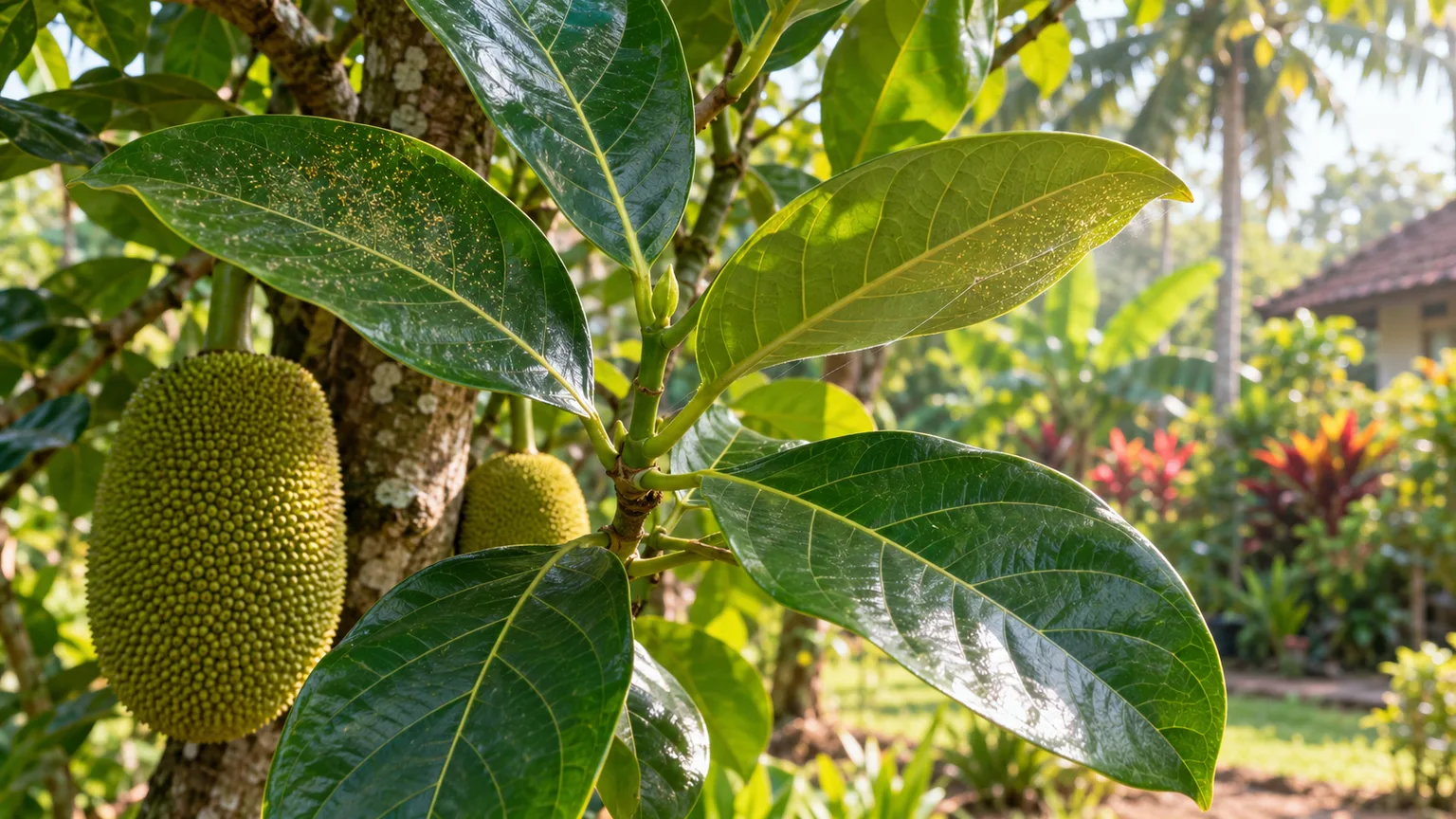
Spider Mites on Jackfruit: Signs, Checks & Safe Control
This guide covers spider mites on Jackfruit. See also the general Spider Mites guide, watering, and light pages for this plant.
Spider Mites on Jackfruit: Signs, Checks & Safe Control
Quick answer: inspect first, then rinse
Start by checking for live mites rather than treating every pale Jackfruit leaf as a pest problem. Turn over several leaves and use a 10× hand lens; if magnification is not available, tap a leaf over white paper and watch for tiny specks that move. If you confirm mites, rinse the reachable foliage with a steady stream of water aimed at the undersides. The water rinse is a first physical knockdown, not proof that the infestation is over.
This is a tree-care diagnosis, not a small-houseplant recipe. Jackfruit (Artocarpus heterophyllus) is a vigorous tropical fruit tree that wants full sun, warmth, and a freely draining root zone. A young tree in a pot can be inspected leaf by leaf; a mature tree may have leaves beyond safe reach. Keep the tree’s normal root moisture and sunlight in place while treating the confirmed pest. For the general mite life cycle and shared control background, see the spider mites hub; this page concentrates on inspecting and caring for Jackfruit.
What spider mites look like on Jackfruit
Spider mite feeding usually begins as many tiny, pale flecks across the leaf surface. The marks can merge into a dull yellow, cream, or bronze cast as feeding continues. On Jackfruit, look at the upper surface for the pattern, then turn the leaf over: mites and their cast skins tend to be concentrated on the underside, and fine silk may appear when numbers are higher. UC IPM describes the early feeding pattern as pale stippling and notes that webbing and leaf discoloration become more apparent as populations build in its twospotted mite profile.
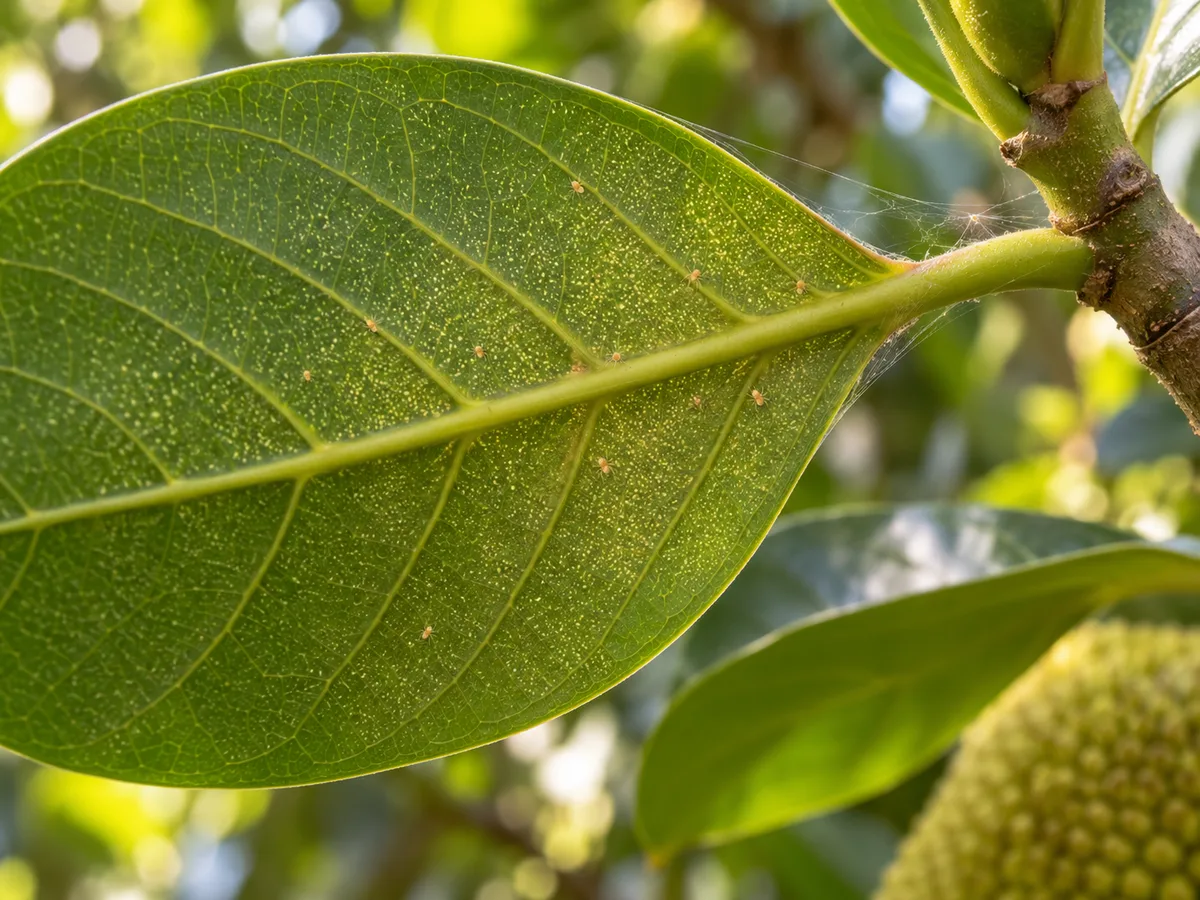
Look under the Jackfruit leaf as well as across its upper surface: stippling shows feeding, while live mites or fine silk help confirm the diagnosis.
Mites are not miniature spiders that are easy to see at arm’s length. University of Minnesota Extension describes the two-spotted spider mite as about 1/50 inch long and reports that it feeds on ornamental, greenhouse, flower, and fruit-tree leaves; activity increases in hot, dry weather, according to its diagnostic profile. A hand lens makes a useful difference. Under magnification, a live mite looks like a tiny moving oval; without it, an isolated dot could be dust, pollen, or debris.
Do not use webbing by itself as the diagnosis. A garden spider may leave a larger, more organized web between branches without causing stippling, while early mite colonies can feed before any obvious silk appears. Look for the combination: new pinprick-like pale marks, moving mites on the underside, and damage increasing on leaves that were clean at the last check. If the leaves are yellowing evenly or the soil has been wet for days, check the root zone as well; the Jackfruit overwatering guide explains why leaf color alone cannot diagnose a pest or watering problem.
Why hot, dry weather raises the risk
Spider mites can occur on many plants, and the sources reviewed do not establish that Jackfruit is uniquely vulnerable or quantify how often it is infested. The defensible link is between mite activity and conditions around the foliage. Minnesota Extension says activity increases in hot, dry weather, and UW–Madison Extension describes dry weather as a period when growers should raise scouting attention for two-spotted mites in crop fields. Those observations support closer inspection during a Jackfruit dry spell; they do not provide an outbreak forecast or treatment threshold for this tree.
Jackfruit’s normal culture helps explain where stress can enter the picture. The tree is adapted to warm tropical and frost-free subtropical growing conditions and performs best in full sun, as described by UF/IFAS Jackfruit guidance. A hot, exposed canopy is therefore not automatically a care mistake. The important distinction is whether the root ball is receiving enough water for its age and setting. Young and container-grown trees dry faster than established in-ground trees; mature Jackfruit can tolerate some drought, but irrigation remains important during prolonged dry weather and from flowering through fruit development.
Gardening Know How notes that dusty areas and water-stressed plants are more susceptible to spider mites. That is a reason to maintain appropriate Jackfruit watering and reduce avoidable dust where practical, not a reason to keep the soil continuously wet. The Jackfruit watering guide explains how to adjust for a pot, rainfall, and fruit stage; the Jackfruit soil guide covers the free drainage this tree needs. Correct the water stress only if the root ball is actually drying too far. Extra irrigation into already wet soil does not rinse mites from leaves and can create a separate root problem.
Confirm mites before treating a whole tree
Use a repeatable check so you can tell whether a correction is working:
- Choose several affected leaves from more than one branch. Include a leaf near the damage and a nearby leaf that still looks clean.
- Turn each leaf over and inspect the midrib, larger veins, and sheltered areas close to the petiole with a hand lens. UC IPM recommends routine inspection of leaf undersides with magnification because colonies can be hard to notice before the foliage changes.
- Tap one leaf over a clean sheet of white paper. Wait a few seconds, then look for specks that move. Gardening Know How describes this paper test as a simple way to spot tiny mites that are difficult to see on the plant.
- Record the leaf or branch you checked and photograph it in the same light. Repeat the check a few days later. Fresh stippling on a previously clean leaf is more useful evidence than an old damaged spot that has not changed.
- If the Jackfruit is potted and small enough to handle safely, separate it from nearby container plants while you inspect. If it is an in-ground tree, inspect the same reachable branches on each visit instead of trying to survey every leaf.
A single mite-like speck does not tell you how serious the problem is. Several moving mites with fresh stippling indicate active feeding. Fine silk across multiple leaves, widespread bronzing, or leaf drop suggest that the affected area is more extensive. UC IPM’s monitoring guidance focuses on confirmed mites, cast skins, webbing, and foliage changes rather than relying on a sticky card; mites are wingless and remain on plant surfaces.
Read the Jackfruit canopy in safe sections
A Jackfruit tree can grow far beyond a person’s reach, and its leaves are spread through a broad canopy. Do not climb an unstable ladder, lean over a balcony edge, or spray blindly into the crown to get a better sample. Check lower branches and any safe mid-canopy access, then mark a branch with fresh symptoms. A hand lens and a small set of repeatable sampling points can show whether the pattern is spreading without turning inspection into a hazardous whole-tree project.
If symptoms are only on one accessible branch, a local arborist or fruit-tree specialist can decide whether upper-canopy inspection is necessary. If a tall tree is badly bronzed, dropping leaves, or close to other valuable fruit trees, send clear photos and the inspection notes to a local extension service. The goal is to confirm the pest and estimate the affected part of the canopy before choosing a control that must reach every leaf surface.
What else can cause pale Jackfruit leaves?
Spider-mite injury is a pattern, not just a color. The tiny flecks are scattered and often numerous; the surface can later turn dull or bronze. Compare that with these common lookalikes:
| What you see | More likely clue | What to check next |
|---|---|---|
| Many tiny pale dots, with moving specks underneath | Active spider mite feeding is plausible | Recheck leaf undersides with magnification and look for fresh stippling |
| One or several leaves yellowing while the pot stays heavy or the site ponds | Root-zone stress is possible | Check drainage and recent rain using the Jackfruit watering guide |
| Older leaves changing color without stippling, mites, or webbing | A whole-leaf aging pattern may fit better than mite feeding | Compare new and old foliage and review seasonal care |
| Pale or silvery scarring with no mites during repeated checks | Another sap-feeding pest or physical abrasion may be involved | Inspect carefully before selecting a pest treatment |
| Fine strands between twigs but no speckling and no moving mites | Ordinary spider silk may be present | Look for the spider and repeat the leaf check rather than spraying |
The table is a triage tool, not a guarantee. If a young container Jackfruit has yellowing while its mix remains wet, use the problems hub to compare the symptom with the tree’s watering and drainage pattern. If repeated checks do not find mites, do not keep applying a mite spray just because the leaves look pale. A treatment aimed at the wrong cause can stress leaves and make the next diagnosis harder.
First fix for a confirmed infestation: rinse reachable foliage
For a small potted Jackfruit, take the pot to a place where runoff can drain and rinse the foliage, concentrating on the underside of affected leaves and nearby leaves. Use a steady, moderate stream that moves mites and loose silk without tearing leaves or bending tender shoots. The Spruce’s practical spider-mite guidance likewise emphasizes water at leaf undersides and repeating physical washing; Gardening Know How also describes a water rinse as a way to knock mites off foliage.
Protect the root ball while you work. If the container mix is already wet, cover the surface loosely or tilt the pot so the rinse does not become another full irrigation. Do not leave the tree standing in a saucer of runoff. Jackfruit needs moisture during dry growth, but its roots need quick drainage; the soil guide is the right reference if the potting mix itself stays saturated after a rinse.
After washing, let foliage dry in the normal bright, ventilated site. Do not move a full-sun Jackfruit into deep shade as a “mite cure”; the tree’s light needs remain the same. Reinspect the same leaves and a clean neighboring leaf in the following days. If you still find live mites or fresh stippling, repeat the physical rinse on accessible foliage and continue monitoring. A single wash can reduce exposed mites but should not be treated as complete eradication, especially where leaves overlap or the tree is too large to cover thoroughly.
Small container Jackfruit: keep the treatment proportional
A young Jackfruit in a container is the easiest case to manage. You can turn the pot, check both sides of several leaves, and rinse the canopy from a stable position. Keep the plant away from other susceptible container plants until repeated checks show no active mites. If the root ball was already dry, water according to its normal needs after the foliage wash; if it was wet, do not add more just because you used water on the leaves.
Avoid improvised pesticide mixtures. Dish detergent, rubbing alcohol, or concentrated oils can damage leaf surfaces, especially on tender growth or a stressed tree. If a labeled contact product is needed after physical washing, verify that the current label permits use on Jackfruit or on the relevant edible fruit crop where you live. The Jackfruit overview gives the tree’s outdoor growing context; the light guide helps you preserve its full-sun placement during recovery.
Mature landscape Jackfruit: don’t spray an unreachable canopy
An established tree calls for restraint. Mites often live on leaf undersides, so a product applied only to the visible top of a tall canopy may miss the target. A homeowner sprayer cannot guarantee coverage of an entire tree, and using stronger pesticide or climbing to improve reach creates avoidable risk. UC IPM advises complete target coverage for contact products, routine monitoring, and careful label use; its nursery product guidance is not a Jackfruit orchard prescription.
First map where the active symptoms are: a few lower branches, one exposed edge, or several parts of the crown. Check whether new stippling is appearing and whether the tree is otherwise holding leaves. Mature woody plants may tolerate low mite numbers, and natural enemies can help keep populations in check; UC IPM advises conserving beneficial predators by avoiding broad-spectrum, persistent insecticides where possible. Do not spray all the leaves simply because you found one mite on one branch.
If a mature Jackfruit is heavily infested, fruiting, or too tall for safe inspection, contact a local extension horticulturist, licensed arborist, or fruit-tree professional. Ask them to identify the pest, assess canopy coverage, and review a product label that is legal for an edible Jackfruit in your jurisdiction. The right local advice depends on your climate, crop status, harvest timing, and the product registration where the tree grows.
Use sprays carefully if rinsing is not enough
Some contact products, including insecticidal soaps and horticultural oils, are used against spider mites, but they work only when they reach the pest. That makes underside coverage important. They can also injure plants if used on stressed foliage, tender new growth, or under conditions excluded by the product label. UC IPM’s guidance for nursery ornamentals warns users to read product labels, consider phytotoxicity, and avoid applying products to stressed plants; the page does not establish that a particular product is approved for Jackfruit fruit trees.
Before using any product, read the complete label rather than relying on a social post or a recipe. Confirm that the product is registered for the crop and target in your location, that it can be used at the current tree stage, and that the listed harvest interval can be met. Follow the specified concentration, application equipment, protective measures, repeat interval, and restrictions around heat, pollinators, or water. If the label does not clearly cover Jackfruit or the relevant edible crop, do not improvise; ask local extension.
Avoid broad-spectrum insecticides as a reflex. Spider mites are arachnids rather than insects, and killing predatory mites or other beneficial organisms can remove part of the natural control in the canopy. UC IPM lists predatory mites and several predatory insects among spider mite natural enemies and recommends conserving them. A selective, label-approved option may be appropriate in some commercial settings, but choosing one is a local crop-management decision rather than a universal home recipe.
Keep Jackfruit care steady while the leaves recover
Do not change every condition at once. Continue to provide the bright, open sun Jackfruit needs, and water according to the soil and the tree’s age rather than a fixed calendar. For a container tree, let excess water drain and check how quickly the root ball dries in the current weather. For a landscape tree, account for recent rain and whether the site drains. The watering guide can help you separate a genuine dry-root problem from the temptation to overwater in response to mite symptoms.
Do not fertilize to “replace” stippled leaves. Feeding cannot restore leaf tissue already damaged by mite feeding, and excessive fertilizer is not a pest treatment. Wait until the tree is growing normally and the root zone is behaving as expected before returning to its usual seasonal feeding. If the tree is fruiting, avoid pruning healthy fruiting shoots just to make every branch easier to spray; reserve cuts for dead, broken, or severely damaged parts that a local grower would remove for plant health.
New growth is the clearest recovery signal. Old leaves may keep their pale dots or bronzing even after mites are controlled. What you want to see is no new stippling on clean leaves, no live mites during repeat checks, and a fresh Jackfruit flush that expands normally. Do not set a guaranteed recovery date: growth depends on temperature, rainfall, tree age, pot size, and fruit load.
Prevent another outbreak
Make inspection part of ordinary Jackfruit care during hot, dry periods and after moving nursery stock. UC IPM recommends regular monitoring and careful inspection of new plants; this is especially practical for a container Jackfruit that moves between a terrace and a protected area. Before bringing a newly purchased tree beside existing fruit trees, examine the undersides of leaves and isolate it if you see active mites.
Keep dust from accumulating around container plants where practical, and avoid prolonged root-ball drought in a young Jackfruit. If the top growth is exposed to hot, dry wind, check the soil rather than watering by leaf color alone. Mature landscape trees can tolerate some drought, but do not mistake that tolerance for immunity to water stress. Conversely, steady moisture never means stagnant, flooded soil. Correct drainage and careful irrigation support the tree; they do not substitute for confirming or washing off mites.
Preserve a diverse garden where possible. UC IPM notes that predators can suppress spider mite populations and warns against persistent broad-spectrum products that disrupt them. That does not mean leaving a confirmed damaging infestation untreated. It means scouting early, starting with physical control when the tree is small enough, and choosing selective, legally labeled treatment only when evidence and local advice justify it.
When to ask for local help
Get advice rather than escalating do-it-yourself treatment when the upper canopy is inaccessible, many branches are bronzed, leaves are dropping quickly, or the Jackfruit is carrying fruit and you are considering a pesticide. Send photographs of the upper and lower leaf surfaces, note where you found live mites, record whether the tree is in a pot or in the ground, and include recent rainfall and watering. Those details help an extension agent distinguish mite feeding from drought, drainage, nutrient, or other pest problems.
A professional assessment is also warranted if symptoms continue to spread despite repeated checks and washes, if the trunk or branch structure is declining, or if you are unsure whether the tiny moving dots are plant-feeding mites or beneficial predators. Do not cut down a mature tree or apply a broad-spectrum chemical based on one mottled leaf. Confirmation and safe coverage matter more than a fast-looking spray.
When to use this page vs other Jackfruit guides
Use this page when you find fine pale stippling, live mites on the undersides of leaves, or mite-like webbing on Jackfruit. If leaf yellowing appears alongside wet soil or slow drainage and you cannot find mites, compare the symptoms with the Jackfruit overwatering guide and the Jackfruit soil guide. For a broad check of other reported problems, start at the Jackfruit problems hub.
The Jackfruit overview is the better starting point for climate, tree size, fruiting, and general placement. Use the Jackfruit light guide if the plant was recently shaded or moved, and the watering guide if its container or site has been too dry or wet. These care routes explain the host tree’s needs; this article stays focused on spider mite confirmation and response.
Related Jackfruit guides
- Jackfruit overview — full-sun placement, warm-climate growth, and tree context.
- Jackfruit watering — adjust irrigation to tree age, container drying, rainfall, and fruit development.
- Jackfruit soil — maintain the free-draining root zone needed after watering and leaf rinsing.
- Jackfruit light — preserve strong sun while the tree recovers.
- Jackfruit problems hub — compare another symptom when mite evidence is absent.
- Jackfruit overwatering — use when yellowing aligns with a persistently wet root zone.
Related tool
Use the Pest Identifier Tool to organize leaf, webbing, and live-pest clues before choosing any treatment.
Conclusion
Spider mites are a diagnosis to confirm, not a default explanation for every pale Jackfruit leaf. Inspect the undersides of several leaves, look for moving specks, and rinse reachable foliage once mites are present. Keep Jackfruit’s sun, water, and drainage needs steady; do not overwater, climb into an unsafe canopy, or apply an unapproved pesticide to an edible tree.
Follow the new leaves and repeat the same inspection points. If the problem is beyond safe reach or keeps spreading, get local fruit-tree advice before escalating treatment.