Overwatered Jackfruit: Signs, Root Checks & Fixes
Quick answer
Jackfruit needs regular water in dry weather and through fruit development, but its roots cannot stay flooded. If the pot or ground is still wet, first stop supplemental watering and remove any standing water around the root zone. Check drainage and recent rain before deciding whether a young container tree needs root inspection; do not dig up a mature Jackfruit or fertilize it just because leaves are yellow.
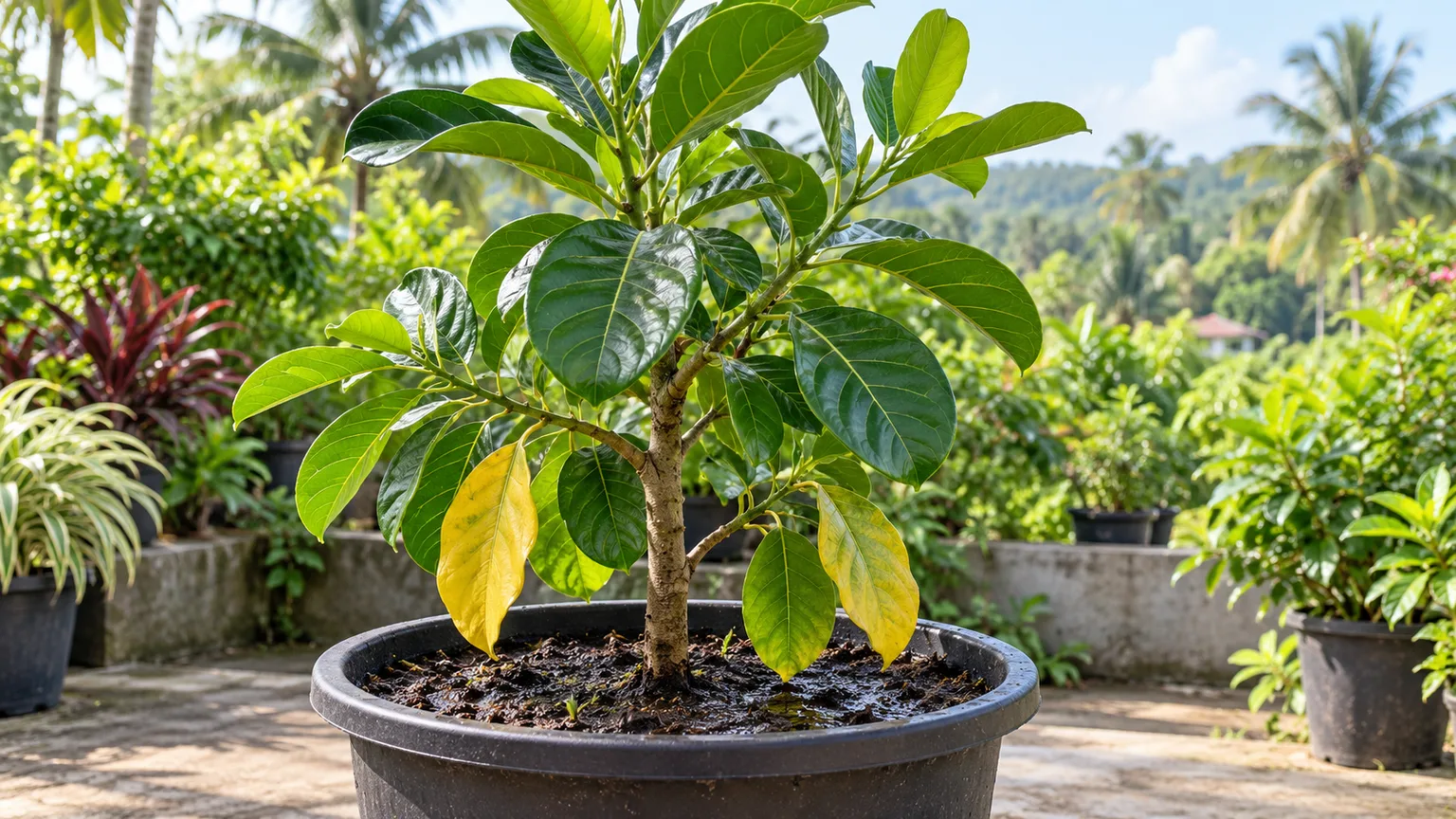
Overwatering Jackfruit: Signs, Root Checks & Recovery
This guide covers overwatering on Jackfruit. See also the general Overwatering guide, watering, and light pages for this plant.
Overwatering Jackfruit: Signs, Root Checks & Recovery
Quick answer
If Jackfruit soil is still wet, stop supplemental watering and drain standing water before changing anything else. This tree needs irrigation during dry spells—and mature, fruiting trees need it from bloom through fruit development—but it is unusually intolerant of flooded roots. UF/IFAS reports that Jackfruit can decline or die after 2–3 days of wet soil, so a heavy pot, ponding after rain, or a tree that stays wet for days matters more than a calendar watering interval.
Do not diagnose overwatering from yellow leaves alone. Check how long the root zone has stayed wet, whether water exits a container freely, what the weather has done, and whether a small amount of root tissue is actually soft or decayed. A thirsty Jackfruit and a waterlogged one can both wilt; the soil and root evidence separates them. For the general mechanics of excess water, see the canonical overwatering guide; the Jackfruit-specific risk is that its roots can be damaged quickly even though the tree needs regular water during important growth stages.
What overwatering looks like on Jackfruit
A young Jackfruit in a large pot may show the earliest clues in the lower or inner leaves: they lose their deep green color, turn yellow, droop, or fall while the mix remains wet. A new flush may stall, and the plant can look wilted even though its root ball is heavy. Those signs are not proof by themselves. Look for a matching root-zone story: repeated watering before the top layer dries, a saucer full of water, compacted mix, a container without an open drain, or rain that has kept the pot saturated.
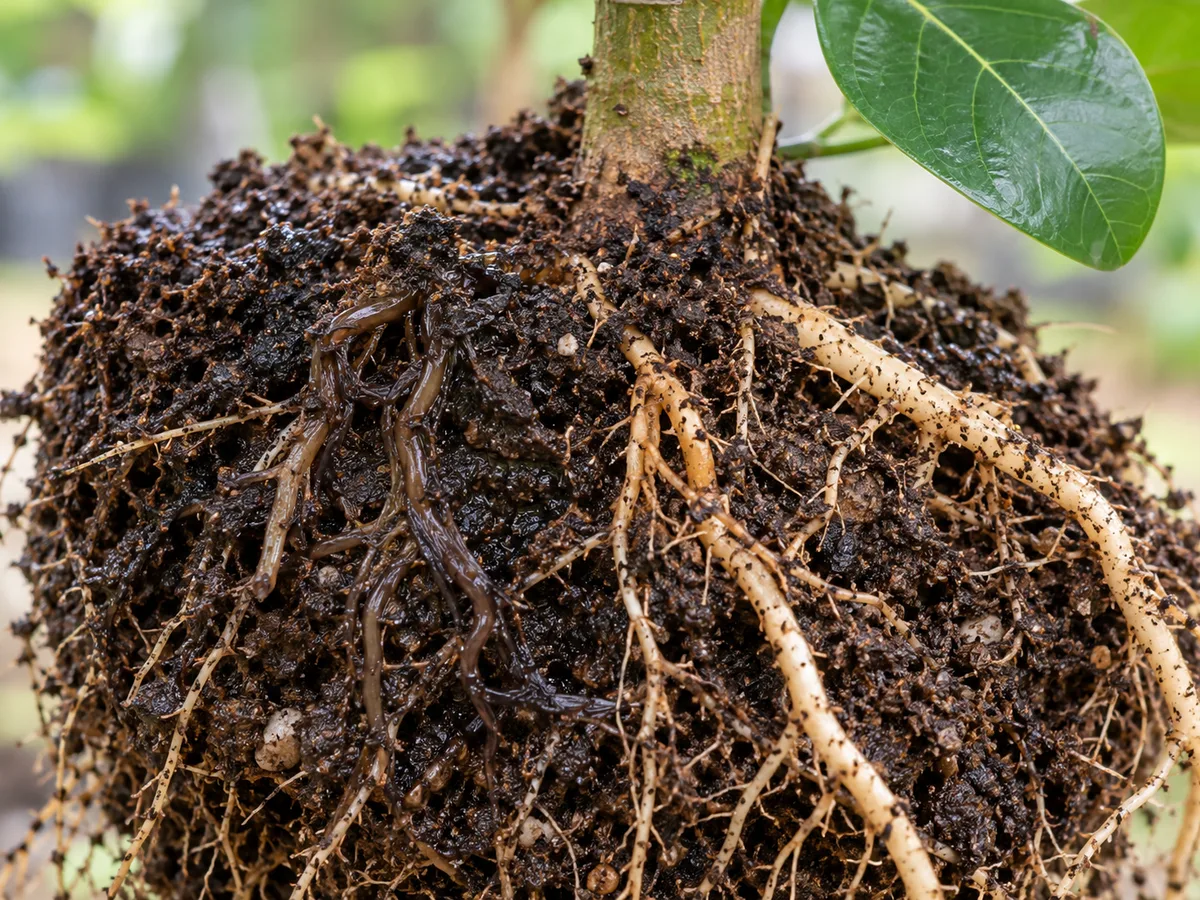
Inspect a small container Jackfruit only when wet soil and declining growth make root damage plausible; dark color alone is not a diagnosis.
An in-ground Jackfruit often gives less immediate evidence because you cannot weigh its root ball or see the feeder roots. Watch for slow canopy decline after repeated rain or irrigation, yellowing that spreads across more than one branch, weak new growth, and soil that remains ponded or saturated around the trunk. UF/IFAS says this species is susceptible to root rot when flooded and lists several possible organisms, including Pythium, Phytophthora, Fusarium, and Rhizoctonia. That list describes risks for Jackfruit in Florida conditions; it does not tell you which pathogen, if any, is affecting a particular tree.
Why Jackfruit roots are sensitive to prolonged wetness
Jackfruit is a tropical fruit tree, not a bog plant. It grows in warm, humid climates and can tolerate some drought once established, yet its roots need a freely draining soil profile. Purdue’s Jackfruit reference says the tree cannot tolerate “wet feet”; UF/IFAS gives a stark landscape warning: Jackfruit is not tolerant of flooded soil conditions, and prolonged wetness may lead to decline or death. This makes repeated irrigation during a rainy spell especially risky in low ground or heavy soil.
Waterlogged soil is more than “too much water in the pot.” When water fills pore spaces that would otherwise hold air, roots get less oxygen and become less able to function; that also raises the risk of root disease. UC Davis describes the lack of oxygen in waterlogged soil as a problem for crop roots and notes that excess water can make plants more susceptible to root rot. On Jackfruit, the result may resemble drought: damaged roots cannot take up water normally, so foliage can droop even while the surrounding soil is wet.
The tree’s water demand still changes with age and crop stage. A newly planted or container-grown Jackfruit needs water during prolonged dry weather so the root ball does not dry hard. A mature landscape tree is moderately drought tolerant, but UF/IFAS says irrigation becomes critical from bloom through fruit development. Therefore, “stop watering until it is bone dry” is not a safe universal repair. The aim is to end chronic saturation while preserving a steady supply during dry conditions and fruit fill. The Jackfruit overview explains why a large outdoor fruit tree needs different care from a small ornamental in a living room.
How to confirm overwatering before disturbing roots
Start with the simplest evidence and keep container and landscape trees separate.
For a container-grown Jackfruit:
- Review the last week of water and rain. Note each watering, heavy shower, and time the pot sat in a cachepot or saucer. A weekly routine can overwater a pot that is still wet after rain or during cool, low-growth weather.
- Feel below the surface. Check the upper 3–5 cm of mix, not only the crust. If it is still cool and damp, and the pot feels heavy, wait before watering. The surface can dry while the center of a large nursery container remains wet.
- Check the exit path. Make sure drainage holes are open and the liner is not standing in runoff. After a normal watering, excess should leave the container rather than collect around the roots. A saucer that never empties keeps the lower root zone wet.
- Look at the growth pattern. One old leaf turning yellow is weak evidence. Several leaves declining while the root ball stays wet, new growth stalling, or branch tips weakening together is more concerning.
- Inspect roots only if the evidence warrants it. If the pot remains wet and the canopy is rapidly worsening, slide the root ball out carefully enough to inspect the outer edge. Firm roots may be tan, cream, or darker from the medium; color alone is not diagnostic. Soft roots whose outer tissue slips away, widespread mushiness, or a persistent sour smell support serious root damage. Do not rinse or untangle the entire root system just to look for a problem.
A Jackfruit in the ground needs a different check. Look at the site after irrigation or rain, including the lower edge of the canopy rather than only beside the trunk. Standing water is a clear drainage warning, and grey or mottled soil can indicate repeated saturation. UC Davis notes that surface ponding signals poor drainage. Do not dig a trench through major roots or expose the root plate to inspect an established tree; use site history, rainfall, and visible canopy change, then ask a local arborist or extension agent when the decline continues.
Separate wet-root decline from common lookalikes
| Clue | More consistent with | What to check next |
|---|---|---|
| Yellow or drooping leaves with a heavy pot or ponded ground | Overwatering or root-zone disease | Confirm how long the soil stays wet and whether drainage is blocked |
| Limp leaves with dry, crumbly mix and a light pot | Underwatering | Check when water was last given and whether the root ball is drying evenly |
| Isolated leaf spots after rain, without a persistently wet root zone | Leaf disease or physical damage | Examine the spot pattern and new growth; wet soil alone does not diagnose root rot |
| A few older leaves yellowing while the rest of the canopy is steady | Normal leaf turnover or another stress | Watch the next flush rather than unpotting immediately |
| Yellowing with wet soil and soft feeder roots | Root injury, possibly root rot | Seek local diagnosis if the decline is spreading |
Root rot is a disease diagnosis, not a synonym for “soil feels wet.” For a container plant, checking the roots is necessary to confirm root rot; yellowing and wilting alone can have other causes. UC IPM describes citrus Phytophthora root rot as a slow decline with yellow leaves and damaged feeder roots, but its pathogen details apply to citrus. That page also notes that symptoms can be difficult to distinguish from flooding, salt, or nematode damage and that lab analysis is needed for positive identification. Use the Jackfruit-specific UF/IFAS list to understand possible risks; do not infer that a Jackfruit has Phytophthora from yellow leaves alone.
First fix: stop adding water and remove standing water
For a Jackfruit with a wet root zone, the first action is to stop supplemental watering and remove water that is trapped around the container or tree. For a potted plant, empty the saucer or outer decorative pot, lift the nursery container onto a surface where the drain holes can run clear, and make sure no liner is blocking them. The Spruce’s expert-reviewed advice likewise recommends removing excess water from a saucer after accidental overwatering or a downpour. Do not add a fan, heater, or intense direct sun to force the pot dry; sudden heat can stress a tropical seedling and does not correct a blocked or compacted root zone.
For an in-ground tree, pause irrigation and redirect fresh runoff away from the trunk without cutting through roots. If the site is still flooded, prioritize safe drainage from the surrounding area rather than digging close to the tree. Do not let an irrigation timer continue because it is “the schedule”; UF/IFAS warns that timed lawn sprinklers can overwater Jackfruit and contribute to root rot. The Jackfruit watering guide helps reset irrigation once the soil begins to drain, while the Jackfruit soil guide covers the long-term need for open, well-drained soil.
After the standing water is gone, let moisture readings—not a fixed number of days—guide the next watering. In a pot, wait until the upper 3–5 cm begins to dry and the container has become noticeably lighter, then water the root ball thoroughly and allow it to drain. Do not keep the surface wet with frequent small sips, but do not leave a young tree bone-dry for an extended period either. An established landscape tree should be watered based on rainfall and the soil at the active root zone, not the trunk surface alone.
When a container Jackfruit needs a root intervention
Do not repot every Jackfruit that has yellow leaves. A seedling may recover after a short wet spell once excess water drains and the roots remain firm. Repotting introduces root disturbance, which is a poor trade if the actual problem is an overfull saucer or one rainy week. Advanced Jackfruit seedlings have a long, delicate taproot, and Purdue warns they can be difficult to transplant; use the Jackfruit repotting guide when the container or root condition truly requires it.
Consider a careful root inspection or repot only when the container stays saturated despite drainage holes, the mix is compacted or broken down, the root ball smells persistently sour, or roots are visibly soft and decaying. If the tree is small enough to handle safely, keep as much healthy root-and-mix structure together as possible. Trim only tissue that is clearly dead or mushy with clean tools, and move the plant into a deep container with unobstructed drainage and a free-draining mix. Do not prune healthy roots aggressively to “balance” a damaged canopy.
A mature Jackfruit in the landscape should not be dug up and repotted. If the surrounding soil stays wet, the underlying cause may be a high water table, runoff, compacted ground, or an irrigation system rather than a bad watering habit. UF/IFAS recommends selecting a site that does not remain wet after typical rains and describes raised planting mounds for low, flood-prone Florida sites. That is a site-planning measure, not an emergency repair to build around an established tree; ask a local fruit-tree specialist before changing grade or cutting drainage channels near major roots.
Recovery: judge the next flush, not old yellow leaves
Leaves that have turned fully yellow or brown usually will not regain their original color. Remove only leaves that are completely dead or mushy; keep partly green leaves if they are still attached and do not show disease. A better sign of recovery is a root zone that drains and dries at a predictable pace, no further spread of wilt or leaf drop, and firm new Jackfruit growth during the appropriate warm growing period.
There is no dependable universal recovery timetable for Jackfruit overwatering. Mild temporary saturation may stabilize without root pruning, while a root system damaged by several days of flooding can take much longer—or fail despite better care. UF/IFAS’s two-to-three-day warning applies to continuously wet or flooded soil, not to a fixed countdown for every container or site. Check the plant regularly for several weeks and make one measured watering decision at a time. If new leaves continue to yellow while the soil remains wet, or branches begin to die back, the problem has not been corrected.
Do not fertilize a stressed Jackfruit to force a replacement flush. Fertilizer cannot restore dead feeder roots and salts can add stress when water uptake is impaired. Wait until drainage is normal and new growth is stable before following the Jackfruit fertilizer guide. If root symptoms keep spreading, contact a county extension office for diagnosis; UF/IFAS specifically recommends local advice for Jackfruit disease control.
Prevent overwatering through Jackfruit’s growing cycle
- Check rain before irrigating. In a tropical garden, a full day of rain can replace a planned watering. Do not leave a timer running through the rainy season; UF/IFAS notes that lawn sprinklers on timers have caused Jackfruit to decline through overwatering.
- Use age and fruit stage to set priorities. A young tree and a container Jackfruit need attention in dry weather, while a mature tree has more drought tolerance. A bearing tree needs reliable water from bloom through fruit development, but the soil must still drain freely between irrigations.
- Keep container drainage open. Use a deep pot with working holes and lift the nursery pot out of its cachepot when watering. Do not let a tray or decorative sleeve hold water beneath the roots. A large pot that stays heavy for days may be too water-retentive for the current site or season.
- Choose an elevated, freely draining landscape site. Jackfruit roots are not suited to a low pocket that repeatedly floods. For a new planting where water tables or seasonal ponding are a known problem, get local advice about a mound or other drainage design before planting.
- Preserve sun while correcting wet soil. Jackfruit grows best in full sun, but moving a waterlogged tree into a dark indoor corner will not fix the root zone. Use the Jackfruit light guide to understand placement and heat; keep the root area draining rather than reducing light as a substitute.
- Keep mulch away from the trunk and watch the wider root zone. Mature roots extend beyond the canopy, so lawn irrigation or a soggy planting bed at the drip line can affect the tree even when soil beside the trunk looks dry. Do not pile extra soil or mulch against the trunk to hide ponding.
When to use this page vs. other Jackfruit guides
Use this page when Jackfruit is declining while its root zone remains wet, a pot stays heavy, or the planting site ponds after irrigation or rain. If the mix is dry and the tree droops, start with the Jackfruit watering guide instead of assuming overwatering. If the soil remains saturated despite careful irrigation, use the Jackfruit soil guide to review drainage and container mix, and the Jackfruit problems hub if the main clues are spots, pests, or a different growth issue.
The Jackfruit overview gives the tree’s size and outdoor growing context; the light guide helps assess a recent move or shading change. Use the repotting guide only for genuine container or root failure, and the fertilizer guide only after new growth and root-zone moisture have stabilized. For broad causes and generic steps used across plants, refer to the single overwatering hub; this Jackfruit page focuses on the species’ short tolerance for flooding and the balance between dry-season irrigation and drainage.
Related Jackfruit guides
- Jackfruit overview — tree size, climate, and the difference between an outdoor fruit tree and a houseplant.
- Jackfruit watering — match irrigation to dry weather, container weight, bloom, and fruit development.
- Jackfruit soil — improve drainage when a potting mix or planting site stays wet.
- Jackfruit light — preserve the sunny placement this tropical tree needs while addressing root-zone stress.
- Jackfruit repotting — use when a container or damaged roots actually require intervention.
- Jackfruit fertilizer — return to feeding only after roots and new growth stabilize.
- Jackfruit problems hub — compare symptoms when the evidence does not fit wet-root decline.
Related tool
Use the Root Rot Risk Checker to organize the soil, watering, and root clues before deciding whether the tree needs local diagnosis.
Conclusion
Jackfruit needs water, but its roots cannot remain flooded. When the mix is still wet, stop adding water and remove standing water first; then distinguish a temporary wet pot from blocked drainage, repeated ponding, or root damage. Treat yellow leaves as a clue, not a diagnosis, and do not disturb a delicate seedling or mature tree without evidence.
Protecting the roots means balancing both sides of the tree’s needs: regular moisture during dry periods and fruit development, plus quick drainage after watering or rain. If a Jackfruit site stays wet for days or decline continues after irrigation stops, get local fruit-tree advice before attempting a pesticide or fungicide treatment.