Aphids on Jackfruit: How to Identify and Control Them
Quick answer
Inspect the undersides of Jackfruit's tender new leaves and shoots for soft-bodied clustered insects, shed skins, and sticky honeydew. If a small colony is confirmed, first rinse it off with a controlled stream of water; do not spray the whole tree by default.
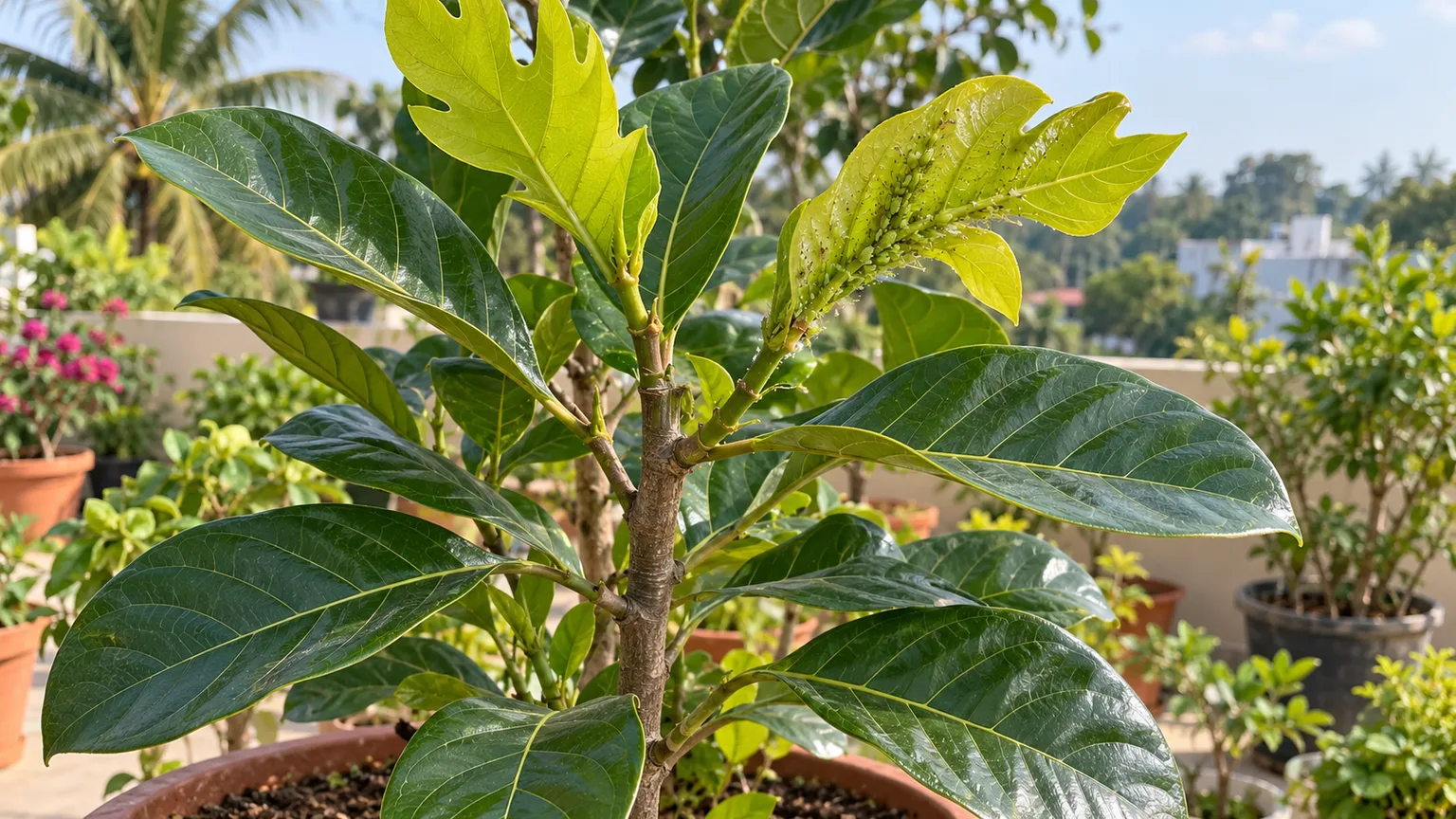
Aphids on Jackfruit: Causes, Checks & Fixes
This guide covers aphids on Jackfruit. See also the general Aphids guide, watering, and light pages for this plant.
Aphids on Jackfruit: Causes, Checks & Fixes
Quick answer
Start on the underside of a tender Jackfruit leaf, not on the potting mix. Look near the tip of an actively growing shoot for a group of small, soft-bodied insects, pale shed skins, and tacky residue. If you confirm a small colony on a reachable shoot, rinse that growth and its leaf undersides with a steady, controlled stream of water. This targets the aphids without exposing the whole tree, its flowers, or beneficial insects to a pesticide.
Jackfruit (Artocarpus heterophyllus) does not look like a typical soft-leaved houseplant. Mature leaves are glossy, dark green, and oval, while young shoots can carry deeply lobed leaves; all leaf parts contain sticky white latex (UF/IFAS Jackfruit profile). The difference matters: white latex can ooze from a cut or torn leaf, while aphid honeydew is usually clear and tacky on surfaces below a feeding colony. Do not diagnose from stickiness alone.
What aphids look like on Jackfruit
Aphids usually cluster on soft growing tissue: the underside of a young leaf, a new shoot tip, or a developing bud. They are small and pear-shaped, often green, yellow-green, brown, or dusky, and many individuals in a colony may be wingless. Look for a pair of tiny backward-pointing tubes on the abdomen if you have a hand lens; these cornicles help distinguish aphids from other soft-bodied pests. UC IPM describes aphids as small, soft-bodied sap feeders that commonly group on tender growth and leave sticky honeydew (UC IPM aphid identification).
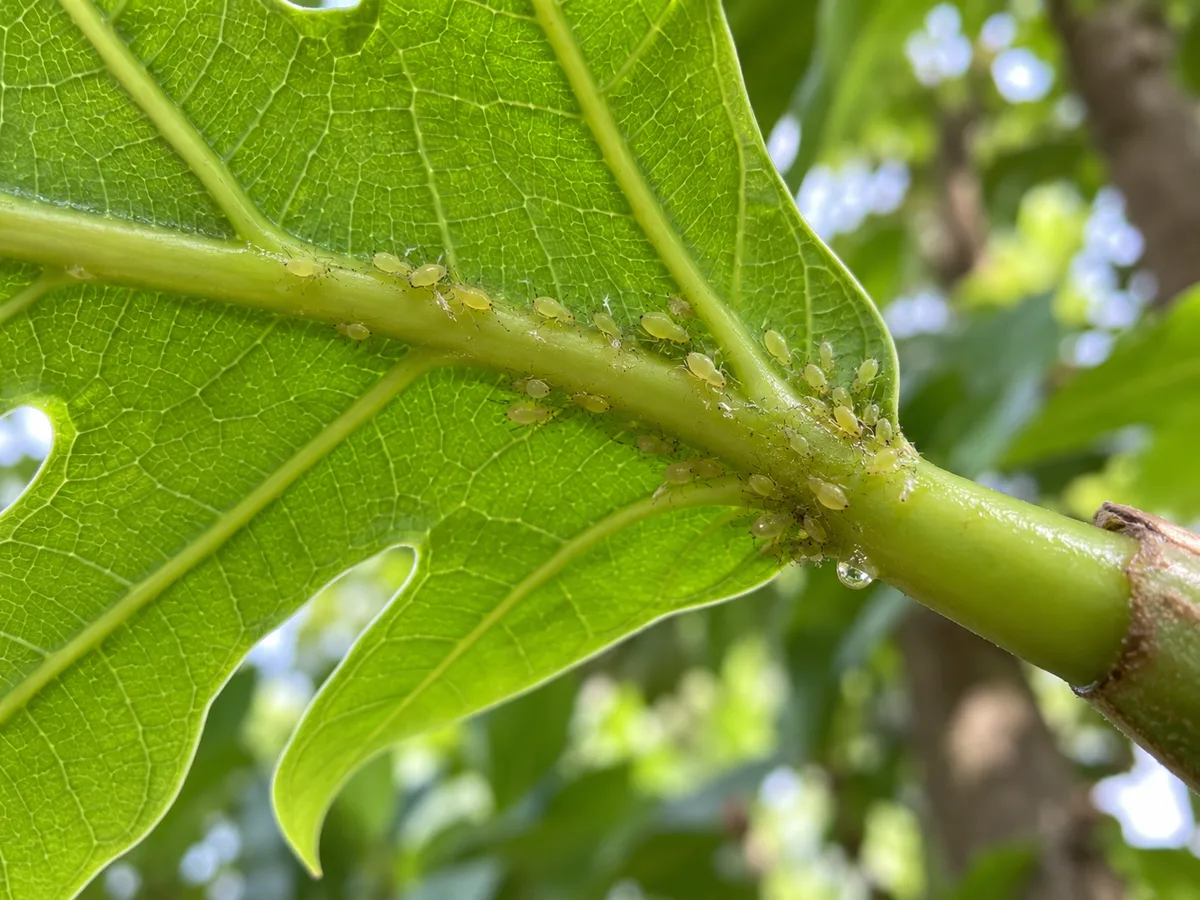
A Jackfruit aphid colony is easiest to spot beneath tender leaves, along new veins, and near the shoot tip.
On Jackfruit, the key is to inspect the new flush rather than only the large, mature foliage. The specialist host account for the jackfruit aphid, Greenidea artocarpi, reports that it feeds on undersides of young leaves, often near the main trunk; it also notes that published information about this species as a pest is limited (jackfruit aphid host account). The government-supported Jackfruit insect-pest guide describes aphids on leaves and buds, with leaf curling and honeydew-associated sooty mold among reported symptoms (Vikaspedia Jackfruit aphid notes).
If an infestation grows, young leaves can curl or become distorted, and shoot tips may look crowded or stunted. Sticky honeydew can coat leaves or branches below the colony; a dark, soot-like coating may develop on those deposits. Fruit-tree aphids can distort foliage without necessarily affecting the crop, and predators often limit colonies in a balanced garden (RHS fruit aphid guidance). A few aphids on one flush are not the same as a tree-wide decline.
Why Jackfruit aphids need a plant-specific check
The most relevant Jackfruit-specific source I found identifies Greenidea artocarpi as a jackfruit aphid and records it on Artocarpus hosts, including A. heterophyllus. It does not establish that this is the only aphid species that may appear on Jackfruit or that it is common in every growing region. The same account lists a second aphid species reported from Jackfruit and says the crop literature is sparse, so treat the insect’s appearance and feeding pattern as the diagnosis rather than assuming a precise species from color alone.
This tree’s growth habit changes where to look. New leaves can be deeply lobed while mature leaves are broader and leathery, and Jackfruit flowering shoots emerge from the trunk and larger branches. Walk around the tree and check both outer shoot tips and tender leaves closer to the trunk. If the tree is in a pot, rotate it and inspect each side of the flush; if it is planted in the ground, use a stable step platform or a phone camera rather than climbing a branch.
Nitrogen-heavy feeding can produce a flush of soft growth that is attractive to aphids. UC IPM advises against overfertilizing because aphids feed on tender new growth; that does not mean Jackfruit should be starved. Keep to the tree’s normal feeding plan and avoid adding an extra nitrogen dose in response to weak-looking leaves. See the Jackfruit fertilizer guide if you have recently changed the schedule.
The tree’s location and condition also guide the response. Jackfruit thrives in warm climates and full sun, but its roots need drainage; prolonged flooding can make the whole tree decline. A yellow or wilted canopy does not confirm aphids. Check the Jackfruit watering guide and soil guide if growth is poor throughout the tree rather than only at a few colonies. Correcting root stress helps the tree withstand pests, but it does not directly remove aphids from leaves.
How to confirm aphids before treating
Inspect a fresh shoot
Choose a leaf or shoot that has recently curled, become shiny, or stopped opening normally. Turn the leaf over and look along the midrib, smaller veins, and petiole. Check the tender tip and the area just below it. Aphids are often stationary while feeding, but may move slowly when disturbed; some colonies include tiny pale cast skins that can look like dust. A magnifier helps, but a visible cluster plus fresh honeydew is usually more informative than one isolated insect.
Look at the surface below the colony too. Honeydew can collect on lower leaves, branches, or objects beneath an aphid-bearing shoot. Black sooty mold grows on honeydew rather than penetrating plant tissue; UC IPM describes it as superficial fungal growth associated with honeydew-producing insects (UC IPM sooty mold guide). If you remove the aphids, new honeydew should stop accumulating, though old residue or mold may take time to weather away.
Separate aphids from latex and other pests
Jackfruit latex appears where a leaf or stem is cut, torn, or bruised. It can be white and sticky, so it can be mistaken for pest residue. Aphid honeydew is more often clear and spread over leaf surfaces beneath a colony, and it comes with visible insects, shed skins, curled new growth, or ant activity. If no colony is present, do not apply an aphid treatment just because a damaged leaf is tacky.
Mealybugs look like cottony or waxy clumps, often tucked into joints or along stems; aphids are more often exposed in groups on young leaves and shoot tips. Spider mite damage is more likely to show fine pale stippling or webbing than a visible colony of pear-shaped insects. Jackfruit leaf webbers can bind leaves together with silk and feeding damage; if you see webbed foliage or chewed tissue without aphids, inspect for a caterpillar instead of spraying for aphids. The Jackfruit problem overview helps route symptoms that do not match this pest pattern.
The first fix: rinse the affected shoot
For a reachable, localized aphid colony, wash the affected shoot and leaf undersides with a steady stream of water. Aim from multiple angles so the water dislodges insects from the veins and petiole. Use enough pressure to knock aphids loose but not enough to tear tender leaves, strip bark, or damage flowers. For a small potted sapling, take it to a hose or shower area where runoff can drain away; for an in-ground tree, work only on shoots you can reach safely. Savvy Gardening also recommends water removal for small aphid populations, with pruning reserved for localized swarms that cannot be washed away (Savvy Gardening aphid management).
Do not combine the rinse with a pesticide, fertilizer spike, hard pruning, and repotting on the same day. First see whether the colony is actually reduced. Wait until foliage dries, then examine the same young leaves over the next few days. If the tree is flowering, aim away from open flowers and pollinators. If it is fruiting, avoid blasting delicate developing fruit or creating standing water around the trunk.
If the colony is too high to reach, too large for a rinse, or repeatedly returns on many flushes, reassess before escalating. Count affected tips, look for natural enemies, and check whether new growth is still being produced. Aphids naturally have predators such as lady beetles and lacewing larvae; broad, nonselective spraying can remove those helpers. The Jackfruit pruning guide covers selective removal of damaged shoots, but avoid cutting away a large portion of a productive canopy for a few aphids.
When a labeled spray may be justified
Use a spray only when aphids remain abundant after physical removal or are repeatedly damaging the tree’s tender growth. Insecticidal soap and horticultural oils work by contact, so the label’s coverage instructions matter. UC IPM recommends nonchemical methods first and cautions against applying soaps or oils to drought-stressed plants or in very hot conditions; it also warns that broad-spectrum insecticides can harm aphid predators and pollinators (UC IPM aphid control guidance).
For Jackfruit, read the complete label and confirm it allows the exact edible crop or ornamental use, application site, and harvest interval relevant to your tree. Do not borrow a rate from another fruit tree, use a household detergent recipe, or spray a product just because its name includes “organic.” Test a small area if the label advises it and wait for any stated injury period before treating more foliage. Keep products off open flowers, bees, and fruit intended for harvest. If no product label clearly covers the situation, ask a local agricultural extension service for crop-specific advice.
Avoid systemic insecticides as a casual remedy on a fruiting tree. They may expose beneficial insects that visit flowers or feed on aphids, and label restrictions vary. The presence of aphids on a few leaves does not justify a tree-wide chemical program. If a severe infestation persists or the canopy is declining, obtain a local diagnosis; the aphid species, season, and permitted products vary by region.
Protect Jackfruit growth while the tree recovers
Keep the tree in its usual warm, sunny position and maintain steady root-zone care. Jackfruit prefers full sun and well-drained soil; it does not recover from aphids faster if the root zone is flooded. For a young or container-grown tree, check the upper mix and pot weight before watering; allow excess water to drain. Use the Jackfruit light guide if recent leaf damage followed a sudden move into shade or hot reflected exposure.
Do not remove every marked leaf. Aphids may leave leaf curl or distortion behind after the colony is gone, and the old tissue may not flatten or look perfect again. Remove only a severely distorted, infested tip when it is localized and pruning will not remove a large share of the tree’s active growth. Jackfruit can exude sticky latex from cut leaf tissue, so wear gloves and use clean pruners; the Jackfruit pruning guide covers the tree’s postharvest pruning rhythm.
If an aphid-bearing shoot is on a small potted Jackfruit, do not repot it solely because aphids are present. Repot only when roots are crowded, the mix has failed, or drainage is poor, and avoid combining root disturbance with a pest treatment unless the root zone itself needs urgent attention. The Jackfruit repotting guide can help you decide whether pot size is a separate issue.
Recovery timeline and what to watch
Check the affected flush every few days for new colonies, sticky deposits, and fresh leaf distortion. A rinse may remove many aphids but cannot guarantee that every insect has been dislodged. If you see live groups again, repeat the inspection and choose the next step based on the number of affected shoots. A tree that has only a few marked leaves can continue growing while those leaves remain scarred; recovery means new leaves open normally and honeydew stops appearing.
If multiple new shoots curl, flowers or small fruit are dropping, or the tree’s entire canopy is yellowing or wilting, widen the diagnosis. Aphids may coexist with root-zone, water, or scale problems. Compare symptoms across old and new growth, inspect leaf undersides, and look at the soil before deciding that aphids explain the whole decline. Use the Jackfruit growing guide for normal care context and the plant-wide problem overview for other causes.
Mistakes that make aphid problems worse
- Treating stickiness as proof. Jackfruit latex may ooze from wounds; look for a colony and the location of residue.
- Spraying before confirming. Aphids are visible on shoots when present. An unnecessary spray can harm predators without solving the real cause.
- Overfertilizing to force new leaves. A sudden soft flush can attract more aphids; follow the normal Jackfruit feeding plan instead.
- Cutting off too much canopy. A localized colony does not justify removing many healthy leaves or productive branches.
- Spraying during heat or drought stress. Contact products can injure foliage under unfavorable conditions; follow the label and local guidance.
- Using a broad-spectrum insecticide on open flowers. Jackfruit flowers and nearby beneficial insects deserve protection; choose the least disruptive option that the label permits.
- Ignoring drainage while treating foliage. Watering errors and flooding can weaken Jackfruit independently of aphids. Correct the root-zone issue separately using the Jackfruit soil guide.
Prevent aphids on the next Jackfruit flush
Inspect the undersides of tender leaves when new shoots open, especially near the trunk and shoot tips. On a young tree, look over the whole plant; on a mature tree, check several representative shoots around the canopy and lower trunk. Early inspection makes it easier to remove a small colony with water before curled leaves and honeydew accumulate.
Avoid unnecessary high-nitrogen feeding, but do not withhold the nutrients Jackfruit needs for active growth and fruiting. Follow the tree’s normal fertilizer and watering guidance, keep the root zone draining, and avoid prolonged drought stress. Do not eliminate every ant or predator by default: ants tending an aphid colony may protect aphids, but many beneficial insects also feed on aphids. Inspect first and use targeted control only if colonies persist.
Keep the canopy open enough to check leaves and shoots safely. For a young potted tree, separate it from other plants while monitoring a confirmed infestation; for an established landscape tree, remove only localized heavily infested growth when pruning is appropriate. Good inspection and measured feeding will not prevent every aphid from landing, but they help you spot the problem early without unnecessary chemical use.
When to use this page vs other Jackfruit guides
Use this page when you can find clustered soft-bodied insects on new Jackfruit leaves or shoot tips. If the main clue is generalized yellowing, weak growth, or wilt without an aphid colony, start with watering, soil drainage, and light rather than treating for insects. Jackfruit’s plant-wide problem overview is the better starting point when several symptoms appear together or the cause remains uncertain.
Related Jackfruit guides
- Jackfruit growing guide: whole-tree identification, size, and seasonal care.
- Jackfruit watering: maintain moisture without flooding roots.
- Jackfruit fertilizer: follow the tree’s normal feeding schedule and avoid an unnecessary nitrogen spike.
- Jackfruit light: keep the tree in the sun exposure it is adapted to.
For the broader pest guide across plants, see the aphids symptom hub. Use the Pest Identifier Tool if the insects or residue do not match the checks above.